
A recruiting firm finds and places candidates in permanent jobs for client companies, earning a placement fee when a candidate is hired. Firms specialize in industries or roles (technology, healthcare, finance, sales, engineering, executives) where hiring is hard and good recruiters save clients time and costly vacancies.
Recruiting has low startup costs but rewards specialization, relationships and persistence. Recruiters must also follow employment laws: anti-discrimination rules, background check requirements and a growing number of pay transparency and salary history laws. The Bureau of Labor Statistics reports a median pay of $72,910 for human resources specialists, a group that includes recruiters (May 2024), with about 944,300 jobs and employment projected to grow about 6% over the decade. This guide covers models, fees, niches, sourcing, compliance, a worked example and a 90-day plan.
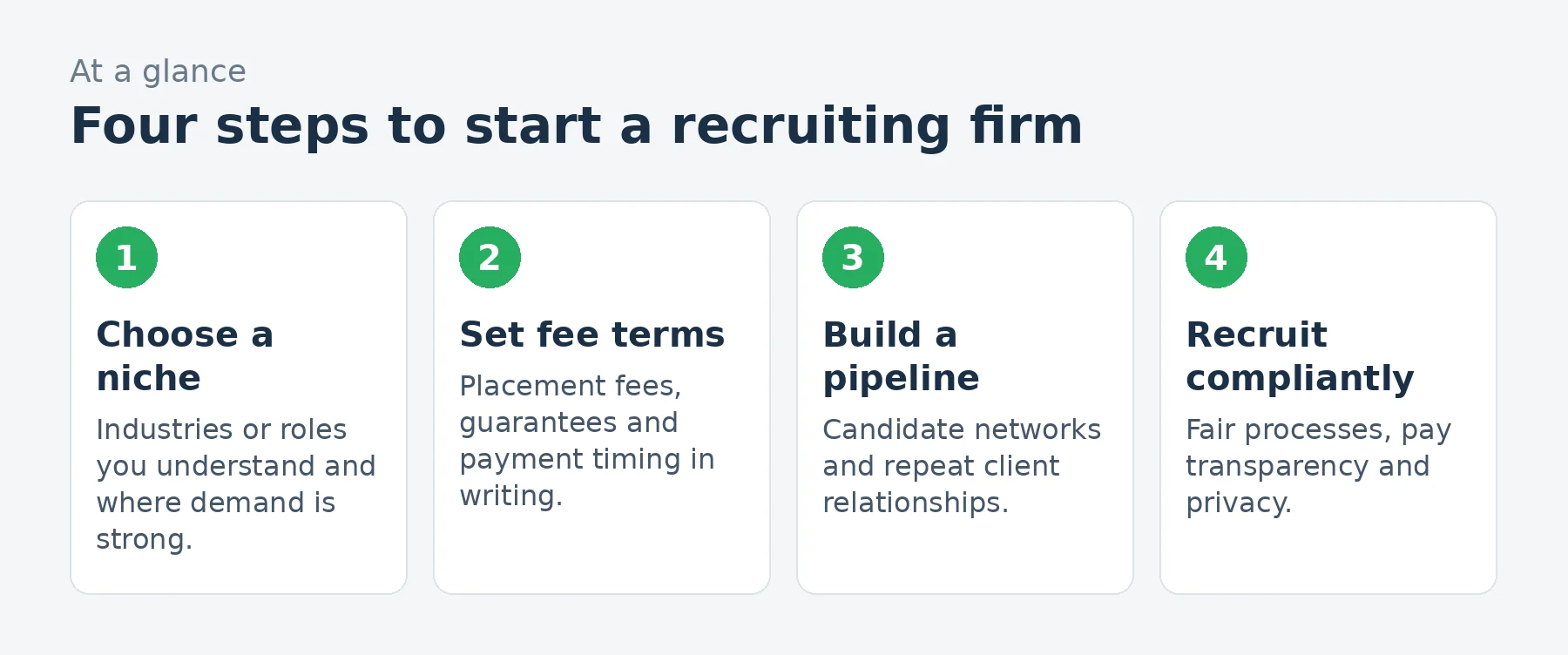
A recruiting firm at a glance
Table of Contents
| Topic | What to expect |
|---|---|
| Startup cost | Low: an applicant tracking system, sourcing tools, a website, contracts, insurance and marketing |
| How you earn | Placement fees, commonly a percentage of the candidate’s first-year salary, or retainers for executive search |
| Key rules | Anti-discrimination laws, FCRA rules for background checks, pay transparency and salary history laws and candidate privacy |
| Models | Contingency, retained search, contract recruiting and recruitment process outsourcing |
| Best for | Persistent, persuasive networkers who enjoy matching people with opportunities |
Who recruiting suits
It suits outgoing, resilient people who enjoy conversations, persuasion and persistence, and can handle rejection from both candidates and clients. Industry knowledge in your niche lets you speak credibly with hiring managers and candidates.
Recruiting models
- Contingency recruiting: paid only when a candidate is hired; common for mid-level roles, often competing with other recruiters.
- Retained search: part of the fee is paid upfront and during the search, usually for senior and executive roles, with exclusivity.
- Contract recruiting: recruiters working inside a client’s team for an hourly or monthly fee.
- Recruitment process outsourcing (RPO): managing part or all of a company’s hiring.
Placement fees and guarantees
Contingency and retained fees are commonly a percentage of the candidate’s first-year base salary (sometimes including bonuses), agreed in writing. Most firms offer a guarantee period: if the placed candidate leaves within an agreed time, the firm replaces them or refunds part of the fee. Fee agreements should define what counts as a hire, including when a client hires a candidate you introduced later.
Choosing a niche
Specialists build deeper candidate networks, understand roles and salaries and earn trust faster. Good niches have steady demand, hard-to-find skills and salaries that support meaningful fees: software engineering, nursing leadership, accounting and finance, sales, skilled trades leadership or a specific industry such as manufacturing or logistics.
Pay transparency and salary history laws
A growing number of states and cities, including Colorado, California, New York, Washington and Illinois, require pay ranges in job postings or on request, and many prohibit asking candidates about salary history. These laws can apply to recruiters posting jobs for clients. Track the rules for every location where you advertise or recruit.
Background checks and anti-discrimination
If you obtain background checks from a consumer reporting agency, the Fair Credit Reporting Act requires disclosure and written authorization, plus specific steps before taking adverse action; many states and cities add ban-the-box rules. Anti-discrimination laws apply to recruiters too: screen candidates on job-related criteria only and never accept client requests to exclude people based on protected characteristics.
Candidate privacy
Resumes and interview notes contain personal information. Store data securely, share it only with consent for specific roles, follow privacy laws in the states where candidates live and delete data you no longer need.
State employment agency rules
Some states license or regulate employment agencies, especially those that charge job seekers fees. Most recruiting firms charge only employers, but check your state’s rules, and never charge candidates where prohibited.
Startup costs to plan for
| Item | What to budget for |
|---|---|
| Applicant tracking system | Candidate database and pipeline |
| Sourcing tools | Professional networking and job board subscriptions |
| Contracts | Fee agreements reviewed by an attorney |
| Insurance | Professional and employment practices liability |
| Website | Niche positioning and job listings |
| Working capital | Months of expenses before first placements pay |
Use our startup cost calculator for your total.
The recruiting process
- Intake meeting: role, must-have skills, salary range, process and timeline.
- Source candidates through your network, outreach and job postings.
- Screen for skills, motivation and fit.
- Present a short list with clear summaries.
- Coordinate interviews and gather feedback.
- Manage the offer and follow up through the guarantee period.
A worked example: a solo recruiter
These are illustrative assumptions for an established solo recruiter, averaged monthly, not predictions.
| Assumption | Monthly | |
|---|---|---|
| Placement fees | 1.5 placements a month at $95,000 salaries and a 20% fee | $28,500 |
| Revenue | $28,500 | |
| Applicant tracking and sourcing tools | Including professional networking subscriptions | $(900) |
| Job advertising | $(500) | |
| Research assistant | Part-time sourcer | $(2,000) |
| Insurance | Professional and employment practices liability | $(200) |
| Marketing, legal and accounting | $(800) | |
| Refund reserve | For guarantee replacements, averaged | $(1,000) |
| Profit before owner pay and taxes | $23,100 |
That leaves about $23,100 a month on average before the recruiter’s pay and taxes, on about $28,500 of revenue. Placement income is lumpy: some months bring several placements and others none, so keep reserves.
Loading the calculator…
Winning clients
- Your industry network and former colleagues.
- Hiring managers with hard-to-fill roles.
- Growing companies without internal recruiters.
- Content and market insights, such as salary guides for your niche.
- Referrals from placed candidates who later hire.
Candidate experience
Candidates become clients and referral sources over time. Communicate honestly, give feedback, respect their time and never present them for roles without permission. A reputation for treating candidates well is one of a recruiter’s biggest assets.
Sourcing tools and AI
Sourcing tools, professional networks and AI-assisted search help find candidates faster, but recruiters still win by building relationships and judging fit. Use automation for research and scheduling, and check that any screening tools you use do not discriminate and comply with emerging state and city rules on automated hiring tools.
Handling counteroffers
Strong candidates often receive counteroffers from their current employers. Discuss motivations early, prepare candidates for counteroffers and keep communication open through their start date, since a withdrawn acceptance can cost a placement.
Building a team
Growth usually means hiring recruiters or researchers paid partly on commission. Clear processes, a shared applicant tracking system and fair commission plans keep a team productive. Some firms split desks between business development and candidate recruiting.
Split placements
Recruiting networks let independent recruiters share open roles and candidates, splitting fees when a placement is made. Splits can add income from candidates who do not fit your own searches.
Writing fee agreements
A strong fee agreement defines the fee percentage and what compensation it applies to, when fees are due, the guarantee period and terms, how long candidate ownership lasts after introduction, exclusivity for retained searches and how disputes are resolved. Have an attorney review your template.
Common mistakes to avoid
- Recruiting for every industry at once.
- No written fee agreement or guarantee terms.
- Submitting candidates without consent.
- Ignoring pay transparency and salary history laws.
- Running background checks without FCRA disclosures.
Your first 90 days
- Days 1-30: choose a niche, set up an applicant tracking system and write fee agreements.
- Days 31-60: build a candidate network and contact 50 hiring managers.
- Days 61-90: work your first searches and make your first placements.
Frequently asked questions
How do recruiting firms get paid?
Usually a placement fee, commonly a percentage of first-year salary, paid when the candidate starts, or retainers for executive search.
What is the difference between contingency and retained recruiting?
Contingency firms are paid only when a hire is made; retained firms receive part of the fee upfront, usually with exclusivity.
What is a placement guarantee?
A promise to replace a candidate or refund part of the fee if the hire leaves within an agreed period.
Do recruiters need a license?
Usually not, but some states regulate employment agencies, especially those charging job seekers.
Do pay transparency laws apply to recruiters?
They can; several states and cities require pay ranges in postings and ban salary history questions.
Can I start a recruiting firm from home?
Yes. Many recruiters work remotely with cloud applicant tracking and video interviews.
Do recruiters need insurance?
Professional liability and employment practices liability insurance are wise, especially when running background checks.
When are recruiting fees paid?
Typically when the candidate starts work, within agreed payment terms; retained searches bill in stages.
How long does it take to make a first placement?
Often a few months, since searches take time; keep savings or other income while building your first pipeline.
What niches are best for recruiting?
Fields with hard-to-find skills and strong salaries, such as technology, healthcare leadership, finance, engineering and skilled trades management.
Should recruiters charge candidates?
Generally no; most firms are paid by employers, and some states restrict fees charged to job seekers.
Keep learning
- Staffing and recruiting industry data
- How to start a staffing agency
- How to start an HR consulting business
- Pricing calculator
Sources
- US Bureau of Labor Statistics, Human resources specialists (includes recruiters)
- NCSL, Pay transparency and salary history laws by state
- FTC, Using consumer reports: what employers need to know (background checks)
- EEOC, Enforcement guidance on staffing firms and contingent workers
- FTC, Protecting personal information: a guide for business
Last reviewed November 3, 2026. Startup costs are estimates; check local prices, licensing and tax rules before you commit money.

