
A healthcare staffing agency places nurses, certified nursing assistants, therapists, technicians and other clinicians with hospitals, nursing homes, clinics, home health agencies and schools. Facilities use staffing agencies to cover shortages, vacations, seasonal surges and hard-to-fill shifts.
Healthcare staffing carries more responsibility than general staffing: you must verify licenses and credentials, screen workers against the federal exclusion list, ensure required health screenings and training, and follow state rules for nurse staffing agencies, which several states have tightened. Accreditation such as Joint Commission Health Care Staffing Services certification signals quality to clients. This guide covers models, credentialing, regulation, insurance, pricing, a worked example and a 90-day plan.
A healthcare staffing agency at a glance
Table of Contents
| Topic | What to expect |
|---|---|
| Startup cost | Moderate to high: insurance (workers’ compensation and professional liability), credentialing software, compliance, recruiting and payroll funding |
| Key duties | License and certification verification, OIG exclusion checks, background checks, health screenings and required training |
| State rules | Several states license or register nurse staffing agencies, such as Illinois, with additional requirements and reporting |
| How you earn | Bill rates marked up over clinician pay for per diem, contract and travel assignments |
| Best for | Organized operators with healthcare knowledge who are meticulous about compliance |
Who healthcare staffing suits
It suits organized, responsive people who understand healthcare operations and are meticulous about compliance. Many founders are nurses, healthcare recruiters or staffing managers. Facilities call at all hours, so dependable scheduling is essential.
Staffing models
- Per diem: individual shifts at local facilities, often booked days or hours ahead.
- Local contracts: assignments of weeks or months for local clinicians.
- Travel staffing: multi-week assignments away from home, with housing and travel stipends.
- Allied health: therapists, technologists, pharmacy and lab staff.
- Non-clinical healthcare roles: registration, scheduling and billing staff.
Credentialing every clinician
- License verification with the state board, including multistate compact licenses where applicable.
- Certifications such as BLS, ACLS and specialty certifications.
- Background checks under FCRA rules, plus state-required checks.
- OIG exclusion screening against the List of Excluded Individuals and Entities, since excluded individuals generally cannot be paid by federal healthcare programs.
- Health screenings: immunizations, tuberculosis testing and drug screening as facilities require.
- Competency and training: skills checklists, HIPAA, infection control and facility orientation.
Re-check licenses and exclusions regularly, not just at hiring.
The Nurse Licensure Compact
The Nurse Licensure Compact lets registered and practical nurses with a multistate license from a compact state practice in other compact states, which simplifies placing nurses across state lines. Non-compact states still require state licenses. Verify each nurse’s license type and the facility’s state before every assignment.
State nurse agency rules
Several states license or register nurse staffing agencies and set requirements on recordkeeping, minimum qualifications, insurance and reporting. Illinois, for example, licenses nurse agencies under its Nurse Agency Licensing Act, and other states have added registration and reporting rules in recent years. Check requirements in every state where you place clinicians.
Accreditation
The Joint Commission’s Health Care Staffing Services certification evaluates an agency’s processes for credentialing, competency, orientation and performance. Many hospitals prefer or require certified agencies, so certification can open larger contracts.
Insurance and employer duties
As employer of record, you provide workers’ compensation, payroll taxes and required benefits. Healthcare staffing also needs professional liability (malpractice) insurance, general liability and employment practices coverage. Facilities commonly require specific coverage levels in contracts. Share safety responsibilities with facilities, including training and exposure protections, consistent with OSHA guidance on temporary workers.
Startup costs to plan for
| Item | What to budget for |
|---|---|
| Insurance | Workers’ compensation, professional and general liability |
| Credentialing software | License tracking, documents and expiration alerts |
| Screening costs | Background checks, drug screens, health records |
| State licensing | Agency registration or licensing fees |
| Accreditation | Joint Commission certification when ready |
| Working capital | Funding payroll before facilities pay |
Use our startup cost calculator for your total.
Bill rates and pay
Bill rates are set by contract or market demand and must cover clinician pay, employer costs, insurance, credentialing and profit. Travel contracts include stipends that must follow tax rules for travel reimbursement. Rates can swing with shortages and surges, so avoid relying on peak-demand pricing. Use our pricing calculator.
A worked example: a small agency
These are illustrative assumptions for a small per diem and local contract agency, not predictions.
| Assumption | Monthly | |
|---|---|---|
| Per diem and contract billings | 3,200 clinician hours at a $68 average bill rate | $217,600 |
| Revenue | $217,600 | |
| Clinician wages | 3,200 hours at $47 average | $(150,400) |
| Employer payroll costs | Taxes, workers’ compensation and benefits | $(22,600) |
| Internal staff | Recruiters, credentialing and scheduling | $(16,000) |
| Credentialing, background and health screening costs | $(2,800) | |
| Professional liability and other insurance | $(2,500) | |
| Payroll funding and software | $(4,200) | |
| Office and marketing | $(3,500) | |
| Profit before owner pay and taxes | $15,600 |
That leaves about $15,600 a month before the owner’s pay and taxes, on about $217,600 of revenue. Margins depend on bill rates, which change with demand, so diversified facility contracts and tight cost control matter.
Loading the calculator…
Facility contracts
Contracts with facilities should cover bill rates, shift cancellation policies, minimum hours, orientation, credential requirements, timekeeping, conversion fees, insurance and incident reporting. Some facilities buy through vendor management systems or managed service providers, which have their own onboarding and fee structures.
Recruiting clinicians
Clinicians choose agencies for pay, flexible scheduling, reliable payment, respectful treatment and fast credentialing. A mobile app or easy scheduling system, weekly pay and responsive recruiters help. Referral programs work well, since nurses know other nurses.
Finding clients
- Nursing homes and assisted living, which often have steady needs.
- Hospitals, through direct contracts or vendor management systems.
- Home health and hospice agencies.
- Clinics, schools and correctional facilities.
- Industry associations for long-term care and hospitals.
Shift cancellations and floating
Facilities sometimes cancel shifts or ask clinicians to float to other units. Contracts should address cancellation notice and pay, floating limits and competency for each unit, so clinicians are treated fairly and patients are safe.
Incident reporting and quality
Have a clear process for facility complaints, clinical incidents and worker concerns: document, investigate and respond promptly. Track performance feedback from facilities and remove clinicians who do not meet standards.
Travel housing and stipends
Travel assignments often include housing and travel stipends. These have tax rules, including requirements related to the clinician’s tax home, so get tax advice and document eligibility properly.
Documentation and audits
Facilities, accreditors and regulators may audit your files. Keep complete, current records for every clinician, including licenses, certifications, health records, competency checklists and training, with alerts before anything expires.
Clinical oversight
A clinical manager, often an experienced registered nurse, reviews competency checklists, handles clinical questions and investigates quality concerns. Clinical oversight reassures facilities and is often expected by accreditors and state rules.
Scheduling technology
Mobile scheduling apps let clinicians pick up shifts, see assignments and submit time quickly, which helps fill urgent shifts and improves retention. Integrate scheduling with credential tracking so no one is booked with an expired document.
Common mistakes to avoid
- Placing clinicians with expired or unverified licenses.
- Skipping OIG exclusion checks.
- Operating without required state agency registration.
- Underestimating professional liability needs.
- Depending on surge pricing that disappears.
Your first 90 days
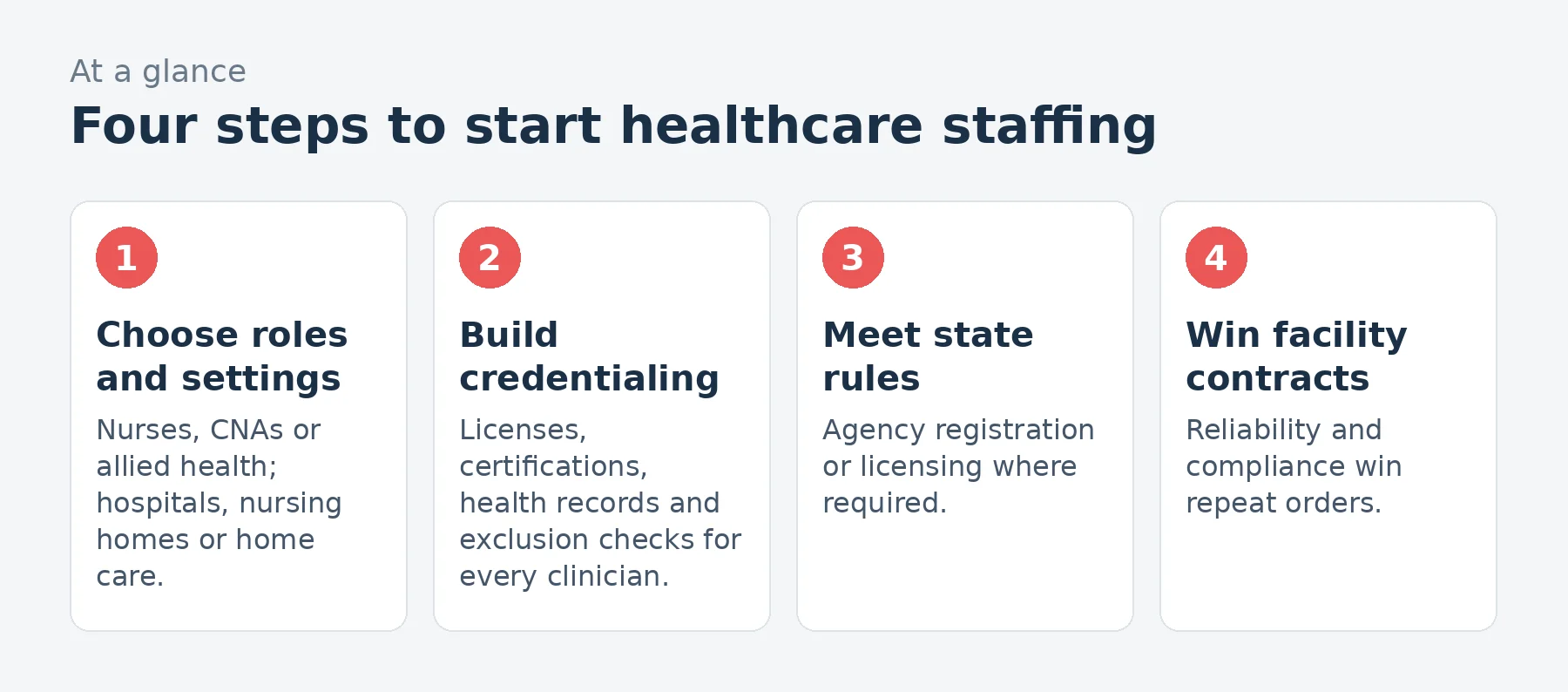
- Days 1-30: choose roles and settings, research state agency rules and buy insurance.
- Days 31-60: set up credentialing software and processes, and recruit a pool of clinicians.
- Days 61-90: register where required, sign first facility contracts and fill shifts reliably.
Frequently asked questions
Do healthcare staffing agencies need a license?
Several states license or register nurse staffing agencies, such as Illinois; check every state where you place clinicians.
What credentials must be verified?
Licenses, certifications, background checks, OIG exclusion status, health screenings and competency.
What is the Nurse Licensure Compact?
An agreement letting nurses with a multistate license practice in other compact states.
What is OIG exclusion screening?
Checking workers against the HHS Office of Inspector General’s list of people excluded from federal healthcare programs.
Is Joint Commission certification required?
Not legally, but many hospitals prefer or require certified staffing agencies.
How do healthcare staffing agencies make money?
By billing facilities more per hour than clinicians are paid, covering employer costs and profit.
Can I start healthcare staffing without being a nurse?
Yes, but you need clinical expertise on your team for competency assessment, and strong credentialing processes.
What insurance does a healthcare staffing agency need?
Workers’ compensation, professional liability (malpractice), general liability and employment practices liability, often at levels facilities set in contracts.
How fast do facilities expect shifts filled?
Per diem shifts are often requested days or even hours ahead, so a pool of credentialed, available clinicians is essential.
Can healthcare staffing agencies place travel nurses?
Yes, with licenses valid in the facility’s state, compliant stipends and strong credentialing.
What roles are easiest to start with?
Many new agencies start with CNAs and licensed practical nurses for nursing homes, where demand is steady, then add registered nurses and allied health.
Do I need HIPAA training for clinicians?
Yes. Clinicians handle protected health information, and facilities expect HIPAA and privacy training.
Keep learning
- Staffing and recruiting industry data
- How to start a staffing agency
- How to start a non-medical home care agency
- Pricing calculator
Sources
- The Joint Commission, Health Care Staffing Services certification
- HHS Office of Inspector General, List of Excluded Individuals and Entities (LEIE)
- NCSBN, Nurse Licensure Compact
- Illinois IDFPR, Nurse Agency Licensing Act
- OSHA, Protecting temporary workers (shared host employer and staffing agency responsibilities)
- HHS, HIPAA privacy rule summary
Last reviewed November 3, 2026. Startup costs are estimates; check local prices, licensing and tax rules before you commit money.

