
Medical couriers move lab specimens, blood products, prescriptions, medical records, equipment and supplies between hospitals, labs, clinics, pharmacies, dental offices and patients’ homes. Work includes scheduled routes that pick up specimens every day and STAT runs that must arrive within an hour or two. This guide explains how to start a medical courier service, from licensing and startup costs to pricing and finding customers.
It’s a delivery business with higher standards. You’ll handle protected health information, so HIPAA rules apply through business associate agreements. Specimens must be packaged and handled under federal transport rules, drivers need bloodborne pathogens training, and many deliveries need temperature control and a documented chain of custody.
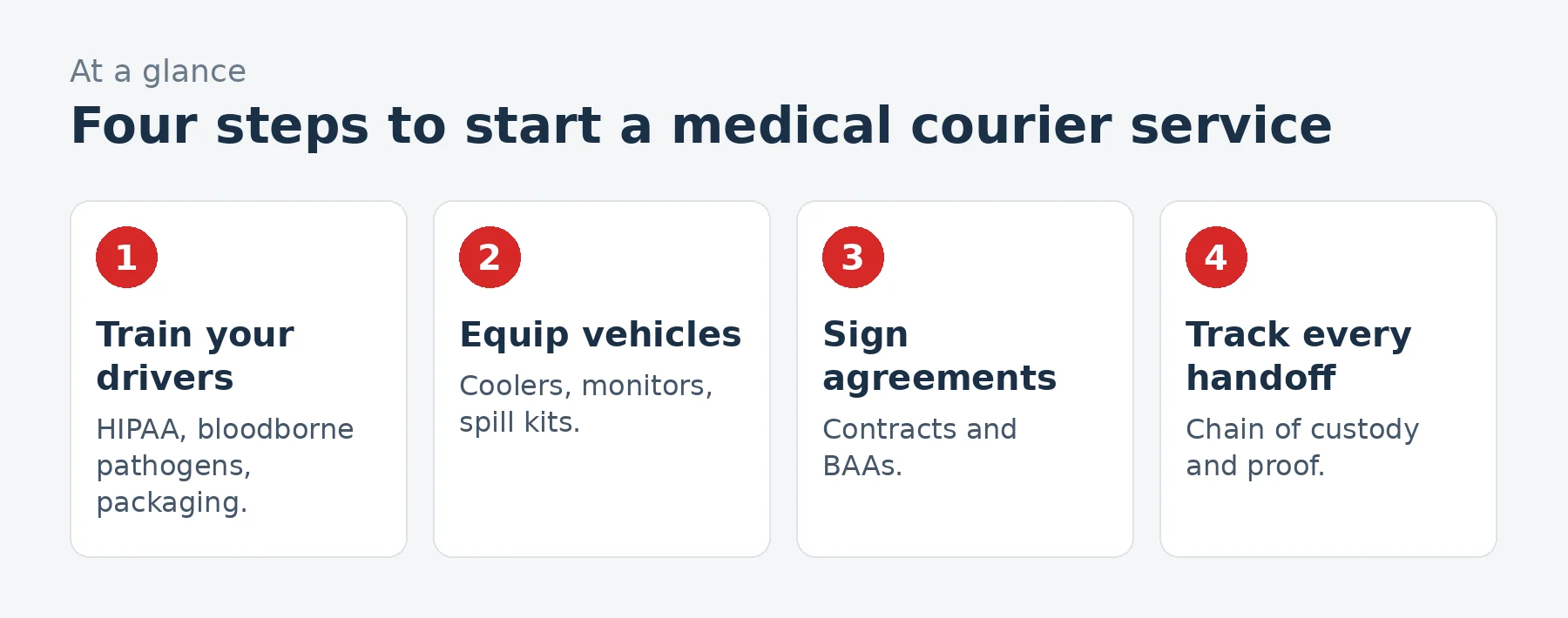
A medical courier service at a glance
Table of Contents
| Topic | What to expect |
|---|---|
| Startup cost | Low to moderate: reliable vehicles, coolers and temperature monitors, spill kits, tracking software, training and insurance |
| Key rules | HIPAA business associate rules, specimen packaging and transport rules, OSHA bloodborne pathogens and chain of custody |
| Revenue model | Route contracts, per-delivery and STAT fees, and mileage |
| How you earn | Daily lab routes, STAT runs, pharmacy deliveries, records and equipment transport |
| Best for | Reliable, detail-oriented drivers and operators who follow procedures exactly |
Who a medical courier business suits
It suits dependable, organized people who follow procedures exactly and stay calm under time pressure. A missed pickup or warm specimen can delay a patient’s diagnosis, so reliability is everything. Owners manage drivers, routes, dispatch, compliance and client relationships with labs and health systems.
HIPAA and business associates
Specimens, prescriptions and records carry protected health information. When you handle it for a covered entity such as a lab, hospital or pharmacy, you’re usually a business associate and must sign a business associate agreement (BAA) and follow the HIPAA Security Rule’s safeguards: training, secure handling, locked vehicles, device security for tracking apps and breach reporting. Never leave packages visible in a car or discuss patients.
Specimen packaging and transport rules
Federal hazardous materials rules, administered by PHMSA, cover transporting infectious substances. Most routine clinical specimens being sent for testing are Category B biological substances shipped as UN3373, which require triple packaging (a leak-proof primary container, leak-proof secondary packaging with absorbent material and a rigid outer package) and marking. Some specimens qualify as exempt but still need proper packaging. Category A infectious substances have much stricter rules. Confirm with each client what they’re sending, and train staff on the packaging requirements.
Bloodborne pathogens and spills
Drivers who could be exposed to blood or other potentially infectious materials need OSHA bloodborne pathogens training, an exposure control plan, gloves and personal protective equipment, the hepatitis B vaccine offered free and spill kits in every vehicle. Train drivers on what to do if a container leaks, and report exposures right away.
Temperature control
Many specimens and medications must stay refrigerated, frozen or at room temperature within tight ranges. Use validated coolers, ice packs or dry ice (which has its own handling rules), temperature monitors or data loggers and procedures for hot and cold weather. Record temperatures when clients require it.
Chain of custody and tracking
Clients expect to know where every package is. Use courier software with barcode scanning, signatures, photos and GPS tracking, and record who handed off each package, when and where. For legal or drug testing specimens, chain-of-custody forms follow strict procedures.
Pharmacy and controlled substances
Pharmacies use couriers for prescription deliveries to patients and facilities. Follow the pharmacy’s instructions on identity checks, signatures and age verification, keep medications secure and at the right temperature and understand any extra rules for controlled substances, which some pharmacies won’t send by courier.
Vehicles and insurance
Reliable, clean cars or vans work for most deliveries. Carry commercial auto insurance (personal policies often exclude business deliveries), general liability, cargo coverage, professional liability and workers’ compensation. Many health systems require specific coverage limits and proof before you start.
Employees or contractors
Many courier companies use independent contractors, but medical clients often require training, uniforms, set routes and procedures that point toward employment under federal and state tests. Classify drivers carefully, and get advice if you plan to use contractors.
Pricing
Price scheduled routes by the day or month, STAT deliveries with higher rates by distance and urgency, and add charges for after-hours, weekends, waiting time and special handling such as dry ice. Use our pricing calculator and track miles with our mileage log.
Startup costs for a medical courier service
| Item | What to budget for |
|---|---|
| Vehicles | Reliable cars or vans with secure storage |
| Equipment | Coolers, data loggers, spill kits, PPE |
| Software | Dispatch, tracking and proof of delivery |
| Training | HIPAA, bloodborne pathogens, packaging |
| Insurance | Commercial auto, cargo, liability, workers’ comp |
| Marketing | Website, capability statement, sales calls |
Use our startup cost calculator for your total.
A worked example: a four-driver courier company
These are illustrative assumptions for a small medical courier company with four drivers, not predictions.
| Assumption | Monthly | |
|---|---|---|
| Scheduled lab and clinic routes | 22 route days at $780 | $17,160 |
| STAT and on-demand deliveries | $7,400 | |
| Pharmacy and equipment deliveries | $3,600 | |
| Revenue | $28,160 | |
| Driver wages | With payroll costs | $(15,800) |
| Fuel and vehicle costs | $(3,900) | |
| Commercial auto and liability insurance | $(1,600) | |
| Dispatch and tracking software | $(450) | |
| Coolers, monitors and supplies | $(400) | |
| Training and compliance | $(250) | |
| Marketing and phone | $(500) | |
| Profit before owner pay and taxes | $5,260 |
That leaves about $5,260 a month before the owner’s pay and taxes, on about $28,160 of revenue. Route contracts bring steady income, while STAT runs pay more per mile.
Loading the calculator…
Winning contracts
Labs, hospitals and health systems often buy courier services through contracts with service level agreements, insurance requirements and audits. Prepare a capability statement with your training, compliance, coverage area, insurance and references. Start with independent clinics, dental offices, veterinary clinics and small labs, then grow into larger contracts.
Drug testing and legal specimens
Workplace drug testing and legal specimen collections need strict chain-of-custody procedures and timely delivery to certified labs. If you handle them, follow each client’s forms and procedures exactly, because a broken chain can make a result invalid.
Route planning
Labs often want specimens picked up at the end of each clinic day and delivered before processing cutoffs. Build routes around those times, plan buffer time for traffic and keep a backup driver for sick days. Routing software helps, but drivers who know each clinic’s door codes and contacts are what make routes run smoothly.
Onboarding new clients
Before the first pickup, learn exactly what you’ll carry, packaging and temperature needs, pickup windows, delivery locations, after-hours procedures, who to call with problems and how they want proof of delivery. Write it down as a client profile every driver can follow.
Quality checks
Track on-time pickups and deliveries, temperature excursions, missed pickups and incidents for every client, and share reports monthly. Investigate every problem, retrain drivers and fix procedures. Health systems renew contracts with couriers who can prove their performance.
Marketing
- Independent labs and clinics without in-house couriers.
- Pharmacies offering home delivery.
- Dental and veterinary offices sending lab work.
- Home health and hospice agencies.
- A capability statement for health system buyers.
Growing beyond one city
Health systems and lab networks often want couriers across a region. Grow by adding drivers along existing routes, then new areas with enough anchor clients to support them. Keep the same training, procedures and reporting everywhere, so new clients get the same reliability.
Common mistakes to avoid when starting a medical courier service
- Handling health information without a BAA.
- Packaging specimens without triple packaging.
- No bloodborne pathogens training or spill kits.
- Personal auto insurance for business deliveries.
- Gaps in chain-of-custody records.
Your first 90 days as a medical courier service owner
- Days 1-30: set up insurance, training programs and courier software.
- Days 31-60: equip vehicles, write procedures and prepare a capability statement.
- Days 61-90: sign BAAs and contracts with clinics, labs and pharmacies and start routes.
Frequently asked questions about starting a medical courier service
Do medical couriers need special certification?
There’s no single license, but HIPAA, bloodborne pathogens and specimen packaging training are essential.
What is a business associate agreement?
A HIPAA contract requiring you to protect health information you handle for a covered entity.
What is UN3373?
The shipping identifier for Category B biological substances, which most clinical specimens are.
Do drivers need the hepatitis B vaccine?
Employers must offer it free to workers with occupational exposure to blood.
What insurance does a medical courier need?
Commercial auto, cargo, general and professional liability and workers’ comp.
How do I price STAT deliveries?
Higher than scheduled routes, by distance, urgency and time of day.
Can I use my personal car?
Yes, with commercial auto coverage and secure storage for packages.
Who hires medical couriers?
Labs, hospitals, clinics, pharmacies, dental and veterinary offices and home health agencies.
What happens if a specimen gets too warm?
Record the excursion, tell the client right away and follow their procedure; the lab may need a redraw.
Do I need dry ice training?
Yes, if you transport dry ice, which has its own hazardous materials rules.
Can I deliver prescriptions to patients’ homes?
Yes, for pharmacies that use couriers; follow their identity, signature and temperature instructions.
Keep learning
- Courier and delivery industry data
- How to start a courier and delivery service
- How to start a mobile phlebotomy business
- Mileage log
Sources
- HHS, Business associate contracts under HIPAA
- PHMSA, Hazardous materials transportation (including UN3373 specimens)
- OSHA, Bloodborne pathogens standard
- HHS, HIPAA for professionals
- U.S. Department of Labor, Employee or independent contractor classification
- US Small Business Administration, Apply for licenses and permits
Last reviewed November 4, 2026. Startup costs are estimates; check local prices, licensing and tax rules before you commit money.

