
A courier and delivery service moves documents, packages, parts and supplies for businesses and individuals, usually locally and often the same day. The most stable courier companies focus on business customers with regular needs: labs and pharmacies, law firms, auto parts suppliers, print shops, florists and retailers.
You can start with a car or cargo van and grow into a small fleet with contract drivers. Margins depend on routing efficiency and repeat customers rather than one-off deliveries, so this guide focuses on choosing a niche, pricing, insurance and a worked example.
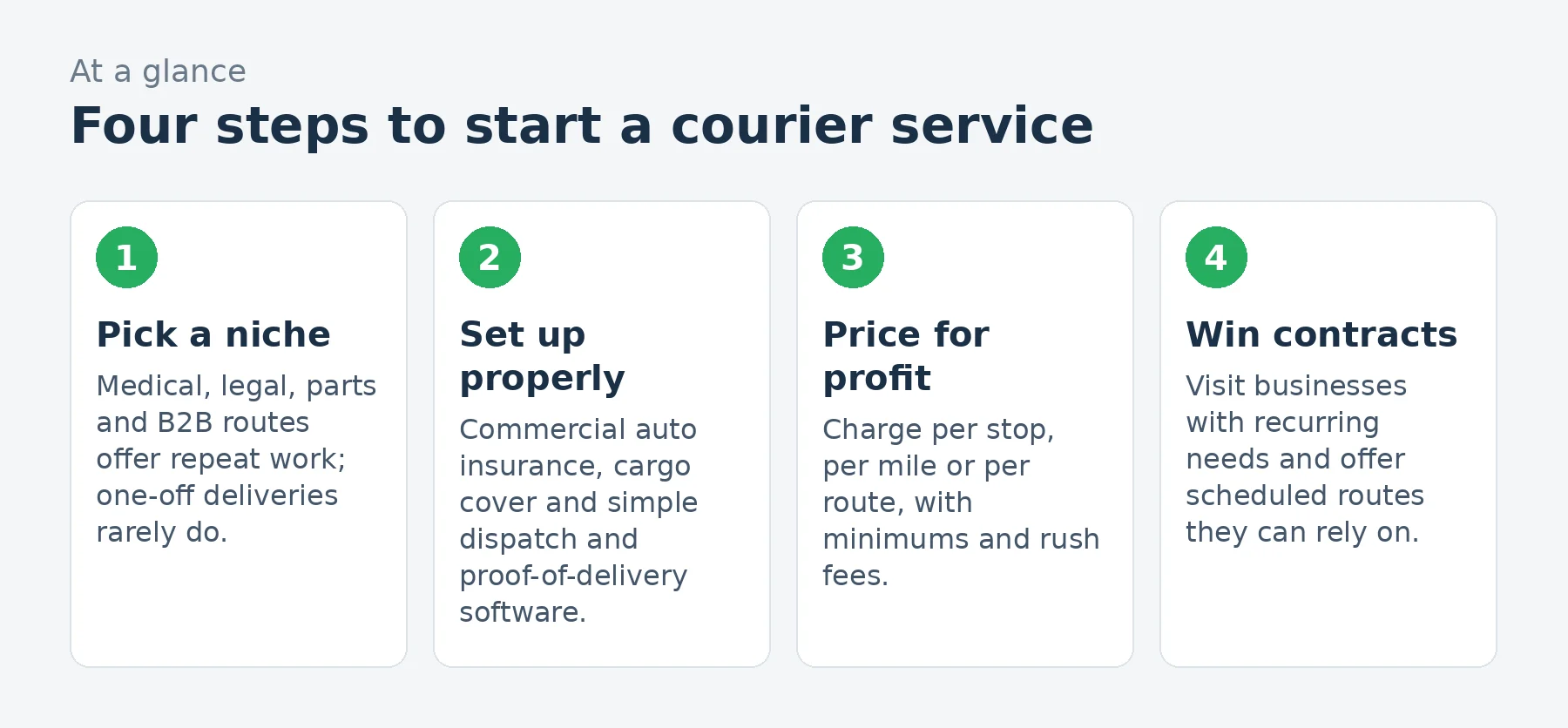
A courier and delivery service at a glance
Table of Contents
| Topic | What to expect |
|---|---|
| Startup cost | Low to moderate: a reliable car or cargo van, insurance, phone and dispatch software |
| Licenses | A business license; USDOT registration only for heavier commercial vehicles or regulated interstate work |
| Best niches | Medical, legal, auto parts, B2B supplies and scheduled retail routes |
| How you charge | Per delivery, per mile, per stop or per route, with rush and after-hours fees |
| Best for | Organized, dependable people who like driving and building local business relationships |
Who a courier business suits
Courier work suits dependable, organized people who enjoy driving and dealing with businesses. The work is about reliability: showing up on time, every time, handling items carefully and keeping customers informed.
The Bureau of Labor Statistics reports median pay of $44,140 for light truck drivers and $37,130 for driver/sales workers (May 2024). As an owner, your income depends on how many profitable stops you can complete each day.
Choosing a niche
General same-day delivery is crowded with gig apps. Niches with recurring needs and specific requirements are easier to win and keep:
- Medical courier: specimens, prescriptions and supplies for labs, clinics and pharmacies. Requires training in safe specimen handling (including OSHA bloodborne pathogen rules), temperature control and patient privacy (HIPAA). Clients expect strict chain-of-custody records.
- Legal courier: court filings and documents for law firms, where deadlines and proof of delivery matter.
- Auto parts and industrial supplies: daily runs from distributors to repair shops and contractors.
- Retail and florists: scheduled local deliveries and seasonal peaks.
- B2B routes: banks, print shops, offices and labs that need the same pickups every day.
Vehicles, licenses and insurance
Most couriers start with a reliable car, SUV or cargo van. Larger vehicles open more work but cost more. A USDOT number is generally required for commercial vehicles over 10,001 pounds in interstate commerce; most local courier vehicles fall below that, but check your state’s rules.
Insurance is essential. Personal auto policies usually exclude business deliveries, so you need commercial auto insurance, plus cargo coverage for the goods you carry and general liability. Many business clients ask for a certificate of insurance before the first delivery.
Startup costs to plan for
| Item | What to budget for |
|---|---|
| Vehicle | Reliable car, SUV or cargo van, bought or leased |
| Insurance | Commercial auto, cargo and general liability |
| Software | Dispatch, routing and proof-of-delivery app |
| Equipment | Hand truck, totes, coolers for medical work |
| Business setup | LLC, license, website and branding |
Use our startup cost calculator for your total.
How to price deliveries
Common pricing methods:
- Per delivery: a base fee plus a per-mile charge beyond a set distance.
- Per stop: for routes with many deliveries.
- Per route or per day: for scheduled contract work.
- Surcharges: rush, after-hours, weekend, wait time and heavy items.
Calculate your real cost per hour and per mile (vehicle, fuel, insurance, your time) and make sure every price covers it. Set minimum charges so short trips are still worth doing, and use our invoice generator to bill clearly with your terms.
A worked example: owner plus one part-time driver
These are illustrative assumptions, not predictions.
| Assumption | Monthly | |
|---|---|---|
| Scheduled routes | 3 daily contract routes, 22 days, $120 a route | $7,920 |
| On-demand deliveries | 180 deliveries a month at $28 average | $5,040 |
| Revenue | $12,960 | |
| Fuel | About 4,000 miles at 22 mpg and $3.60 a gallon | $(650) |
| Vehicle payment and maintenance | Cargo van | $(900) |
| Insurance | Commercial auto and cargo | $(450) |
| Part-time driver | Covers afternoon on-demand work | $(2,600) |
| Dispatch software and phone | $(150) | |
| Profit before owner pay and taxes | $8,210 |
That leaves about $8,210 a month before the owner’s pay and taxes, on about $12,960 of revenue. The scheduled routes are what make the model work: they cover fixed costs every month, while on-demand jobs add profit.
Running routes efficiently
Profit in courier work comes from stops per hour. A few habits make a large difference:
- Use routing software to plan the fastest order of stops and avoid backtracking.
- Batch on-demand jobs going in the same direction when customers’ timing allows.
- Set clear pickup windows with scheduled clients so drivers do not wait.
- Use an app for proof of delivery (signature, photo and time stamp) and send it to the customer automatically.
- Track profit per route each month and reprice or drop routes that do not cover their cost.
Medical courier requirements in more detail
Medical courier work pays for reliability and care. Before bidding, put these in place:
- Training in bloodborne pathogens and safe specimen handling, following OSHA standards, and in spill response.
- Temperature control: coolers, gel packs and logs for specimens that must stay cold or at room temperature.
- Chain of custody: a record of who handled each item and when, from pickup to delivery.
- Privacy: keep patient information confidential and follow the HIPAA requirements your clients set, which often include a business associate agreement.
- Clean, dedicated containers and a vehicle cleaning routine.
Labs and clinics often require proof of training and insurance before they sign a contract.
The technology you need
You do not need expensive systems to start, but a few tools make you look professional and save hours each week:
- Dispatch and routing software to assign jobs, plan routes and track drivers.
- Proof-of-delivery app that captures signatures, photos and time stamps and emails them to the customer.
- Online booking form on your website for on-demand requests, with clear prices and service areas.
- Invoicing and accounting to bill business customers monthly and track what each route earns.
- A business phone number that forwards to whoever is dispatching, so customers always reach a person.
Clients notice these details. A courier who sends automatic delivery confirmations with photos often wins business from one who simply says the package was dropped off.
Hiring drivers
When routes grow, you will need drivers. Decide carefully whether they are employees or independent contractors: the classification depends on how much you control their work, not just what the agreement says, and misclassification can lead to back taxes and penalties. Check your state’s rules and the IRS guidance, and when in doubt, talk to an accountant or employment attorney. Check driving records, require the right insurance, and train every driver on your service standards.
Winning business customers
Visit businesses in your niche in person with a simple offer: scheduled pickups, reliable timing, proof of delivery and one contact who answers the phone. Ask what goes wrong with their current delivery arrangements and solve that problem. A single lab, law firm or parts distributor with daily runs can anchor your business.
List your business in local directories, including the Advanton business directory, and ask satisfied clients for reviews and referrals.
Common mistakes to avoid
- Relying on gig apps instead of building your own customers.
- Using personal auto insurance for business deliveries.
- Pricing without counting your time, fuel and vehicle wear.
- Taking medical work without proper training and procedures.
- Growing so fast that reliability slips.
Your first 90 days
- Days 1-30: choose your niche, form your business, buy commercial insurance and set up dispatch and proof-of-delivery software.
- Days 31-60: visit 50 target businesses, offer trial deliveries and set clear prices and terms.
- Days 61-90: turn trial customers into scheduled routes, track profit per route and hire part-time help only when routes are steady.
Frequently asked questions
Do I need a special license to start a courier business?
Usually just a business license. Heavier commercial vehicles and some interstate work need USDOT registration, and medical courier work requires specific training.
How much does it cost to start a courier service?
It can be one of the lower-cost delivery businesses if you start with a vehicle you own. Commercial insurance is usually the biggest early cost.
How do courier companies get clients?
Mostly by contacting businesses with recurring delivery needs directly, then earning referrals through reliability.
Is medical courier work worth it?
It can provide steady contract routes, but it requires training in specimen handling, temperature control and patient privacy, and clients expect careful records.
Can I use my personal car?
You can, but you need commercial auto insurance that covers business deliveries; personal policies usually exclude them.
Should my drivers be employees or contractors?
It depends on how much control you have over their work under IRS and state rules. Misclassification is costly, so get advice from an accountant or employment attorney before you hire.
Keep learning
- Courier and delivery industry data
- How to start a box truck business
- Invoice generator
- Add your business to the directory
Sources
- US Bureau of Labor Statistics, Delivery truck drivers and driver/sales workers
- FMCSA, Registration: get authority to operate
- FMCSA, Do I need a USDOT number?
- OSHA, Bloodborne pathogens standard
- HHS, HIPAA for professionals
Last reviewed November 2, 2026. Startup costs are estimates; check local prices, licensing and tax rules before you commit money.

