
Online shopping, same-day expectations and local businesses that need deliveries have kept courier work in demand. Online sales reached 17.1% of all U.S. retail sales in the second quarter of 2026, according to the Census Bureau. The Bureau of Labor Statistics counted about 1.1 million light truck drivers in 2024, with a median wage of $44,140 in May 2024; 37% worked for couriers and messengers. Below is the key industry data on courier and delivery businesses, with costs, business models and a first-year projection.
Independent courier businesses win by focusing on contract work (pharmacies, labs, law firms, auto parts stores, florists and local retailers) rather than relying only on gig apps, where pay and volume are set by the platform.
The workforce
| Occupation | Jobs (2024) | Median pay (May 2024) | Projected growth, 2024 to 2034 |
|---|---|---|---|
| Light truck drivers | about 1.1 million | $44,140 | n/a |
| Driver/sales workers | n/a | $37,130 | n/a |
Source: U.S. Bureau of Labor Statistics, Occupational Outlook Handbook and Occupational Employment and Wage Statistics.
Market data
| Measure | Value |
|---|---|
| Share of light truck drivers employed by couriers and messengers (2024) | 37% |
| E-commerce share of U.S. retail sales, Q2 2026 (Census Bureau) | 17.1% |
Business models compared
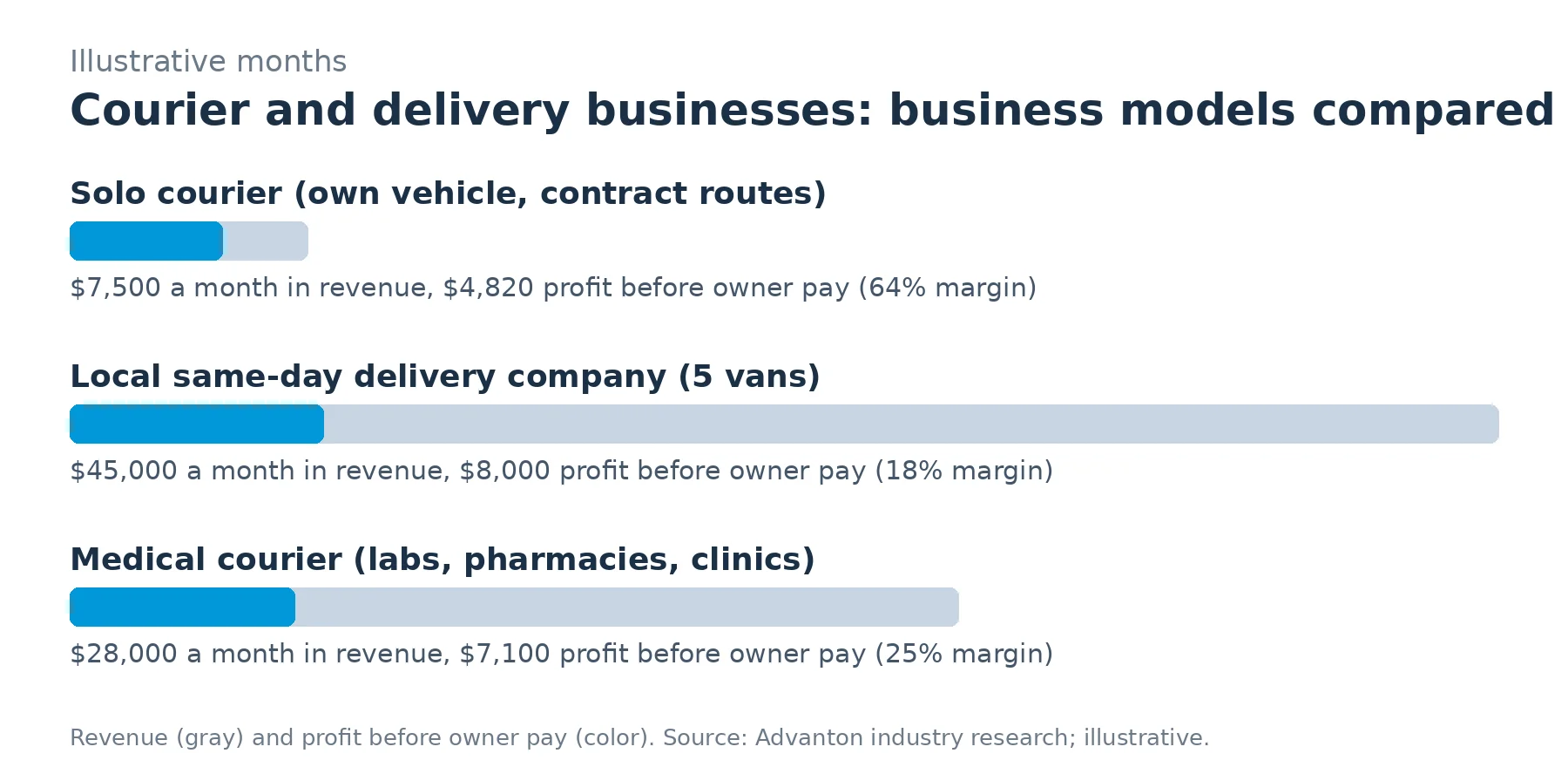
The figures below are illustrative months from our research, not industry averages. They show how revenue and costs typically fit together; your market, prices and costs will differ.
| Business model | Startup costs | Example monthly revenue | Costs | Profit before owner pay | Margin |
|---|---|---|---|---|---|
| Solo courier (own vehicle, contract routes) | Low: reliable vehicle, insurance, phone and apps | $7,500 | $2,680 | $4,820 | 64% |
| Local same-day delivery company (5 vans) | Moderate: vans, insurance, dispatch software, drivers | $45,000 | $37,000 | $8,000 | 18% |
| Medical courier (labs, pharmacies, clinics) | Moderate: temperature-controlled equipment, training, insurance | $28,000 | $20,900 | $7,100 | 25% |
Fixed and variable costs
For projections, the most useful split is between variable costs, which rise and fall with sales (materials, supplies, hourly labor, fees), and fixed costs, which you pay every month regardless (rent, salaried staff, insurance, loan payments).
| Business model | Variable costs (% of revenue) | Fixed costs per month | What it means |
|---|---|---|---|
| Solo courier (own vehicle, contract routes) | 22.7% | $980 | Mostly fixed: needs steady volume to cover overhead |
| Local same-day delivery company (5 vans) | 60.4% | $9,800 | Mostly variable: profitable early, but watch cash flow |
| Medical courier (labs, pharmacies, clinics) | 58.2% | $4,600 | Mostly variable: profitable early, but watch cash flow |
What the numbers say
Solo couriers keep low overhead, with fuel and vehicle costs as the main expenses.
Fleets add drivers, insurance and dispatch, so route density and contract pricing decide margins.
Medical courier work pays more per route but requires training, compliance and reliable timing.
The three models in brief
Solo courier. Contract routes and on-demand deliveries for local businesses. See trucking and logistics data.
Local same-day delivery company. Vans and drivers serving retailers, law firms, auto parts stores and online sellers.
Medical courier. Specimens, prescriptions and supplies for labs, pharmacies and clinics. See healthcare practices data.
Cost structure: local same-day delivery company (5 vans)
Each cost as a share of the example month’s revenue ($45,000):
| Cost | Monthly amount | Share of revenue | Type |
|---|---|---|---|
| Driver wages | $18,000 | 40.0% | Variable |
| Fuel | $5,000 | 11.1% | Variable |
| Dispatcher | $3,200 | 7.1% | Fixed |
| Van payments | $3,000 | 6.7% | Fixed |
| Payroll taxes and workers’ comp | $2,700 | 6.0% | Variable |
| Insurance (auto and cargo) | $2,000 | 4.4% | Fixed |
| Maintenance | $1,500 | 3.3% | Variable |
| Sales and marketing | $1,200 | 2.7% | Fixed |
| Dispatch and routing software | $400 | 0.9% | Fixed |
| Profit before owner pay | $8,000 | 18% |
A first-year projection: local same-day delivery company (5 vans)
New businesses rarely start at full speed. This projection assumes revenue ramps from 35% of the example month in month 1 to 100% by month 12, variable costs move with revenue, and fixed costs stay the same every month. It’s a planning illustration, not a forecast.
| Month | Revenue | Variable costs | Fixed costs | Profit | Cumulative |
|---|---|---|---|---|---|
| 1 | $15,750 | $9,513 | $9,800 | -$3,563 | -$3,563 |
| 2 | $20,250 | $12,231 | $9,800 | -$1,781 | -$5,344 |
| 3 | $24,750 | $14,949 | $9,800 | $1 | -$5,343 |
| 4 | $27,900 | $16,852 | $9,800 | $1,248 | -$4,095 |
| 5 | $31,500 | $19,026 | $9,800 | $2,674 | -$1,421 |
| 6 | $34,200 | $20,657 | $9,800 | $3,743 | $2,322 |
| 7 | $36,900 | $22,288 | $9,800 | $4,812 | $7,134 |
| 8 | $39,150 | $23,647 | $9,800 | $5,703 | $12,837 |
| 9 | $40,950 | $24,734 | $9,800 | $6,416 | $19,253 |
| 10 | $42,750 | $25,821 | $9,800 | $7,129 | $26,382 |
| 11 | $44,100 | $26,636 | $9,800 | $7,664 | $34,046 |
| 12 | $45,000 | $27,180 | $9,800 | $8,020 | $42,066 |
Year one: revenue $403,200, profit before owner pay $42,066. The first profitable month is month 3. Cumulative results bottom out at -$5,344, which is the minimum cash cushion this plan would need, before any startup costs.
Van payments, insurance and a dispatcher start before contracts fill routes, so this fleet illustration turns profitable in month 3, with a cumulative low of about $5,300.
How courier businesses earn
- Per delivery or per stop.
- Mileage-based pricing for longer runs.
- Dedicated routes at daily or weekly rates.
- Rush and after-hours premiums.
- Contract minimums for regular clients.
Contracts beat gig apps
Gig platforms bring volume but set prices and can change terms. Contract clients (pharmacies, labs, law firms, florists, parts stores) bring predictable routes and better rates. Many couriers use apps to fill gaps while building contracts.
Insurance matters
Personal auto policies often exclude business deliveries. Commercial auto, cargo and general liability coverage protect your business; medical and high-value clients may require specific limits.
A startup checklist for courier and delivery businesses
- Register the business and get commercial auto and cargo insurance.
- Check USDOT requirements for your vehicles and routes.
- Choose routing and proof-of-delivery software.
- Write service agreements with rates, minimums and liability terms.
- Plan vehicle maintenance and backups.
Medical courier requirements
Medical deliveries may involve specimens, temperature-controlled items and patient information. Train drivers on handling, chain of custody, spill response and privacy; use proper containers and temperature monitoring; and document every handoff.
Where the opportunities are
- Pharmacy and lab routes.
- Legal document delivery.
- Auto parts and supply house runs.
- Local e-commerce same-day delivery.
- Florist and bakery deliveries.
Key terms
| Term | Meaning |
|---|---|
| Dedicated route | A scheduled route for one client |
| Proof of delivery | Signatures, photos or scans confirming delivery |
| Cargo insurance | Coverage for goods in transit |
| USDOT number | Federal identifier for certain commercial vehicles |
Route density and pricing
Profit comes from stops per hour. Price by mileage, stops, weight and urgency, and design routes that cluster stops. Track cost per mile, including fuel, maintenance, insurance and vehicle payments.
Key numbers to track
Track revenue per route hour, cost per mile, on-time delivery rate, damage claims, contract retention and vehicle downtime.
Common mistakes
- Using personal insurance for business deliveries.
- Underpricing mileage and waiting time.
- Relying only on gig apps.
- No backup vehicle for contract routes.
- Misclassifying drivers.
Marketing a courier business
Direct outreach to pharmacies, labs, law firms and retailers, Google Business Profile, reviews and a professional website with service areas and rates win contracts. See how to win commercial contracting jobs for bidding tips that apply to delivery contracts.
Vehicles and fuel
Choose vehicles that match your loads: cars for documents and prescriptions, cargo vans for parcels and parts. Fuel-efficient or electric vehicles can lower cost per mile on predictable routes, and regular maintenance prevents missed deliveries.
Technology for couriers
Routing, dispatch, real-time tracking and electronic proof of delivery are now expected by business clients. Good software reduces miles, answers "where is my delivery?" questions automatically and supports billing.
Hiring drivers
Reliable drivers with clean records protect contracts and insurance rates. Check driving records, train on customer service and handling, and set clear expectations for timing and communication.
Test these numbers with your own plan
Open this industry in our free Business Idea Reality Check to start from any model above, change prices, costs, startup budget and your own pay, and see your break-even month, the cash you’d need, three scenarios and how new businesses in this sector survive in your state.
- Start with the closest model and its cost structure.
- Replace every price and cost with local quotes.
- Estimate your ramp: how fast customers will realistically come in year one.
- Map cash month by month with the free Cash & Payroll Planner.
- Build the full plan in the free Business Planner.
About this data
Workforce figures come from the U.S. Bureau of Labor Statistics (Occupational Outlook Handbook and Occupational Employment and Wage Statistics, May 2024 wages and the 2024 to 2034 projections, unless noted). Market figures cite their sources above. Business model figures are illustrative months built from typical prices and costs to show how revenue, fixed costs and variable costs fit together; they are not industry averages or guarantees. We review these profiles when new government data is released, at least once a year, and the same figures power the Business Idea Reality Check.
Licensing and rules
Business registration and commercial auto insurance (personal policies often exclude business deliveries); cargo insurance for goods in transit; vehicles used in interstate commerce above certain weights need a USDOT number and must follow federal motor carrier rules; medical couriers handling specimens or patient information follow HIPAA, bloodborne pathogen and specimen-transport requirements; drivers must be properly classified as employees or contractors. Requirements change; confirm with your state and local agencies before you start.
Frequently asked questions about courier and delivery businesses
How much do delivery drivers earn?
BLS reported a median of $44,140 for light truck drivers in May 2024.
Do couriers need special insurance?
Yes. Commercial auto and cargo insurance are usually needed, since personal policies often exclude business deliveries.
Do I need a USDOT number?
Vehicles used in interstate commerce above certain weights need one; check federal rules for your vehicles.
Is medical courier work profitable?
It can pay well, but requires training, compliance and reliable timing.
What vehicle do I need to start a courier business?
A reliable, fuel-efficient car works for documents and prescriptions; cargo vans suit parcels, parts and larger loads.
How do couriers find contracts?
Direct outreach to local businesses, referrals and a professional online presence.
Should I use gig apps?
They can fill gaps, but contract clients usually offer steadier routes and better rates.
How can I test these numbers?
Open courier and delivery in the Business Idea Reality Check and enter your own rates and costs.
Keep learning
- Trucking and logistics data
- Moving and storage data
- Ecommerce industry data
- Business Idea Reality Check
Sources
Last reviewed November 1, 2026. Startup costs are estimates; check local prices, licensing and tax rules before you commit money.
In India
Small businesses like this in India
In MoSPI’s survey of unincorporated businesses (proprietorships, partnerships and similar firms), this falls under Transport support, postal and courier. In 2023-24 India had 1.1 lakh such establishments employing 3 lakh workers, and 50.4% were run without hired workers. Across the wider other services group, the number of establishments grew 10.29% between 2023-24 and 2025.
| Urban | Rural | All India | |
|---|---|---|---|
| Value added per business a year | ₹7,34,456 | ₹2,69,025 | ₹6,13,157 |
| Value added per worker a year | ₹2,43,215 | ₹1,53,291 | ₹2,27,926 |
| Pay per hired worker a year | ₹1,71,923 | ₹1,19,371 | ₹1,67,572 |
Running it alone or with staff: businesses with no hired workers added about ₹1,98,733 a year on average, while those with hired workers added about ₹10,33,908 (all India).
Where these businesses are: the states with the most small other services businesses are West Bengal (13.1%), Uttar Pradesh (11.6%), Maharashtra (8.8%), Tamil Nadu (6.2%), Gujarat (6.0%) of the national total (2023-24).
Value added is what a business produces minus what it spends on materials and other inputs, before paying its workers and owner, so it’s a rough guide to the income a typical small business generates. These figures cover the whole activity, which can be broader than this one business type. Across all small businesses, average fixed assets such as equipment, furniture and vehicles were ₹3,42,242 per establishment in 2025.
Licences and registrations to expect
- Commercial vehicle registration, fitness certificates and permits from the RTO.
- Driving schools need an RTO licence; e-rickshaws must be registered and, in many cities, permitted.
- Registration under your state’s Shops and Establishments Act if you have premises or employees.
- A trade licence from your municipal corporation or council for many shop and service businesses.
- GST registration once turnover crosses ₹40 lakh for goods or ₹20 lakh for services (lower in some special category states), or earlier if you sell goods to other states or through e-commerce marketplaces.
- Professional tax registration in states that levy it.
- Free Udyam (MSME) registration, which helps with loans, government schemes and delayed-payment protection.
Rules differ by state and city. Check with your municipal corporation, state departments and a chartered accountant before you start.
Run a business like this in India? List it free in the India Business Directory, with your hours, deals and GST registration.
Free tools for India: Make a GST invoice · Compare business credit cards
Build a market report for Courier and Delivery Businesses in India Pick your state and see market size, earnings, competition and licences, from official data. Free, with a PDF download.
Sources: MoSPI, Annual Survey of Unincorporated Sector Enterprises (ASUSE) 2023-24, full report, Appendix A Tables 4, 29, 33, 35 and 37 (survey period October 2023 to September 2024); MoSPI, Annual Survey of Unincorporated Sector Enterprises (ASUSE) 2025, factsheet (survey period January to December 2025, released 24 March 2026). Licensing summary by Advanton, checked November 2026.