
Owning a practice lets clinicians shape how they care for patients and build a lasting business asset, and healthcare’s growth supports it. The Bureau of Labor Statistics projects physical therapist jobs to grow 11% from 2024 to 2034, much faster than average, and dentists’ median pay was $179,210 in May 2024.
Practices are also among the most regulated and capital-intensive small businesses: clinical licenses, privacy rules, insurance credentialing and billing all come before the first patient pays. This page gathers the key numbers, compares four business models (including medical billing, which serves practices rather than patients) and shows how a new dental practice’s first year might look.
The workforce
| Occupation | Jobs (2024) | Median pay (May 2024) | Projected growth, 2024 to 2034 |
|---|---|---|---|
| Dentists | about 149,300 | $179,210 | +4% |
| Physical therapists | about 267,200 | $101,020 | +11% |
| Physical therapist assistants | n/a | $65,510 | n/a |
Source: U.S. Bureau of Labor Statistics, Occupational Outlook Handbook.
Business models compared
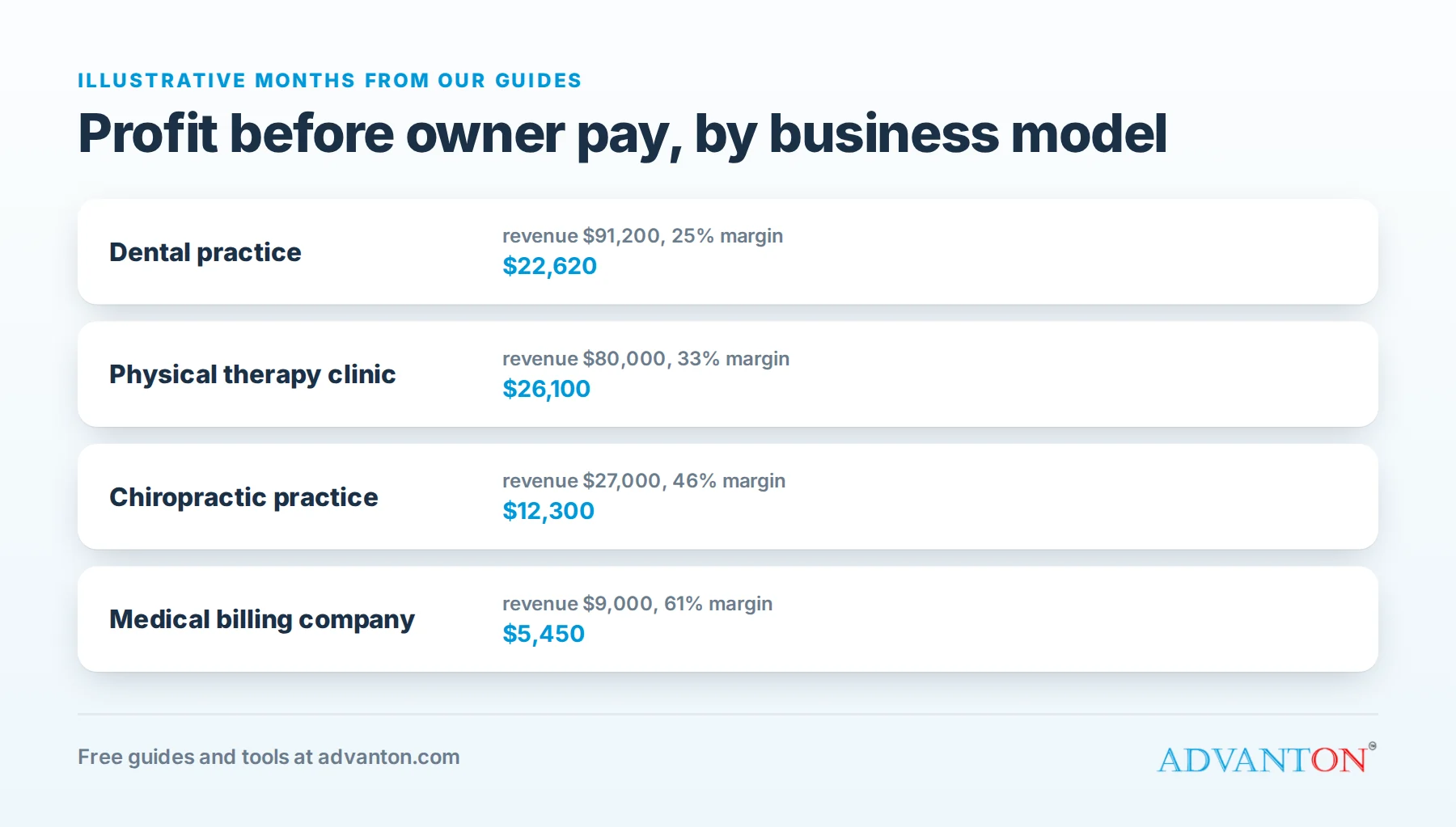
The figures below are illustrative months from our step-by-step guides, not industry averages. They show how revenue and costs typically fit together; your market, prices and costs will differ.
| Business model | Startup costs | Example monthly revenue | Costs | Profit before owner pay | Margin |
|---|---|---|---|---|---|
| Dental practice (established, solo dentist) | Very high: build-out, equipment, technology, working capital | $91,200 | $68,580 | $22,620 | 25% |
| Physical therapy clinic (2 therapists) | Moderate to high: space, equipment, credentialing time, working capital | $80,000 | $53,900 | $26,100 | 33% |
| Chiropractic practice (established, solo) | Moderate: space, tables, software, marketing | $27,000 | $14,700 | $12,300 | 46% |
| Medical billing company | Low: software, clearinghouse, insurance | $9,000 | $3,550 | $5,450 | 61% |
Fixed and variable costs
For projections, the most useful split is between variable costs, which rise and fall with sales (materials, parts, hourly labor), and fixed costs, which you pay every month regardless (rent, salaried staff, insurance, loan payments).
| Business model | Variable costs (% of revenue) | Fixed costs per month | What it means |
|---|---|---|---|
| Dental practice (established, solo dentist) | 14.5% | $55,380 | Mostly fixed: slow start-up months are expensive |
| Physical therapy clinic (2 therapists) | 5.0% | $49,900 | Mostly fixed: slow start-up months are expensive |
| Chiropractic practice (established, solo) | 7.4% | $12,700 | Mostly fixed: slow start-up months are expensive |
| Medical billing company | 28.9% | $950 | Low costs overall: time is the main constraint |
What the numbers say
Clinical pay is high, but so are overheads. Practices carry substantial fixed costs: rent, clinical and front-office staff, equipment payments and software. The example dental practice has about $55,000 of fixed costs a month, so patient volume decides profitability.
Reimbursement shapes revenue. Insurance participation brings patients but sets fees; cash-pay and membership models offer more control but must attract patients willing to pay directly. Credentialing with insurers often takes months.
Support businesses have low barriers. A medical billing company needs little capital, but depends on skill, accuracy and strict data security under HIPAA.
The four models in brief
Dental practice. High revenue per visit and high overhead; new practices build patients over months or years. See how to start a dental practice.
Physical therapy clinic. Growing demand, insurance-heavy revenue, and payroll as the largest cost. See how to start a physical therapy clinic.
Chiropractic practice. Lower overhead than dental or PT, often cash-based or hybrid; Medicare covers only spinal manipulation. See how to start a chiropractic practice.
Medical billing company. Serves practices remotely for a share of collections; low startup costs, high responsibility for accuracy and privacy. See how to start a medical billing business.
Cost structure: dental practice (established, solo dentist)
Each cost as a share of the example month’s revenue ($91,200):
| Cost | Monthly amount | Share of revenue | Type |
|---|---|---|---|
| Hygienists | $14,000 | 15.4% | Fixed |
| Dental assistants | $8,400 | 9.2% | Fixed |
| Front office | $8,000 | 8.8% | Fixed |
| Rent | $8,000 | 8.8% | Fixed |
| Lab fees | $6,500 | 7.1% | Variable |
| Payroll taxes and benefits | $6,080 | 6.7% | Fixed |
| Equipment and build-out loan | $6,000 | 6.6% | Fixed |
| Dental supplies | $5,500 | 6.0% | Variable |
| Marketing | $2,500 | 2.7% | Fixed |
| Insurance | $1,500 | 1.6% | Fixed |
| Processing and billing | $1,200 | 1.3% | Variable |
| Software | $900 | 1.0% | Fixed |
| Profit before owner pay | $22,620 | 25% |
A first-year projection: dental practice (established, solo dentist)
New businesses rarely start at full speed. This projection assumes revenue ramps from 35% of the example month in month 1 to 100% by month 12, variable costs move with revenue, and fixed costs stay the same every month. It’s a planning illustration, not a forecast.
| Month | Revenue | Variable costs | Fixed costs | Profit | Cumulative |
|---|---|---|---|---|---|
| 1 | $31,920 | $4,620 | $55,380 | -$28,080 | -$28,080 |
| 2 | $41,040 | $5,940 | $55,380 | -$20,280 | -$48,360 |
| 3 | $50,160 | $7,260 | $55,380 | -$12,480 | -$60,840 |
| 4 | $56,544 | $8,184 | $55,380 | -$7,020 | -$67,860 |
| 5 | $63,840 | $9,240 | $55,380 | -$780 | -$68,640 |
| 6 | $69,312 | $10,032 | $55,380 | $3,900 | -$64,740 |
| 7 | $74,784 | $10,824 | $55,380 | $8,580 | -$56,160 |
| 8 | $79,344 | $11,484 | $55,380 | $12,480 | -$43,680 |
| 9 | $82,992 | $12,012 | $55,380 | $15,600 | -$28,080 |
| 10 | $86,640 | $12,540 | $55,380 | $18,720 | -$9,360 |
| 11 | $89,376 | $12,936 | $55,380 | $21,060 | $11,700 |
| 12 | $91,200 | $13,200 | $55,380 | $22,620 | $34,320 |
Year one: revenue $817,152, profit before owner pay $34,320. The first profitable month is month 6. Cumulative results bottom out at -$68,640, which is the minimum cash cushion this plan would need, before any startup costs.
A dental practice’s costs are mostly fixed: staff, rent and equipment payments arrive every month from opening day. In this illustration, the first five months lose money, the cumulative low point is about $68,600, and the year still ends ahead. Real startups often ramp more slowly than this, so lenders and owners usually plan for a longer runway, often with a line of credit arranged well before opening day.
How practices get paid
- Insurance participation: joining networks brings patients but means accepting negotiated fees, documentation requirements and payment delays.
- Cash-pay and hybrid models: transparent prices for visits, often with packages or memberships; common in chiropractic and some physical therapy.
- Dental membership plans: a yearly fee covering preventive care for uninsured patients, plus discounts on treatment.
- Medical billing companies charge practices a percentage of collections, per-claim fees or flat monthly fees.
Demand patterns
Healthcare demand is steady, with some seasonality: many patients schedule care after meeting insurance deductibles later in the year, and new-year deductibles can slow visits in January and February. Patient retention (completing plans of care and returning for recall visits) is as important as winning new patients.
A startup checklist
- Confirm licensing and ownership rules for your profession and state.
- Decide: start new, buy, or join a practice.
- Plan credentialing with insurers, and Medicare enrollment if relevant, months before opening.
- Set up HIPAA-compliant software, policies and vendor agreements.
- Choose a location with visibility, parking and accessibility.
- Arrange financing for build-out, equipment and working capital.
- Hire and train front-office staff as carefully as clinical staff.
Questions to answer before you start
- What’s your expected payer mix, and what does each payer reimburse?
- How many patients per day do you need to cover fixed costs?
- How long will credentialing take, and how will you cover costs meanwhile?
- What will make patients choose you over established practices nearby?
- What’s your plan if growth is slower than expected?
A realistic answer to these questions is what lenders look for, and what protects you from opening with too little runway.
Where the opportunities are
- Specialty clinics: sports, pelvic health, vestibular rehabilitation and pediatric therapy help practices stand out.
- Membership and cash-pay options for patients without insurance or with high deductibles.
- Underserved communities with few providers per resident.
- Practice purchases: retiring owners selling established practices with existing patients.
- Billing and credentialing services for the many small practices that struggle with insurance paperwork.
Key terms
| Term | Meaning |
|---|---|
| Credentialing | Enrolling a provider with an insurance plan so its patients can be billed |
| Payer mix | The share of revenue from each insurer, government program and cash pay |
| Production vs collections | The value of care billed vs the money actually collected |
| Days in accounts receivable | How long, on average, it takes to get paid |
| Overhead percentage | Total costs as a share of collections |
Financing a practice
Dental and physical therapy practices often need significant financing for build-out, equipment and working capital. Healthcare-focused lenders are common, and banks generally view licensed professionals favorably, but they’ll expect a business plan, projections, location analysis and personal financial information. Buying an established practice can provide immediate revenue, while a startup offers full control but a longer ramp. Include loan payments in fixed costs, and plan working capital for credentialing delays and slow early months. See how to get a startup loan.
Measuring practice health
Owners track a handful of numbers monthly: new patients, active patients, visits per day, collections compared with production, days in accounts receivable, denial rates and overhead percentage. Sudden changes in any of them, such as falling new-patient numbers or rising denials, are early warnings worth acting on before they reach the bank balance.
Staffing a practice
Practices run on teams: hygienists, assistants, therapists, front-desk staff and billers. Competition for clinical staff is strong, so practices that offer fair pay, predictable schedules, training and a respectful culture keep their teams longer. The front desk deserves special attention: it verifies insurance, schedules plans of care, collects payments and shapes every patient’s first impression. Include payroll taxes and benefits, typically a meaningful share on top of wages, in every projection, and check the full cost of each hire with our hiring cost calculator. Many owners also budget for continuing education and licensing renewals for every clinician, since these are required to keep practicing, and plan coverage for vacations and illness so patient schedules aren’t disrupted.
How to use these numbers for your own plan
- Start with the closest model above and its cost structure.
- Replace every price and cost with local quotes: rent, insurance, wages, materials and your expected prices.
- Estimate your ramp: how many customers, visits or jobs you can realistically win each month in year one.
- Separate fixed and variable costs, then calculate your break-even point with our free break-even calculator.
- Map cash month by month with our cash flow forecast, including startup costs and loan payments.
- Build the plan in our free Business Planner, which carries your numbers from startup costs through pricing, break-even and funding.
These industry figures will also feed a planned Advanton projection tool, so you’ll be able to start from an industry template and adjust it to your situation. Until then, a simple spreadsheet with your own numbers, reviewed with an accountant or a free SCORE mentor, is a strong start.
Licensing and rules
Every clinician needs a state license (DDS/DMD for dentists, DPT for physical therapists, DC for chiropractors); some states restrict practice ownership; HIPAA privacy and security; insurance credentialing and Medicare enrollment; Medicare covers chiropractic spinal manipulation only. Requirements change; confirm with your state and local agencies before you start.
Trends to watch
- Aging population: rising demand for rehabilitation, dental care and chronic condition management.
- Direct-to-patient models: membership plans and cash-pay services alongside insurance.
- Consolidation: larger groups and private equity buying practices, which affects valuations and competition.
- Technology: digital imaging, practice software and telehealth where permitted.
- Staffing: competition for hygienists, assistants and therapists.
Risks to plan for
- Long credentialing and payment cycles that strain cash flow.
- High fixed costs while the patient base grows.
- Compliance: HIPAA, documentation, billing rules and state practice acts.
- Ownership rules that limit partners and investors in some states.
- Staff shortages in clinical roles.
Frequently asked questions
What do dentists and physical therapists earn?
In May 2024, dentists’ median pay was $179,210 and physical therapists’ was $101,020, according to the BLS.
How fast is physical therapy growing?
The BLS projects physical therapist jobs to grow 11% from 2024 to 2034.
Can a non-clinician own a practice?
Some states restrict ownership of healthcare practices to licensed professionals. Check your state’s rules with a healthcare attorney.
Why do practices take months to break even?
Most costs are fixed from opening day, while patient volume and insurance payments take time to build.
Is buying a practice less risky than starting one?
Often, because it brings existing patients and revenue from day one. It still requires careful review of finances, staff, equipment and the lease, plus a fair price.
Keep learning
- Dental practice guide
- Physical therapy clinic guide
- Chiropractic practice guide
- Medical billing company guide
Sources
- U.S. Bureau of Labor Statistics, Dentists
- U.S. Bureau of Labor Statistics, Physical therapists
- U.S. Bureau of Labor Statistics, Physical therapist assistants and aides
Last reviewed October 28, 2026. Startup costs are estimates; check local prices, licensing and tax rules before you commit money.

