
Many physical therapists dream of running their own practice: setting their own standards of care, spending more time with patients and building a business in their community. Demand supports it: an aging population, active people recovering from injuries and surgeries, and growing awareness of physical therapy as a first step for pain.
According to the U.S. Bureau of Labor Statistics, physical therapists held about 267,200 jobs in 2024, earning a median of $101,020, and employment is projected to grow 11% from 2024 to 2034. Physical therapists need a Doctor of Physical Therapy (DPT) degree, and all states require a license.
Running a clinic adds business skills to clinical skills: credentialing, billing, compliance, staffing and marketing. This guide covers them.
Physical therapy clinic at a glance
Table of Contents
| Owner requirements | DPT, state license; some states restrict who can own a clinic |
| Payment | Commercial insurance, Medicare, Medicaid, workers’ comp, auto claims, cash pay |
| Startup costs | Moderate to high: space, equipment, software, credentialing time, working capital |
| Biggest challenges | Insurance reimbursement, billing, staffing, patient flow |
| Specialties | Orthopedic, sports, pelvic health, vestibular, pediatrics, geriatrics |
Ownership and licensing
- State PT license for each therapist, and a business license for the clinic.
- Ownership rules: some states restrict ownership of healthcare practices to licensed professionals or specific entity types. Check your state’s rules before bringing in non-clinician partners or investors.
- Entity choice: many practices form a professional entity (such as a PLLC or PC) where required.
- National Provider Identifier (NPI) numbers for the clinic and each therapist.
A healthcare attorney and accountant who work with practices are worth the investment at this stage.
Direct access
Every state allows patients to see a physical therapist without a physician’s referral in some form, but the rules vary: some limit the number of visits or days before a referral is needed, and insurers may require referrals for payment regardless of state law. Know your state’s rules and each payer’s requirements.
Insurance credentialing and Medicare
- Credentialing: apply to join the networks of the insurance plans your patients use. It often takes several months, so start early.
- Medicare enrollment: enroll the clinic and therapists if you’ll treat Medicare patients, and follow Medicare’s documentation and plan-of-care requirements.
- Medicaid, workers’ compensation and auto insurance: each has its own rules.
- Billing: decide whether to bill in-house or use a billing service.
Reimbursement varies widely by payer, so model your expected payer mix before signing a lease.
Cash-pay and hybrid models
Some clinics accept no insurance (or limited insurance) and charge patients directly, offering longer one-to-one sessions and services insurance doesn’t cover, such as wellness, performance training or dry needling where permitted. Others combine insurance and cash-pay services. Cash-pay practices must follow rules on Medicare beneficiaries and opting out, so check carefully before treating Medicare patients outside the system.
Startup costs to plan for
- Lease deposit and build-out of treatment areas.
- Equipment: tables, exercise and balance equipment, modalities.
- Practice management software with documentation and billing.
- Credentialing and legal fees.
- Insurance: malpractice, general liability and property.
- Marketing for your opening.
- Working capital: several months of expenses, because insurance payments often arrive weeks after visits.
Total everything with our startup cost calculator.
Space and equipment
- Location: visibility, parking, accessibility and proximity to referral sources.
- Layout: treatment tables, private rooms for evaluations, an open gym area, restrooms and a waiting area.
- Equipment: treatment tables, exercise equipment, weights and bands, balance tools, modalities you’ll use.
- Practice management software: scheduling, documentation (EMR), billing and patient reminders.
Lease or finance larger equipment to preserve cash. See how to get a startup loan.
HIPAA and compliance
Clinics must protect patient health information under HIPAA: use compliant software, sign agreements with vendors that handle patient data, train staff, secure devices and records, and have a breach response plan. Also follow documentation standards, billing rules and state practice acts. Compliance mistakes are costly; build good habits from day one.
Staffing
Typical roles include physical therapists, physical therapist assistants (BLS median $65,510 in May 2024), aides, and front desk and billing staff. Follow your state’s supervision rules for assistants and aides, and include payroll taxes and benefits in your budget. Our hiring cost calculator shows the full cost of each role.
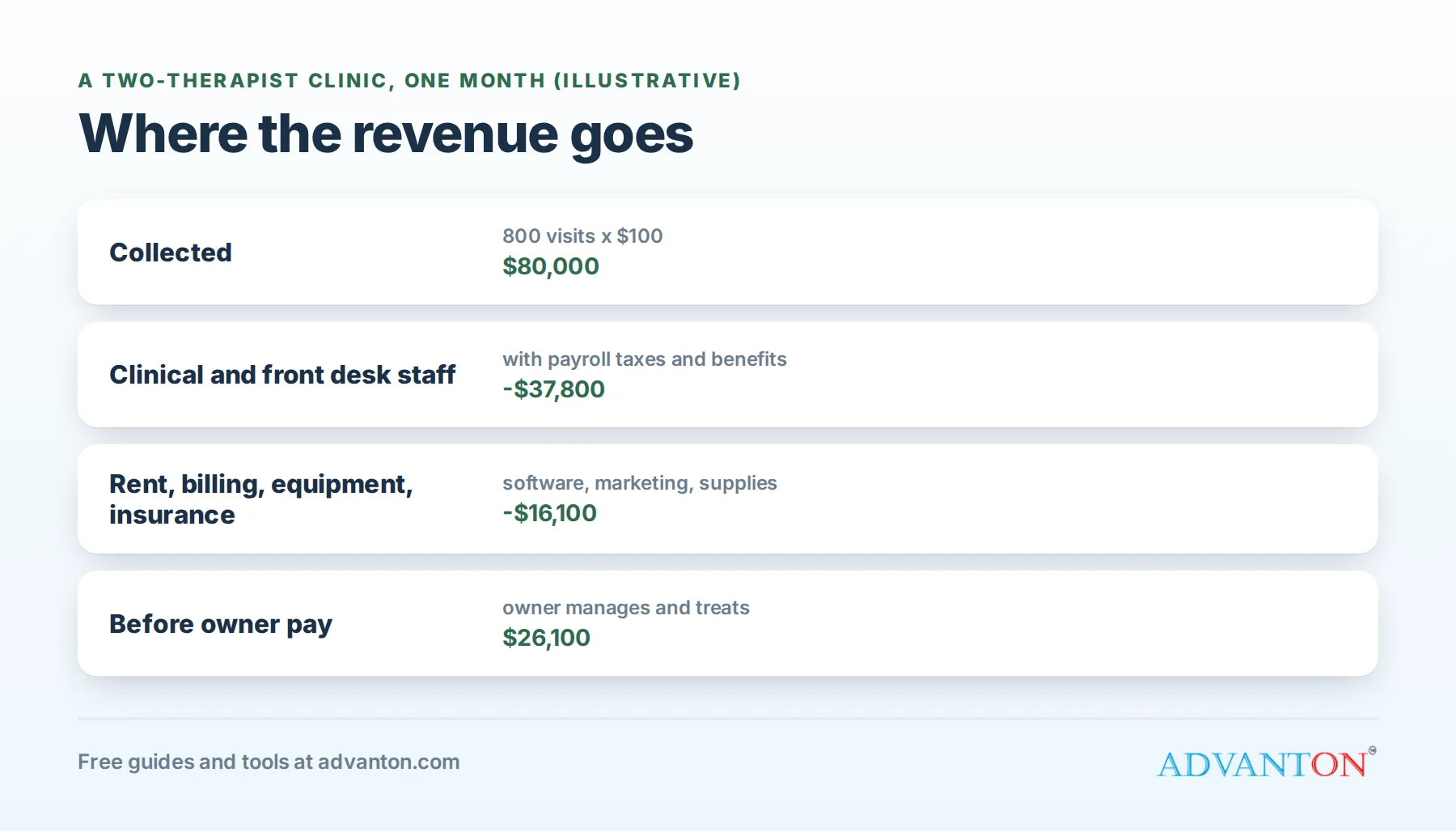
A worked example: a two-therapist clinic
These figures are illustrative for one month.
| Revenue | Amount |
|---|---|
| 800 visits × $100 average collected | $80,000 |
| Costs | Amount |
|---|---|
| Two physical therapists | $18,000 |
| Physical therapist assistant | $6,000 |
| Front desk and billing staff | $7,500 |
| Payroll taxes and benefits (about 20%) | $6,300 |
| Rent | $7,000 |
| Billing service (about 4%) | $3,200 |
| Equipment lease | $1,500 |
| Malpractice and business insurance | $1,200 |
| Practice software | $900 |
| Marketing | $1,500 |
| Supplies | $800 |
| Total costs | $53,900 |
Profit before owner’s pay and taxes: $26,100, with the owner managing the clinic and treating some patients. The keys are visits per day, average collected per visit and cancellations. Model your own numbers with our break-even calculator.
Choosing a specialty
A focused specialty helps referral sources remember you: sports and orthopedics, pelvic health, vestibular and balance disorders, neurological rehabilitation, pediatrics, older adults and fall prevention, or work injuries. Specialty certifications strengthen credibility, and specialized equipment or longer visits can justify cash-pay services.
Key metrics to track
| Metric | Why it matters |
|---|---|
| Visits per therapist per day | Drives revenue and staffing |
| Arrival rate | Shows cancellations and no-shows |
| Average collected per visit | Reflects payer mix and billing quality |
| Plan-of-care completion | Links to outcomes and referrals |
| Days in accounts receivable | Shows how fast you get paid |
| Claim denial rate | Reveals documentation or billing problems |
Building referrals
- Physicians and surgeons: orthopedic surgeons, primary care, sports medicine.
- Chiropractors, athletic trainers and personal trainers.
- Gyms, running clubs and sports teams.
- Direct-to-patient marketing: Google Business Profile, reviews and educational content.
- Workshops on back pain, injury prevention or fall prevention.
Send referring providers clear, timely progress reports; they remember clinics that communicate well.
The front desk makes or breaks a clinic
Your front desk verifies insurance and benefits before the first visit, explains costs, schedules the full plan of care, sends reminders, collects copays and follows up on cancellations. Train them well, give them scripts for common questions, and measure arrival rates and collections. A strong front desk protects revenue and patient experience every day.
The first visit
Make the evaluation visit welcoming and clear: online intake forms before arrival, a thorough evaluation, an explanation of the diagnosis and plan in plain language, a first set of home exercises, and the next visits booked before the patient leaves. Patients who understand their plan are far more likely to complete it.
Patient retention
Patients who finish their plan of care get better results and refer friends. Reduce dropouts with clear goals, visible progress, reminder systems, convenient scheduling and a home exercise program patients understand.
Telehealth
Telehealth physical therapy can work for follow-ups, home exercise progressions and patients far from the clinic. Coverage and rules vary by payer and state, so check before offering it, and use HIPAA-compliant video tools.
Growing your practice
When your schedule is consistently full, add therapists, extend hours or open a second location. Grow when your systems (scheduling, documentation, billing and hiring) work smoothly, since problems multiply with each new therapist or site.
Measure outcomes
Track patients’ progress with standardized outcome measures, such as pain, function and goal achievement, at the start and end of care. Outcomes show patients their progress, support conversations with insurers, and give referring physicians evidence that sending patients to you works. Share summary results (without personal details) in your marketing, honestly and accurately.
Common mistakes to avoid
- Signing a lease before credentialing is underway.
- Ignoring payer mix and reimbursement rates.
- Weak documentation that leads to denied claims.
- High cancellation rates without follow-up.
- Underestimating working capital while insurance payments arrive.
Your first 90 days of planning
- Days 1 to 30: confirm ownership rules, form your entity, get NPIs, and start credentialing.
- Days 31 to 60: choose a location, set up software and HIPAA policies, and arrange financing.
- Days 61 to 90: buy equipment, hire staff, build referral relationships and plan your opening.
Frequently asked questions
How long does insurance credentialing take?
Often several months, depending on the payer. Start as early as possible.
Can I start a cash-pay practice?
Yes, many do. Understand the rules for Medicare beneficiaries and be clear with patients about costs.
Do I need a referral to treat patients?
State direct access laws allow some treatment without one, but limits and insurer requirements vary.
Should I specialize?
A specialty, such as sports, pelvic health or vestibular therapy, helps you stand out and build referral networks.
What can physical therapist assistants do?
PTAs provide treatment under a physical therapist’s plan and supervision, following state rules. Evaluations and plans of care remain the physical therapist’s responsibility.
How much working capital do I need?
Enough to cover several months of expenses, including payroll and rent, while credentialing finishes and insurance payments start arriving. Your forecast should show the gap clearly, so you can arrange a line of credit before you need it.
Keep learning
Sources
- U.S. Bureau of Labor Statistics, Physical therapists
- U.S. Bureau of Labor Statistics, Physical therapist assistants and aides
Last reviewed October 28, 2026. Startup costs are estimates; check local prices, licensing and tax rules before you commit money.


Leave a Reply