
An aging population, active lifestyles and a focus on non-surgical treatment keep demand for physical therapy growing. The Bureau of Labor Statistics counted about 267,200 physical therapists in 2024, with a median wage of $101,020 in May 2024 and 11% projected growth from 2024 to 2034, plus about 13,200 openings a year; physical therapist assistants earned a median of $65,510, with 22% projected growth, among the fastest of any occupation.
Private practices choose between billing insurance (higher volume, lower rates per visit, more paperwork) and cash-based care (higher fees, fewer patients, more marketing). Many blend both.
The workforce
| Occupation | Jobs (2024) | Median pay (May 2024) | Projected growth, 2024 to 2034 |
|---|---|---|---|
| Physical therapists | 267,200 | $101,020 | +11% |
| Physical therapist assistants | n/a | $65,510 | +22% |
Source: U.S. Bureau of Labor Statistics, Occupational Outlook Handbook and Occupational Employment and Wage Statistics.
Market data
| Measure | Value |
|---|---|
| Physical therapist openings projected each year, 2024 to 2034 | about 13,200 |
Business models compared
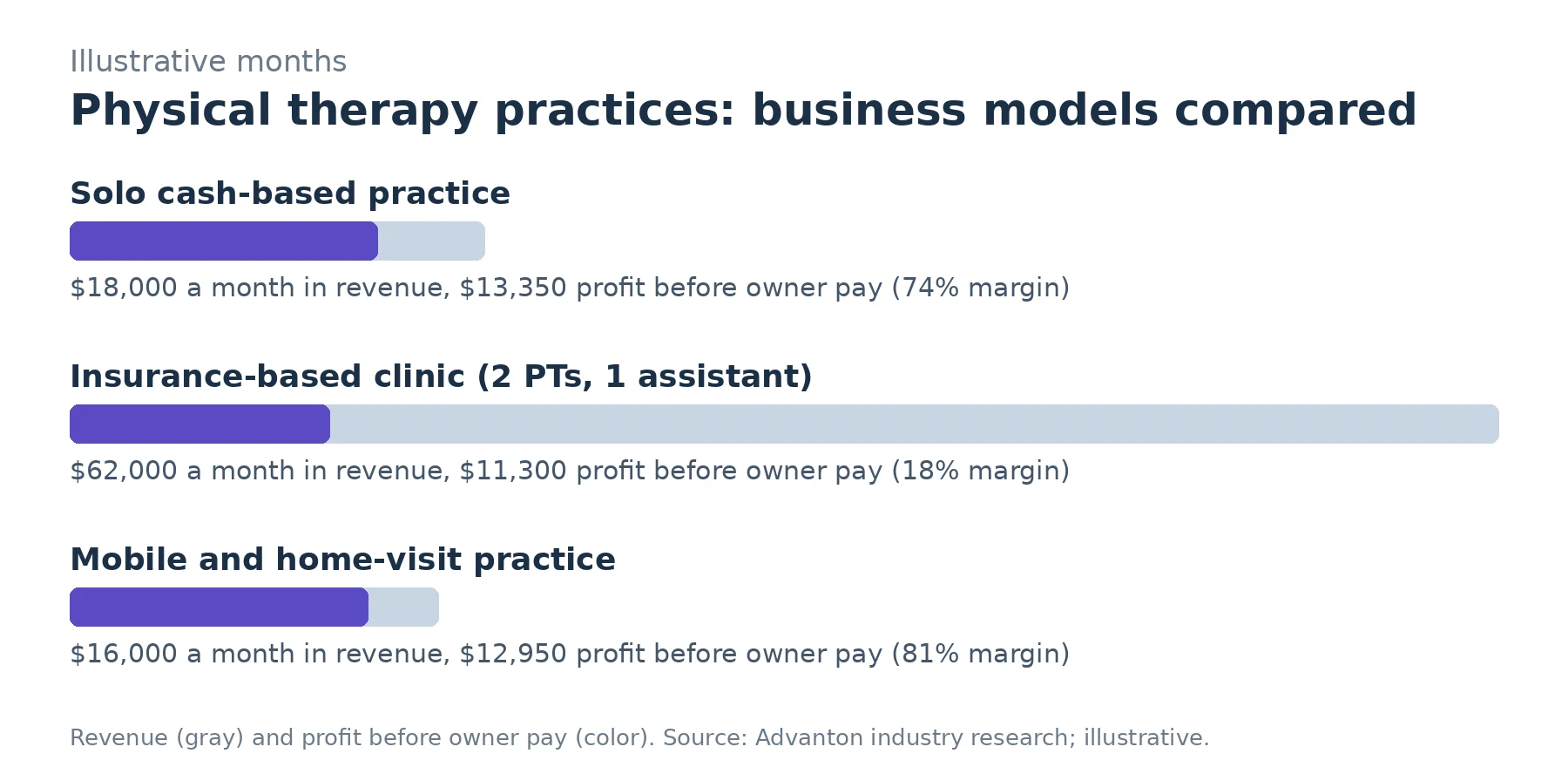
The figures below are illustrative months from our research, not industry averages. They show how revenue and costs typically fit together; your market, prices and costs will differ.
| Business model | Startup costs | Example monthly revenue | Costs | Profit before owner pay | Margin |
|---|---|---|---|---|---|
| Solo cash-based practice | Low to moderate: treatment space, table, equipment, software | $18,000 | $4,650 | $13,350 | 74% |
| Insurance-based clinic (2 PTs, 1 assistant) | Moderate: clinic space, equipment, credentialing, billing | $62,000 | $50,700 | $11,300 | 18% |
| Mobile and home-visit practice | Low: vehicle, portable equipment, software | $16,000 | $3,050 | $12,950 | 81% |
Fixed and variable costs
For projections, the most useful split is between variable costs, which rise and fall with sales (materials, supplies, hourly labor, fees), and fixed costs, which you pay every month regardless (rent, salaried staff, insurance, loan payments).
| Business model | Variable costs (% of revenue) | Fixed costs per month | What it means |
|---|---|---|---|
| Solo cash-based practice | 4.2% | $3,900 | Mostly fixed: needs steady volume to cover overhead |
| Insurance-based clinic (2 PTs, 1 assistant) | 8.9% | $45,200 | Mostly fixed: needs steady volume to cover overhead |
| Mobile and home-visit practice | 10.0% | $1,450 | Mostly fixed: needs steady volume to cover overhead |
What the numbers say
Cash-based solo practices have high margins but depend on marketing and patients willing to pay out of pocket.
Insurance-based clinics need volume. Reimbursement per visit is lower, and staff, rent and billing costs are fixed.
Mobile practices start lean and can reach older adults and busy professionals at home or work.
The three models in brief
Solo cash-based practice. One therapist offering longer, one-on-one sessions at set fees.
Insurance-based clinic. Several therapists treating patients covered by insurance and Medicare. See healthcare practices data.
Mobile practice. Visits at homes, workplaces or gyms. See home health data.
Cost structure: insurance-based clinic (2 PTs, 1 assistant)
Each cost as a share of the example month’s revenue ($62,000):
| Cost | Monthly amount | Share of revenue | Type |
|---|---|---|---|
| Therapist and assistant wages | $26,000 | 41.9% | Fixed |
| Rent | $5,500 | 8.9% | Fixed |
| Payroll taxes and benefits | $5,200 | 8.4% | Fixed |
| Billing service fees | $4,300 | 6.9% | Variable |
| Front desk | $3,800 | 6.1% | Fixed |
| Marketing and physician outreach | $1,800 | 2.9% | Fixed |
| Equipment payments | $1,500 | 2.4% | Fixed |
| Supplies | $1,200 | 1.9% | Variable |
| EMR software | $700 | 1.1% | Fixed |
| Insurance | $700 | 1.1% | Fixed |
| Profit before owner pay | $11,300 | 18% |
A first-year projection: insurance-based clinic (2 PTs, 1 assistant)
New businesses rarely start at full speed. This projection assumes revenue ramps from 35% of the example month in month 1 to 100% by month 12, variable costs move with revenue, and fixed costs stay the same every month. It’s a planning illustration, not a forecast.
| Month | Revenue | Variable costs | Fixed costs | Profit | Cumulative |
|---|---|---|---|---|---|
| 1 | $21,700 | $1,931 | $45,200 | -$25,431 | -$25,431 |
| 2 | $27,900 | $2,483 | $45,200 | -$19,783 | -$45,214 |
| 3 | $34,100 | $3,035 | $45,200 | -$14,135 | -$59,349 |
| 4 | $38,440 | $3,421 | $45,200 | -$10,181 | -$69,530 |
| 5 | $43,400 | $3,863 | $45,200 | -$5,663 | -$75,193 |
| 6 | $47,120 | $4,194 | $45,200 | -$2,274 | -$77,467 |
| 7 | $50,840 | $4,525 | $45,200 | $1,115 | -$76,352 |
| 8 | $53,940 | $4,801 | $45,200 | $3,939 | -$72,413 |
| 9 | $56,420 | $5,021 | $45,200 | $6,199 | -$66,214 |
| 10 | $58,900 | $5,242 | $45,200 | $8,458 | -$57,756 |
| 11 | $60,760 | $5,408 | $45,200 | $10,152 | -$47,604 |
| 12 | $62,000 | $5,518 | $45,200 | $11,282 | -$36,322 |
Year one: revenue $555,520, profit before owner pay -$36,322. The first profitable month is month 7. Cumulative results bottom out at -$77,467, which is the minimum cash cushion this plan would need, before any startup costs.
Therapist wages, rent and billing start before referrals build, so this clinic illustration turns profitable in month 7, with a cumulative low of about $77,500.
How PT practices earn
- Insurance and Medicare reimbursement per visit and service.
- Cash-pay sessions and packages.
- Wellness and performance programs.
- Workplace and sports contracts.
- Telehealth follow-ups where allowed.
Referrals and direct access
Physicians, chiropractors, coaches and gyms refer patients. Many states allow patients to see a physical therapist without a physician referral, though rules and insurer requirements vary. Building relationships with local referral sources is often the most important marketing work. Track which physicians and partners send patients, send progress updates with patient consent, and thank top referrers personally.
A startup checklist
- Confirm state licensing for therapists and assistants.
- Decide cash, insurance or hybrid, then credential with chosen payers early, since it takes time.
- Choose an EMR built for physical therapy documentation and billing.
- Set up HIPAA policies and secure systems.
- Equip the space for your specialty.
Where the opportunities are
- Orthopedic and sports rehabilitation.
- Pelvic health and women’s health.
- Vestibular and balance programs for older adults.
- Workplace injury prevention.
- Performance and wellness packages.
Pricing a cash-based practice
Cash-based practices set fees for evaluations, follow-up sessions and packages, often with longer one-on-one visits than insurance-based clinics. Clear pricing, superbills that patients can submit for possible out-of-network reimbursement, and visible results help patients see the value. Packages for common conditions improve commitment and cash flow.
Telehealth and hybrid care
Many practices combine in-person treatment with telehealth check-ins and home exercise apps. Hybrid care can reduce cancellations, extend reach to rural patients and keep patients on track between visits. Check payer and state rules for telehealth billing before offering it.
Documentation and compliance
Payers require detailed documentation of evaluations, plans of care and progress. Good documentation protects reimbursement and supports audits. Train staff and review notes regularly.
Key terms
| Term | Meaning |
|---|---|
| Direct access | Patients seeing a PT without a physician referral |
| Credentialing | Enrolling with insurers to bill them |
| Plan of care | The documented treatment plan and goals |
| Visits per case | Average number of visits per patient episode |
Key numbers to track
Track new patients per week, visits per case, cancellation and no-show rates, collections per visit, days in accounts receivable and referral sources.
Patient retention
Patients who stop coming before finishing their plan of care often don’t reach their goals. Clear goals at the first visit, reminders, progress check-ins and flexible scheduling improve completion rates and outcomes, which also drives referrals and reviews.
Hiring and retention
Licensed therapists have many options. Reasonable caseloads, mentorship, continuing education and flexible schedules help practices recruit and keep good clinicians.
Common mistakes
- Underestimating credentialing time.
- Low reimbursement contracts without volume to match.
- High cancellation rates without follow-up systems.
- Weak referral relationships.
- Poor documentation that leads to denials.
Marketing a PT practice
Physician and coach relationships, Google Business Profile, reviews, community workshops and clear website pages for each condition you treat bring patients. See directory listings for professional services.
Test these numbers with your own plan
Open this industry in our free Business Idea Reality Check to start from any model above, change prices, costs, startup budget and your own pay, and see your break-even month, the cash you’d need, three scenarios and how new businesses in this sector survive in your state.
- Start with the closest model and its cost structure.
- Replace every price and cost with local quotes.
- Estimate your ramp: how fast customers will realistically come in year one.
- Map cash month by month with the free Cash & Payroll Planner.
- Build the full plan in the free Business Planner.
About this data
Workforce figures come from the U.S. Bureau of Labor Statistics (Occupational Outlook Handbook and Occupational Employment and Wage Statistics, May 2024 wages and the 2024 to 2034 projections, unless noted). Market figures cite their sources above. Business model figures are illustrative months built from typical prices and costs to show how revenue, fixed costs and variable costs fit together; they are not industry averages or guarantees. We review these profiles when new government data is released, at least once a year, and the same figures power the Business Idea Reality Check.
Licensing and rules
All states license physical therapists, and most license or certify physical therapist assistants; practices billing Medicare or insurers must enroll and credential with each payer and follow documentation rules; HIPAA privacy and security apply; state direct-access laws determine whether patients can see a PT without a referral. Requirements change; confirm with your state and local agencies before you start.
Frequently asked questions
What do physical therapists earn?
BLS reported a median of $101,020 in May 2024.
Can patients see a physical therapist without a referral?
Many states allow direct access, though rules, visit limits and insurer requirements vary, so check your state’s practice act and each payer’s policies.
Is a cash-based PT practice profitable?
It can be, with strong marketing, clear results and patients willing to pay out of pocket.
Do I need a large clinic to start?
No. Many therapists start in shared or small spaces, mobile practices or gyms, and expand as caseloads grow.
How long does insurance credentialing take?
Often several months for each payer, so start the applications well before you open.
Should a new PT practice accept Medicare?
Medicare brings many older patients but adds documentation and enrollment requirements; many practices accept it, while some cash-based practices opt out.
What equipment does a PT clinic need?
Treatment tables, exercise equipment, modalities and documentation software; specialties add their own tools.
Is physical therapy growing?
Yes. BLS projects 11% growth for therapists and 22% for assistants from 2024 to 2034.
How can I test these numbers?
Open physical therapy in the Business Idea Reality Check and enter your own rates, visits and costs.
Keep learning
- Healthcare practices industry data
- Home health industry data
- Wellness industry data
- Business Idea Reality Check
Sources
- U.S. Bureau of Labor Statistics, Physical therapists
- U.S. Bureau of Labor Statistics, Physical therapist assistants and aides
Last reviewed November 1, 2026. Startup costs are estimates; check local prices, licensing and tax rules before you commit money.

