
A virtual assistant (VA) agency provides remote support to busy business owners and executives: inbox and calendar management, customer service, data entry, scheduling, social media, bookkeeping support, research and project coordination. An agency matches clients with trained assistants and manages quality, so clients get reliable help without hiring employees.
Many VAs start solo and grow into agencies by hiring other assistants. The business depends on recruiting reliable people, training them well, protecting client data and pricing for a healthy margin. Advanton’s virtual assistant data shows a median pay of $46,290 for secretaries and administrative assistants. This guide covers services, team building, classification, contracts, security, pricing, a worked example and a 90-day plan.
A virtual assistant agency at a glance
Table of Contents
| Topic | What to expect |
|---|---|
| Startup cost | Low: a website, project and time tracking tools, a password manager, contracts and insurance |
| Team | Assistants as independent contractors or employees, classified correctly; international contractors in some agencies |
| Key responsibilities | Confidentiality, secure access to client accounts and reliable quality |
| How you charge | Monthly retainers or prepaid hour packages, priced above assistant pay |
| Best for | Organized former assistants or managers who can train people and serve clients |
Who a VA agency suits
It suits organized people with administrative or operations experience who enjoy helping others and managing a team. Agency owners spend less time on tasks and more on sales, hiring, training and quality.
Services to offer
- Administrative support: email, calendar, travel and document management.
- Executive assistance for founders and leaders.
- Customer service: email, chat and phone support.
- Marketing support: social media scheduling, newsletters and content uploads.
- Bookkeeping support: data entry and receipts, coordinated with a bookkeeper.
- Real estate and e-commerce support: listings, transaction coordination, order management.
A niche, such as real estate agents or online coaches, lets you train assistants on specific tools and processes.
Building your team
Recruit for reliability, communication and attention to detail, then test candidates with paid trial tasks. Train them on your processes, tools and client standards, and give each client a dedicated assistant with a backup for coverage. A team lead or quality manager reviews work as you grow.
Contractors or employees
Classify workers correctly under federal and state law. Independent contractors generally control how and when they work and often serve multiple clients; workers you closely control may be employees, which brings payroll taxes and labor law duties. The Department of Labor’s guidance explains the factors, and some states use stricter tests.
International assistants
Some agencies work with assistants in other countries. This can widen your talent pool, but plan for time zones, contracts that fit local laws, secure international payments and data security. Tell clients where their assistants are located, since some clients have data or regulatory restrictions.
Client contracts and confidentiality
Client agreements should cover services, hours and response times, pricing and billing, unused hours, confidentiality, data handling, non-solicitation of your assistants, liability limits and termination. Have assistants sign confidentiality agreements, and limit access to what each task requires.
Data security
Assistants often access email, calendars, payment systems and customer data. Use a password manager to share access without revealing passwords, require two-factor authentication, use separate user accounts rather than shared logins, remove access immediately when assignments end and train the team on phishing. The FTC expects businesses to protect personal information they handle.
Startup costs to plan for
| Item | What to budget for |
|---|---|
| Software | Project management, time tracking, password manager, communication |
| Contracts | Client agreements and confidentiality agreements |
| Insurance | Professional and cyber liability |
| Recruiting | Job posts and paid trial tasks |
| Website | Services, niches and pricing approach |
| Training materials | Process guides and tool tutorials |
Use our startup cost calculator for your total.
Pricing
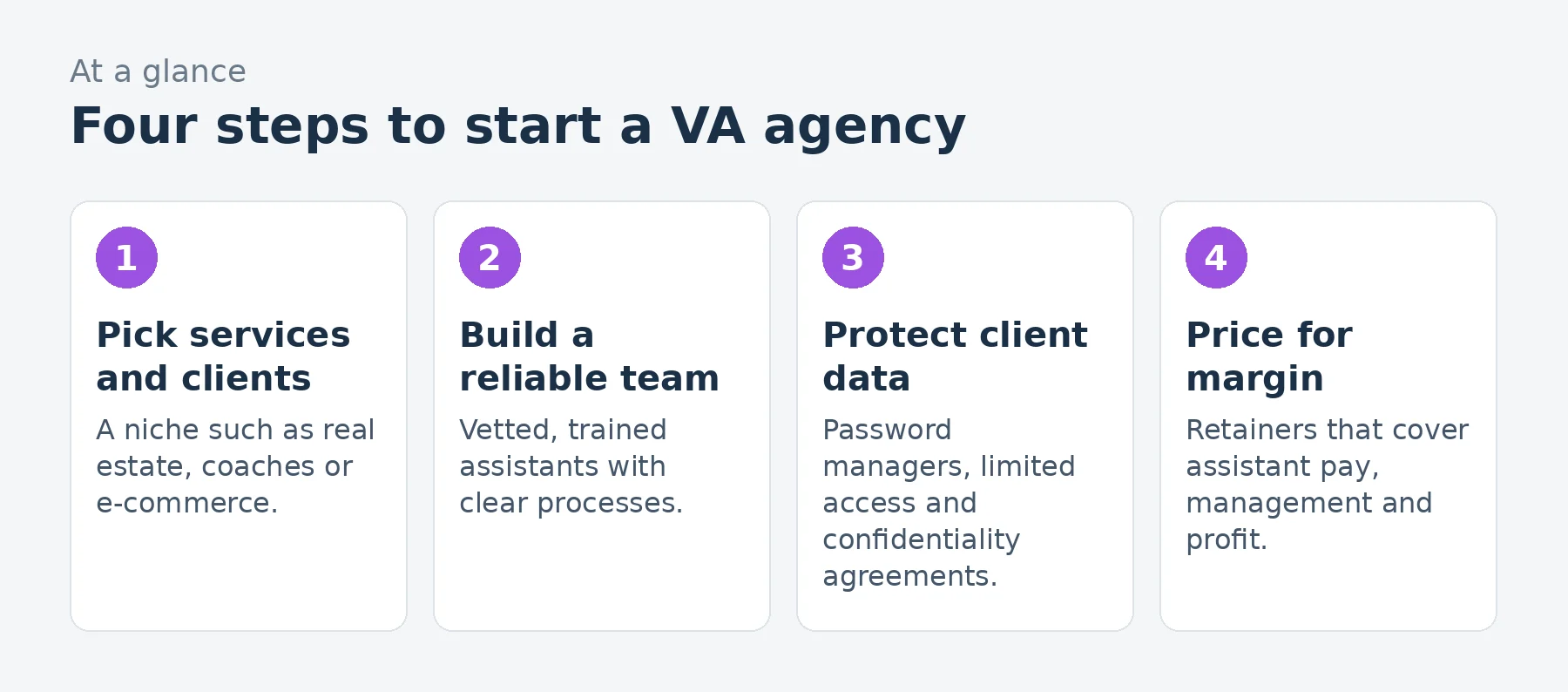
Most agencies sell monthly retainers or prepaid hour packages at a rate that covers assistant pay, management, tools, unbilled time and profit. Specialized skills (bookkeeping support, marketing, executive assistance) command higher rates. Decide how unused hours are handled. Use our pricing calculator.
A worked example: a small agency
These are illustrative assumptions for a small agency with eight assistants, not predictions.
| Assumption | Monthly | |
|---|---|---|
| Client retainers | 20 clients averaging 40 hours a month at $38 | $30,400 |
| Revenue | $30,400 | |
| Assistant pay | 800 hours at $22 | $(17,600) |
| Team lead and quality control | Part-time | $(2,500) |
| Software | Project management, time tracking, password manager | $(400) |
| Recruiting and training | $(500) | |
| Insurance | Professional and cyber liability | $(250) |
| Marketing and sales | $(1,200) | |
| Profit before owner pay and taxes | $7,950 |
That leaves about $7,950 a month before the owner’s pay and taxes, on about $30,400 of revenue. The gap between client rates and assistant pay funds management and profit, so keeping assistants productive and clients satisfied protects the margin.
Loading the calculator…
Onboarding clients
- Discovery call: tasks, tools, priorities and working hours.
- Match the client with an assistant and backup.
- Set up secure access and communication channels.
- Document recurring tasks in a client playbook.
- Check in weekly at first, then monthly.
Quality and retention
Clients leave when quality slips or communication breaks down. Use checklists for recurring tasks, review work regularly, track response times and hold monthly reviews. Keep assistants motivated with fair pay, recognition and growth opportunities; turnover is costly for both clients and the agency.
Finding clients
- Your network and past employers.
- Niche communities such as real estate, coaching or e-commerce groups.
- Referrals from satisfied clients.
- Partnerships with bookkeepers, marketing agencies and business coaches.
- Content showing how delegation saves time.
Time zones and coverage
Clients expect help during their business hours. Match assistants to clients’ time zones, define response times for urgent requests and arrange backup coverage for holidays and sick days. Reliable coverage is a key reason clients choose an agency over a solo VA.
Communication standards
Set standards for how assistants report progress, ask questions and flag problems, such as daily updates or a shared task board. Clear communication prevents misunderstandings and makes clients feel in control.
Specialized VA roles
Specialized assistants, such as transaction coordinators for real estate, podcast production assistants, e-commerce operations assistants or executive assistants, command higher rates than general administrative help. Train for specialties your target clients need.
Scaling the agency
As you grow, add team leads, standardize onboarding and quality reviews and build a bench of trained assistants ready for new clients. Track utilization, client satisfaction and assistant retention monthly.
Client playbooks
Document each client’s recurring tasks, preferences, tools, contacts and approval rules in a playbook. Playbooks make onboarding faster, keep quality consistent and let backup assistants step in without disruption.
Pricing tiers
Offer simple tiers, such as part-time, half-time and dedicated assistant packages, with clear monthly hours and rates. Tiers make buying easy and help forecast assistant capacity.
Common mistakes to avoid
- Sharing passwords insecurely.
- Misclassifying assistants.
- Pricing too close to assistant pay.
- No backup coverage when assistants are away.
- Taking every type of task instead of a clear niche.
Your first 90 days
- Days 1-30: choose a niche, define services and pricing and set up tools and contracts.
- Days 31-60: recruit and test two or three assistants, and sign first clients.
- Days 61-90: document playbooks, add a team lead role and ask clients for referrals.
Frequently asked questions
How much does it cost to start a VA agency?
Usually little: software, contracts, insurance and marketing. Assistants are paid as client work comes in.
Should my assistants be contractors or employees?
It depends on how you control their work; follow Department of Labor and state classification rules.
How do VA agencies price services?
Monthly retainers or prepaid hour packages priced above assistant pay to cover management and profit.
How do I keep client accounts secure?
Use a password manager, two-factor authentication, separate accounts and remove access when assignments end.
Can I hire assistants from other countries?
Many agencies do, with appropriate contracts, payments, time zone planning and client disclosure.
What tasks do clients delegate most?
Email and calendar management, customer service, scheduling, data entry and social media support.
How many clients can one virtual assistant handle?
It depends on hours; many assistants serve two to five clients, while some work full time for one.
Do VA agencies need insurance?
Professional and cyber liability insurance help protect against errors and data incidents.
What is the difference between a freelance VA and an agency?
An agency manages a team, provides backup coverage and quality control, while freelancers work individually.
How do VA agencies find assistants?
Through job boards, referrals from current assistants and paid trial tasks to test skills and reliability.
What tools do VA agencies use?
Project management, time tracking, password managers, communication apps and secure file sharing.
How should unused retainer hours be handled?
Decide in advance, such as limited rollover or no rollover, and state it clearly in the client agreement.
Can I start a VA agency as a solo VA?
Yes. Many agency owners start as solo assistants, then add team members as client demand grows.
Do I need a contract for every client?
Yes, covering services, hours, pricing, confidentiality, data handling and termination.
Keep learning
- Virtual assistants industry data
- How to start a staffing agency
- How to start a bookkeeping business
- Pricing calculator
Sources
- US Bureau of Labor Statistics, Secretaries and administrative assistants
- U.S. Department of Labor, Employee or independent contractor classification
- FTC, Protecting personal information: a guide for business
- U.S. Department of Labor, Fair Labor Standards Act
Last reviewed November 3, 2026. Startup costs are estimates; check local prices, licensing and tax rules before you commit money.

