
Small business owners, executives, coaches and real estate agents need help with email, scheduling, bookkeeping support, customer service, social media and countless other tasks, but many don’t need a full-time employee. Virtual assistants fill that gap remotely, often on monthly retainers. Secretaries and administrative assistants earned a median of about $46,290, according to BLS figures as reported by a data aggregator, while traditional in-office assistant jobs are projected to decline slightly as work shifts to software, remote support and specialized services.
The most successful VAs specialize: real estate transaction support, podcast production, e-commerce operations, medical office admin or bookkeeping. Specialization supports higher rates and steadier clients.
The workforce
| Occupation | Jobs (2024) | Median pay (May 2024) | Projected growth, 2024 to 2034 |
|---|---|---|---|
| Secretaries and administrative assistants (figures as reported) | n/a | $46,290 | -1.6% |
Source: U.S. Bureau of Labor Statistics, Occupational Outlook Handbook and Occupational Employment and Wage Statistics.
Business models compared
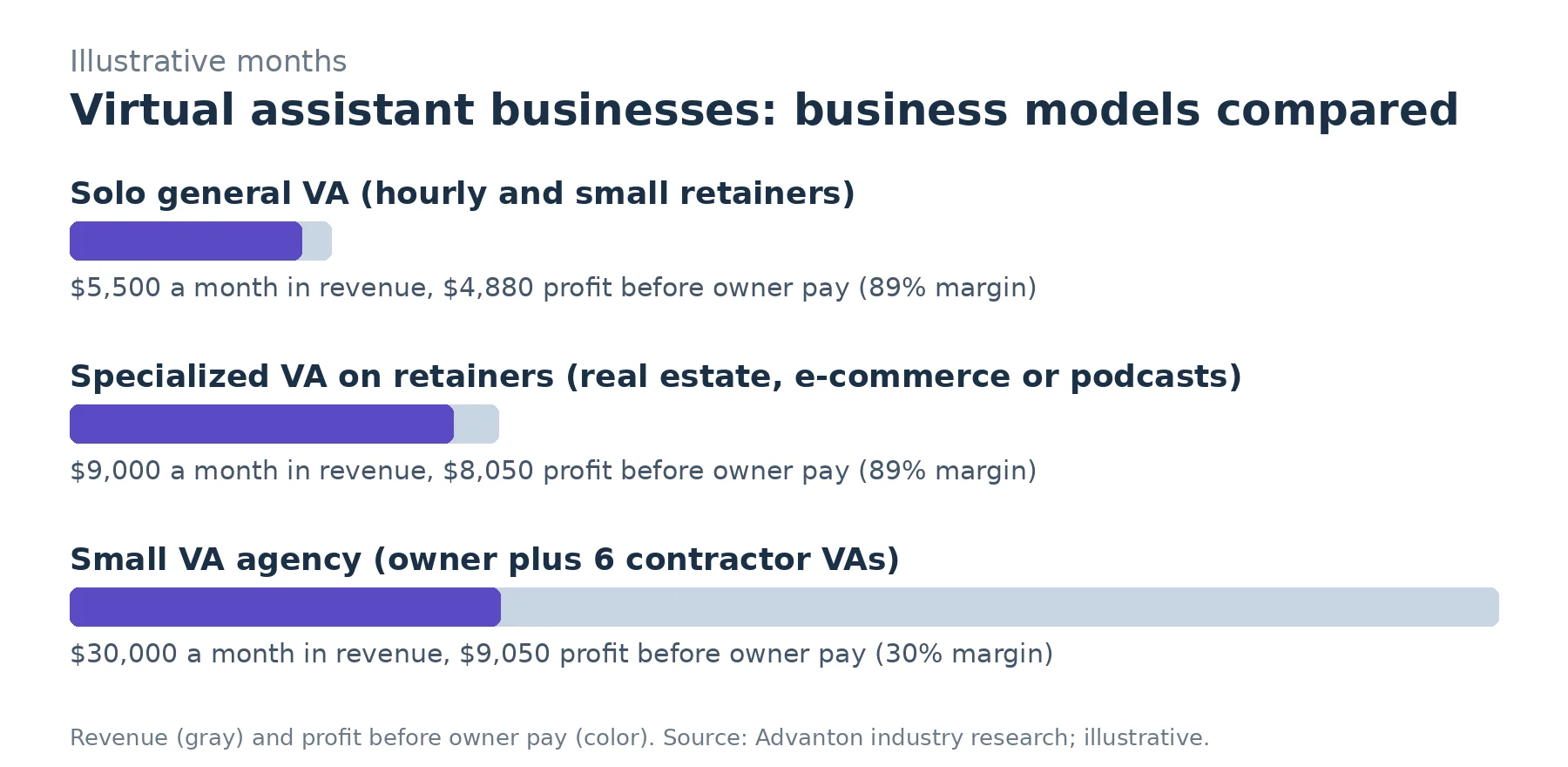
The figures below are illustrative months from our research, not industry averages. They show how revenue and costs typically fit together; your market, prices and costs will differ.
| Business model | Startup costs | Example monthly revenue | Costs | Profit before owner pay | Margin |
|---|---|---|---|---|---|
| Solo general VA (hourly and small retainers) | Low: computer, software, website | $5,500 | $620 | $4,880 | 89% |
| Specialized VA on retainers (real estate, e-commerce or podcasts) | Low: software, training in the niche, website | $9,000 | $950 | $8,050 | 89% |
| Small VA agency (owner plus 6 contractor VAs) | Low to moderate: systems, contracts, recruiting, sales | $30,000 | $20,950 | $9,050 | 30% |
Fixed and variable costs
For projections, the most useful split is between variable costs, which rise and fall with sales (materials, supplies, hourly labor, fees), and fixed costs, which you pay every month regardless (rent, salaried staff, insurance, loan payments).
| Business model | Variable costs (% of revenue) | Fixed costs per month | What it means |
|---|---|---|---|
| Solo general VA (hourly and small retainers) | 3.1% | $450 | Mostly fixed: needs steady volume to cover overhead |
| Specialized VA on retainers (real estate, e-commerce or podcasts) | 3.0% | $680 | Mostly fixed: needs steady volume to cover overhead |
| Small VA agency (owner plus 6 contractor VAs) | 59.7% | $3,050 | Mostly variable: profitable early, but watch cash flow |
What the numbers say
Solo VAs have very low overhead, so most revenue becomes income, but hours are the limit.
Specialized retainers raise rates and keep schedules predictable.
Agencies scale beyond the owner’s hours, with VA pay as the main cost and sales and quality control as the owner’s job.
The three models in brief
Solo general VA. Email, scheduling, data entry and customer support for several clients.
Specialized VA. Deep expertise in one niche, such as real estate transactions, e-commerce operations or podcast production. See real estate services data.
Small VA agency. An owner who sells, manages quality and matches clients with contractor VAs. See staffing and recruiting data.
Cost structure: specialized VA on retainers (real estate, e-commerce or podcasts)
Each cost as a share of the example month’s revenue ($9,000):
| Cost | Monthly amount | Share of revenue | Type |
|---|---|---|---|
| Payment processing | $270 | 3.0% | Variable |
| Software subscriptions | $250 | 2.8% | Fixed |
| Marketing | $250 | 2.8% | Fixed |
| Niche training | $100 | 1.1% | Fixed |
| Insurance | $50 | 0.6% | Fixed |
| Website | $30 | 0.3% | Fixed |
| Profit before owner pay | $8,050 | 89% |
A first-year projection: specialized VA on retainers (real estate, e-commerce or podcasts)
New businesses rarely start at full speed. This projection assumes revenue ramps from 35% of the example month in month 1 to 100% by month 12, variable costs move with revenue, and fixed costs stay the same every month. It’s a planning illustration, not a forecast.
| Month | Revenue | Variable costs | Fixed costs | Profit | Cumulative |
|---|---|---|---|---|---|
| 1 | $3,150 | $94 | $680 | $2,376 | $2,376 |
| 2 | $4,050 | $122 | $680 | $3,248 | $5,624 |
| 3 | $4,950 | $148 | $680 | $4,122 | $9,746 |
| 4 | $5,580 | $167 | $680 | $4,733 | $14,479 |
| 5 | $6,300 | $189 | $680 | $5,431 | $19,910 |
| 6 | $6,840 | $205 | $680 | $5,955 | $25,865 |
| 7 | $7,380 | $221 | $680 | $6,479 | $32,344 |
| 8 | $7,830 | $235 | $680 | $6,915 | $39,259 |
| 9 | $8,190 | $246 | $680 | $7,264 | $46,523 |
| 10 | $8,550 | $256 | $680 | $7,614 | $54,137 |
| 11 | $8,820 | $265 | $680 | $7,875 | $62,012 |
| 12 | $9,000 | $270 | $680 | $8,050 | $70,062 |
Year one: revenue $80,640, profit before owner pay $70,062. The first profitable month is month 1. Cumulative results stay positive from the start, before any startup costs.
Contractor VAs are paid only for client hours, so costs rise and fall with revenue and this agency illustration is profitable from month 1. The real constraints are winning retainer clients and keeping quality consistent as the team grows.
How virtual assistants earn
- Hourly billing for flexible tasks.
- Monthly retainers for a set number of hours or services.
- Packages for specific outcomes, such as inbox management or listing coordination.
- Project fees for setup work such as CRM migrations.
- Agency margins on contractor VAs.
Choosing a niche
Specialists earn more than generalists because they solve specific problems faster. Pick a niche that matches your experience (real estate, healthcare admin, e-commerce, bookkeeping support, social media or executive support), then learn its tools and terminology deeply.
Retainers create stability
Monthly retainers with clear hours, response times and rollover rules make income predictable and help clients rely on you. Review retainers quarterly and adjust as needs grow.
A startup checklist
- Register the business and open a business bank account.
- Write a service agreement with scope, confidentiality and payment terms.
- Set up secure systems: password manager, two-factor authentication and encrypted file sharing.
- Choose time tracking and invoicing tools.
- Build a simple website and LinkedIn profile.
Data privacy and trust
VAs often access email, finances and customer records. Use separate logins rather than shared passwords, follow clients’ security rules, sign confidentiality agreements and, for health clients, business associate agreements. Trust is your product.
Where the opportunities are
- Real estate transaction coordination.
- E-commerce operations and customer service.
- Podcast and content production.
- Bookkeeping and invoicing support.
- Executive and founder support.
Key terms
| Term | Meaning |
|---|---|
| Retainer | A monthly agreement for set hours or services |
| Scope creep | Work expanding beyond what was agreed |
| SOP | Standard operating procedure documenting a task |
| Business associate agreement | A HIPAA contract for handling health information |
Taxes for independent VAs
Independent VAs generally pay self-employment tax and make quarterly estimated payments. Track business expenses, set aside a share of each payment for taxes and talk to a tax professional. See tax preparation data.
Key numbers to track
Track effective hourly rate, retainer revenue share, client retention, hours by client and time spent on unbillable tasks.
Common mistakes
- Underpricing to win first clients.
- No written contracts or scope.
- Shared passwords and weak security.
- Too many small clients with constant context switching.
- No niche.
Marketing a VA business
LinkedIn, referrals from happy clients, niche communities, partnerships with business coaches and accountants, and a clear website with packages bring clients. See directory listings for professional services.
Growing into an agency
Agencies grow by documenting processes, recruiting reliable VAs, managing quality and handling sales. Classify workers correctly, protect client data across the team and keep the owner focused on clients and systems.
Tools of the trade
Project management tools, shared calendars, password managers, communication apps and time tracking keep work organized and transparent. Learn the tools your niche uses, such as transaction management software for real estate or store platforms for e-commerce.
Setting boundaries
Clear working hours, response times and communication channels prevent burnout and keep expectations realistic. Put them in your agreement and stick to them.
AI and automation
Automation tools handle routine tasks faster, which shifts VA value toward judgment, communication, coordination and setting up systems. VAs who use automation well can serve more clients and charge for outcomes rather than hours.
Test these numbers with your own plan
Open this industry in our free Business Idea Reality Check to start from any model above, change prices, costs, startup budget and your own pay, and see your break-even month, the cash you’d need, three scenarios and how new businesses in this sector survive in your state.
- Start with the closest model and its cost structure.
- Replace every price and cost with local quotes.
- Estimate your ramp: how fast customers will realistically come in year one.
- Map cash month by month with the free Cash & Payroll Planner.
- Build the full plan in the free Business Planner.
About this data
Workforce figures come from the U.S. Bureau of Labor Statistics (Occupational Outlook Handbook and Occupational Employment and Wage Statistics, May 2024 wages and the 2024 to 2034 projections, unless noted). Market figures cite their sources above. Business model figures are illustrative months built from typical prices and costs to show how revenue, fixed costs and variable costs fit together; they are not industry averages or guarantees. We review these profiles when new government data is released, at least once a year, and the same figures power the Business Idea Reality Check.
Licensing and rules
Register the business and follow local rules; use written contracts covering scope, confidentiality, data handling and payment; when handling client data, follow applicable privacy and security rules (including HIPAA business associate agreements for health clients and safeguards for financial information); independent contractors pay self-employment tax and estimated taxes, and agencies must classify workers correctly as employees or contractors under legal tests. Requirements change; confirm with your state and local agencies before you start.
Frequently asked questions
How much do virtual assistants charge?
Rates vary by niche and experience; specialists and retainers usually earn more than general hourly work.
Do virtual assistants need a license?
Usually just business registration, plus contracts and privacy safeguards.
Is the virtual assistant market growing?
Demand for remote, specialized support is strong even as traditional in-office assistant jobs decline slightly.
What niches pay best?
Specialized niches such as real estate coordination, e-commerce operations and executive support often command higher rates.
How do VAs find clients?
LinkedIn, referrals, niche communities and partnerships.
Should I start an agency?
Once you have more demand than hours, documented processes and a reliable team.
How can I test these numbers?
Open virtual assistants in the Business Idea Reality Check and enter your own rates and costs.
Keep learning
- Online courses and coaching data
- Staffing and recruiting data
- Tax preparation industry data
- Business Idea Reality Check
Sources
Last reviewed November 1, 2026. Startup costs are estimates; check local prices, licensing and tax rules before you commit money.

