
Millions of individuals and small businesses pay someone to prepare their taxes every year, and many stay with the same preparer for decades. Tax preparation can be started with modest costs, but it is highly seasonal and carries serious responsibilities for accuracy and data security. Tax preparers earned a median of about $50,560 in May 2024, with about 5% projected growth and about 10,400 openings a year from 2024 to 2034, according to BLS data as reported via O*NET and data aggregators; accountants earned a median of $81,680.
Practices range from seasonal solo preparers to year-round tax and bookkeeping offices and franchise locations. Year-round services such as bookkeeping, payroll and tax planning turn a seasonal business into a steady one.
The workforce
| Occupation | Jobs (2024) | Median pay (May 2024) | Projected growth, 2024 to 2034 |
|---|---|---|---|
| Tax preparers (figures as reported) | n/a | $50,560 | +5% |
| Accountants and auditors (as reported) | n/a | $81,680 | n/a |
Source: U.S. Bureau of Labor Statistics, Occupational Outlook Handbook and Occupational Employment and Wage Statistics.
Market data
| Measure | Value |
|---|---|
| Projected tax preparer openings each year (as reported) | about 10,400 |
Business models compared
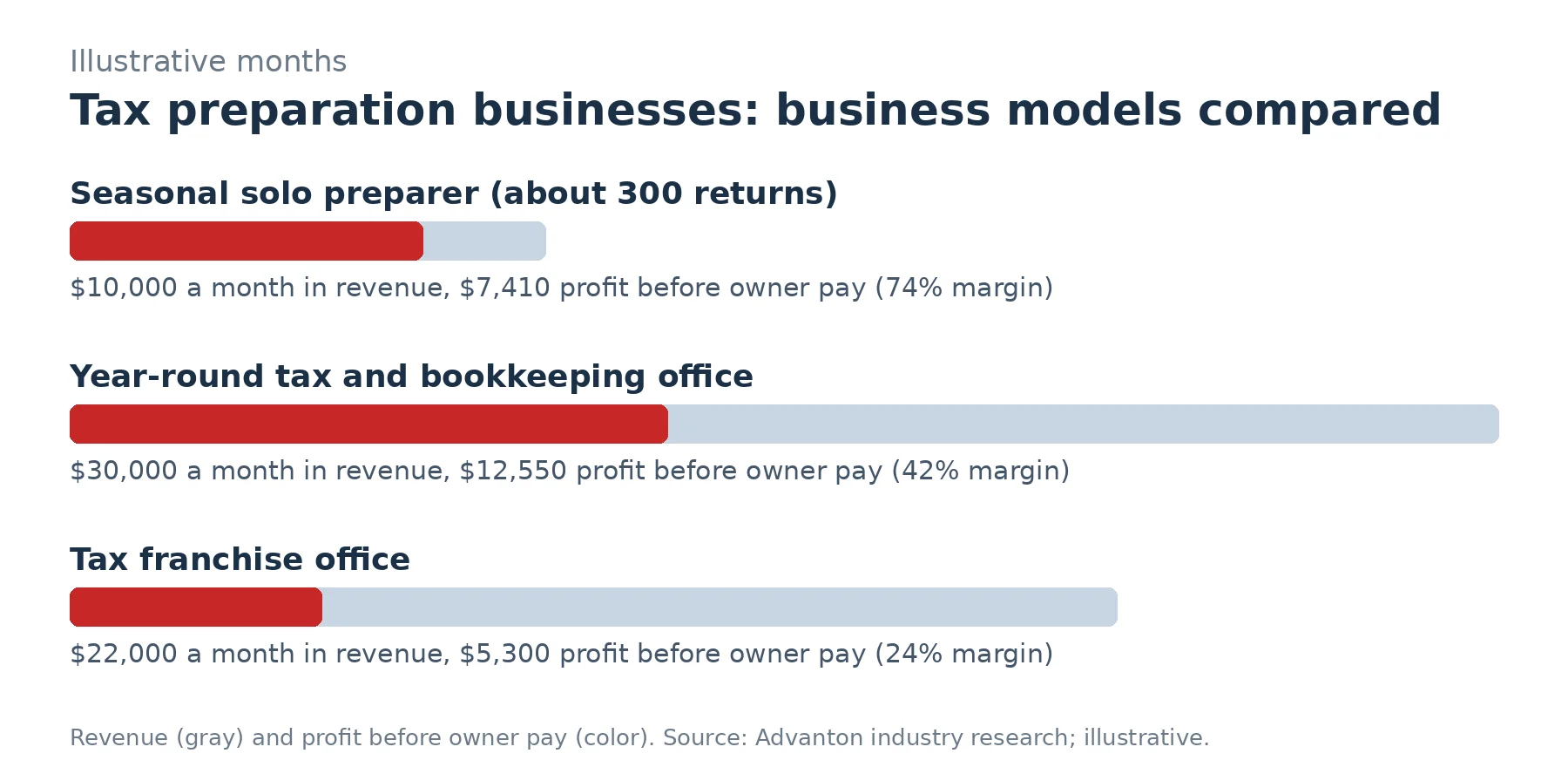
The figures below are illustrative months from our research, not industry averages. They show how revenue and costs typically fit together; your market, prices and costs will differ.
| Business model | Startup costs | Example monthly revenue | Costs | Profit before owner pay | Margin |
|---|---|---|---|---|---|
| Seasonal solo preparer (about 300 returns) | Low: software, PTIN, EFIN, insurance, secure systems | $10,000 | $2,590 | $7,410 | 74% |
| Year-round tax and bookkeeping office | Moderate: office, staff, software, security | $30,000 | $17,450 | $12,550 | 42% |
| Tax franchise office | Moderate: franchise fee, office, seasonal staff, royalties | $22,000 | $16,700 | $5,300 | 24% |
Fixed and variable costs
For projections, the most useful split is between variable costs, which rise and fall with sales (materials, supplies, hourly labor, fees), and fixed costs, which you pay every month regardless (rent, salaried staff, insurance, loan payments).
| Business model | Variable costs (% of revenue) | Fixed costs per month | What it means |
|---|---|---|---|
| Seasonal solo preparer (about 300 returns) | 14.0% | $1,190 | Mostly fixed: needs steady volume to cover overhead |
| Year-round tax and bookkeeping office | 10.0% | $14,450 | Mostly fixed: needs steady volume to cover overhead |
| Tax franchise office | 49.1% | $5,900 | Balanced: margins improve as volume grows |
What the numbers say
Solo seasonal preparers have very low overhead, but revenue concentrates in a few months.
Year-round offices add bookkeeping and payroll, smoothing revenue but adding staff and rent.
Franchises provide brand, software and training in exchange for royalties.
The three models in brief
Seasonal solo preparer. Individual returns from January to April, often from a home office or shared space. See accounting and bookkeeping data.
Year-round tax and bookkeeping office. Tax returns plus bookkeeping, payroll and planning for small businesses.
Tax franchise office. A branded location with franchisor software, training and marketing. See franchises.
Cost structure: year-round tax and bookkeeping office
Each cost as a share of the example month’s revenue ($30,000):
| Cost | Monthly amount | Share of revenue | Type |
|---|---|---|---|
| Staff | $9,000 | 30.0% | Fixed |
| Software per-return and payroll fees | $2,400 | 8.0% | Variable |
| Rent | $2,200 | 7.3% | Fixed |
| Marketing | $1,000 | 3.3% | Fixed |
| Payroll taxes | $900 | 3.0% | Fixed |
| Software and cloud tools | $700 | 2.3% | Fixed |
| Card fees | $600 | 2.0% | Variable |
| Data security and IT | $300 | 1.0% | Fixed |
| Insurance | $200 | 0.7% | Fixed |
| Continuing education | $150 | 0.5% | Fixed |
| Profit before owner pay | $12,550 | 42% |
A first-year projection: year-round tax and bookkeeping office
New businesses rarely start at full speed. This projection assumes revenue ramps from 35% of the example month in month 1 to 100% by month 12, variable costs move with revenue, and fixed costs stay the same every month. It’s a planning illustration, not a forecast.
| Month | Revenue | Variable costs | Fixed costs | Profit | Cumulative |
|---|---|---|---|---|---|
| 1 | $10,500 | $1,050 | $14,450 | -$5,000 | -$5,000 |
| 2 | $13,500 | $1,350 | $14,450 | -$2,300 | -$7,300 |
| 3 | $16,500 | $1,650 | $14,450 | $400 | -$6,900 |
| 4 | $18,600 | $1,860 | $14,450 | $2,290 | -$4,610 |
| 5 | $21,000 | $2,100 | $14,450 | $4,450 | -$160 |
| 6 | $22,800 | $2,280 | $14,450 | $6,070 | $5,910 |
| 7 | $24,600 | $2,460 | $14,450 | $7,690 | $13,600 |
| 8 | $26,100 | $2,610 | $14,450 | $9,040 | $22,640 |
| 9 | $27,300 | $2,730 | $14,450 | $10,120 | $32,760 |
| 10 | $28,500 | $2,850 | $14,450 | $11,200 | $43,960 |
| 11 | $29,400 | $2,940 | $14,450 | $12,010 | $55,970 |
| 12 | $30,000 | $3,000 | $14,450 | $12,550 | $68,520 |
Year one: revenue $268,800, profit before owner pay $68,520. The first profitable month is month 3. Cumulative results bottom out at -$7,300, which is the minimum cash cushion this plan would need, before any startup costs.
Staff and rent run all year while tax revenue clusters in spring, so this year-round office illustration turns profitable in month 3, with a cumulative low of about $7,300. Real tax businesses swing much more by season than this smooth ramp shows.
How tax preparers earn
- Per-return fees by complexity and forms.
- Business returns for sole proprietors, partnerships and corporations.
- Bookkeeping and payroll year-round.
- Tax planning and amended returns.
- IRS notice and representation work for credentialed practitioners.
Credentials and representation
Anyone with a PTIN can prepare returns for pay, but representation rights before the IRS depend on credentials. Enrolled agents (who pass an IRS exam), CPAs and attorneys can represent clients generally; preparers in the IRS Annual Filing Season Program have limited representation rights for returns they prepared. Credentials increase trust and allow higher-value services.
Data security is mandatory
Tax preparers hold Social Security numbers, bank details and income records, which makes them targets for identity thieves. Use multi-factor authentication, encrypted file sharing, secure client portals and strong passwords, train staff, and keep a written information security plan as federal rules require.
A startup checklist for tax preparation businesses
- Get a PTIN and apply for an EFIN.
- Check state requirements for preparer registration or licensing.
- Choose professional tax software and secure client portals.
- Write an information security plan and train staff.
- Carry errors and omissions insurance.
Seasonality and year-round revenue
Most individual returns arrive between late January and April, with extensions in the fall. Bookkeeping, payroll, quarterly estimates, tax planning and business clients turn a seasonal practice into a year-round business.
Due diligence and accuracy
Returns claiming the earned income tax credit, child tax credit and certain other credits carry due diligence requirements, with penalties for failures. Interview clients carefully, keep documentation and never guess. Accuracy protects clients and your PTIN.
Where the opportunities are
- Small business and self-employed clients.
- Bilingual services.
- Gig workers and side businesses.
- Multi-state and rental property returns.
- IRS notice resolution for credentialed preparers.
Key terms
| Term | Meaning |
|---|---|
| PTIN | IRS number required for paid preparers |
| EFIN | IRS number allowing electronic filing |
| Enrolled agent | A federally credentialed tax practitioner who can represent clients |
| WISP | Written information security plan |
Pricing your services
Many preparers price by forms and complexity rather than a flat fee. Publish starting prices, quote complex returns after reviewing documents, and avoid fees tied to refund amounts, which professional standards discourage.
Key numbers to track
Track returns per season, average fee, client retention, year-round revenue share, rejections and time per return.
Common mistakes
- Weak data security.
- Skipping due diligence on credit claims.
- Underpricing complex returns.
- Ignoring state registration rules.
- No year-round services.
Marketing a tax practice
Referrals, Google Business Profile, reviews, community workshops and partnerships with real estate agents, financial planners and small business groups bring clients. See directory listings for professional services.
Client retention
Most tax clients return if they trust you. Send reminders before the season, make document collection easy with secure portals, and explain results clearly. Loyal clients refer family and friends.
Avoiding risky practices
Never promise bigger refunds than competitors, base fees on refund size or file returns without proper documents. Aggressive preparers attract IRS scrutiny, penalties and loss of e-file privileges.
Test these numbers with your own plan
Open this industry in our free Business Idea Reality Check to start from any model above, change prices, costs, startup budget and your own pay, and see your break-even month, the cash you’d need, three scenarios and how new businesses in this sector survive in your state.
- Start with the closest model and its cost structure.
- Replace every price and cost with local quotes.
- Estimate your ramp: how fast customers will realistically come in year one.
- Map cash month by month with the free Cash & Payroll Planner.
- Build the full plan in the free Business Planner.
About this data
Workforce figures come from the U.S. Bureau of Labor Statistics (Occupational Outlook Handbook and Occupational Employment and Wage Statistics, May 2024 wages and the 2024 to 2034 projections, unless noted). Market figures cite their sources above. Business model figures are illustrative months built from typical prices and costs to show how revenue, fixed costs and variable costs fit together; they are not industry averages or guarantees. We review these profiles when new government data is released, at least once a year, and the same figures power the Business Idea Reality Check.
Licensing and rules
Every paid federal tax return preparer must have an IRS Preparer Tax Identification Number (PTIN), renewed annually; electronic filing requires an IRS e-file application and Electronic Filing Identification Number (EFIN), and preparers who file 11 or more individual returns a year generally must e-file; due diligence rules apply to returns claiming the earned income tax credit and certain other credits; tax preparers are covered by the FTC Safeguards Rule and IRS guidance calling for a written information security plan; California, Oregon, Maryland, New York and some other states have their own preparer registration or licensing requirements. Requirements change; confirm with your state and local agencies before you start.
Frequently asked questions about tax preparation businesses
Do I need a license to prepare taxes?
You need an IRS PTIN; some states, including California, Oregon, Maryland and New York, have additional requirements.
What is an EFIN?
An Electronic Filing Identification Number that lets preparers e-file returns.
How much do tax preparers earn?
About a $50,560 median in May 2024 (BLS, as reported); practice owners’ income varies widely.
Is tax preparation seasonal?
Yes; year-round services such as bookkeeping and payroll help smooth revenue.
Do tax preparers need a security plan?
Yes; federal rules require safeguards, including a written information security plan.
Can tax preparers represent clients before the IRS?
Full representation requires credentials such as enrolled agent, CPA or attorney.
How can I test these numbers?
Open tax preparation in the Business Idea Reality Check and enter your own fees and costs.
Keep learning
- Accounting and bookkeeping data
- Financial planning data
- Directory listings for professional services
- Business Idea Reality Check
Sources
- Tax preparers median wage and projections (BLS OEWS and Employment Projections, as reported via O*NET and data aggregators)
- Internal Revenue Service, Paid tax return preparers and PTIN requirements
Last reviewed November 1, 2026. Startup costs are estimates; check local prices, licensing and tax rules before you commit money.
In India
In India: Income tax return and GST filing services.
Small businesses like this in India
In MoSPI’s survey of unincorporated businesses (proprietorships, partnerships and similar firms), this falls under Professional, scientific and technical services. In 2023-24 India had 6.9 lakh such establishments employing 14.3 lakh workers, and 67.2% were run without hired workers. Across the wider other services group, the number of establishments grew 10.29% between 2023-24 and 2025.
| Urban | Rural | All India | |
|---|---|---|---|
| Value added per business a year | ₹5,92,712 | ₹2,37,366 | ₹5,07,055 |
| Value added per worker a year | ₹2,63,104 | ₹1,67,511 | ₹2,47,186 |
| Pay per hired worker a year | ₹1,87,936 | ₹1,04,059 | ₹1,82,391 |
Running it alone or with staff: businesses with no hired workers added about ₹2,50,602 a year on average, while those with hired workers added about ₹10,44,736 (all India).
Where these businesses are: the states with the most small other services businesses are West Bengal (13.1%), Uttar Pradesh (11.6%), Maharashtra (8.8%), Tamil Nadu (6.2%), Gujarat (6.0%) of the national total (2023-24).
Value added is what a business produces minus what it spends on materials and other inputs, before paying its workers and owner, so it’s a rough guide to the income a typical small business generates. These figures cover the whole activity, which can be broader than this one business type. Across all small businesses, average fixed assets such as equipment, furniture and vehicles were ₹3,42,242 per establishment in 2025.
Licences and registrations to expect
- Registration with the body that regulates your profession, where the law requires it: for example the ICAI for chartered accountants, the Bar Council for advocates, the Council of Architecture to use the title “architect”, your state RERA for real estate agents, IRDAI for insurance agents and SEBI for investment advisers.
- Registration under your state’s Shops and Establishments Act if you have premises or employees.
- A trade licence from your municipal corporation or council for many shop and service businesses.
- GST registration once turnover crosses ₹40 lakh for goods or ₹20 lakh for services (lower in some special category states), or earlier if you sell goods to other states or through e-commerce marketplaces.
- Professional tax registration in states that levy it.
- Free Udyam (MSME) registration, which helps with loans, government schemes and delayed-payment protection.
Rules differ by state and city. Check with your municipal corporation, state departments and a chartered accountant before you start.
Run a business like this in India? List it free in the India Business Directory, with your hours, deals and GST registration.
Free tools for India: Make a GST invoice · Compare business credit cards
Build a market report for Tax Preparation Businesses in India Pick your state and see market size, earnings, competition and licences, from official data. Free, with a PDF download.
Sources: MoSPI, Annual Survey of Unincorporated Sector Enterprises (ASUSE) 2023-24, full report, Appendix A Tables 4, 29, 33, 35 and 37 (survey period October 2023 to September 2024); MoSPI, Annual Survey of Unincorporated Sector Enterprises (ASUSE) 2025, factsheet (survey period January to December 2025, released 24 March 2026). Licensing summary by Advanton, checked November 2026.