
A Medicare insurance agency helps people who are turning 65, or otherwise eligible for Medicare, choose coverage: Medicare Advantage plans, Medicare Supplement (Medigap) policies and Part D prescription drug plans. About 11,000 Americans turn 65 every day, and many find Medicare choices confusing, so trusted local agents are in demand.
Medicare sales are tightly regulated by CMS (the Centers for Medicare and Medicaid Services) and state insurance departments. Rules cover how you may contact people, what you must say, how appointments are documented, how calls are recorded and how much agents may be paid. The Bureau of Labor Statistics reports a median pay of $60,370 for insurance sales agents (May 2024). This guide covers licensing, carriers, CMS rules, enrollment periods, products, commissions, a worked example and a 90-day plan.
A Medicare insurance agency at a glance
Table of Contents
| Topic | What to expect |
|---|---|
| Startup cost | Low: licensing, E&O insurance, annual certifications, a CRM with call recording, a website and community marketing |
| Licensing | State life and health license, carrier appointments and nonresident licenses for other states |
| Key CMS rules | No unsolicited contact, scope of appointment documentation (generally 48 hours before a meeting), required disclaimers and recording of certain calls |
| How you earn | Carrier commissions on new enrollments and renewals, with Medicare Advantage and Part D pay limited by CMS |
| Best for | Patient, trustworthy advisors who explain clearly and enjoy helping seniors |
Who a Medicare agency suits
It suits patient, empathetic people who enjoy explaining complicated choices, are comfortable with strict rules and paperwork and want to build long-term relationships in their community.
Licensing
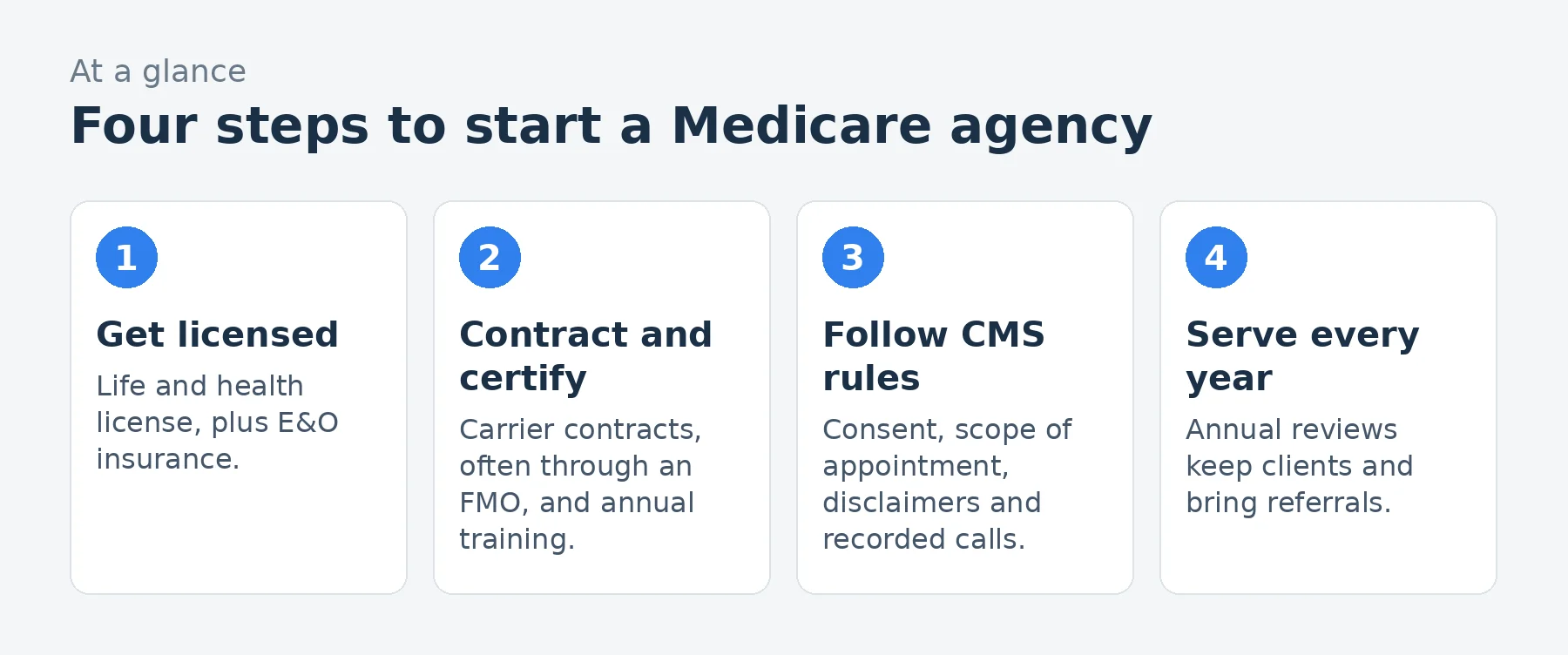
You need a state life and health (accident and health) insurance license, which typically involves pre-licensing education in many states, a state exam, a background check and fingerprints, plus continuing education. To help clients in other states, apply for nonresident licenses. Carry errors and omissions insurance, which carriers generally require.
Carriers and field marketing organizations
To sell plans, you need appointments (contracts) with insurance carriers. Many independent Medicare agents contract through a field marketing organization (FMO), which provides access to multiple carriers, training, quoting tools and support. Compare FMOs on carrier lineup, technology, compliance support and contract terms.
Annual certification
Before each selling season, agents must complete required annual training and carrier certifications for Medicare Advantage and Part D, commonly including an industry-standard Medicare training course plus each carrier’s product training. Missing certification means you cannot sell that carrier’s plans for the year.
CMS marketing rules
- No unsolicited contact: door-to-door visits, cold calls and unsolicited texts or emails to sell Medicare plans are prohibited; contact must be initiated by or permitted by the beneficiary.
- Scope of appointment: document the products to be discussed before a sales meeting, generally at least 48 hours in advance, with limited exceptions such as walk-ins and the end of enrollment periods.
- Required disclaimers: third-party marketing organizations must use CMS’s required disclaimer about the plans and organizations they represent.
- Call recording: certain sales and enrollment calls must be recorded and kept.
- Events and materials: marketing and educational events, advertising and websites must follow CMS content and filing rules.
CMS updates its Medicare Communications and Marketing Guidelines regularly, so review the current version before each season.
Enrollment periods
- Initial Enrollment Period: the seven-month window around a person’s 65th birthday month.
- Annual Enrollment Period (AEP): October 15 to December 7, when Medicare Advantage and Part D enrollees can change plans.
- Medicare Advantage Open Enrollment Period: January 1 to March 31, with more limited changes.
- Special Enrollment Periods after qualifying events, such as moving or losing coverage.
- Medigap open enrollment: a six-month window starting when someone is 65 or older and enrolled in Part B, when insurers generally cannot use medical underwriting.
Medicare Advantage, Medigap and Part D
Medicare Advantage plans replace Original Medicare with private plans that often include drug coverage and extra benefits, usually with provider networks. Medicare Supplement (Medigap) policies work alongside Original Medicare to cover cost-sharing and are regulated mostly by states, with standardized plan letters. Part D plans cover prescription drugs. Explaining these differences clearly, including networks, costs and drug coverage, is the heart of the job.
Commissions and compensation limits
Carriers pay commissions on new enrollments and renewals. For Medicare Advantage and Part D, CMS sets limits on agent and broker compensation and on how it may be structured; Medigap commissions are set by carriers within state rules. Avoid any practice that could look like steering clients for higher pay, and document why each plan fits.
Startup costs to plan for
| Item | What to budget for |
|---|---|
| Licensing | Pre-licensing course, exam, fingerprints, license fees |
| E&O insurance | Required by most carriers |
| Certifications | Annual Medicare training and carrier certifications |
| Technology | CRM, quoting tools, call recording and secure storage |
| Marketing | Compliant website, community events, materials |
| Office | Private space for appointments, or home visits by permission |
Use our startup cost calculator for your total.
A compliant client meeting
- Confirm the client asked to meet, and complete the scope of appointment in advance.
- Use the required disclaimer and explain who you represent.
- Review doctors, prescriptions, budget and health needs.
- Compare suitable plans and explain costs and networks.
- Enroll only with the client’s informed consent, and record calls where required.
- Follow up after enrollment to confirm coverage.
A worked example: a solo agent
These are illustrative assumptions for an established solo agent, averaged monthly across a year, not predictions; commissions depend on carriers, products and CMS limits.
| Assumption | Monthly | |
|---|---|---|
| Medicare Advantage and Part D commissions | New enrollments and renewals, averaged monthly | $6,800 |
| Medicare Supplement commissions | New and renewal policies | $2,900 |
| Ancillary products | Dental, vision and hospital indemnity | $500 |
| Revenue | $10,200 | |
| Seasonal assistant | During enrollment periods, averaged monthly | $(900) |
| CRM, call recording and quoting tools | $(300) | |
| E&O insurance, licenses and certifications | Averaged monthly | $(150) |
| Marketing and community events | $(800) | |
| Profit before owner pay and taxes | $8,050 |
That leaves about $8,050 a month on average before the agent’s pay and taxes, on about $10,200 of revenue. Renewals accumulate as clients stay with their plans, so retention through annual reviews is the engine of the business.
Loading the calculator…
Finding clients compliantly
- Referrals from current clients, the best source by far.
- Educational seminars at libraries and community centers, following CMS event rules.
- Partnerships with financial advisors, accountants and senior organizations.
- People turning 65 who request information through your website.
- Local presence: Google Business Profile and reviews.
Buying leads is common, but you are responsible for making sure leads were generated with proper consent and that follow-up contact follows CMS and telemarketing rules.
Annual reviews
Plans change every year: premiums, drug lists, networks and benefits. Reviewing each client’s coverage before the Annual Enrollment Period shows care, catches problems and keeps clients loyal. Many agents build their business almost entirely on retention and referrals.
Medigap underwriting and timing
Outside the Medigap open enrollment period and certain guaranteed issue rights, insurers in most states can use medical underwriting for Medicare Supplement policies, which can make switching difficult later. Explain this timing clearly to clients choosing between Medicare Advantage and Medigap, since the choice can be hard to reverse.
Complaints and oversight
CMS and state insurance departments track complaints about agents, and carriers monitor enrollment quality and rapid disenrollments. Explain plans carefully, document clients’ choices and respond quickly to concerns. A clean record protects your contracts and reputation.
Common mistakes to avoid
- Cold calling or door-knocking to sell plans.
- Skipping scope of appointment documentation.
- Missing annual certification deadlines.
- Enrolling or switching clients without informed consent.
- Using non-compliant marketing materials.
Your first 90 days
- Days 1-30: complete pre-licensing, pass the life and health exam and apply for your license.
- Days 31-60: choose an FMO, contract with carriers, complete certifications and buy E&O insurance.
- Days 61-90: set up compliant tools and materials, build referral partners and schedule educational events.
Frequently asked questions
What license do I need to sell Medicare plans?
A state life and health insurance license, carrier appointments and annual Medicare certification for Medicare Advantage and Part D plans.
Can Medicare agents make cold calls?
No. CMS prohibits unsolicited contact such as cold calls and door-to-door sales of Medicare plans.
What is a scope of appointment?
Documentation of which products will be discussed, generally completed at least 48 hours before a sales meeting, with limited exceptions.
When is the Annual Enrollment Period?
October 15 to December 7 each year.
How are Medicare agents paid?
Through carrier commissions, with CMS limits on Medicare Advantage and Part D compensation.
What is an FMO?
A field marketing organization that gives agents access to multiple carriers, training and tools.
Can I sell Medicare plans over the phone?
Yes, when the beneficiary initiated contact or gave permission, with required disclaimers and call recording.
Do Medicare clients pay agents?
No. Carriers pay agents commissions, and clients pay the same plan premiums whether or not they use an agent.
Keep learning
- Insurance agencies industry data
- How to start a health insurance brokerage business
- How to start an independent insurance agency
- Startup cost calculator
Sources
- CMS, Medicare Communications and Marketing Guidelines
- CMS, Medicare agent and broker compensation
- Medicare.gov, Medigap (Medicare Supplement Insurance) basics
- US Bureau of Labor Statistics, Insurance sales agents
Last reviewed November 3, 2026. Startup costs are estimates; check local prices, licensing and tax rules before you commit money.

