
A health insurance brokerage helps individuals, families, seniors and employers choose health coverage: plans on the Affordable Care Act Marketplace, Medicare Advantage, Medicare Supplement and prescription drug plans, small group plans for employers and supplemental coverage such as dental and vision. People find health plans confusing, and good brokers help them choose well at no extra cost to the client, since carriers pay commissions.
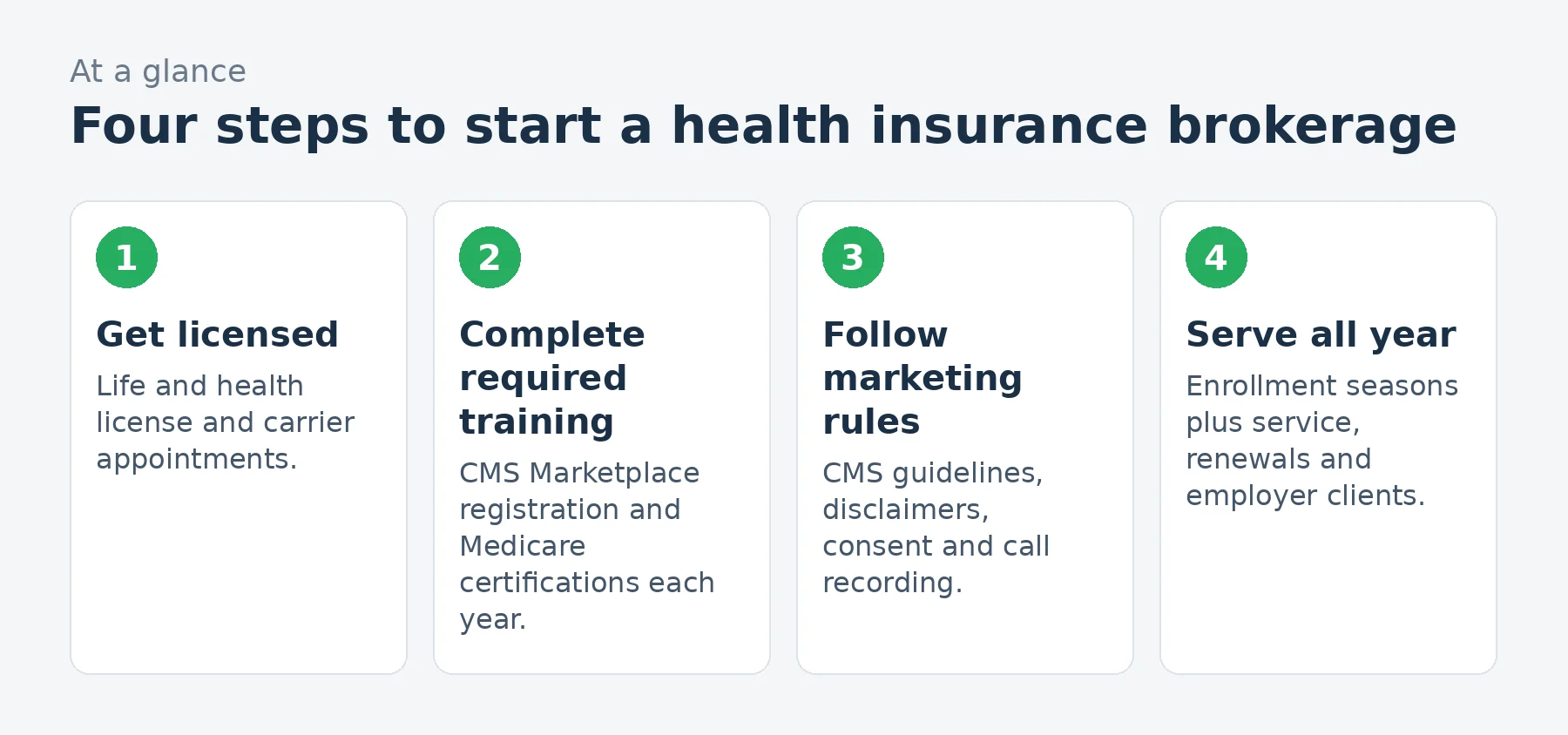
Health insurance is among the most regulated insurance lines. Agents need a state life and health (accident and health) license, Marketplace agents must register and complete training with CMS each year for the federal Marketplace (state-based exchanges have their own requirements), and Medicare agents must follow CMS marketing rules and complete annual training. The Bureau of Labor Statistics reports a median pay of $60,370 for insurance sales agents (May 2024). Agency owners earn commissions on the policies their agency places, so income depends on the size of the book of business and retention. This guide covers licensing, Marketplace and Medicare rules, employer benefits, seasons, a worked example and a 90-day plan.
A health insurance brokerage at a glance
Table of Contents
| Topic | What to expect |
|---|---|
| Startup cost | Low to moderate: licensing, E&O insurance, CMS and carrier training, a CRM and quoting tools, marketing |
| Licensing | State life and health license, carrier appointments and nonresident licenses for other states |
| Marketplace rules | Annual CMS registration and training for the federal Marketplace; state exchange certification where applicable |
| Medicare rules | Annual training and carrier certification, CMS marketing rules, required disclaimers and call recording, compensation limits |
| Best for | Patient, detail-oriented advisors who explain choices clearly and handle busy enrollment seasons |
Who health insurance brokerage suits
It suits patient people who enjoy helping others make complicated decisions, are comfortable with rules and deadlines and can handle intense enrollment seasons. Empathy matters: clients are often worried about health and costs.
Licensing and appointments
Insurance agents (producers) must be licensed by their state for each line they sell, and health insurance requires a life and health (accident and health) license. Licensing usually involves pre-licensing education in many states, a state exam, a background check and fingerprints, then continuing education to renew. Agencies typically need a business entity license and a designated responsible licensed producer. Selling to clients in other states requires nonresident licenses, which many agents manage through NIPR. Agents also need appointments with insurance companies to sell their products.
ACA Marketplace requirements
Agents and brokers who help consumers enroll through the federal Health Insurance Marketplace must register with CMS and complete required training and agreements each plan year before assisting with enrollments. States that run their own exchanges have separate certification requirements. Follow Marketplace rules on consumer consent, accurate applications and privacy; CMS has increased enforcement against agents who enroll or switch consumers without consent.
Medicare requirements
Selling Medicare Advantage and Part D plans requires carrier appointments and annual training and certification, including the widely used industry training many carriers require. CMS’s Medicare Communications and Marketing Guidelines set rules on marketing materials, events, scope of appointment documentation, required disclaimers for third-party marketing organizations and recording of certain sales calls. CMS also sets limits on agent and broker compensation for Medicare plans. These rules change regularly, so review them before each season.
Employer and small group benefits
Small businesses need help with group health plans, dental and vision, life and disability coverage and newer options such as individual coverage health reimbursement arrangements (ICHRAs). Benefits brokers help employers choose plans, run enrollment and handle renewals. Employer clients bring larger, steadier revenue and year-round work.
Enrollment seasons
- Medicare Annual Enrollment Period: October 15 to December 7.
- Marketplace open enrollment: typically from November 1 into January for the federal Marketplace, with state exchanges setting their own dates.
- Special enrollment periods after qualifying life events.
- Employer renewals throughout the year.
Privacy, consent and calls
Health brokers handle sensitive personal and health information, so protect it with secure systems and follow applicable privacy rules. Get consent before contacting people, follow telemarketing and texting rules under the Telephone Consumer Protection Act and keep records of consent and enrollment authorizations.
E&O insurance
Carry errors and omissions (E&O) insurance, which many carriers require before appointing an agency, because mistakes in coverage advice or paperwork can leave clients uninsured. Protect clients’ personal information: insurance agencies are covered by privacy and data security rules, including state insurance data security laws modeled on NAIC standards in many states, and the FTC Safeguards Rule applies to some financial businesses.
Startup costs to plan for
| Item | What to budget for |
|---|---|
| Licensing | Pre-licensing course, exam, fingerprints, license fees |
| Training | CMS Marketplace training, Medicare certifications |
| E&O insurance | Required by most carriers |
| Technology | CRM, quoting tools, call recording, secure documents |
| Office | Private space for appointments, or virtual setup |
| Marketing | Community events, referral partners, website |
Use our startup cost calculator for your total.
How brokers are paid
Carriers pay commissions, often on a per-member, per-month basis or as a percentage of premium, with Medicare compensation subject to CMS limits. Clients usually pay nothing extra for a broker’s help. Renewal commissions build over time as clients stay with their plans.
A worked example: a solo broker
These are illustrative assumptions for an established solo broker, averaged per month across a year, not predictions; commissions vary by carrier, plan type and state.
| Assumption | Monthly | |
|---|---|---|
| Medicare plan commissions | Renewals and new enrollments, averaged monthly | $7,200 |
| Individual and family Marketplace plans | $3,600 | |
| Small group and ancillary benefits | $2,400 | |
| Revenue | $13,200 | |
| Assistant during enrollment seasons | Averaged monthly | $(1,400) |
| CRM, quoting and call recording tools | $(350) | |
| E&O insurance and licenses | Averaged monthly | $(200) |
| Training and certifications | Averaged monthly | $(60) |
| Marketing and events | $(900) | |
| Profit before owner pay and taxes | $10,290 |
That leaves about $10,290 a month on average before the broker’s pay and taxes, on about $13,200 of revenue. Most enrollments cluster in the fall and winter seasons, so plan cash flow and staffing around them.
Loading the calculator…
Year-round service
Serve clients beyond enrollment: help with claims questions, provider and drug coverage, life changes and annual reviews. Service builds retention and referrals, which matter more than constant new sales.
Finding clients
- People turning 65, through community events and referrals.
- Self-employed people and families buying Marketplace coverage.
- Small employers through chambers of commerce, accountants and payroll providers.
- Referral partners: financial advisors, tax preparers and community organizations.
- Local presence and reviews.
Comparing plans for clients
Good advice goes beyond premiums: check networks for clients’ doctors and hospitals, drug formularies and costs, deductibles and out-of-pocket maximums, and expected use of care. Document the options presented and the client’s choice to protect both of you.
ICHRA and newer employer options
Individual coverage health reimbursement arrangements let employers reimburse employees for individual health plans instead of offering a group plan. They suit some small and growing employers, and brokers who understand both individual and employer rules can help design and enroll them.
Handling complaints and errors
Mistakes happen, such as an application error or a missed deadline. Fix them quickly with the carrier or exchange, communicate honestly with the client and document everything. Complaints to regulators are taken seriously in health insurance, so responsive service matters.
Common mistakes to avoid
- Enrolling or changing plans without the consumer’s documented consent.
- Missing annual CMS and carrier training deadlines.
- Ignoring Medicare marketing rules and disclaimers.
- Calling or texting people without consent.
- Weak protection of health information.
Your first 90 days
- Days 1-30: complete pre-licensing and the life and health exam, and apply for your license.
- Days 31-60: get carrier appointments, complete CMS and Medicare training and buy E&O insurance.
- Days 61-90: set up CRM and call recording, build referral partners and prepare for the next enrollment season.
Frequently asked questions
What license do I need to sell health insurance?
A state life and health (accident and health) license, plus carrier appointments and nonresident licenses for other states.
Do I need to register with CMS?
Agents helping consumers enroll through the federal Marketplace must register and complete training each plan year; state exchanges have their own rules.
What rules apply to selling Medicare plans?
Annual training and carrier certification, CMS marketing guidelines, required disclaimers, call recording for certain calls and compensation limits.
Do clients pay health insurance brokers?
Usually not; carriers pay brokers commissions.
When are the busiest seasons?
Medicare’s Annual Enrollment Period from October 15 to December 7 and Marketplace open enrollment, which typically starts November 1.
Can I sell group health insurance to employers?
Yes, with your license and carrier appointments, helping employers choose plans and run enrollment.
Can I sell both Medicare and Marketplace plans?
Yes, many brokers do, completing the required training and certifications for each each year.
Do health brokers need E&O insurance?
Yes. Most carriers require errors and omissions coverage, and it protects brokers from claims about enrollment or advice errors.
How do I get Medicare carrier appointments?
Through carriers directly or through field marketing organizations, after licensing and completing annual training and certifications.
Keep learning
- Insurance agencies industry data
- How to start an independent insurance agency
- How to start an HR consulting business
- Startup cost calculator
Sources
- CMS, Agents and brokers in the Health Insurance Marketplace (registration and training)
- CMS, Medicare Communications and Marketing Guidelines
- CMS, Medicare agent and broker compensation
- NAIC, Producer licensing
- HHS, HIPAA privacy rule summary
- FCC, Telephone Consumer Protection Act (calls and texts)
- US Bureau of Labor Statistics, Insurance sales agents
Last reviewed November 3, 2026. Startup costs are estimates; check local prices, licensing and tax rules before you commit money.

