
Farmers markets, street fairs, festivals and holiday markets let food entrepreneurs sell directly to customers with low overhead and test products before opening stores or brands. Vendors sell baked goods, jams, prepared foods, hot meals and produce. Cooks earned a median of $35,760 in May 2024, and food service managers earned $65,310, according to the Bureau of Labor Statistics.
Businesses range from cottage food vendors selling home-made goods to hot food festival vendors and multi-market stands selling produce and prepared foods across several markets each week.
The workforce
| Occupation | Jobs (2024) | Median pay (May 2024) | Projected growth, 2024 to 2034 |
|---|---|---|---|
| Cooks | n/a | $35,760 | n/a |
| Food service managers | 352,800 | $65,310 | +6% |
Source: U.S. Bureau of Labor Statistics, Occupational Outlook Handbook and Occupational Employment and Wage Statistics.
Business models compared
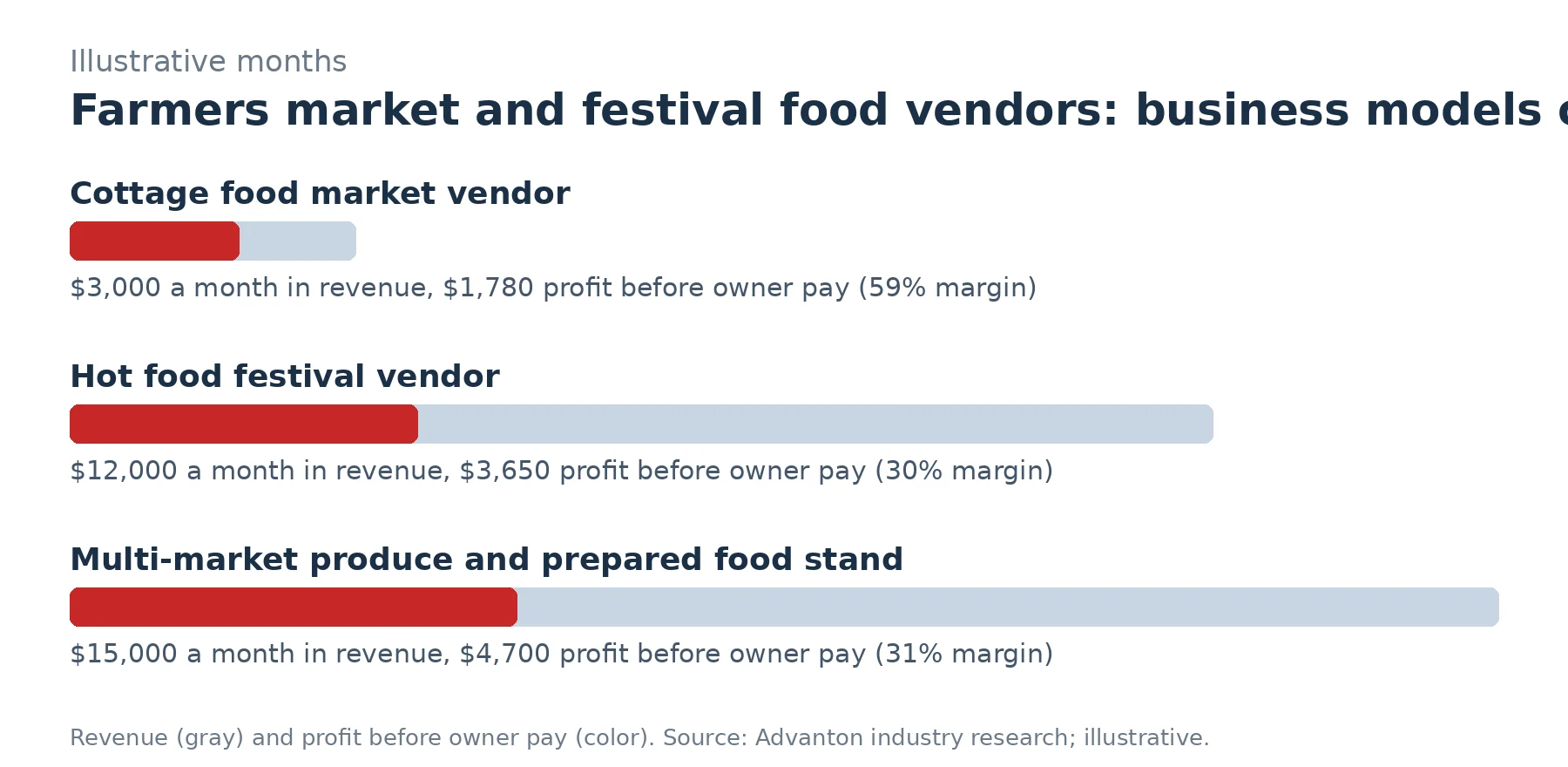
The figures below are illustrative months from our research, not industry averages. They show how revenue and costs typically fit together; your market, prices and costs will differ.
| Business model | Startup costs | Example monthly revenue | Costs | Profit before owner pay | Margin |
|---|---|---|---|---|---|
| Cottage food market vendor | Low: ingredients, packaging, tent, table, permits | $3,000 | $1,220 | $1,780 | 59% |
| Hot food festival vendor | Moderate: cooking equipment, tent, generator, permits, commissary | $12,000 | $8,350 | $3,650 | 30% |
| Multi-market produce and prepared food stand | Moderate: van, coolers, tents, licensed kitchen access | $15,000 | $10,300 | $4,700 | 31% |
Fixed and variable costs
For projections, the most useful split is between variable costs, which rise and fall with sales (materials, supplies, hourly labor, fees), and fixed costs, which you pay every month regardless (rent, salaried staff, insurance, loan payments).
| Business model | Variable costs (% of revenue) | Fixed costs per month | What it means |
|---|---|---|---|
| Cottage food market vendor | 38.0% | $80 | Balanced: margins improve as volume grows |
| Hot food festival vendor | 60.4% | $1,100 | Mostly variable: profitable early, but watch cash flow |
| Multi-market produce and prepared food stand | 59.3% | $1,400 | Mostly variable: profitable early, but watch cash flow |
What the numbers say
Booth fees and ingredients are the main costs, so pricing and volume per event decide profit.
Cottage food vendors start with very low costs but face product and sales limits.
Hot food vendors earn more per event with more equipment, permits and labor.
The three models in brief
Cottage food market vendor. Baked goods, jams and candies allowed under cottage food laws. See bakery data.
Hot food festival vendor. Cooked foods at festivals, fairs and events. See food trucks data.
Multi-market stand. Produce and prepared foods at several weekly markets. See small farms data.
Cost structure: hot food festival vendor
Each cost as a share of the example month’s revenue ($12,000):
| Cost | Monthly amount | Share of revenue | Type |
|---|---|---|---|
| Food and supplies | $3,600 | 30.0% | Variable |
| Event and booth fees | $1,800 | 15.0% | Variable |
| Helper wages | $1,500 | 12.5% | Variable |
| Equipment and van | $400 | 3.3% | Fixed |
| Card fees | $350 | 2.9% | Variable |
| Commissary | $300 | 2.5% | Fixed |
| Permits and insurance | $200 | 1.7% | Fixed |
| Propane and fuel | $200 | 1.7% | Fixed |
| Profit before owner pay | $3,650 | 30% |
A first-year projection: hot food festival vendor
New businesses rarely start at full speed. This projection assumes revenue ramps from 35% of the example month in month 1 to 100% by month 12, variable costs move with revenue, and fixed costs stay the same every month. It’s a planning illustration, not a forecast.
| Month | Revenue | Variable costs | Fixed costs | Profit | Cumulative |
|---|---|---|---|---|---|
| 1 | $4,200 | $2,537 | $1,100 | $563 | $563 |
| 2 | $5,400 | $3,262 | $1,100 | $1,038 | $1,601 |
| 3 | $6,600 | $3,986 | $1,100 | $1,514 | $3,115 |
| 4 | $7,440 | $4,494 | $1,100 | $1,846 | $4,961 |
| 5 | $8,400 | $5,074 | $1,100 | $2,226 | $7,187 |
| 6 | $9,120 | $5,508 | $1,100 | $2,512 | $9,699 |
| 7 | $9,840 | $5,943 | $1,100 | $2,797 | $12,496 |
| 8 | $10,440 | $6,306 | $1,100 | $3,034 | $15,530 |
| 9 | $10,920 | $6,596 | $1,100 | $3,224 | $18,754 |
| 10 | $11,400 | $6,886 | $1,100 | $3,414 | $22,168 |
| 11 | $11,760 | $7,103 | $1,100 | $3,557 | $25,725 |
| 12 | $12,000 | $7,248 | $1,100 | $3,652 | $29,377 |
Year one: revenue $107,520, profit before owner pay $29,377. The first profitable month is month 1. Cumulative results stay positive from the start, before any startup costs.
Food, fees and helper pay move with events and fixed costs are small, so this festival vendor illustration is profitable from month 1. The real challenges are getting into strong events and weather.
How market vendors earn
- Direct sales at markets and festivals.
- Pre-orders for pickup at markets.
- Catering and private events.
- Wholesale to local shops.
- Online sales of shelf-stable products.
Permits for events
Health departments usually require temporary food permits for each event or season, and they inspect booths for handwashing, temperature control and food protection. Apply early, since some events require permits weeks ahead.
Cottage food rules
Cottage food laws let you make certain low-risk foods at home, such as many baked goods and jams, with labeling and sales limits. Hot meals and perishable foods usually need licensed kitchens.
A startup checklist
- Check cottage food and event permit rules.
- Apply to markets and events early.
- Buy a tent, tables and signage.
- Set up card payments.
- Get liability insurance required by markets.
Choosing events
Not every event is worth the fee. Ask about attendance, competing vendors and past sales, and start with smaller events before committing to expensive festivals.
Where the opportunities are
- Holiday and night markets.
- Specialty baked goods.
- Cultural and regional foods.
- Farm-to-table prepared foods.
- Corporate and private events.
Key terms
| Term | Meaning |
|---|---|
| Temporary food permit | Permission to sell food at a specific event |
| Cottage food | Low-risk foods allowed from home kitchens |
| Booth fee | Fee charged by markets and events |
| Commissary | Licensed kitchen used for prep |
Booth design
Attractive signs, clear menus and prices, samples where allowed and a clean setup draw customers from the aisle.
Key numbers to track
Track sales per event, cost per event, best-selling items, waste and repeat customers.
Common mistakes
- Paying high fees for low-traffic events.
- Selling foods not allowed under cottage rules.
- Running out or over-preparing.
- No card payments.
- Ignoring weather plans.
Marketing as a vendor
Social media posts about where you’ll be, email lists and loyalty cards bring repeat customers. See food trucks data.
Weather
Rain and heat change sales; plan shade, tent weights and flexible prep amounts, and track how weather affects each market so you can plan better next time.
Pricing
Price to cover ingredients, packaging, booth fees and your time; simple, round price points speed sales during busy rushes.
Labels
Cottage food and packaged items need labels with ingredients, allergens and any statements your state requires, such as notices that the food was made in a home kitchen.
Food safety at booths
Handwashing stations, thermometers, covered food and proper cold holding protect customers and keep inspectors satisfied.
Growing beyond markets
Many vendors grow into shops, food trucks or packaged brands once demand is proven at markets, using sales records to plan the next step.
Seasonality
Markets peak in summer and fall; holiday markets and online sales help in winter.
Building a loyal following
Regular market customers want to find you every week. Use the same booth spot when possible, announce specials on social media and offer pre-orders so regulars can reserve favorites before they sell out.
Prep and quantities
Track what sells at each market and adjust prep amounts. Running out disappoints customers, while overproduction wastes ingredients; good records solve both problems over time.
Payments
Card readers with offline mode prevent lost sales in weak signal areas, and many customers no longer carry cash.
Test these numbers with your own plan
Open this industry in our free Business Idea Reality Check to start from any model above, change prices, costs, startup budget and your own pay, and see your break-even month, the cash you’d need, three scenarios and how new businesses in this sector survive in your state.
- Start with the closest model and its cost structure.
- Replace every price and cost with local quotes.
- Estimate your ramp: how fast customers will realistically come in year one.
- Map cash month by month with the free Cash & Payroll Planner.
- Build the full plan in the free Business Planner.
About this data
Workforce figures come from the U.S. Bureau of Labor Statistics (Occupational Outlook Handbook and Occupational Employment and Wage Statistics, May 2024 wages and the 2024 to 2034 projections, unless noted). Market figures cite their sources above. Business model figures are illustrative months built from typical prices and costs to show how revenue, fixed costs and variable costs fit together; they are not industry averages or guarantees. We review these profiles when new government data is released, at least once a year, and the same figures power the Business Idea Reality Check.
Licensing and rules
Selling food at markets and events usually requires temporary food event permits from local health departments, often per event or per season; home-made low-risk foods may be sold under state cottage food laws, with registration, labeling and sales limits; hot and perishable foods generally must be prepared in licensed kitchens with handwashing, temperature control and approved equipment at the booth; collect sales tax where required; markets set their own rules, insurance requirements and fees. Requirements change; confirm with your state and local agencies before you start.
Frequently asked questions
Do I need a permit to sell food at a farmers market?
Usually a temporary food permit or cottage food registration, depending on what you sell.
Can I sell home-made food at markets?
Many states allow certain low-risk foods under cottage food laws.
Can I sell hot food at festivals?
Usually with temporary permits, licensed prep and booth safety equipment.
Is market vending profitable?
It can be, with good events, efficient prep and strong pricing.
What do cooks earn?
BLS reported a median of $35,760 in May 2024.
How do vendors choose events?
By attendance, fees, competition and past sales.
How can I test these numbers?
Open farmers market and festival food vendors in the Business Idea Reality Check and enter your own numbers.
Keep learning
Sources
Last reviewed November 2, 2026. Startup costs are estimates; check local prices, licensing and tax rules before you commit money.

