
Food trucks bring restaurant food to office parks, breweries, festivals and neighborhoods without the cost of a full restaurant. They’re a popular way to test a concept and build a following before opening a storefront. The Bureau of Labor Statistics counted about 352,800 food service managers in 2024, with a median wage of $65,310 in May 2024, 6% projected growth and 30% self-employed; cooks earned a median of $35,760.
Food truck economics depend on locations, events and speed: how many customers you can serve in a lunch rush, and how many profitable bookings you can fill each week. Permits, commissaries and weather shape every plan.
The workforce
| Occupation | Jobs (2024) | Median pay (May 2024) | Projected growth, 2024 to 2034 |
|---|---|---|---|
| Food service managers | 352,800 | $65,310 | +6% |
| Cooks | n/a | $35,760 | n/a |
Source: U.S. Bureau of Labor Statistics, Occupational Outlook Handbook and Occupational Employment and Wage Statistics.
Market data
| Measure | Value |
|---|---|
| Share of food service managers who are self-employed (2024) | 30% |
Business models compared
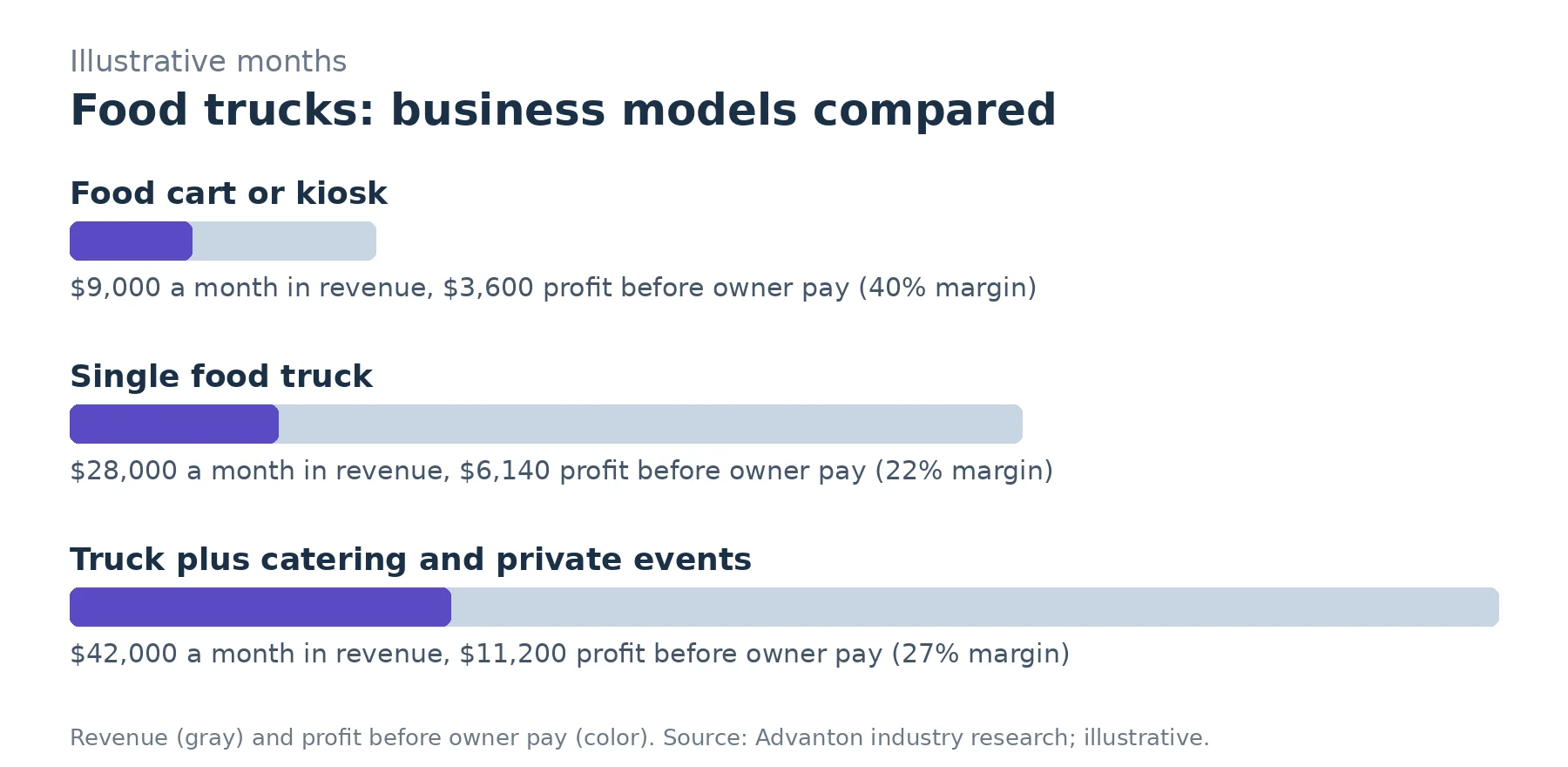
The figures below are illustrative months from our research, not industry averages. They show how revenue and costs typically fit together; your market, prices and costs will differ.
| Business model | Startup costs | Example monthly revenue | Costs | Profit before owner pay | Margin |
|---|---|---|---|---|---|
| Food cart or kiosk | Low to moderate: cart, permits, small equipment | $9,000 | $5,400 | $3,600 | 40% |
| Single food truck | Moderate: truck build-out, equipment, permits, wrap | $28,000 | $21,860 | $6,140 | 22% |
| Truck plus catering and private events | Moderate to high: truck, catering equipment, staff | $42,000 | $30,800 | $11,200 | 27% |
Fixed and variable costs
For projections, the most useful split is between variable costs, which rise and fall with sales (materials, supplies, hourly labor, fees), and fixed costs, which you pay every month regardless (rent, salaried staff, insurance, loan payments).
| Business model | Variable costs (% of revenue) | Fixed costs per month | What it means |
|---|---|---|---|
| Food cart or kiosk | 49.4% | $950 | Balanced: margins improve as volume grows |
| Single food truck | 61.3% | $4,700 | Mostly variable: profitable early, but watch cash flow |
| Truck plus catering and private events | 58.6% | $6,200 | Mostly variable: profitable early, but watch cash flow |
What the numbers say
Food and labor take most of each sale, so menu pricing and speed of service decide margins.
Event fees and locations vary widely, and good spots are worth more than lower fees.
Catering and private events raise revenue per day with guaranteed minimums.
The three models in brief
Food cart or kiosk. A simple menu at fixed spots and markets.
Single food truck. Lunch spots, breweries, events and festivals. See restaurant data.
Truck plus catering and private events. Weddings, corporate events and parties with set minimums. See catering data.
Cost structure: single food truck
Each cost as a share of the example month’s revenue ($28,000):
| Cost | Monthly amount | Share of revenue | Type |
|---|---|---|---|
| Food and packaging | $8,960 | 32.0% | Variable |
| Staff wages | $6,000 | 21.4% | Variable |
| Truck payment | $1,600 | 5.7% | Fixed |
| Event and location fees | $1,400 | 5.0% | Variable |
| Fuel and propane | $900 | 3.2% | Fixed |
| Card fees | $800 | 2.9% | Variable |
| Commissary | $800 | 2.9% | Fixed |
| Insurance and permits | $500 | 1.8% | Fixed |
| Maintenance | $500 | 1.8% | Fixed |
| Marketing | $400 | 1.4% | Fixed |
| Profit before owner pay | $6,140 | 22% |
A first-year projection: single food truck
New businesses rarely start at full speed. This projection assumes revenue ramps from 35% of the example month in month 1 to 100% by month 12, variable costs move with revenue, and fixed costs stay the same every month. It’s a planning illustration, not a forecast.
| Month | Revenue | Variable costs | Fixed costs | Profit | Cumulative |
|---|---|---|---|---|---|
| 1 | $9,800 | $6,007 | $4,700 | -$907 | -$907 |
| 2 | $12,600 | $7,724 | $4,700 | $176 | -$731 |
| 3 | $15,400 | $9,440 | $4,700 | $1,260 | $529 |
| 4 | $17,360 | $10,642 | $4,700 | $2,018 | $2,547 |
| 5 | $19,600 | $12,015 | $4,700 | $2,885 | $5,432 |
| 6 | $21,280 | $13,045 | $4,700 | $3,535 | $8,967 |
| 7 | $22,960 | $14,074 | $4,700 | $4,186 | $13,153 |
| 8 | $24,360 | $14,933 | $4,700 | $4,727 | $17,880 |
| 9 | $25,480 | $15,619 | $4,700 | $5,161 | $23,041 |
| 10 | $26,600 | $16,306 | $4,700 | $5,594 | $28,635 |
| 11 | $27,440 | $16,821 | $4,700 | $5,919 | $34,554 |
| 12 | $28,000 | $17,164 | $4,700 | $6,136 | $40,690 |
Year one: revenue $250,880, profit before owner pay $40,690. The first profitable month is month 2. Cumulative results bottom out at -$907, which is the minimum cash cushion this plan would need, before any startup costs.
The truck payment, commissary and permits start on day one while the schedule and following build, so this truck illustration turns profitable in month 2, with a cumulative low of about $900, before the truck and build-out themselves.
How food trucks earn
- Lunch service at office parks and busy streets.
- Breweries and wineries without kitchens.
- Festivals and events.
- Private catering with guaranteed minimums.
- Merchandise and packaged items.
Menu design for speed
A short menu with shared ingredients speeds service, reduces waste and keeps quality consistent. Design items you can serve in a few minutes during rushes, and price each one using real ingredient and packaging costs.
Locations and events
Track sales by location, day and weather. Build relationships with breweries, office managers, apartment communities and event organizers, and confirm fees, minimums and exclusivity before booking.
Permits and commissaries
Most cities require a health permit for the truck, a commissary kitchen for prep, cleaning and water, and fire inspections for cooking equipment and propane. Some limit where trucks can park or how long they can stay. Learn the rules in every city you plan to serve.
A startup checklist
- Research local permits for each city you’ll serve.
- Choose a truck or trailer and plan the kitchen layout with code requirements in mind.
- Find a commissary if required.
- Get a certified food protection manager on your team.
- Insure the truck and business, including commercial auto and general liability.
Buying a truck
New builds cost more but are customized; used trucks save money but may need repairs and upgrades to pass local inspections. Have a mechanic inspect the vehicle and a health official review the kitchen layout before buying.
Where the opportunities are
- Corporate catering and office lunches.
- Brewery partnerships.
- Weddings and private events.
- Specialty cuisines with a loyal following.
- Testing a concept before opening a restaurant.
Key terms
| Term | Meaning |
|---|---|
| Commissary | A licensed kitchen for prep, storage and cleaning |
| Food cost percentage | Ingredient cost as a share of menu price |
| Event minimum | A guaranteed sales amount for private bookings |
| Mobile vending permit | City permission to sell from a vehicle |
Weather and seasonality
Rain, heat and cold change sales dramatically. Build a calendar of indoor-friendly bookings and catering for slower seasons, and use social media to tell customers where you’ll be.
Key numbers to track
Track sales per service, customers per hour, food cost percentage, labor cost percentage, event profitability and repeat bookings.
Common mistakes
- Too large a menu.
- Underpricing after food and packaging costs.
- Ignoring local permit rules.
- Booking low-traffic events.
- No plan for breakdowns.
Marketing a food truck
Instagram, a weekly schedule on your website and social pages, Google Business Profile, reviews and partnerships with breweries and event organizers build a following. See restaurant data.
Maintenance and breakdowns
A truck that won’t start means canceled bookings. Keep regular maintenance schedules for engine, generator and kitchen equipment, and have a backup plan for critical events.
Staffing a truck
Most trucks run with two or three people during service: a cook, an order taker and sometimes a runner. Cross-train everyone, plan prep at the commissary to keep service fast, and schedule extra help for large events.
From truck to restaurant
Many successful trucks open restaurants once they’ve proven demand. Use your sales data, customer locations and following to choose a location and concept with less risk.
Test these numbers with your own plan
Open this industry in our free Business Idea Reality Check to start from any model above, change prices, costs, startup budget and your own pay, and see your break-even month, the cash you’d need, three scenarios and how new businesses in this sector survive in your state.
- Start with the closest model and its cost structure.
- Replace every price and cost with local quotes.
- Estimate your ramp: how fast customers will realistically come in year one.
- Map cash month by month with the free Cash & Payroll Planner.
- Build the full plan in the free Business Planner.
About this data
Workforce figures come from the U.S. Bureau of Labor Statistics (Occupational Outlook Handbook and Occupational Employment and Wage Statistics, May 2024 wages and the 2024 to 2034 projections, unless noted). Market figures cite their sources above. Business model figures are illustrative months built from typical prices and costs to show how revenue, fixed costs and variable costs fit together; they are not industry averages or guarantees. We review these profiles when new government data is released, at least once a year, and the same figures power the Business Idea Reality Check.
Licensing and rules
Local health departments permit food businesses and inspect them; many states require at least one certified food protection manager; sales tax permits; business licenses; fire safety rules for cooking equipment and propane; food labeling rules for packaged items. Many cities require food trucks to operate from an approved commissary kitchen, hold mobile vending permits and follow rules on where and when they may park; fire departments may inspect cooking and propane systems. Requirements change; confirm with your state and local agencies before you start.
Frequently asked questions
How much does it cost to start a food truck?
Moderate: the truck or trailer build-out, equipment, permits, wrap and initial inventory are the main costs.
Do food trucks need a commissary?
Many cities require trucks to operate from an approved commissary kitchen.
What permits does a food truck need?
Typically a health permit, mobile vending permit, business license, fire inspection and sales tax permit.
Are food trucks profitable?
They can be, with a fast menu, good locations, catering and careful costs.
How do food trucks find locations?
Breweries, office parks, apartment communities, events and city-approved spots.
What do food service managers earn?
BLS reported a median of $65,310 in May 2024.
How can I test these numbers?
Open food trucks in the Business Idea Reality Check and enter your own prices and costs.
Keep learning
- Restaurants and food service data
- Catering industry data
- Bakery and specialty food data
- Business Idea Reality Check
Sources
Last reviewed November 1, 2026. Startup costs are estimates; check local prices, licensing and tax rules before you commit money.

