
Small farms sell vegetables, meat, eggs, flowers and experiences directly to local customers through farmers markets, community supported agriculture (CSA) shares, farm stands and agritourism. The Bureau of Labor Statistics counted about 836,100 farmers, ranchers and other agricultural managers in 2024, with a median wage of $87,980 in May 2024; 63% were self-employed.
Farming income is highly seasonal and weather-dependent. The monthly figures in this profile are averages across a year, not month-by-month income; real cash flow is concentrated in growing and harvest seasons.
The workforce
| Occupation | Jobs (2024) | Median pay (May 2024) | Projected growth, 2024 to 2034 |
|---|---|---|---|
| Farmers, ranchers and other agricultural managers | about 836,100 | $87,980 | -1% |
Source: U.S. Bureau of Labor Statistics, Occupational Outlook Handbook.
Market data
| Measure | Value |
|---|---|
| Share self-employed (2024) | 63% |
Business models compared
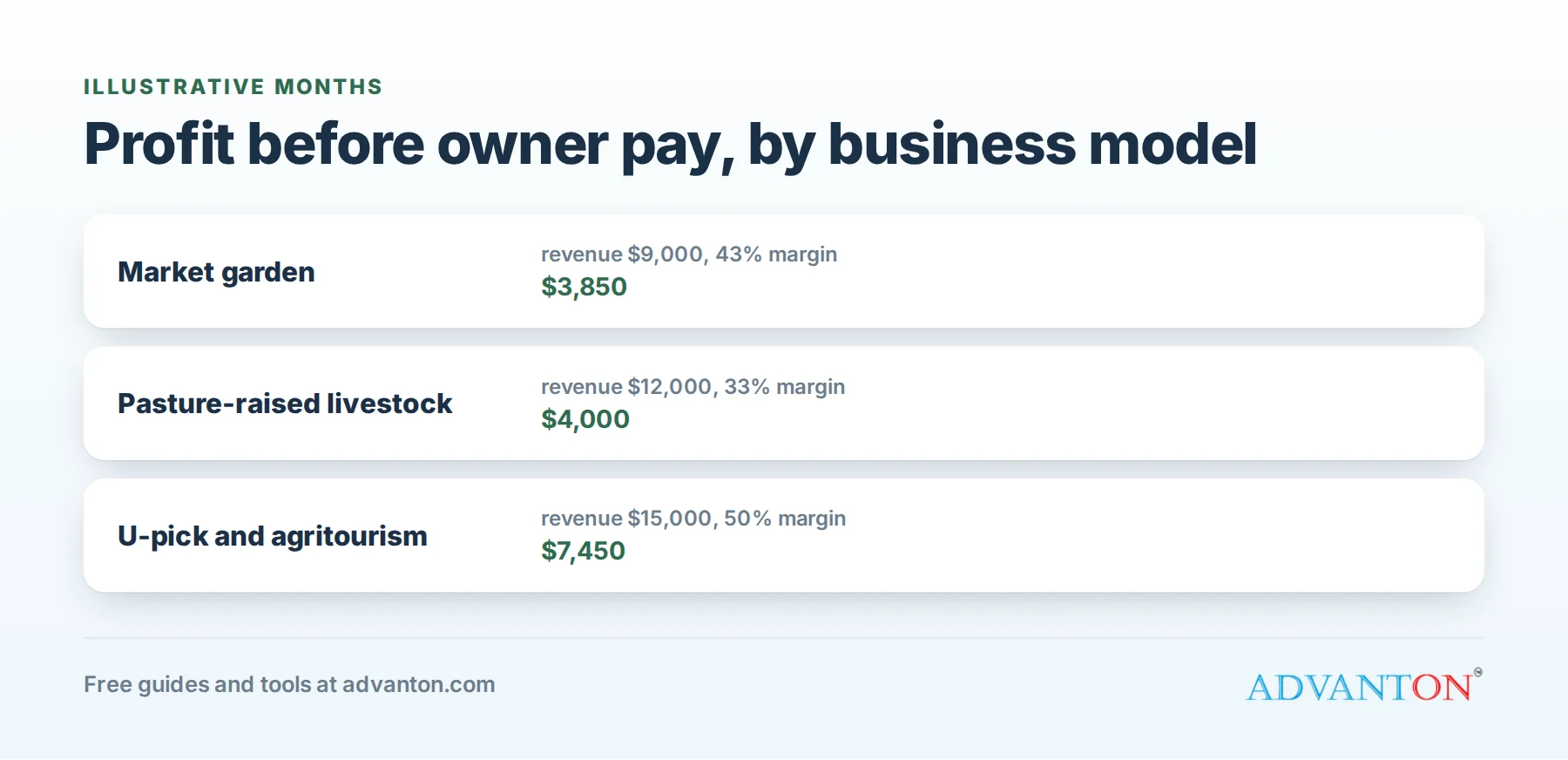
The figures below are illustrative months from our step-by-step guides, not industry averages. They show how revenue and costs typically fit together; your market, prices and costs will differ.
| Business model | Startup costs | Example monthly revenue | Costs | Profit before owner pay | Margin |
|---|---|---|---|---|---|
| Market garden (vegetables, farmers markets and CSA) | Moderate: land or lease, irrigation, tools, high tunnel | $9,000 | $5,150 | $3,850 | 43% |
| Pasture-raised livestock (direct sales) | High: land, animals, fencing, processing access | $12,000 | $8,000 | $4,000 | 33% |
| U-pick and agritourism | Moderate to high: orchard or berry plantings, parking, liability coverage | $15,000 | $7,550 | $7,450 | 50% |
Fixed and variable costs
For projections, the most useful split is between variable costs, which rise and fall with sales (materials, parts, hourly labor), and fixed costs, which you pay every month regardless (rent, salaried staff, insurance, loan payments).
| Business model | Variable costs (% of revenue) | Fixed costs per month | What it means |
|---|---|---|---|
| Market garden (vegetables, farmers markets and CSA) | 38.9% | $1,650 | Mostly variable: profitable early, but watch cash flow |
| Pasture-raised livestock (direct sales) | 48.3% | $2,200 | Mostly variable: profitable early, but watch cash flow |
| U-pick and agritourism | 26.3% | $3,600 | Low costs overall: time is the main constraint |
What the numbers say
Direct sales raise margins compared with selling wholesale.
Seasonality dominates cash flow. Plan for months with little income.
Agritourism adds experiences that command higher prices per visitor.
The three models in brief
Market garden. Intensive vegetable growing for markets and CSA members.
Pasture-raised livestock. Meat sold directly, with licensed processing.
U-pick and agritourism. Customers harvest or visit for experiences.
Cost structure: pasture-raised livestock (direct sales)
Each cost as a share of the example month’s revenue ($12,000):
| Cost | Monthly amount | Share of revenue | Type |
|---|---|---|---|
| Feed and supplements | $3,000 | 25.0% | Variable |
| Processing | $2,400 | 20.0% | Variable |
| Land lease | $800 | 6.7% | Fixed |
| Fencing and equipment | $700 | 5.8% | Fixed |
| Cold storage and delivery | $500 | 4.2% | Fixed |
| Vet care | $400 | 3.3% | Variable |
| Insurance | $200 | 1.7% | Fixed |
| Profit before owner pay | $4,000 | 33% |
A first-year projection: pasture-raised livestock (direct sales)
New businesses rarely start at full speed. This projection assumes revenue ramps from 35% of the example month in month 1 to 100% by month 12, variable costs move with revenue, and fixed costs stay the same every month. It’s a planning illustration, not a forecast.
| Month | Revenue | Variable costs | Fixed costs | Profit | Cumulative |
|---|---|---|---|---|---|
| 1 | $4,200 | $2,030 | $2,200 | -$30 | -$30 |
| 2 | $5,400 | $2,610 | $2,200 | $590 | $560 |
| 3 | $6,600 | $3,190 | $2,200 | $1,210 | $1,770 |
| 4 | $7,440 | $3,596 | $2,200 | $1,644 | $3,414 |
| 5 | $8,400 | $4,060 | $2,200 | $2,140 | $5,554 |
| 6 | $9,120 | $4,408 | $2,200 | $2,512 | $8,066 |
| 7 | $9,840 | $4,756 | $2,200 | $2,884 | $10,950 |
| 8 | $10,440 | $5,046 | $2,200 | $3,194 | $14,144 |
| 9 | $10,920 | $5,278 | $2,200 | $3,442 | $17,586 |
| 10 | $11,400 | $5,510 | $2,200 | $3,690 | $21,276 |
| 11 | $11,760 | $5,684 | $2,200 | $3,876 | $25,152 |
| 12 | $12,000 | $5,800 | $2,200 | $4,000 | $29,152 |
Year one: revenue $107,520, profit before owner pay $29,152. The first profitable month is month 2. Cumulative results bottom out at -$30, which is the minimum cash cushion this plan would need, before any startup costs.
Using average months, this livestock illustration turns profitable in month 2, with a cumulative low close to break-even. Real farm cash flow follows the seasons, so plan reserves for winter months.
How small farms earn
- Farmers markets and farm stands.
- CSA subscriptions paid before the season.
- Direct meat and egg sales.
- Restaurant and grocery accounts.
- Agritourism: U-pick, events and tours.
A startup checklist for small farms
- Secure land through ownership or a lease.
- Learn food safety rules for your products.
- Arrange licensed processing for meat sold by the cut.
- Check zoning for farm stands and agritourism.
- Explore USDA programs and farm loans.
Where the opportunities are
- CSA shares that provide early-season cash.
- Specialty crops and flowers.
- Farm experiences and events.
- Restaurant partnerships.
Key terms
| Term | Meaning |
|---|---|
| CSA | Community supported agriculture subscriptions |
| Direct marketing | Selling straight to customers |
| Agritourism | Visitor experiences on the farm |
| Season extension | Tools like high tunnels that lengthen growing seasons |
Plan for weather and risk
Weather, pests and markets bring uncertainty. Diversify products and sales channels, and consider crop insurance where available.
Marketing a small farm
Farmers markets, social media, email lists and local search build loyal customers. Tell your farm’s story with photos.
Manage seasonal cash
Pre-sold CSA shares, winter products and reserves help smooth the year.
How to use these numbers for your own plan
- Start with the closest model above and its cost structure.
- Replace every price and cost with local quotes: insurance, wages, vehicles, materials and your expected prices.
- Estimate your ramp: how many jobs you can realistically win each month in year one.
- Separate fixed and variable costs, then calculate your break-even point with our free break-even calculator.
- Map cash month by month with our cash flow forecast, including equipment and loan payments.
- Build the plan in our free Business Planner.
These figures will also feed a planned Advanton projection tool, so you’ll be able to start from an industry template and adjust it to your situation.
About this data
Workforce figures come from the U.S. Bureau of Labor Statistics (Occupational Outlook Handbook and Occupational Employment and Wage Statistics, May 2024 and the 2024 to 2034 projections). Market figures cite their sources in the list above. Business model figures are illustrative months built from typical prices and costs to show how revenue, fixed costs and variable costs fit together; they are not industry averages or guarantees. We review these profiles when new government data is released, at least once a year. The same figures are available in a structured format for Advanton’s upcoming business projection tool.
Licensing and rules
Rules vary by product: food safety rules for produce, licensed processing for meat sold by cut, dairy and egg rules, farmers market permits, zoning for agritourism and liability considerations; USDA programs and loans may help. Requirements change; confirm with your state and local agencies before you start.
Frequently asked questions about small farms
What do farmers earn?
BLS reported a $87,980 median for farmers, ranchers and agricultural managers (May 2024).
Do I need a license to sell meat?
Meat sold by the cut generally requires licensed processing; rules vary by state.
How do small farms handle seasonality?
CSA shares, diverse products and cash reserves.
How can I use these numbers?
Start with the closest farm model, then replace every figure with your local prices, wages and expected volume.
Keep learning
- Market garden
- Local SEO for contractors
- How to get more contractor leads
- Specialty trades industry data
Sources
Last reviewed October 30, 2026. Startup costs are estimates; check local prices, licensing and tax rules before you commit money.
In India
In India: Small farms and agri-businesses (outside ASUSE; separate agriculture data).
Farming and allied activities are outside MoSPI’s survey of unincorporated businesses. The Ministry of Agriculture and state agriculture departments publish data and run schemes for these businesses.
Licences and registrations to expect
- Agriculture is outside ASUSE. GST generally doesn’t apply to unprocessed farm produce; registrations depend on what you sell, such as FSSAI for processed food.
- Registration under your state’s Shops and Establishments Act if you have premises or employees.
- A trade licence from your municipal corporation or council for many shop and service businesses.
- GST registration once turnover crosses ₹40 lakh for goods or ₹20 lakh for services (lower in some special category states), or earlier if you sell goods to other states or through e-commerce marketplaces.
- Professional tax registration in states that levy it.
- Free Udyam (MSME) registration, which helps with loans, government schemes and delayed-payment protection.
Rules differ by state and city. Check with your municipal corporation, state departments and a chartered accountant before you start.
Run a business like this in India? List it free in the India Business Directory, with your hours, deals and GST registration.
Free tools for India: Make a GST invoice · Compare business credit cards
Build a market report for Small Farms in India Pick your state and see market size, earnings, competition and licences, from official data. Free, with a PDF download.
Sources: MoSPI, Annual Survey of Unincorporated Sector Enterprises (ASUSE) 2025, factsheet (survey period January to December 2025, released 24 March 2026). Licensing summary by Advanton, checked November 2026.