
A fake one-star review can feel like an attack on everything you’ve built. Sometimes it is: a competitor, a disgruntled former employee, someone who confused you with another business, or a scammer demanding money to remove it. Other reviews are real but unfair, exaggerating a small problem or leaving out the customer’s role.
You can’t control every review, but you can respond wisely, report reviews that break platform rules, protect yourself from scams and build a reputation strong enough that one bad review barely matters. For replying to genuine complaints from real customers, see how to respond to negative reviews.
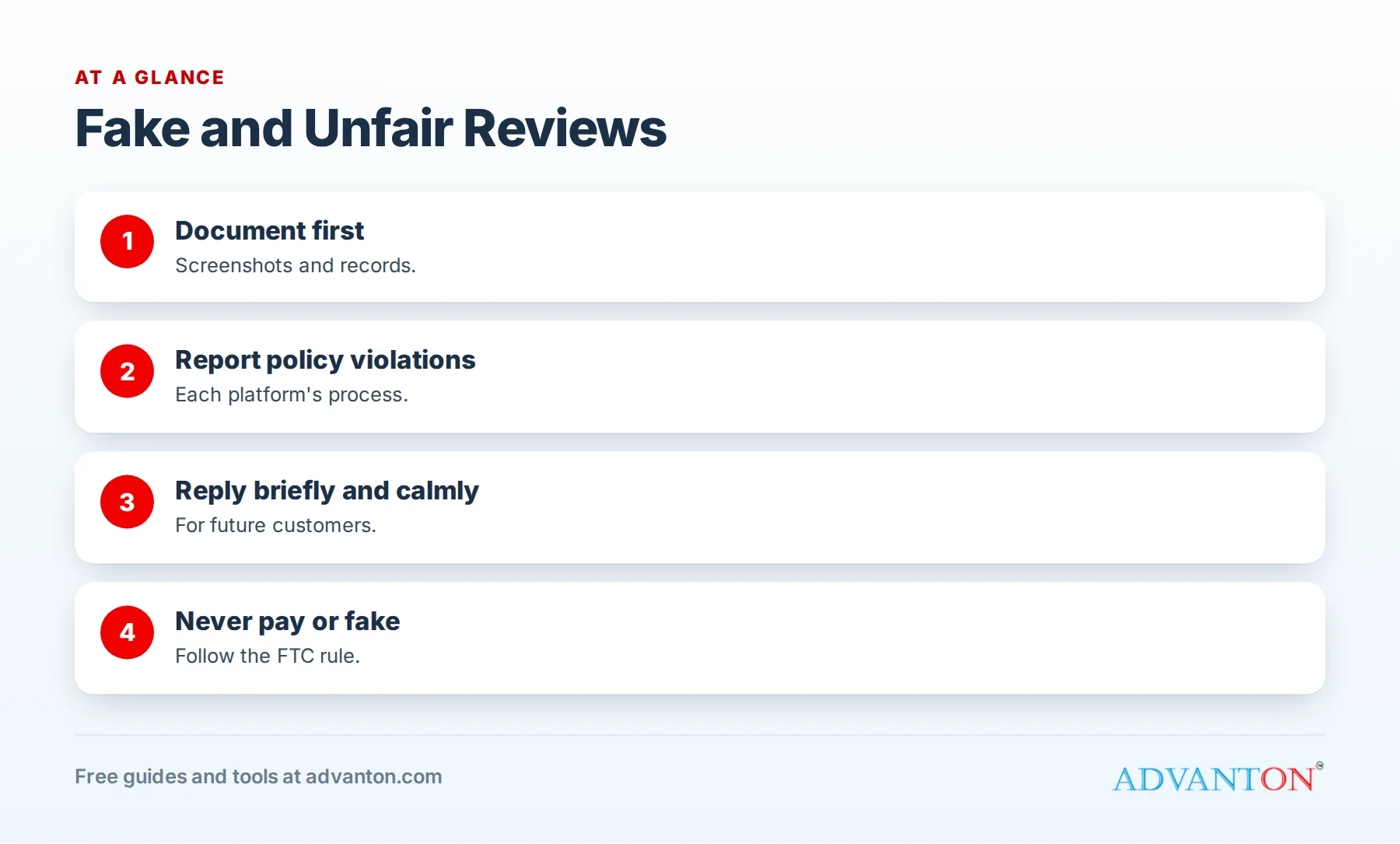
Fake vs unfair: know the difference
Table of Contents
| Type | What it looks like | What to do |
|---|---|---|
| Fake review | Reviewer was never a customer; details don’t match any job | Document, report to the platform, reply briefly |
| Wrong business | Reviewer confused you with another company | Reply politely to clarify; report if needed |
| Competitor or ex-employee | Insider details, sudden attacks, conflicts of interest | Document, report as a conflict of interest |
| Extortion | Negative reviews followed by a demand for payment | Don’t pay; document and report |
| Unfair but real | A real customer exaggerates or omits context | Respond calmly with facts; offer to resolve |
Signs a review may be fake
- No record of the reviewer as a customer, by name, address or phone.
- Vague details that don’t match your services or area.
- A sudden cluster of negative reviews in a short time.
- Reviewer profiles with no history or many reviews posted at once.
- Wording that mirrors other suspicious reviews.
- Mentions of services you don’t offer.
Check your records carefully before concluding a review is fake; some customers use nicknames or a spouse’s account.
Review extortion scams
Some businesses receive negative reviews followed by messages offering to remove them for a payment, or "reputation repair" offers from the same people who posted the reviews. Don’t pay. Document every message and review, report the reviews and the messages to the platform, and consider reporting the scam to the FTC and local law enforcement.
Document everything
Before doing anything else, take screenshots of each review, the reviewer’s profile, dates and any related messages. Note why you believe the review is fake or unrelated. Documentation supports platform reports and any legal steps.
Report reviews to the platform
Most platforms let businesses flag reviews that violate their policies, such as fake engagement, conflicts of interest, spam, off-topic content or harassment.
| Platform | How to report |
|---|---|
| Flag the review from your Business Profile and follow Google’s review management process | |
| Yelp | Report the review from your business account |
| Report the recommendation through the page | |
| Nextdoor, Angi, Thumbtack, Houzz | Use each platform’s reporting tools or support |
| BBB | Contact the BBB about the review or complaint |
Explain briefly and factually why the review violates the platform’s policies. Platforms generally won’t remove honest negative reviews, but they do remove reviews that break their rules.
Reply publicly, briefly and calmly
Even while a report is pending, a short public reply shows future customers you’re paying attention:
"We take all feedback seriously, but we can’t find any record of working with you or of this project. If we’ve missed something, please contact us at [number] so we can look into it."
Don’t accuse the reviewer of lying, reveal private information or argue.
When to talk to an attorney
If a review contains false statements of fact that seriously damage your business, or if you’re the target of a sustained campaign, consult an attorney about your options. Platforms are generally protected from liability for content their users post, so legal options usually involve the person who wrote the review, and outcomes vary. Think carefully before suing; public legal fights can draw more attention to the review.
What businesses must never do
The FTC’s rule on consumer reviews and testimonials, effective in October 2024, prohibits businesses from:
- Writing, buying or selling fake reviews.
- Using fake reviews of competitors.
- Suppressing reviews through threats or intimidation.
- Using certain insider reviews without clear disclosure.
The Consumer Review Fairness Act also prohibits contract terms that stop customers from posting honest reviews. Respond to fake reviews within these rules; never fight fake reviews with fake reviews.
Protect your reputation long term
The best defense against fake reviews is a steady stream of genuine ones. A business with 150 recent, detailed reviews barely notices one fake review; a business with eight reviews feels every one. Ask every satisfied customer, every time. See review request templates and how many reviews a contractor needs.
Monitor reviews regularly
Turn on review notifications, and check your main platforms at least weekly. Catching fake reviews early lets you report and reply before they influence many customers.
Help your team respond the same way
Make one person responsible for review responses and reports. Share this process with your team so no one replies emotionally or contacts a reviewer directly.
A worked example
A roofing company receives four one-star reviews in two days, none matching any customer, followed by an email offering to "fix" the reviews for a fee. The owner screenshots everything, reports the reviews and the email to Google, replies briefly to each review, and doesn’t respond to the email. Within a few weeks, several reviews are removed, and steady genuine reviews from recent customers outweigh the rest. This example is illustrative.
Reviews from former employees
Former employees sometimes post reviews as if they were customers. Most platforms treat reviews from people with a conflict of interest as policy violations. Document the connection where you can, report the review, and reply briefly without discussing employment matters publicly.
Review bombing after news or social media
A news story, viral post or local dispute can trigger a wave of reviews from people who were never customers. Platforms often have processes for unusual activity; report the reviews, reply consistently and briefly, and wait for the attention to pass. Don’t engage in arguments online, which tend to prolong the attention.
Fake reviews on lead platforms
If you receive suspicious reviews on Angi, Thumbtack, Houzz or similar sites, use their support channels. These platforms often verify that reviewers were connected to a real request, which can help remove reviews from people who never hired you.
A response timeline
| When | Action |
|---|---|
| Same day | Screenshot the review and profile; check your records |
| Within 24 hours | Report to the platform if it breaks policy |
| Within 48 hours | Post a brief, calm public reply |
| Two weeks later | Check the report’s status; follow up if needed |
| Ongoing | Keep asking satisfied customers for genuine reviews |
Don’t let one review change how you work
A fake review can feel personal, but it rarely changes how homeowners see a business with a strong overall reputation. Keep doing excellent work, asking satisfied customers for reviews and replying professionally. Over time, the steady flow of genuine reviews tells the real story, and homeowners are good at spotting a single review that doesn’t fit the pattern.
Keep your business details consistent
Fake or mistaken reviews sometimes appear because a duplicate or outdated listing confuses customers. Make sure your business name, phone and address match everywhere, and fix duplicate listings that could attract misplaced reviews. See how to fix duplicate listings.
Common mistakes
- Replying in anger or accusing reviewers publicly.
- Paying anyone to remove reviews.
- Posting fake positive reviews to bury negative ones.
- Not documenting before reporting.
- Ignoring real complaints by assuming every negative review is fake.
Frequently asked questions
Can I get a fake review removed?
If it violates the platform’s policies, report it with clear documentation; platforms remove reviews that break their rules.
What if someone demands money to remove reviews?
Don’t pay. Document everything and report it to the platform, and consider reporting the scam to the FTC and local authorities.
Should I reply to a fake review?
Yes, briefly and calmly, explaining that you can’t find a record of the reviewer and inviting them to contact you.
Can I sue over a fake review?
Possibly, in serious cases involving false statements of fact; consult an attorney about your options and the risks.
Can I post positive reviews to balance fake ones?
No. Fake positive reviews are prohibited under the FTC’s 2024 rule and platform policies.
How long do platforms take to review reported reviews?
It varies by platform and case, from days to weeks; follow up if you don’t hear back.
Should I hire a reputation management company?
Be careful. Avoid any service that offers fake reviews or guaranteed removals; legitimate help focuses on monitoring, reporting and earning genuine reviews.
Do fake reviews affect my ranking?
Ratings and reviews are among the signals Google considers, which is another reason to report policy violations and keep earning genuine reviews.
How Advanton helps
Advanton is a free resource for small businesses. Build a steady stream of genuine reviews with our free review request kit, and review your listings with the online presence checkup. You can also add your business to the Advanton directory for free. Advanton earns money when you buy a domain or hosting through our store, which helps keep everything else free.
Keep learning
Sources
- Federal Trade Commission, Rule on the use of consumer reviews and testimonials (effective October 2024)
- Federal Trade Commission, Consumer Review Fairness Act guidance for business
Last reviewed October 30, 2026. Startup costs are estimates; check local prices, licensing and tax rules before you commit money.


Leave a Reply