
"How many reviews do I need?" is one of the most common questions contractors ask about online marketing. The honest answer: there’s no single number. What you need depends on your trade, your market and how many reviews your competitors already have. But there is a reliable way to work out a target for your business, and a simple system for reaching it.
Google says review count and score factor into local ranking, and BrightLocal’s 2026 survey found 97% of consumers read reviews for local businesses. Reviews affect both whether homeowners see you and whether they call.
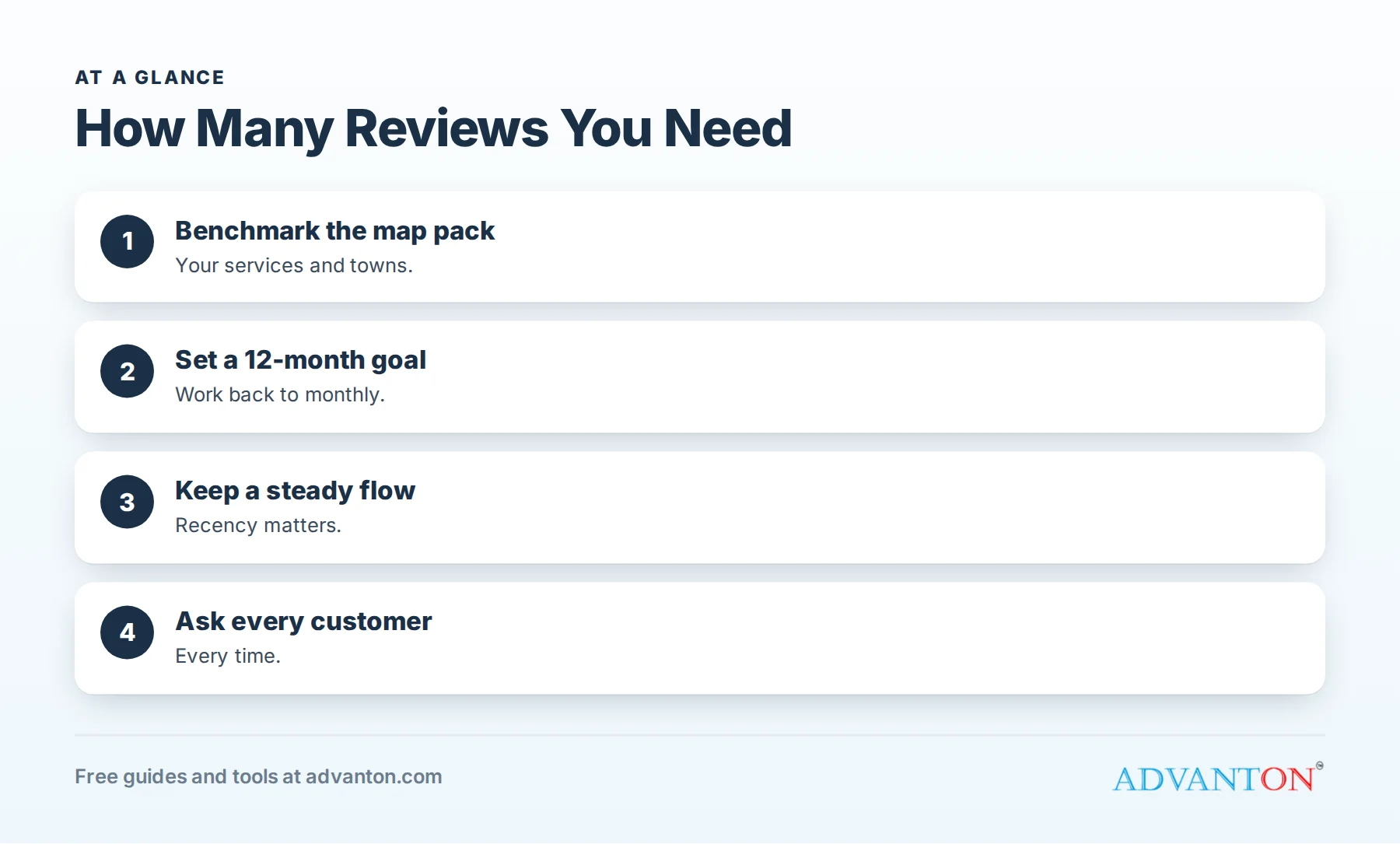
Why there’s no magic number
Table of Contents
| Factor | Why it changes your target |
|---|---|
| Market size | Big cities have more competitors with more reviews |
| Trade | Some trades (such as HVAC and plumbing) have high review volumes |
| Competition | You need to compare well with the businesses already ranking |
| Business age | Newer businesses start lower and grow |
A plumber in a large city may compete with businesses that have hundreds of reviews; a fence contractor in a small town may lead the area with a few dozen.
Benchmark against who’s ranking
- Search your main service and town, for example "roof repair [town]."
- Note the businesses in the map pack and their review counts and ratings.
- Repeat for your other main services and towns.
- Find the typical count among the top businesses.
Your first goal: get close to that range. Your longer-term goal: pass it.
| Example market | Top three review counts | A sensible 12-month goal |
|---|---|---|
| Small town fencing | 25, 40, 60 | 50+ |
| Suburban HVAC | 150, 220, 400 | 200+ |
| City plumbing | 300, 650, 1,100 | Steady growth toward 400+ |
These examples are illustrative; run the search for your own trade and area.
Count isn’t everything
| Factor | What homeowners and platforms notice |
|---|---|
| Rating | A strong average rating matters, but a perfect score with few reviews can look less credible than a slightly lower score with many |
| Recency | Recent reviews show you’re active and consistent |
| Steady flow | A few reviews every month beats a burst followed by silence |
| Detail | Reviews mentioning services and towns help customers and relevance |
| Replies | Thoughtful replies show you care |
Recency matters
Homeowners notice when the newest review is months old. A business with fewer but recent reviews can look more active than one with many old reviews. Aim for new reviews every week or month, depending on your volume.
Set a monthly goal
Work backward from your 12-month target:
- 12-month target: 200 reviews.
- Current count: 80.
- Reviews needed: 120.
- Monthly goal: 10 reviews.
If you complete 60 jobs a month, you need about one review for every six jobs, which is achievable when you ask every customer consistently.
Build reviews into every job
- Ask at the final walkthrough in person.
- Text the review link the same day.
- Send one gentle reminder a few days later.
- Track requests and reviews weekly.
See review request templates for messages.
Reply to every review
Replying to reviews shows future customers that you care about feedback. Thank happy customers personally, and respond calmly to concerns. See how to respond to negative reviews.
Where to focus
Focus your requests on Google for most contractors, plus the platforms that matter in your trade. See where contractors should get reviews.
Ratings: what’s realistic
A mix of mostly five-star reviews with an occasional lower rating looks natural to customers. Don’t worry about a single negative review among many positive ones; worry about patterns. If several reviews mention the same issue, fix the underlying problem.
Reviews and Local Services Ads
If you run Google Local Services Ads, your Google rating and review count appear on your ads and affect where they show. Building reviews improves both free and paid visibility. See Google Local Services Ads for contractors.
Track your progress
| Month | Total reviews | New reviews | Average rating | Top competitor count |
|---|---|---|---|---|
| January | ||||
| February | ||||
| March |
Review this table monthly with your team.
What not to do
- Don’t buy reviews or use review services; the FTC’s 2024 rule prohibits fake and purchased reviews.
- Don’t offer incentives for reviews.
- Don’t filter which customers you ask.
- Don’t post reviews from staff or family.
From zero to your first 25 reviews
New businesses feel the review gap most. To build your first 25 quickly and honestly:
- Ask every customer of your new business, without exception, including friends and neighbors who genuinely hired you. Reviews should reflect a real experience with this business.
- Take on small jobs early; each completed job is a chance for an honest review.
- Text the link the same day.
- Send one reminder.
- Thank every reviewer.
Most new contractors reach their first 25 within a few months when they ask consistently.
Reviews by business stage
| Stage | Focus |
|---|---|
| New (0 to 25 reviews) | Ask every customer; build the habit |
| Growing (25 to 100) | Benchmark competitors; set monthly goals |
| Established (100+) | Keep the flow steady; reply to every review; encourage detail |
| Market leader | Maintain recency; use reviews in ads, website and training |
Reviews per technician
Track reviews by technician or crew. Recognize those who generate the most reviews, and coach others on asking naturally. A small friendly competition, recognizing the month’s most-reviewed technician, can lift totals quickly, as long as no one pressures customers or offers incentives.
Plan for seasons
Review volume follows job volume. Ask consistently during busy seasons, when you complete the most jobs, to build a buffer for slower months. In quiet months, follow up with recent customers who haven’t reviewed yet.
What customers read in reviews
Homeowners scan for patterns: punctuality, communication, cleanliness, fair pricing and quality. Reviews that mention these details persuade more than generic praise. Encouraging customers to mention what you did and where helps future customers with similar projects.
Multiple locations
If you have several genuine locations, each with its own Business Profile, set review goals for each one. Customers look at the reviews for the location nearest them.
Reviews and your other marketing
Reviews make every other marketing channel work better. Homeowners who see your yard sign, postcard or ad often look up your reviews before calling. A strong, recent review profile turns that curiosity into calls; a thin or outdated one sends them to a competitor. That’s why building reviews pays off well beyond rankings. See neighborhood marketing for contractors.
Detailed reviews are worth more
A review that says "Great job!" helps a little; one that says "They replaced our water heater the same day, explained every option and left the basement spotless" helps a lot. Detailed reviews answer the questions future customers have and mention the services they’re searching for. You can encourage detail without scripting it: "If you mention what we did, it helps neighbors with the same problem find us."
Respond to reviews quickly
Aim to reply within a few days. Quick, personal replies show future customers that you pay attention, and they encourage more customers to leave reviews when they see that reviews are read and appreciated.
Reviews as a team scoreboard
Post your monthly review count and a few favorite review quotes where your team will see them, such as in the shop, the group chat or team meetings. When technicians see the impact of their work in customers’ words, asking for reviews becomes part of the culture rather than a chore.
Common mistakes
- Chasing a number without asking every customer.
- Bursts of requests followed by months of silence.
- Ignoring competitors’ counts.
- Not replying to reviews.
- Focusing on platforms that don’t matter for your trade.
Frequently asked questions
How many Google reviews does a contractor need?
Enough to compare well with the businesses already ranking for your main services and towns; benchmark them and set a 12-month goal.
Is it better to have more reviews or a higher rating?
Both matter. A strong rating with a healthy number of recent reviews is most persuasive.
How often should I get new reviews?
Regularly; aim for new reviews every week or month, depending on your job volume.
Do old reviews still count?
They still help, but recent reviews show customers you’re active.
What’s the fastest way to get more reviews?
Ask every satisfied customer the same day, with a direct link.
Do I need more reviews than my competitors?
Comparing well with businesses already ranking is a good goal; steady, recent reviews also matter.
Can friends and family leave reviews?
Only if they genuinely hired you and experienced your service; reviews must reflect real experiences.
Does responding to reviews help me get more reviews?
Often, yes. Customers who see thoughtful replies are more willing to leave their own reviews.
How Advanton helps
Advanton is a free resource for small businesses. Our free review request kit creates your review link and messages, and the lead source tracker helps you track progress. You can also add your business to the Advanton directory for free. Advanton earns money when you buy a domain or hosting through our store, which helps keep everything else free.
Keep learning
Sources
- Google Business Profile Help, Tips to improve your local ranking on Google
- BrightLocal, Local Consumer Review Survey 2026
Last reviewed October 30, 2026. Startup costs are estimates; check local prices, licensing and tax rules before you commit money.


Leave a Reply