
Every contractor eventually gets a negative review. A job runs late, a customer misunderstands the scope, a crew member has a bad day, or someone posts a complaint that isn’t fair at all. The review itself matters less than what happens next. Future customers read how you respond, and a calm, professional reply can actually build trust, showing that you take problems seriously and treat people fairly.
This guide gives contractors a simple process, reply templates and the rules to follow.
Why your response matters
Table of Contents
- Future customers read replies, often more closely than the review itself.
- A good reply can resolve the problem and sometimes leads customers to update their review.
- Silence looks like indifference.
- An angry reply damages your reputation more than the original review.
The five-step process
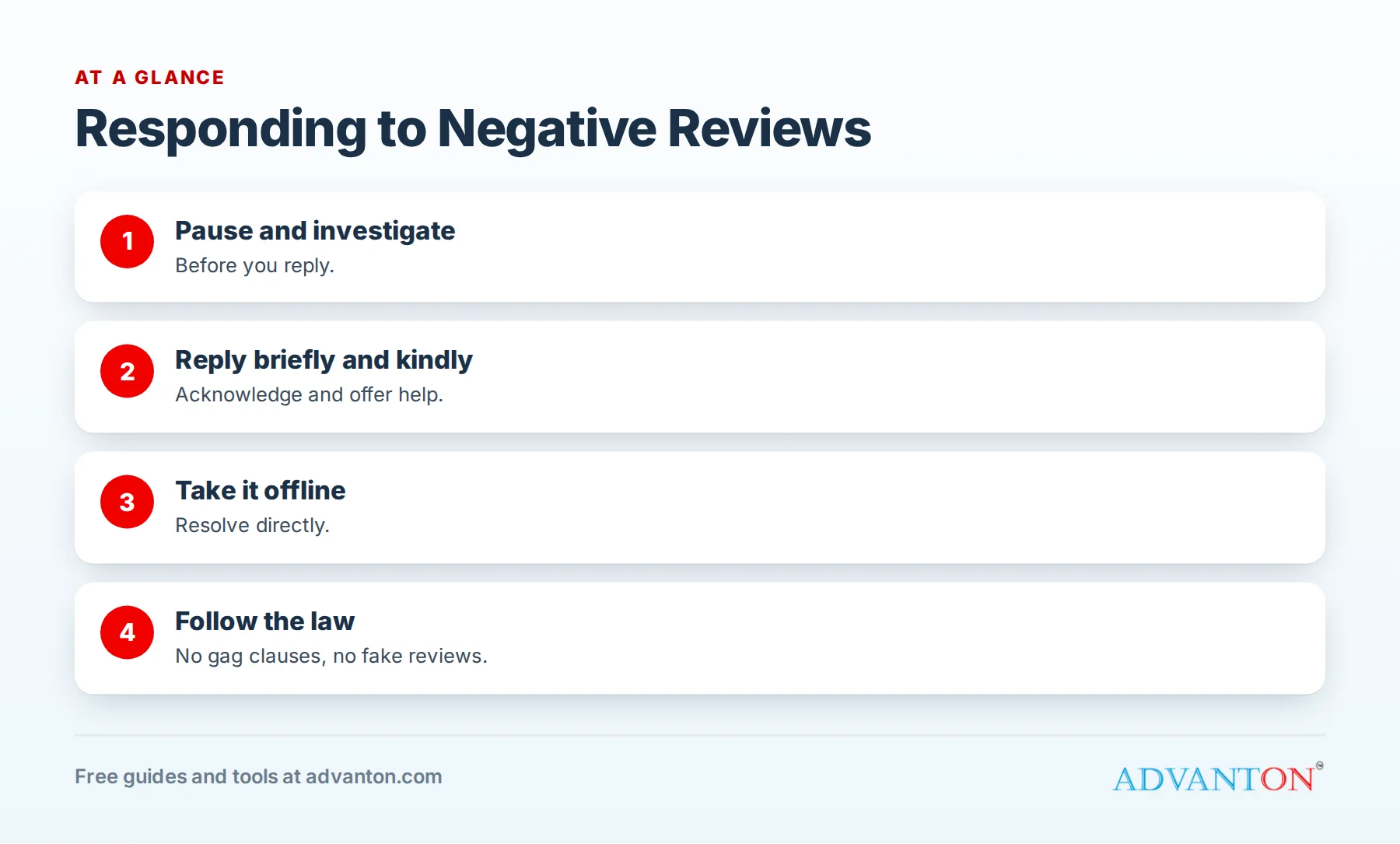
- Pause. Don’t reply while you’re upset. Wait a few hours if needed.
- Investigate. Check job records, photos, messages and talk to your team.
- Reply publicly, briefly and professionally. Thank them, acknowledge their experience, and offer to resolve it.
- Take it offline. Invite them to call or message you directly.
- Follow through, and update your reply if the issue is resolved.
Reply templates
Delay or scheduling problem:
"Thank you for your feedback, [Name]. You’re right that we didn’t meet the schedule we promised, and I’m sorry for the inconvenience. I’d like to make this right. Please call me directly at [number]. [Owner name], [Business]"
Pricing dispute:
"Thanks for sharing your concerns, [Name]. We aim to be clear about pricing upfront, and I’m sorry that didn’t happen here. I’d like to review the estimate and invoice with you. Please reach me at [number]."
Quality complaint:
"We’re sorry the work didn’t meet your expectations. Our workmanship is guaranteed, and we’d like to come back and take a look. Please call me at [number] so we can schedule a visit."
Review from someone who isn’t a customer:
"We take all feedback seriously, but we can’t find any record of working with you. If we’ve missed something, please contact us at [number] so we can look into it."
Partly unfair review:
"Thank you for your feedback. We’d like to clarify that [brief, factual explanation]. We’re still sorry you were disappointed and would welcome the chance to talk. Please call [number]."
Keep replies short, polite and specific. Don’t share private details about the customer or job.
What never to do
- Don’t argue or blame the customer publicly.
- Don’t reveal private information, such as addresses, payment details or personal circumstances.
- Don’t offer money in exchange for removing a review.
- Don’t threaten legal action in a public reply.
- Don’t post fake positive reviews to bury a negative one.
Flagging reviews that break the rules
Platforms remove reviews that violate their policies, such as spam, off-topic content, conflicts of interest or offensive language. If a review clearly breaks a platform’s rules (for example, it’s from a competitor or about a different business), report it through the platform’s process. Honest negative reviews generally won’t be removed, so respond to them instead.
The law on reviews
- The Consumer Review Fairness Act makes it illegal to use contract terms that prohibit or penalize customers for honest reviews. Don’t put "no negative reviews" clauses in your contracts.
- The FTC’s rule on consumer reviews and testimonials, effective in October 2024, prohibits fake reviews, buying reviews and certain review suppression practices. Never post fake reviews or pay for positive ones.
- Review platforms’ own rules (such as Google’s) also prohibit incentivized reviews and review gating.
Learn from every complaint
Negative reviews often point to fixable problems: communication gaps, scheduling issues or unclear estimates. Track complaints, look for patterns and change processes. A complaint that leads to a better estimate template or clearer scheduling prevents future problems.
Balance negatives with steady positive reviews
The best protection against one bad review is a steady stream of genuine positive reviews from happy customers. Ask every satisfied customer for a review, every time. See how to get more reviews as a contractor.
When a customer updates their review
If you resolve the issue, you can politely ask whether they’d consider updating their review, but never pressure or pay them. Many customers update reviews voluntarily after a good resolution.
A worked example
A painting company receives a one-star review about paint on a customer’s floor. The owner replies within a day, apologizes, offers to return and calls the customer. The crew cleans the floor and touches up a wall at no charge. The customer updates the review to four stars, mentioning how the owner handled it. Later customers mention that reply when they call. This example is illustrative, but common.
Respond on every platform
Negative reviews can appear on Google, Yelp, Facebook, Angi, Nextdoor and other sites. Check all of them regularly and reply on each. Yelp and Google allow public business responses; some platforms also allow private messages. Use the same calm approach everywhere.
When the reviewer is right
If the customer has a valid point, say so plainly and apologize. Explain what you’re doing to fix it and to prevent it from happening again. Owning mistakes builds more trust than any defense.
When the reviewer is wrong
If a review contains factual errors, correct them briefly and politely without attacking the reviewer. Future customers will judge the tone of your reply as much as the facts.
Train your team
Decide who responds to reviews (usually the owner or a manager) and share your process with the team. Crew members should never reply to reviews or contact reviewers on their own. Discuss negative reviews in team meetings as learning opportunities, not blame sessions.
Reply quickly
Aim to reply within a day or two. A quick, thoughtful response shows you’re attentive, and it may catch the customer before frustration grows.
Monitor your reviews
Turn on review notifications on each platform, or check weekly. Our free online presence checkup helps you see where your business is listed.
When reviews feel like an attack
Occasionally a business receives a sudden wave of negative reviews from people who aren’t customers, sometimes after a news story or online dispute. Don’t respond to each in anger. Document them, report them through each platform’s process and reply briefly and consistently.
Turn reviews into quality data
Collect every review, positive and negative, into a simple list and tag recurring themes: communication, timeliness, cleanliness, pricing clarity and workmanship. Every quarter, look for patterns. If several reviews mention slow callbacks, fix your phone process; if they praise a particular crew, learn what that crew does differently. Reviews are free customer research.
Prevent negative reviews before they happen
Many negative reviews come from surprises: unclear estimates, unexpected delays or missed callbacks. Set expectations in writing, update customers proactively and check in before the job ends with a simple question: "Is there anything we could do better before we wrap up?" Fixing a concern on site is far easier than responding to it online.
A reply checklist
Before posting any reply, check: Is it calm? Does it thank the reviewer and acknowledge their experience? Does it avoid private details? Does it offer a direct way to resolve the issue? Is it short? Would a future customer reading it feel reassured? If the answer to any of these is no, revise before posting.
Common mistakes
- Replying angrily or defensively.
- Ignoring negative reviews.
- Sharing private details.
- Trying to buy or force review removal.
- Never fixing the underlying problem.
Frequently asked questions
Should contractors respond to every negative review?
Yes, calmly and professionally, ideally within a day or two.
Can I get a negative review removed?
Only if it violates the platform’s policies; report it through the platform’s process. Otherwise, respond professionally.
Can my contract stop customers from leaving negative reviews?
No. The Consumer Review Fairness Act prohibits contract terms that restrict honest reviews.
Should I offer a refund to remove a review?
Don’t trade money for review removal. Resolve problems fairly, and let customers decide whether to update their review.
How many negative reviews hurt a business?
Customers look at the overall picture; steady positive reviews and thoughtful replies matter more than one bad review.
Should I respond to positive reviews too?
Yes. A short thank-you shows appreciation and tells future customers you value feedback.
Can I ask a customer to remove a negative review?
You can ask politely after resolving the problem, but never pressure or pay them; the choice is theirs.
Do replies help my ranking?
Google encourages businesses to respond to reviews; replies mainly help trust, which helps customers choose you.
How Advanton helps
Advanton is a free resource for small businesses. Use our free review request kit to build a steady stream of genuine reviews, and the online presence checkup to review your listings. You can also add your business to the Advanton directory for free. Advanton earns money when you buy a domain or hosting through our store, which helps keep everything else free.
Keep learning
Sources
- Federal Trade Commission, Consumer Review Fairness Act guidance for business
- Federal Trade Commission, Rule on the use of consumer reviews and testimonials (effective October 2024)
Last reviewed October 30, 2026. Startup costs are estimates; check local prices, licensing and tax rules before you commit money.


Leave a Reply