
Every growing business eventually faces the same question: grow using your own money and profits, or bring in outside money to grow faster? Bootstrapping means funding the business from savings and revenue. Raising money usually means borrowing (debt) or selling part of the business to investors (equity). Each path changes how fast you can grow, how much risk you take, and how much of the business you’ll own in the end.
There’s no single right answer. Most small businesses, such as local services, shops, trades and online stores, are best built by bootstrapping and modest borrowing. A small number of businesses with the potential to grow very large, very fast, are built with investor money. This guide helps you work out which describes yours.
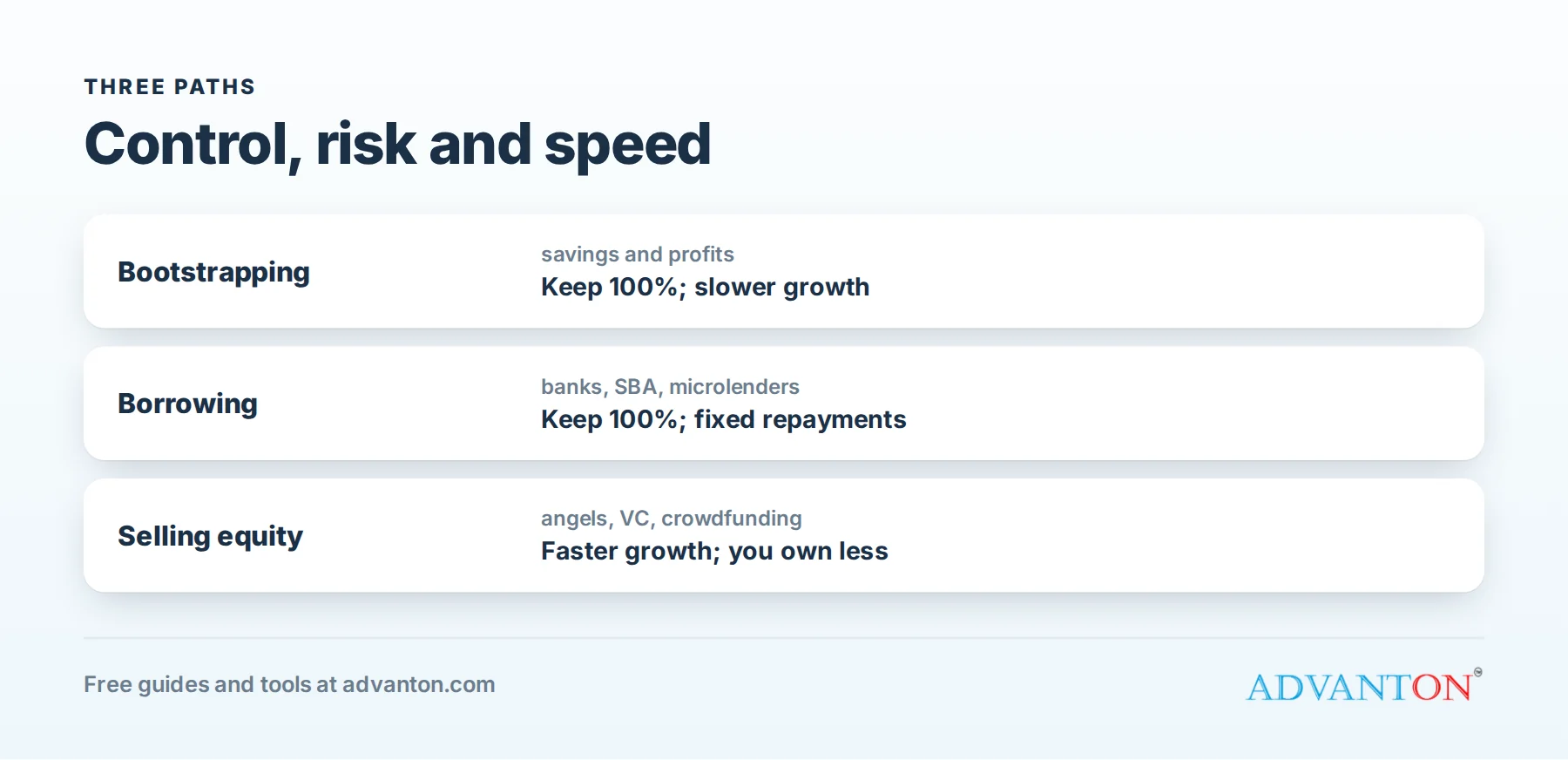
The three paths at a glance
Table of Contents
| Bootstrapping | Borrowing (debt) | Selling equity (investors) | |
|---|---|---|---|
| Where the money comes from | Savings and profits | Banks, credit unions, SBA lenders, microlenders | Angel investors, venture capital, equity crowdfunding |
| Ownership | You keep 100% | You keep 100% | You give up a share |
| Repayment | None | Fixed payments with interest | None, but investors expect a return through growth and an eventual sale |
| Speed of growth | Limited by your profits | Faster, within what you can repay | Fastest, when the business can use it |
| Personal risk | Your savings | Often a personal guarantee | Lower financial risk, but less control |
| Best for | Most small businesses | Businesses with steady cash flow and clear uses for money | Businesses that could grow very large, quickly |
Bootstrapping: growing on your own revenue
How it works: you start lean and reinvest profits to grow, adding staff, equipment and marketing only when sales pay for them.
Advantages
- Full ownership and control. Every decision, and every dollar of profit and of an eventual sale, is yours.
- Discipline. Spending only what you earn forces you to focus on what customers will pay for.
- No repayments or investor pressure.
Drawbacks
- Slower growth. Competitors with funding may grow faster.
- Personal financial strain, especially early on, when owners often pay themselves little.
- Missed opportunities that need money up front, such as a large order or a second location.
Bootstrapping works best for service businesses, businesses that are profitable from early on, and owners who value control and steady growth over speed.
Borrowing: growing with debt
How it works: you borrow for a specific purpose, such as equipment, inventory or a new location, and repay it from the profits that purchase helps create.
Advantages
- You keep full ownership.
- The cost is known: interest and fees, set in advance.
- Interest is generally a deductible business expense.
Drawbacks
- Payments are due whether sales are good or bad.
- Personal guarantees are common. According to the Federal Reserve’s 2026 Report on Employer Firms, 59% of small businesses with debt used a personal guarantee to get it.
- Approval isn’t guaranteed. Of businesses that applied for financing, the same report found 42% received the full amount, 36% part of it and 22% nothing.
Borrowing works best when you have, or will soon have, steady cash flow, and a specific use for the money that will clearly increase profits. See how to get a startup loan.
Selling equity: raising money from investors
How it works: investors give you money in exchange for a share of ownership. They earn a return only if the business becomes much more valuable, usually when it’s sold or goes public.
Advantages
- Larger amounts of money, with no monthly payments.
- Experience and connections: good investors bring advice, contacts and credibility.
- Shared risk: if the business fails, investors lose their money, not you personally (unless you’ve guaranteed something).
Drawbacks
- You own less. Every round of investment reduces your share.
- Investors expect fast growth, often aiming for a sale within several years.
- Shared control. Investors may get a board seat or veto rights over major decisions.
- Raising takes time: months of pitching, negotiating and legal work.
Equity works best for businesses with the potential to grow very large, such as technology, consumer brands with national reach, or businesses with high upfront costs before revenue. Most local small businesses aren’t a fit for venture capital, and that’s fine.
Bootstrapping tactics that work
- Charge from day one, even a little; it tests whether customers value what you offer.
- Take deposits and pre-payments so customers fund your materials and inventory.
- Sell services alongside products to bring in cash while products take off.
- Keep fixed costs low: work from home, rent equipment, use contractors before employees.
- Reinvest a set share of profit every month into growth, such as marketing or equipment.
- Watch cash weekly with a cash flow forecast.
Hybrid strategies
Few businesses use only one path. Common combinations:
- Bootstrap, plus a small loan for a specific purchase, such as a van or equipment, that clearly increases revenue.
- Customer-funded growth: pre-sales, subscriptions, memberships and deposits fund expansion without debt or investors.
- A line of credit for seasonal gaps, repaid when sales come in.
- Friends and family for an early boost, then bank loans once you have a track record.
A worked example: what ownership really costs
These figures are illustrative.
Selling 20% of your business. An investor puts in $250,000 when your business is valued at $1,000,000 before the investment. After the investment, the business is worth $1,250,000, and the investor owns $250,000 ÷ $1,250,000 = 20%.
Fast forward several years: the business earns $300,000 a year in profit.
- Bootstrapped, you own 100%: your share of the profit is $300,000.
- With the investor, you own 80%: your share is $225,000, and the investor’s is $75,000, every year, plus 20% of any sale.
If the investment helped the business grow much faster or larger than it could have alone, owning 80% of a bigger business can be worth far more than 100% of a smaller one. If it didn’t, the $250,000 was very expensive money.
Compare that with a loan. Borrowing $250,000 means interest and repayments for several years, but once it’s repaid, you own 100% of every future dollar.
SAFEs and convertible notes
Early-stage startups often raise money with a SAFE (simple agreement for future equity) or a convertible note. Investors give money now and receive shares later, usually when the company raises a larger round, often at a discount or capped valuation. For example, a $150,000 SAFE with a $3,000,000 valuation cap converts into roughly 5% of the company if the next round values it above the cap. These tools are quick and cheap to set up, but founders should still model how much ownership they’ll give up.
Equity crowdfunding: a middle path
Regulation Crowdfunding lets businesses sell small ownership stakes to the public, including customers, through SEC-registered platforms, raising up to $5 million in 12 months. It can turn loyal customers into investors, but it involves legal filings, ongoing reporting, and many small shareholders.
What investors expect in return
Investors take a big risk on young businesses, and most of their investments don’t succeed, so they look for businesses that could return many times their money. That usually means:
- A large market and a way to grow well beyond one location or region.
- A plan to sell the business, or another way for investors to get their money back, often within several years.
- Regular reporting and a say in major decisions.
- A capable team, because investors back people as much as ideas.
If your goal is a profitable, independent business you run for decades, those expectations may not fit.
Signs it may be time to raise money
- Customers are clearly buying, and demand outpaces what you can supply.
- Growth needs money before revenue, such as inventory for a big retail order or equipment for a large contract.
- A competitor with funding could take the market if you grow slowly.
- You’ve tested the numbers: each dollar invested reliably brings back more in profit.
A decision checklist
Answer these honestly:
- Can the business grow profitably on its own revenue, even if more slowly? If yes, bootstrapping is usually the best start.
- Do you have a specific use for money that would clearly increase profits, with cash flow to repay a loan? If yes, consider borrowing.
- Could the business realistically become very large, and does it need significant money before it earns revenue? If yes, investors may be the right fit.
- How important is control to you? If very important, favor bootstrapping and debt.
- How much personal risk can you take? Loans with personal guarantees put your assets at risk; equity shares the risk.
- What’s your goal: a business that supports your life for decades, or one you build to sell? Investors usually need the second.
Questions to ask before taking investor money
- What exactly will the money pay for, and how will it increase the business’s value?
- How much of the business will I own after this round, and after likely future rounds?
- What rights do investors get: board seats, vetoes, information rights, preferences when the business is sold?
- What does this investor expect, and by when?
- Who else has this investor backed, and what do those founders say about working with them?
- Could I reach the same goal with revenue, a loan or a smaller raise?
A common path: bootstrap first, raise later
Many successful businesses start bootstrapped, prove that customers will pay, and only then raise money, on much better terms. Investors pay more for a business with revenue and growth, and lenders approve businesses with a track record. Every month of proven sales improves your negotiating position, and lets you keep a larger share of what you build.
Common mistakes
- Raising money before proving demand, and giving up a large share at a low valuation.
- Taking investor money for a business that can’t grow fast enough to give investors the return they need.
- Borrowing to cover losses rather than to fund profitable growth.
- Not modeling ownership across future rounds.
- Skipping legal advice on investment terms.
Frequently asked questions
Is bootstrapping better than raising money?
For most small businesses, yes, at least at the start. It keeps you in control and forces focus. Raising makes sense when money would clearly create more value than it costs.
How much equity should I give an investor?
It depends on how much you raise and how the business is valued. Early rounds often involve selling a minority stake. Model it carefully, and get legal advice before agreeing.
Can I raise money without giving up equity?
Yes: loans, grants, customer pre-sales and revenue-based financing don’t require selling ownership.
Do lenders or investors prefer bootstrapped businesses?
Often, yes. A business that has grown on its own revenue has proven customers will pay, which makes it less risky for lenders and more valuable to investors, and gives you better terms either way.
Keep learning
- How to find investors for a small business
- How to fund a startup with no money
- Plan your numbers in the free Business Planner
Sources
- Federal Reserve Banks, 2026 Report on Employer Firms (Small Business Credit Survey)
- U.S. Securities and Exchange Commission, Regulation Crowdfunding
Last reviewed October 28, 2026. Startup costs are estimates; check local prices, licensing and tax rules before you commit money.


Leave a Reply