
Dropshipping is often sold as an easy, no-risk way to start an online store: list products, and a supplier ships them to your customers, so you never hold inventory. The model is real and it can work, but the "easy money" pitch hides the hard parts. Margins are often thin, advertising is expensive, and you’re responsible for the customer’s experience even though someone else ships the product.
Online shopping keeps growing: US e-commerce sales reached $340.2 billion in the second quarter of 2026, about 17.1% of all retail sales, according to the Census Bureau. This guide gives you an honest picture of how dropshipping works, what you actually keep from each order, the rules you must follow, and how to build something durable.
How dropshipping works
Table of Contents
- A customer buys a product from your online store.
- You pass the order and payment to a supplier.
- The supplier ships the product directly to the customer, ideally with your branding or without the supplier’s.
- You keep the difference between your price and the supplier’s price, minus all your other costs.
You own the customer relationship: marketing, customer service, refunds and complaints. In the customer’s eyes, you are the store, so every delay or quality problem from a supplier becomes your problem to solve. That’s why supplier choice and clear policies matter more than any marketing trick.
Dropshipping at a glance
| Topic | What to expect |
|---|---|
| Startup cost | Low: store platform, samples, branding and, most importantly, a marketing budget |
| License required? | A business license and sales tax registration where required |
| Typical margins | Often thin after product, shipping, payment fees and advertising |
| Biggest challenges | Advertising costs, shipping times, supplier quality, returns and customer service |
| Best for | Marketers who can find a niche and build a brand, not people looking for passive income |
A worked example: what you keep from one order
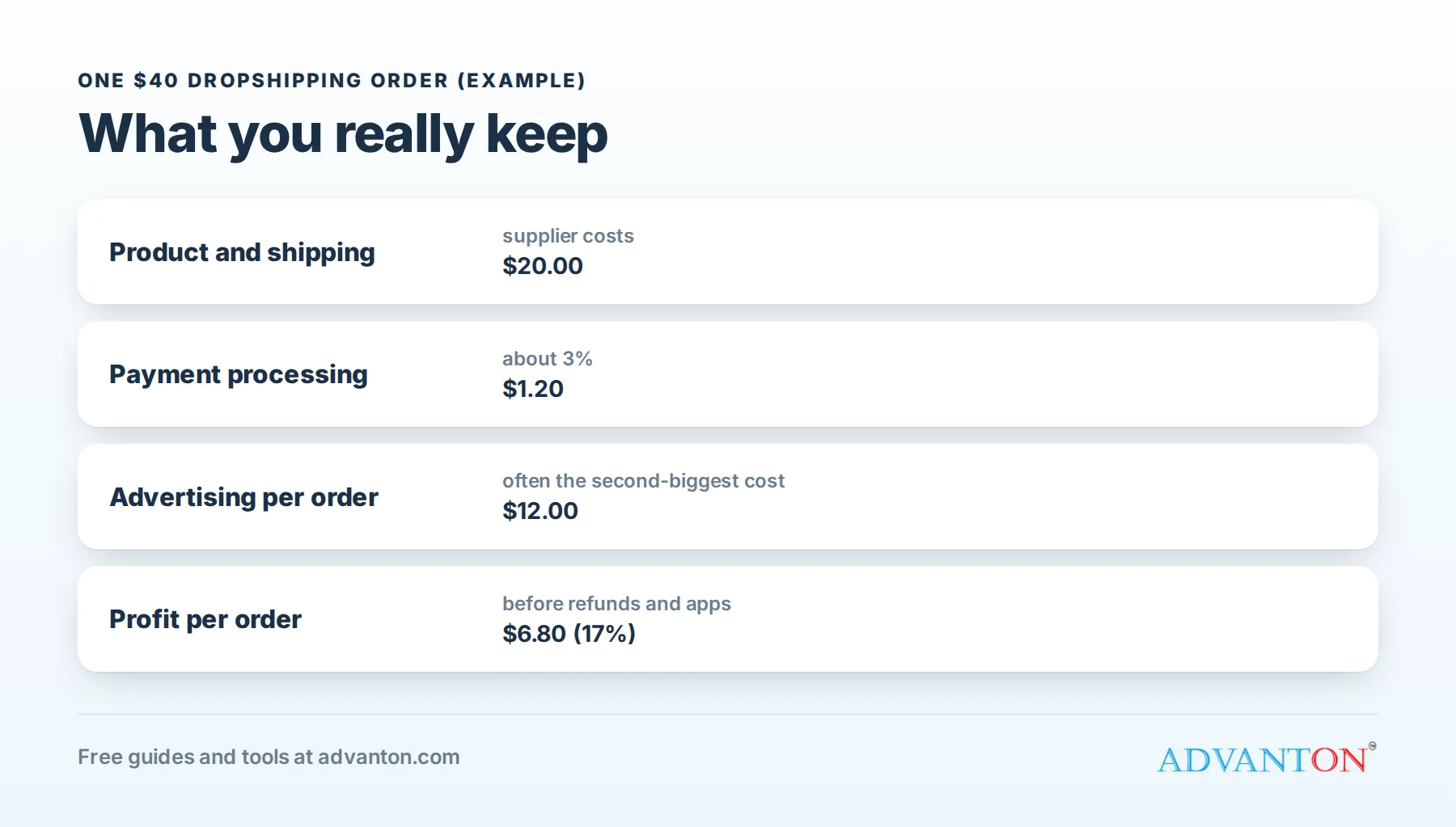
These are illustrative numbers for a single order.
| Amount | |
|---|---|
| Selling price | $40.00 |
| Product cost from supplier | $(14.00) |
| Shipping | $(6.00) |
| Payment processing (about 3%) | $(1.20) |
| Advertising cost per order | $(12.00) |
| Profit per order | $6.80 (17%) |
That’s before refunds, chargebacks, apps and your time. Notice that advertising is the second-largest cost. Many dropshipping stores fail because it costs more to win a customer than the first order earns. Profitable stores raise their average order value (bundles, upsells), win repeat customers and lower acquisition costs through content, email and organic social media.
Choose your niche and products
- Solve a specific problem for a specific group, such as gear for a hobby or products for new parents, rather than selling random trending items.
- Look for healthy margins: products you can sell for well above cost after shipping and fees.
- Avoid products that are fragile, regulated or often returned.
- Check safety rules: children’s products, cosmetics, electrical items and many others have safety and labeling requirements. You can be responsible as the seller even though a supplier made the product.
- Order samples and test quality, packaging and shipping time yourself before you sell.
Find reliable suppliers
| Supplier type | Pros | Cons |
|---|---|---|
| US-based wholesalers and dropshippers | Faster shipping; easier returns | Higher product costs |
| Overseas suppliers | Lower product costs | Longer shipping; quality and communication risks |
| Print-on-demand | Custom designs with no inventory | Lower margins; limited product types |
| Brands with dropship programs | Known products; reliable fulfillment | Price competition with other retailers |
Vet suppliers carefully: order samples, ask about shipping times, returns, branding options and stock levels, and agree terms in writing.
Choosing a store platform
Popular options include Shopify, WooCommerce (on WordPress) and BigCommerce, each with apps that connect to dropshipping suppliers and print-on-demand services. Compare:
- Monthly costs and transaction fees.
- Supplier integrations, so orders flow to suppliers automatically.
- Themes and mobile experience, since most shoppers buy on phones.
- Apps you’ll need, such as reviews, email and upsells, which add monthly costs.
- How easily you could move to another platform later.
Start simple: a clean theme, a handful of well-photographed products, and clear policies beat a cluttered store with hundreds of untested items.
The rules you must follow
The FTC’s Mail Order Rule. If you state a shipping time, you must have a reasonable basis to expect to ship within it; if you don’t state one, you must ship within 30 days. If you can’t ship on time, you must notify the customer and give them the option to cancel for a full refund. Long, uncertain overseas shipping times are a common way dropshippers break this rule.
Marketplace policies. Amazon allows dropshipping only if you are the seller of record: you must identify yourself as the seller on packing slips and invoices, remove any third-party seller information, and handle returns. Buying products from another online retailer and having them ship directly to your customers is prohibited. Other marketplaces have their own rules.
Sales tax. Since the Supreme Court’s 2018 Wayfair decision, states can require online sellers to collect sales tax once sales into the state pass a threshold. Marketplaces often collect it for you; your own store may need to register and collect.
Truthful advertising. Product claims and reviews must be honest; the FTC bans fake reviews.
Startup costs to plan for
| Item | What to budget for |
|---|---|
| Store platform and apps | Monthly subscriptions |
| Domain and branding | Logo, design and product photography |
| Samples | Testing products and suppliers |
| Advertising | The largest early cost for most stores |
| Business setup | LLC, sales tax registration |
Marketing channels compared
| Channel | Pros | Cons |
|---|---|---|
| Paid social ads | Fast to test; precise targeting | Costs rise with competition; easy to overspend |
| Search ads | Reach people already looking to buy | Competitive keywords are expensive |
| Organic social and short video | Low cost; builds a brand | Takes time and consistency |
| SEO and content | Free traffic over time | Slow to build |
| Email and SMS | Cheapest way to drive repeat sales | Requires building a list first, with permission |
| Influencer partnerships | Borrowed trust | Must be disclosed under FTC rules; results vary |
Track the cost to acquire a customer for each channel, and compare it with how much a customer is worth over time, not just the first order.
Customer service and returns
Customers blame you, not your supplier, for late, damaged or wrong orders. Set clear expectations on your website (shipping times, returns and refunds), answer messages within a day, and make returns straightforward. Agree with suppliers who pays for returns and replacements before you start selling, because these costs can wipe out your margin.
When to hold your own inventory
Once a product sells consistently, buying inventory in bulk (and storing it yourself or with a fulfillment company) usually lowers your product cost, speeds up shipping, improves packaging and gives you control over quality. Many successful brands start by dropshipping to test demand, then switch their best sellers to stocked inventory.
Build a brand, not just a store
- Own your audience: collect emails and build an email list from day one.
- Create useful content: guides, videos and reviews that attract customers without paid ads.
- Offer great service: clear shipping times, fast replies and easy returns.
- Consider moving to inventory for your best sellers, which improves margins, shipping times and quality control.
Common mistakes to avoid
- Chasing trending products with no brand or niche.
- Ignoring shipping times and the FTC’s rules.
- Not testing suppliers before selling.
- Spending heavily on ads before knowing your customer acquisition cost.
- Breaking marketplace policies, risking account suspension.
Your first 90 days
- Choose a niche you understand.
- Find and test three suppliers with sample orders.
- Set up your store with clear shipping and return policies.
- Calculate your break-even advertising cost per order.
- Start with small, focused ad tests and organic content.
- Collect emails and ask early customers for reviews.
Frequently asked questions
Is dropshipping legal?
Yes, when done properly: following consumer protection rules, marketplace policies, product safety requirements and tax obligations.
Is dropshipping profitable?
It can be, but margins are often thin once advertising is included. Profitable stores build brands, repeat customers and higher order values.
Can I dropship on Amazon?
Only as the seller of record, following Amazon’s dropshipping policy. Buying from another retailer and having it ship directly to your customer isn’t allowed.
How long should shipping take?
As long as you clearly promise, and no longer. Under the FTC’s rule, you must ship within the time stated, or within 30 days if no time is stated, unless you notify the customer and offer a refund.
How many products should I start with?
Fewer than most people think. A focused store with five to twenty well-chosen, well-presented products in one niche is easier to market and manage than a store with hundreds of random items.
Do I need an LLC to dropship?
Not legally, but an LLC separates your personal assets from business risks such as product liability claims. See our guide to choosing a business structure.
What about print-on-demand?
Print-on-demand suppliers print your designs on shirts, mugs and posters as orders arrive. It avoids inventory and lets you build an original brand, but margins are thinner, so original designs and a clear audience matter.
Keep learning
Sources
- Federal Trade Commission, Business guide to the Mail, Internet, or Telephone Order Merchandise Rule
- Amazon Seller Central, Drop shipping policy
- US Census Bureau, Quarterly Retail E-Commerce Sales, Q2 2026
- US Consumer Product Safety Commission, Business guidance
Last reviewed October 26, 2026. Startup costs are estimates; check local prices, licensing and tax rules before you commit money.


Leave a Reply