
Fulfillment by Amazon (FBA) lets you sell to Amazon’s enormous customer base while Amazon stores your inventory, ships orders (often with Prime delivery), handles returns and answers delivery questions. For many small brands, it’s the fastest way to reach national customers. But FBA is a fee-heavy business, and profit depends on understanding every cost per unit before you order inventory.
This guide covers how FBA works, the 2026 fee changes, a worked profit-per-unit example, how to choose products, protect your brand and manage inventory, and the risks to plan for.
How FBA works
Table of Contents
- You source a product (often your own brand) from a manufacturer.
- You ship inventory to Amazon, following its preparation and labeling rules.
- Amazon stores your products in its fulfillment centers.
- Customers buy on Amazon; Amazon picks, packs, ships and handles returns.
- Amazon pays you the sale price minus its fees.
You’re responsible for product sourcing, listing quality, advertising, pricing, compliance and keeping inventory in stock.
Amazon FBA at a glance
| Topic | What to expect |
|---|---|
| Startup cost | Moderate: inventory is the main cost, plus samples, branding, photography and advertising |
| What Amazon charges | Referral fees (commonly 8% to 15% by category, 15% in most), FBA fulfillment fees per unit, storage, inbound placement and other fees |
| 2026 changes | Fulfillment fees rose about $0.08 per unit on average from January 15, 2026, and a 3.5% fuel and logistics surcharge applies to fulfillment fees from April 17, 2026 |
| Best for | Product-focused entrepreneurs who can manage suppliers, inventory and advertising |
The 2026 fee picture
Amazon announced its 2026 US fee changes in October 2025, effective January 15, 2026:
- Referral fee percentages stayed unchanged for 2026.
- FBA fulfillment fees rose an average of about $0.08 per unit, varying by size and weight tier.
- A 3.5% fuel and logistics surcharge applies on top of FBA fulfillment fees in the US and Canada from April 17, 2026.
- Inbound placement fees charge for distributing your inventory across Amazon’s network; choosing Amazon-optimized splits or other options can reduce them.
- Low-inventory-level fees apply when stock runs low relative to demand, but new products are exempt for their first 180 days after the first FBA sale.
- Storage and aged-inventory fees rise for slow-moving stock.
Amazon also offers incentives for new sellers’ first products through its FBA New Selection program. Check Seller Central for current details, because fees change at least yearly.
A worked example: profit per unit
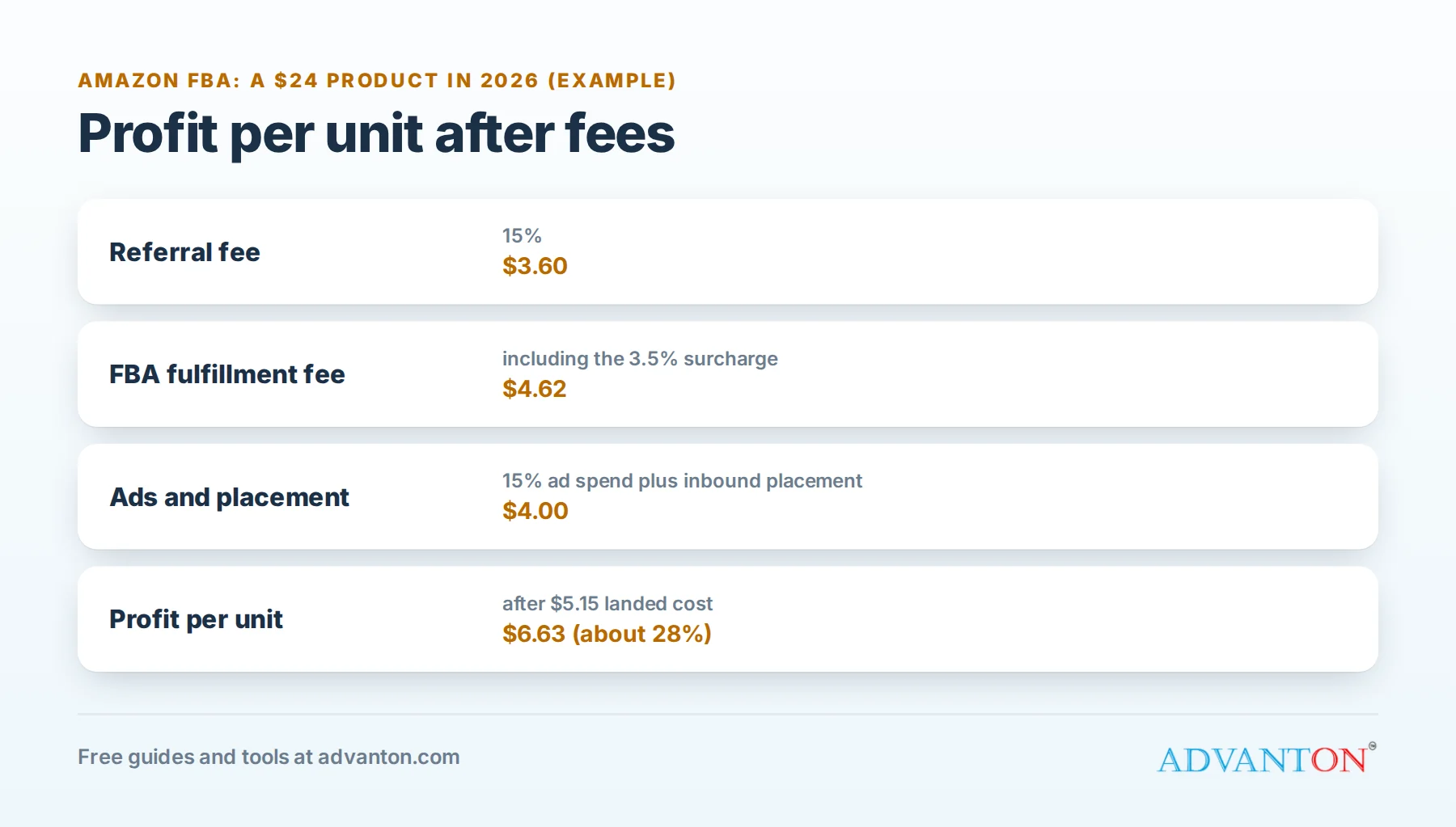
These are illustrative numbers based on a 2026 example breakdown for a $24 product.
| Per unit | |
|---|---|
| Selling price | $24.00 |
| Referral fee (15%) | $(3.60) |
| FBA fulfillment fee, including the 3.5% surcharge | $(4.62) |
| Inbound placement fee (typical) | $(0.40) |
| Advertising (15% of sales) | $(3.60) |
| Landed product cost (manufacturing plus shipping to Amazon) | $(5.15) |
| Profit per unit | $6.63 (about 28%) |
Storage, returns, coupons and your own overhead reduce this further. Run these numbers for every product idea before ordering inventory; many products that look profitable on price alone lose money after fees and advertising. Amazon’s revenue calculator in Seller Central estimates fees for a specific product, and a simple spreadsheet lets you test different prices, ad budgets and costs.
Choose the right product
- Healthy margins after every fee and advertising.
- Small, light and durable, which keeps fulfillment fees and damage low.
- Steady demand, not a short-lived trend.
- Room to stand out: better quality, design, bundles or branding than existing listings.
- Not restricted or heavily regulated: some categories require approval, and many products have safety and compliance requirements.
- Reviews and complaints on competitors reveal what customers want improved.
Sourcing and inventory
- Order samples from several manufacturers and compare quality.
- Negotiate price, minimum order quantities, packaging and payment terms.
- Inspect production before shipping, especially from overseas.
- Plan restocks carefully: include production time, shipping, and Amazon’s check-in time, so you avoid stockouts (and low-inventory fees) without overstocking (and storage fees).
- Consider fulfilling some orders yourself (FBM) for oversized or slow-moving items.
Create a listing that sells
- Title: the product name, key feature and important details customers search for, written for people rather than stuffed with keywords.
- Images: a clean main image on white, plus lifestyle photos, size comparisons and close-ups.
- Bullet points: the main benefits, answers to common questions and what’s included.
- Description or A+ content: brand-registered sellers can add richer content with images and comparison charts.
- Accurate details: dimensions, materials and compatibility, which reduce returns and complaints.
Advertising basics
Most new products need advertising to get seen. Amazon’s Sponsored Products ads appear in search results and on product pages, and you pay per click. Two numbers to track:
- ACoS (advertising cost of sale): ad spend divided by ad-attributed sales. It shows how efficient your ads are.
- TACoS (total advertising cost of sale): ad spend divided by total sales. It shows how dependent your business is on advertising.
Start with focused campaigns, cut keywords that spend without selling, and raise bids on those that convert profitably.
Building reviews the right way
Reviews drive sales on Amazon, but they must be earned honestly. Brand-registered sellers can use Amazon Vine, which offers products to trusted reviewers for honest reviews, and Amazon’s "Request a Review" button sends a compliant request after delivery. Never offer incentives for positive reviews, ask friends to review, or try to remove negative reviews improperly; these break Amazon’s policies and the FTC’s rules on reviews.
Protect your brand
- Register a trademark. Amazon Brand Registry, which gives you more control over your listings and tools to report counterfeits, requires a registered or pending trademark. See how to trademark a business name.
- Use quality photos and clear, accurate listings.
- Build reviews honestly through Amazon’s approved programs; never buy or manipulate reviews.
- Sell beyond Amazon too: your own website reduces dependence on one platform.
Startup costs to plan for
| Item | What to budget for |
|---|---|
| Inventory | Your first production run, the largest cost |
| Samples and inspection | Testing products and checking quality |
| Branding and packaging | Logo, packaging design, labels |
| Photography and listing | Professional photos and copy |
| Seller account and tools | Professional seller plan, research and accounting tools |
| Advertising | Launch campaigns |
| Trademark | USPTO filing; see our trademark guide |
FBA or fulfill orders yourself?
| FBA (Amazon fulfills) | FBM (you fulfill) | |
|---|---|---|
| Prime eligibility | Yes | Only through Amazon’s seller-fulfilled Prime program, with strict standards |
| Who ships and handles returns | Amazon | You |
| Costs | FBA fees, storage and inbound placement | Your own shipping, packaging, labor and storage |
| Best for | Small, fast-selling products | Oversized, slow-moving, fragile or high-value items |
| Your workload | Lower day to day | Higher, but more control |
Many sellers use FBA for their best sellers and fulfill the rest themselves.
Taxes and accounting
Amazon generally collects and remits sales tax on marketplace orders in states with marketplace facilitator laws, but you may still need to register in some states, especially where your inventory is stored. Track every fee in your bookkeeping; see best free accounting software.
Risks to plan for
- Fee increases that squeeze margins.
- Account suspensions for policy violations or complaints, which can halt sales overnight.
- Competition and copycats, especially for simple products.
- Inventory risk: unsold stock costs money to store, return or dispose of.
- Advertising costs that rise as competition grows.
Common mistakes to avoid
- Ordering inventory before running full fee calculations.
- Choosing heavy, bulky or fragile products with high fees.
- Running out of stock, which hurts rankings.
- Ignoring Amazon policies on reviews, listings and product safety.
- Depending entirely on Amazon with no other sales channel.
Your first 90 days
- Research ten product ideas and calculate full profit per unit.
- Order samples from three suppliers for your best idea.
- File your trademark application.
- Set up your seller account, business and bookkeeping.
- Order a modest first production run and create a strong listing.
- Launch with a focused advertising budget, and track profit per unit weekly.
Frequently asked questions
How much does Amazon take from each sale?
Referral fees are commonly 8% to 15% depending on category, plus per-unit FBA fulfillment fees, storage and other fees. Total fees often take a large share of the sale price, so calculate them per product.
Did Amazon fees go up in 2026?
Fulfillment fees rose about $0.08 per unit on average from January 15, 2026, a 3.5% fulfillment surcharge applies from April 17, 2026, and referral fee percentages stayed the same.
Do I need a trademark to sell on Amazon?
Not to sell, but Brand Registry, which protects your listings, requires a registered or pending trademark.
FBA or fulfill orders myself?
FBA offers Prime shipping and convenience at a cost; fulfilling yourself (FBM) can be cheaper for oversized, slow-moving or high-value items. Many sellers use both.
How much money do I need to start Amazon FBA?
Enough for samples, your first inventory order, branding, photography, your trademark and a launch advertising budget. Inventory is usually the largest cost, so start with a modest first order to test demand before scaling.
Can I sell on Amazon without FBA?
Yes. Fulfilling orders yourself (FBM) avoids FBA fees but means handling storage, packing, shipping and returns.
Keep learning
Sources
- Amazon Selling Partners, Update to US referral and FBA fees for 2026
- Amazon Seller Central, 2026 US FBA fulfillment fee changes (3.5% surcharge)
- ConnectBooks, Amazon FBA fees in 2026 (June 2026)
- Seller Labs, Amazon FBA fee changes in 2026
Last reviewed October 26, 2026. Startup costs are estimates; check local prices, licensing and tax rules before you commit money.


Leave a Reply