
Busy professionals, families, athletes and older adults all pay for healthy meals they don’t have to cook. A meal prep delivery business cooks in batches, packages meals and delivers them on a fixed weekly schedule. Compared with a restaurant, you know your orders in advance, waste less food and earn recurring subscription revenue, which makes planning and purchasing far easier.
This guide covers choosing your niche, kitchens and permits, labeling rules, menu and packaging, pricing, delivery, a worked weekly example and how to find your first subscribers.
Meal prep delivery at a glance
Table of Contents
| Topic | What to expect |
|---|---|
| Startup cost | Low to moderate: rented commercial kitchen, packaging, labels, delivery setup and an ordering website |
| License required? | Yes: health department permit for a licensed kitchen, food safety certification and a business license |
| Business model | Weekly orders or subscriptions with set delivery days |
| Best for | Organized cooks who like systems, consistency and nutrition |
Choose your niche
| Niche | What customers want | Notes |
|---|---|---|
| Fitness | High-protein, portion-controlled meals with macros | Partner with gyms and trainers |
| Busy families | Ready-to-heat family dinners | Larger portions; kid-friendly options |
| Dietary needs | Gluten-free, plant-based, low-sodium or diabetes-friendly | Requires careful ingredients and labeling |
| Older adults | Easy-to-eat, nutritious meals | Reliable delivery and clear heating instructions |
| Corporate | Healthy weekday lunches | Bulk orders; weekday schedule |
A clear niche makes your menu, marketing and partnerships much easier.
Step 1: Find a licensed kitchen
Meal prep involves perishable cooked foods, so most states require a licensed commercial kitchen; cottage food laws rarely cover it. Start in a commissary or shared-use kitchen that rents by the hour or month, then move to your own space once volume justifies it.
Step 2: Permits and food safety
- Health department permit and inspection for your operation.
- Certified food protection manager on staff (required in many areas), and food handler training for everyone.
- Safe cooling, holding and reheating, following your health department’s rules (most are based on the FDA Food Code).
- Business license and insurance: general and product liability, plus commercial auto for delivery.
Step 3: Label every meal correctly
Packaged meals need clear labels. Typically:
- The name of the food.
- Ingredients, in order of weight.
- Major food allergens. The FDA identifies nine: milk, eggs, fish, crustacean shellfish, tree nuts, peanuts, wheat, soybeans and sesame.
- Net weight.
- Your business name and address.
- A use-by date and storage and reheating instructions.
Be careful with claims. Calorie and macro counts must be accurate, so use consistent portions and recipes. Claims such as "keto", "heart-healthy" or "low sodium" should be truthful and, where federal definitions apply, meet them. Ask your health department about local labeling requirements.
Step 4: Design your menu and packaging
- A rotating menu of a few dishes each week keeps prep efficient and customers interested.
- Dishes that reheat well: grain bowls, stews, roasted proteins and vegetables hold up better than fried or crispy foods.
- Packaging that’s microwave-safe (if intended), seals tightly and stacks well. Some businesses run reusable container programs with a deposit.
- Consistent portions, weighed every time, so labels stay accurate.
Choosing packaging
Packaging affects food quality, customer experience and your margins, so compare options carefully:
| Option | Strengths | Trade-offs |
|---|---|---|
| Plastic microwave-safe containers | Affordable, sturdy, easy to stack and seal | Some customers prefer to avoid plastic |
| Compostable or fiber containers | Appeal to eco-conscious customers | Often cost more; some don’t seal as well or tolerate microwaving |
| Aluminum trays | Oven-safe; good for family meals | Can’t go in the microwave |
| Reusable containers with a deposit | Lower waste; strong brand loyalty | Collection, washing and sanitizing take time |
Whatever you choose, test it for real: pack a meal, refrigerate it for three days, reheat it as a customer would, and check for leaks, sogginess and taste. Only make environmental claims (such as "compostable") you can back up.
Startup costs to plan for
| Item | What to budget for |
|---|---|
| Kitchen rental | Weekly prep days at a commissary |
| Packaging and labels | Containers, sleeves, label printer and stock |
| Equipment | Batch cooking, cooling and portioning tools (some commissaries provide these) |
| Delivery | Insulated bags or coolers; a refrigerated vehicle as you grow |
| Permits and certification | Health permit, food manager certification and business license |
| Insurance | Liability and commercial auto |
| Ordering website | Menus, subscriptions, payments and delivery zones |
| Marketing | Photos, launch offers and partnerships |
How to price meal prep
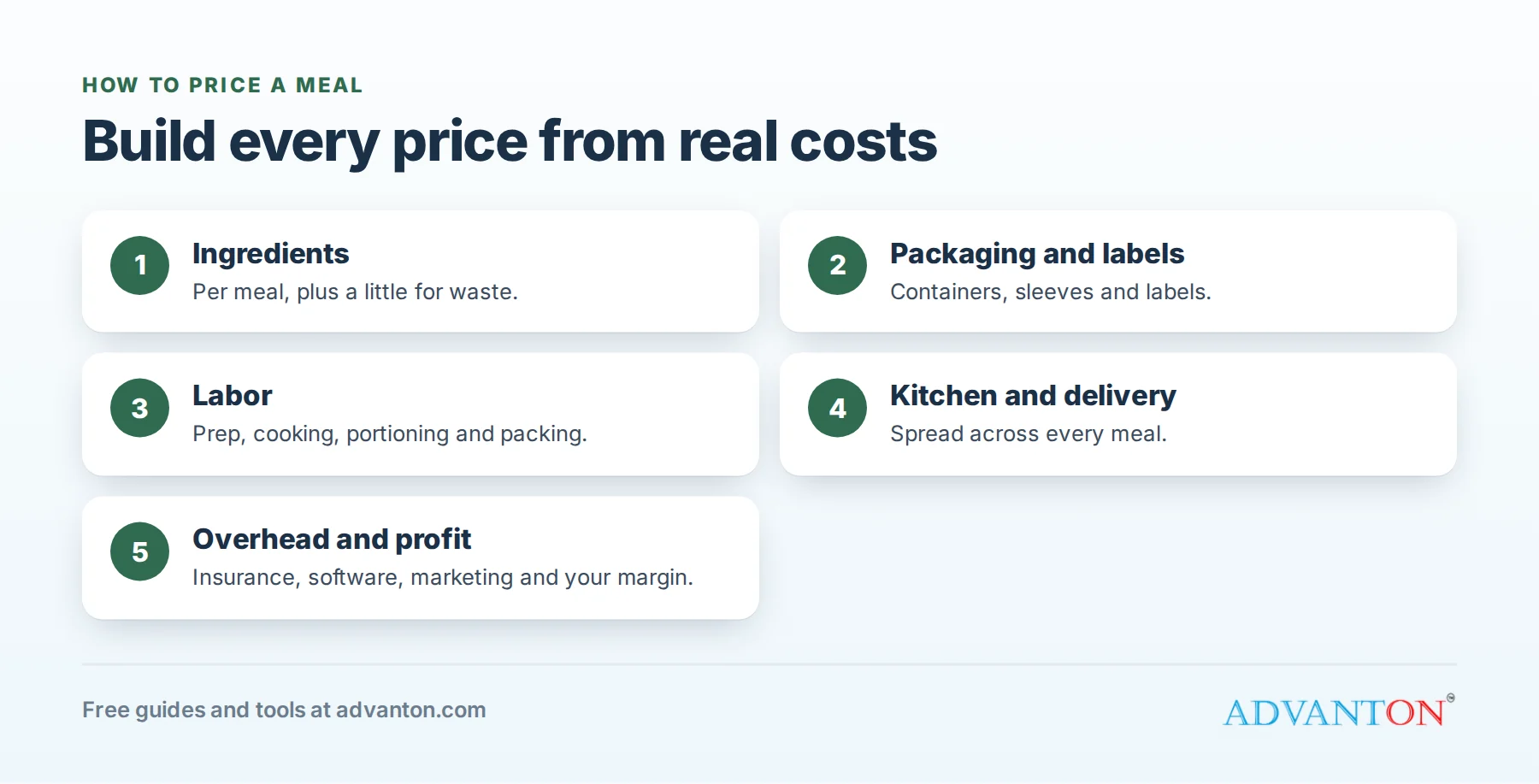
Build each meal’s price from its real costs:
- Ingredients per meal, plus a little for waste.
- Packaging and labels.
- Labor: prep, cooking, portioning and packing.
- Kitchen rental and delivery, spread across meals.
- Overhead and profit.
Then decide how you’ll sell:
- Per meal, with discounts for larger weekly orders.
- Weekly or monthly subscriptions, which make revenue and purchasing predictable.
- Delivery fees, or free delivery above an order minimum.
Our pricing calculator and break-even calculator help you find the price and volume you need.
A worked example: one prep day a week
These are illustrative assumptions to show how the numbers fit together, not market prices. Check prices charged by local competitors before setting yours.
| Assumption | Weekly | |
|---|---|---|
| Orders | 60 customers, 8 meals each = 480 meals, at $13 per meal | $6,240 |
| Ingredients | $4.00 per meal | $(1,920) |
| Packaging and labels | $0.80 per meal | $(384) |
| Kitchen rental | Two days | $(500) |
| Staff | Two helpers on prep and packing days | $(800) |
| Delivery | Fuel and a part-time driver | $(450) |
| Software, payment fees, insurance and marketing | $(500) | |
| Profit before owner pay and taxes | $1,686 |
The levers are ingredient cost per meal (smart menus and buying), order size per customer (bundles), delivery density (tight zones and pickup points) and retention (subscribers who stay for months).
Cool food safely
Meal prep depends on cooling large batches safely, which is where many new businesses slip up. The FDA Food Code, which most states base their rules on, requires cooked food to cool from 135°F to 70°F within 2 hours, and to 41°F or below within 6 hours in total. To get there:
- Cool in shallow pans rather than deep pots, and portion hot food into smaller containers.
- Use ice baths or blast chillers where your kitchen has them.
- Keep finished meals at 41°F or below in storage and during delivery.
- Log temperatures for each batch.
The tech you’ll need
- An ordering website with weekly menus, subscriptions, order cutoffs and delivery zones.
- Payments with automatic billing for subscribers.
- Production reports that turn orders into a prep list: how many portions of each dish to cook.
- A label printer linked to your menu, so allergens and dates are always right.
- Route planning for deliveries.
Many meal prep platforms combine ordering, subscriptions and production reports, so compare a few before you launch.
Delivery logistics
- Set fixed delivery days and zones, and plan efficient routes.
- Keep food cold in insulated bags with ice packs or a refrigerated vehicle.
- Offer pickup points at gyms, offices or cafés to cut delivery costs.
- Communicate: delivery windows and text alerts reduce missed deliveries.
How to find customers
- Partner with gyms, personal trainers, dietitians and wellness businesses, often with a discount for their members.
- Offer a trial week at a small discount.
- Post your weekly menu on social media with appetizing photos.
- Reward referrals, since happy subscribers bring friends.
- Target offices with weekly lunch subscriptions.
- Build an ordering website with menus and subscriptions, and ask every customer for a review.
Keep your subscribers
Winning a new customer costs far more than keeping one, so retention is where meal prep businesses make their money:
- Rotate the menu weekly or fortnightly, with a few permanent favorites people can count on.
- Make pausing easy. Customers who can skip a week for a vacation stay subscribed; customers who must cancel often don’t come back.
- Ask for feedback on every new dish, and retire the ones people skip.
- Reward loyalty: a free meal after a set number of weeks, or a discount for prepaying a month.
- Watch your delivery reliability. Late or warm deliveries are the fastest way to lose subscribers.
Our guide to keeping customers coming back has more ideas.
Common mistakes to avoid
- Cooking at home when your state requires a licensed kitchen.
- Inaccurate labels, especially allergens and nutrition claims.
- Menus that don’t reheat well.
- Delivering to too wide an area, so delivery costs eat your margin.
- Pricing without costing every meal.
Your first 90 days
- Choose your niche and confirm health department requirements.
- Book a commissary kitchen and get your permits.
- Test five to eight dishes for taste, reheating and cost.
- Create compliant labels and choose packaging.
- Set up ordering, subscriptions, payments and delivery zones.
- Launch with a trial offer through two or three local partners.
- Ask every customer for feedback and a review.
Frequently asked questions
Can I start a meal prep business from home?
In most states, no. Meal prep involves perishable cooked foods, which usually must be prepared in a licensed commercial kitchen. Check your state and local health department.
What must a meal prep label include?
Typically the food name, ingredients, major allergens, net weight, your business name and address, and a use-by date with storage and heating instructions. Nutrition and health claims must be accurate.
Are subscriptions better than one-off orders?
Subscriptions make revenue and purchasing predictable and reduce waste, so most meal prep businesses encourage them, while still offering one-off orders to attract new customers.
Keep learning
- Restaurants and food service industry profile
- How to start a catering business
- Cottage food business
Sources
- US Food and Drug Administration, Food allergies: what you need to know
- US Food and Drug Administration, Food labeling and nutrition
- US Food and Drug Administration, Food Code
Last reviewed October 26, 2026. Startup costs are estimates; check local prices, licensing and tax rules before you commit money.


Leave a Reply