
Catering lets you build a food business around the parts many cooks love most: creating menus, cooking for a crowd and making events memorable, without the fixed costs of running a full-time restaurant. You can start with drop-off lunches for local offices, grow into weddings and private events, and scale at your own pace.
The trade-off is that catering is regulated like any food business, the work is intense around events, and pricing mistakes are easy to make. This guide covers the rules, your kitchen options, what clients actually pay, how to price a menu for profit, a worked event example, and how to fill your calendar.
Catering at a glance
Table of Contents
| Topic | What to expect |
|---|---|
| Startup cost | Low to moderate: start in a rented commercial kitchen with transport and serving equipment |
| License required? | Yes: health department permits, food safety certification and a business license; a liquor license or licensed partner for alcohol |
| What clients pay | Drop-off often $10 to $20 per person; corporate buffets $15 to $40; weddings about $80 per guest on average |
| Best for | Organized cooks who thrive under pressure and enjoy working with clients |
Catering vs cottage food: an important difference
Most states let people sell certain low-risk foods made at home, such as baked goods, under cottage food laws. But those laws usually don’t cover catering, because catering involves perishable foods (meat, dairy, cooked dishes) served to the public. In most places, caterers must prepare food in a licensed commercial kitchen and hold a health department permit. Always check your state and county rules first. See our cottage food business guide for what home kitchens can do.
Choose your niche
| Niche | What clients want | Pros | Cons |
|---|---|---|---|
| Corporate drop-off | Reliable office lunches and meeting food | Weekday work; repeat orders; low staffing | Lower price per person |
| Corporate events | Buffets and receptions for meetings and parties | Bigger orders; professional clients | Tight timelines |
| Weddings | Tastings, plated or buffet dinners, full service | Highest value per event | Seasonal; weekends; high expectations |
| Private parties | Birthdays, showers, holidays | Flexible; good word of mouth | Smaller budgets |
| Specialty | A cuisine or dietary focus (vegan, gluten-free, kosher, halal, BBQ, grazing boards) | Easier to stand out | Narrower market |
Many caterers start with corporate drop-off, which builds steady weekday income, then add weekend events.
Step 1: Find a licensed kitchen
- Commissary or shared-use kitchens rent licensed space by the hour or month, often the best way to start.
- Restaurant kitchens can sometimes be rented during their off-hours.
- Your own commercial kitchen makes sense once demand is proven, but involves build-out, equipment and inspections.
Step 2: Get licensed and insured
- Health department permit for your kitchen and catering operation, with inspections.
- Food safety certification: most areas require a certified food protection manager on staff, and food handler training for employees. The FDA Food Code is the model most states base their rules on.
- Business license and any local permits, including temporary event permits in some areas.
- Alcohol: a liquor license where allowed, or partner with a licensed bartending service.
- Insurance: general and product liability, commercial auto, workers’ compensation once you hire, and liquor liability if alcohol is served.
Startup costs for a catering business
| Item | What to budget for |
|---|---|
| Kitchen rental | Hourly or monthly commissary fees |
| Transport and holding | Insulated carriers, chafing dishes, coolers and a suitable vehicle |
| Serving equipment | Platters, utensils, linens (or rentals), disposables for drop-off |
| Permits and certification | Health permits, food manager certification, business license |
| Insurance | Liability, auto and liquor liability if needed |
| Tastings and menu testing | Ingredients and time |
| Marketing | Website, photos, menus and samples for planners and venues |
What clients pay
| Service | Typical prices per person |
|---|---|
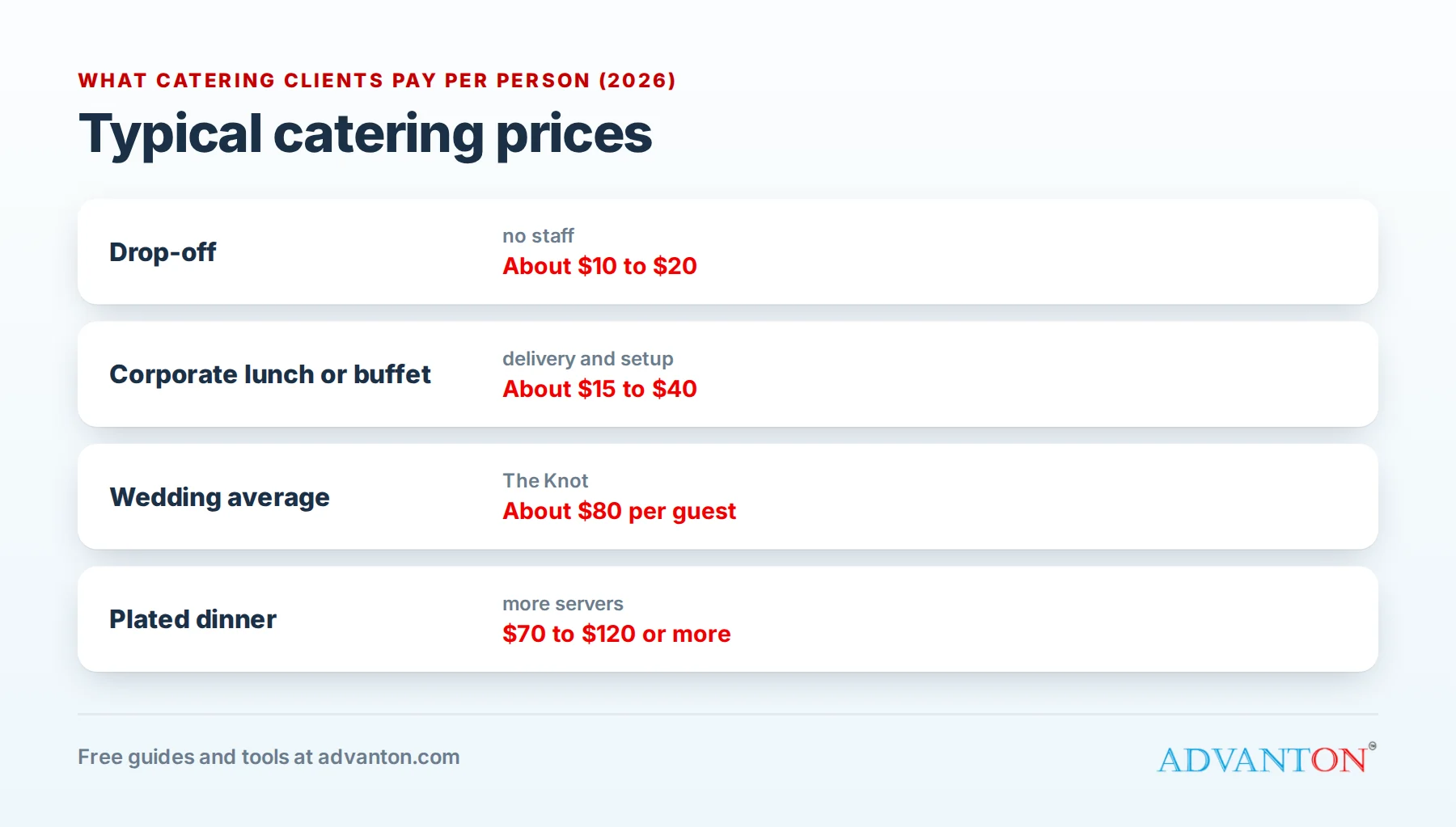
| Drop-off catering | About $10 to $20 (no staff, food delivered ready to serve) |
| Corporate lunch or buffet | About $15 to $40 |
| Buffet with setup and staff | Often $18 to $35 or more |
| Wedding catering | About $80 per guest on average, according to The Knot’s Real Weddings Study; plated dinners often $70 to $120 or more |
A plated dinner can cost roughly twice a staffed buffet because of the extra servers: a buffet needs about one server per 50 guests, while plated service needs many more.
How to price a catering menu
- Cost every dish per serving: ingredients, plus a little for waste.
- Keep food cost to a target share of your price. Many caterers aim for food costs of roughly 25% to 35% of the per-person price, but your target depends on your service style.
- Price labor separately or build it in: prep, cooking, delivery, servers and cleanup.
- Add overhead and profit: kitchen rental, insurance, transport and marketing.
- List add-ons clearly: staffing, rentals, setup, delivery, cake cutting and late-night snacks.
- Take a deposit to hold the date, with written cancellation terms and a final guest count deadline.
Our pricing calculator helps, and our quote and invoice generator makes professional event quotes.
A worked example: a 100-guest buffet
These are illustrative assumptions, not predictions.
| Assumption | Amount | |
|---|---|---|
| Price | 100 guests at $45 per person (buffet with setup and two servers) | $4,500 |
| Food | 30% of price | $(1,350) |
| Labor | Prep, cooking, two servers and a lead for the event | $(1,000) |
| Kitchen rental, transport and disposables | $(450) | |
| Insurance, marketing and overhead (share per event) | $(400) | |
| Profit before owner pay and taxes | $1,300 |
Two such events a month, plus weekday drop-off orders, can make a solid part-time or early full-time business. The levers are menu design (dishes that hold well and cost less), staffing efficiency and add-ons.
Loading the calculator…
Keep food safe from kitchen to table
Most foodborne illness at events comes from food held at the wrong temperature for too long. The FDA Food Code, which most states base their rules on, sets clear targets:
- Hot food held at 135°F or above. Use chafing dishes, insulated carriers and food warmers, and check temperatures with a probe thermometer.
- Cold food held at 41°F or below. Use coolers with ice, chilled platters and refrigerated transport.
- Cool cooked food quickly if you prepare it ahead: from 135°F to 70°F within 2 hours, and to 41°F within 6 hours in total.
- Keep a temperature log for each event. Inspectors appreciate it, and it protects you if a guest becomes ill.
- Label allergens on the buffet with small cards, so guests with allergies can choose safely.
An event-day timeline
A repeatable timeline keeps events calm and profitable:
| When | What happens |
|---|---|
| Two weeks before | Confirm menu, final guest count deadline, venue access times and rentals |
| Three to five days before | Order ingredients and disposables; schedule staff |
| One to two days before | Prep sauces, marinades, desserts and anything that holds well; check equipment |
| Event day, morning | Cook, chill or hold; pack by checklist; load vehicles |
| Arrival | Set up stations, check temperatures, brief staff |
| Service | Replenish, monitor temperatures, keep stations tidy |
| After | Break down, clean the venue area, collect equipment, send a thank-you and review request |
Checklists for packing, setup and breakdown prevent the most common event-day problem: forgetting something essential.
How to book events
- Partner with venues, wedding planners, event rental companies and photographers. Many venues keep a preferred caterer list.
- Offer tastings to engaged couples and planners, credited toward their booking.
- Target local businesses with a simple office lunch menu and reliable delivery.
- Show your food: professional photos on your website and social media sell catering.
- Collect reviews after every event with our review request kit.
- Build a website with menus, sample prices and an inquiry form. Our free website builder has a template for food businesses.
How to grow a catering business
Once your first events go well, growth usually comes from four places:
- Recurring corporate accounts. A weekly lunch for one office can be worth more over a year than several weddings, and it fills quiet weekdays.
- Preferred vendor lists. Getting onto a venue’s or planner’s preferred caterer list brings a steady stream of qualified inquiries.
- A reliable team. A core group of trusted servers and a sous chef lets you take on bigger events, or two events on the same day.
- Your own kitchen, once your commissary hours and costs show that a dedicated space would pay for itself.
Track profit per event type, not just revenue, so you grow the work that actually pays best.
Common mistakes to avoid when starting a catering business
- Cooking at home for catering when your state requires a commercial kitchen.
- Underpricing by forgetting labor, transport and disposables.
- No deposit or contract, then last-minute cancellations.
- Menus that don’t travel: dishes that wilt, separate or cool quickly.
- Saying yes to every event before you have the staff and equipment.
Your first 90 days as a catering business owner
- Confirm health department requirements and book a commissary kitchen.
- Get your permits, food manager certification and insurance.
- Build a focused menu of dishes that travel well, and cost every item.
- Write your contract, deposit and cancellation terms.
- Launch a simple website with menus and an inquiry form.
- Meet five venues, planners or office managers.
- Book three tastings or small events.
Frequently asked questions about starting a catering business
Can I start a catering business from home?
Usually not for perishable foods. Most states require caterers to use a licensed commercial kitchen. Cottage food laws, where they exist, typically cover only certain low-risk foods and direct sales.
How much should I charge per person?
It depends on your service style and market. Drop-off catering often runs about $10 to $20 per person, corporate buffets $15 to $40, and weddings average about $80 per guest. Cost your menu first, then price for profit.
Do I need a liquor license?
If you serve alcohol, yes, where allowed, or partner with a licensed bartending service.
Keep learning
Sources
- US Food and Drug Administration, Food Code
- Stacker, Corporate catering value guide (April 2026)
- Paperlust, How much does wedding catering cost? (citing The Knot Real Weddings Study)
- US Small Business Administration, Apply for licenses and permits
Last reviewed October 26, 2026. Startup costs are estimates; check local prices, licensing and tax rules before you commit money.
This article is general information, not financial, legal or tax advice. Check the rules that apply to you or talk to a qualified professional before making decisions. See our disclaimer.
Leave a Reply