
Diabetes, heart disease, digestive conditions, food allergies, sports performance and weight concerns all send people looking for nutrition help. Registered dietitians can bill insurance for medical nutrition therapy in many cases, while nutrition coaches work with clients on habits and goals within legal limits. Dietitians and nutritionists earned a median of about $73,850 in May 2024, with about 5.5% projected growth, according to BLS figures as reported.
Nutrition businesses range from private practice dietitians and telehealth group practices to coaching programs. What you can call yourself and what services you can provide depend on state law, so the first step is understanding your state’s rules.
The workforce
| Occupation | Jobs (2024) | Median pay (May 2024) | Projected growth, 2024 to 2034 |
|---|---|---|---|
| Dietitians and nutritionists (figures as reported) | n/a | $73,850 | +5.5% |
Source: U.S. Bureau of Labor Statistics, Occupational Outlook Handbook and Occupational Employment and Wage Statistics.
Business models compared
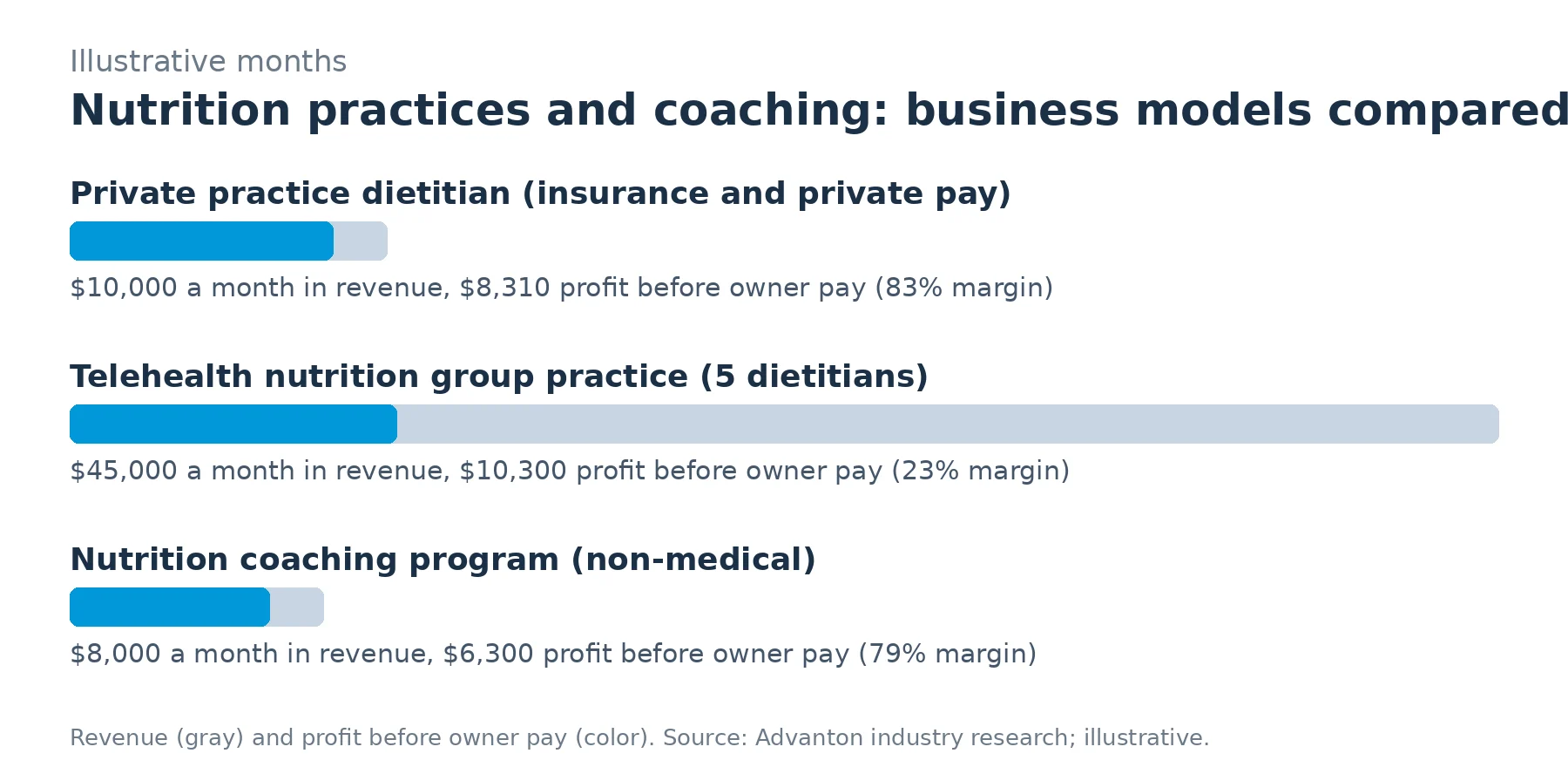
The figures below are illustrative months from our research, not industry averages. They show how revenue and costs typically fit together; your market, prices and costs will differ.
| Business model | Startup costs | Example monthly revenue | Costs | Profit before owner pay | Margin |
|---|---|---|---|---|---|
| Private practice dietitian (insurance and private pay) | Low: licensing, EHR, telehealth, credentialing | $10,000 | $1,690 | $8,310 | 83% |
| Telehealth nutrition group practice (5 dietitians) | Low to moderate: credentialing across states, software, staff | $45,000 | $34,700 | $10,300 | 23% |
| Nutrition coaching program (non-medical) | Low: program content, coaching app, website | $8,000 | $1,700 | $6,300 | 79% |
Fixed and variable costs
For projections, the most useful split is between variable costs, which rise and fall with sales (materials, supplies, hourly labor, fees), and fixed costs, which you pay every month regardless (rent, salaried staff, insurance, loan payments).
| Business model | Variable costs (% of revenue) | Fixed costs per month | What it means |
|---|---|---|---|
| Private practice dietitian (insurance and private pay) | 5.0% | $1,190 | Mostly fixed: needs steady volume to cover overhead |
| Telehealth nutrition group practice (5 dietitians) | 58.2% | $8,500 | Mostly variable: profitable early, but watch cash flow |
| Nutrition coaching program (non-medical) | 3.0% | $1,460 | Mostly fixed: needs steady volume to cover overhead |
What the numbers say
Solo practices keep overhead low, with most revenue becoming income once caseloads fill.
Group practices scale through dietitian pay and need strong intake and billing systems.
Coaching programs can scale beyond hours but depend on marketing and must stay within legal limits.
The three models in brief
Private practice dietitian. Individual counseling, in person or by telehealth. See healthcare practices data.
Telehealth group practice. Several dietitians serving insured clients across multiple states.
Nutrition coaching program. Habit-based programs without medical treatment. See online courses and coaching data.
Cost structure: telehealth nutrition group practice (5 dietitians)
Each cost as a share of the example month’s revenue ($45,000):
| Cost | Monthly amount | Share of revenue | Type |
|---|---|---|---|
| Dietitian pay | $24,000 | 53.3% | Variable |
| Payroll taxes and benefits | $2,800 | 6.2% | Fixed |
| Intake coordinator | $2,500 | 5.6% | Fixed |
| Billing and claim fees | $2,200 | 4.9% | Variable |
| Marketing | $2,000 | 4.4% | Fixed |
| Software and telehealth | $700 | 1.6% | Fixed |
| Insurance | $300 | 0.7% | Fixed |
| Licensing in multiple states | $200 | 0.4% | Fixed |
| Profit before owner pay | $10,300 | 23% |
A first-year projection: telehealth nutrition group practice (5 dietitians)
New businesses rarely start at full speed. This projection assumes revenue ramps from 35% of the example month in month 1 to 100% by month 12, variable costs move with revenue, and fixed costs stay the same every month. It’s a planning illustration, not a forecast.
| Month | Revenue | Variable costs | Fixed costs | Profit | Cumulative |
|---|---|---|---|---|---|
| 1 | $15,750 | $9,166 | $8,500 | -$1,916 | -$1,916 |
| 2 | $20,250 | $11,786 | $8,500 | -$36 | -$1,952 |
| 3 | $24,750 | $14,404 | $8,500 | $1,846 | -$106 |
| 4 | $27,900 | $16,238 | $8,500 | $3,162 | $3,056 |
| 5 | $31,500 | $18,333 | $8,500 | $4,667 | $7,723 |
| 6 | $34,200 | $19,904 | $8,500 | $5,796 | $13,519 |
| 7 | $36,900 | $21,476 | $8,500 | $6,924 | $20,443 |
| 8 | $39,150 | $22,785 | $8,500 | $7,865 | $28,308 |
| 9 | $40,950 | $23,833 | $8,500 | $8,617 | $36,925 |
| 10 | $42,750 | $24,880 | $8,500 | $9,370 | $46,295 |
| 11 | $44,100 | $25,666 | $8,500 | $9,934 | $56,229 |
| 12 | $45,000 | $26,190 | $8,500 | $10,310 | $66,539 |
Year one: revenue $403,200, profit before owner pay $66,539. The first profitable month is month 3. Cumulative results bottom out at -$1,952, which is the minimum cash cushion this plan would need, before any startup costs.
Coordinator, software and marketing costs start before insured caseloads fill, so this group practice illustration turns profitable in month 3, with a cumulative low of about $2,000.
How nutrition practices earn
- Insurance-covered medical nutrition therapy.
- Private pay sessions and packages.
- Employer wellness contracts.
- Group programs and classes.
- Online courses and coaching memberships.
Know your state’s rules
States differ widely: some license dietitians and restrict nutrition care, others protect only titles, and a few have little regulation. Before opening, learn which titles you may use, which services require a license and how telehealth rules apply to clients in other states.
Insurance and Medicare
Many insurers cover visits with registered dietitians for conditions such as diabetes, heart disease and obesity, and Medicare covers medical nutrition therapy for diabetes and kidney disease. Credentialing and documentation take effort but can fill a schedule with clients who couldn’t otherwise afford care.
A startup checklist
- Confirm licensing and title rules in your state.
- Choose a niche and services.
- Credential with insurers if you plan to bill them.
- Set up HIPAA-compliant telehealth and records.
- Carry professional liability insurance.
Choosing a niche
Specializing in diabetes, eating disorders, gut health, sports nutrition, pediatrics, kidney disease or prenatal nutrition helps referral sources and clients find you. Niches also guide continuing education and marketing, and let you build programs that serve similar clients efficiently.
Where the opportunities are
- Telehealth practices serving insured clients.
- Diabetes and cardiometabolic care.
- Employer wellness programs.
- Eating disorder treatment teams.
- Sports and performance nutrition.
Key terms
| Term | Meaning |
|---|---|
| Registered dietitian | A nationally credentialed nutrition professional |
| Medical nutrition therapy | Nutrition care for medical conditions |
| Title protection | Laws limiting who may use certain professional titles |
| Credentialing | Enrolling with insurers to bill them |
Referral relationships
Physicians, endocrinologists, gastroenterologists, therapists and fitness professionals refer clients who need nutrition support. Send concise progress updates with consent, and make referral forms easy to use.
Key numbers to track
Track new clients per month, sessions per client, insurance collections, no-show rate and client outcomes. Outcome data helps with referrals and employer contracts.
Common mistakes
- Using protected titles without the right credential.
- Treating medical conditions as a coach.
- Underestimating credentialing time.
- No niche.
- Single sessions instead of programs.
Marketing a nutrition business
Educational content, physician referrals, Google Business Profile, workshops and partnerships with gyms and employers bring clients. See healthcare practices data.
Programs over single sessions
Behavior change takes time. Multi-session programs with goals, check-ins and education produce better results and more predictable revenue than one-time visits.
Telehealth
Telehealth lets dietitians serve clients across a state or multiple states where licensed. It reduces overhead and no-shows, and fits busy clients’ schedules.
Ethical marketing
Avoid unrealistic weight-loss claims and before-and-after promises. Truthful, evidence-based marketing protects clients and your professional standing.
Employer wellness
Employers buy workshops, group programs and individual sessions for staff. These contracts bring volume and visibility with predictable scheduling.
Coaching within scope
Nutrition coaches can help with habits, meal planning and accountability, but should refer clients with medical conditions to licensed professionals. Clear scope statements protect both clients and coaches.
Supplements and products
Selling supplements raises conflict-of-interest questions. Disclose any financial interest, recommend only evidence-based products and follow FTC rules on claims.
Test these numbers with your own plan
Open this industry in our free Business Idea Reality Check to start from any model above, change prices, costs, startup budget and your own pay, and see your break-even month, the cash you’d need, three scenarios and how new businesses in this sector survive in your state.
- Start with the closest model and its cost structure.
- Replace every price and cost with local quotes.
- Estimate your ramp: how fast customers will realistically come in year one.
- Map cash month by month with the free Cash & Payroll Planner.
- Build the full plan in the free Business Planner.
About this data
Workforce figures come from the U.S. Bureau of Labor Statistics (Occupational Outlook Handbook and Occupational Employment and Wage Statistics, May 2024 wages and the 2024 to 2034 projections, unless noted). Market figures cite their sources above. Business model figures are illustrative months built from typical prices and costs to show how revenue, fixed costs and variable costs fit together; they are not industry averages or guarantees. We review these profiles when new government data is released, at least once a year, and the same figures power the Business Idea Reality Check.
Licensing and rules
Many states license or certify dietitians and protect titles such as "dietitian" and sometimes "nutritionist," and some restrict who may provide medical nutrition therapy; the credential "registered dietitian" requires national requirements; Medicare covers medical nutrition therapy by registered dietitians for certain conditions such as diabetes and kidney disease; billing insurance requires credentialing; HIPAA applies to covered practices; telehealth across state lines must follow each state’s licensing rules; coaches must avoid diagnosing or treating medical conditions where reserved for licensed professionals. Requirements change; confirm with your state and local agencies before you start.
Frequently asked questions
Do I need a license to give nutrition advice?
It depends on your state; many license dietitians and restrict medical nutrition therapy.
What do dietitians earn?
About a $73,850 median in May 2024 (BLS, as reported).
Does insurance cover dietitian visits?
Many plans do for certain conditions, and Medicare covers medical nutrition therapy for diabetes and kidney disease.
What is the difference between a dietitian and a nutrition coach?
Registered dietitians hold national credentials and can provide medical nutrition therapy; coaches work on habits within legal limits.
Can I offer nutrition services by telehealth?
Yes, following licensing rules in the client’s state.
How do nutrition practices find clients?
Physician referrals, insurance directories, content marketing and employer partnerships.
How can I test these numbers?
Open nutrition practices and coaching in the Business Idea Reality Check and enter your own numbers.
Keep learning
- Healthcare practices data
- Personal training data
- Online courses and coaching data
- Business Idea Reality Check
Sources
Last reviewed November 1, 2026. Startup costs are estimates; check local prices, licensing and tax rules before you commit money.

