
People pay personal trainers for results, accountability and safety: losing weight, getting stronger, recovering from injury or training for an event. Exercise trainers and group fitness instructors held about 370,100 jobs in 2024, with a median wage of about $46,180 and about 12% projected growth from 2024 to 2034, according to BLS projections as reported by Stacker. Trainers who build full client schedules or their own studios often earn far more than the median. Below is the key industry data on personal training businesses, with costs, business models and a first-year projection.
Training businesses range from independent trainers working in clients’ homes or rented gym space to small-group studios and online coaching programs that serve clients anywhere.
The workforce
| Occupation | Jobs (2024) | Median pay (May 2024) | Projected growth, 2024 to 2034 |
|---|---|---|---|
| Exercise trainers and group fitness instructors (figures as reported) | 370,100 | $46,180 | +12% |
Source: U.S. Bureau of Labor Statistics, Occupational Outlook Handbook and Occupational Employment and Wage Statistics.
Market data
| Measure | Value |
|---|---|
| Projected job change, 2024 to 2034 (as reported) | 44,100 |
Business models compared
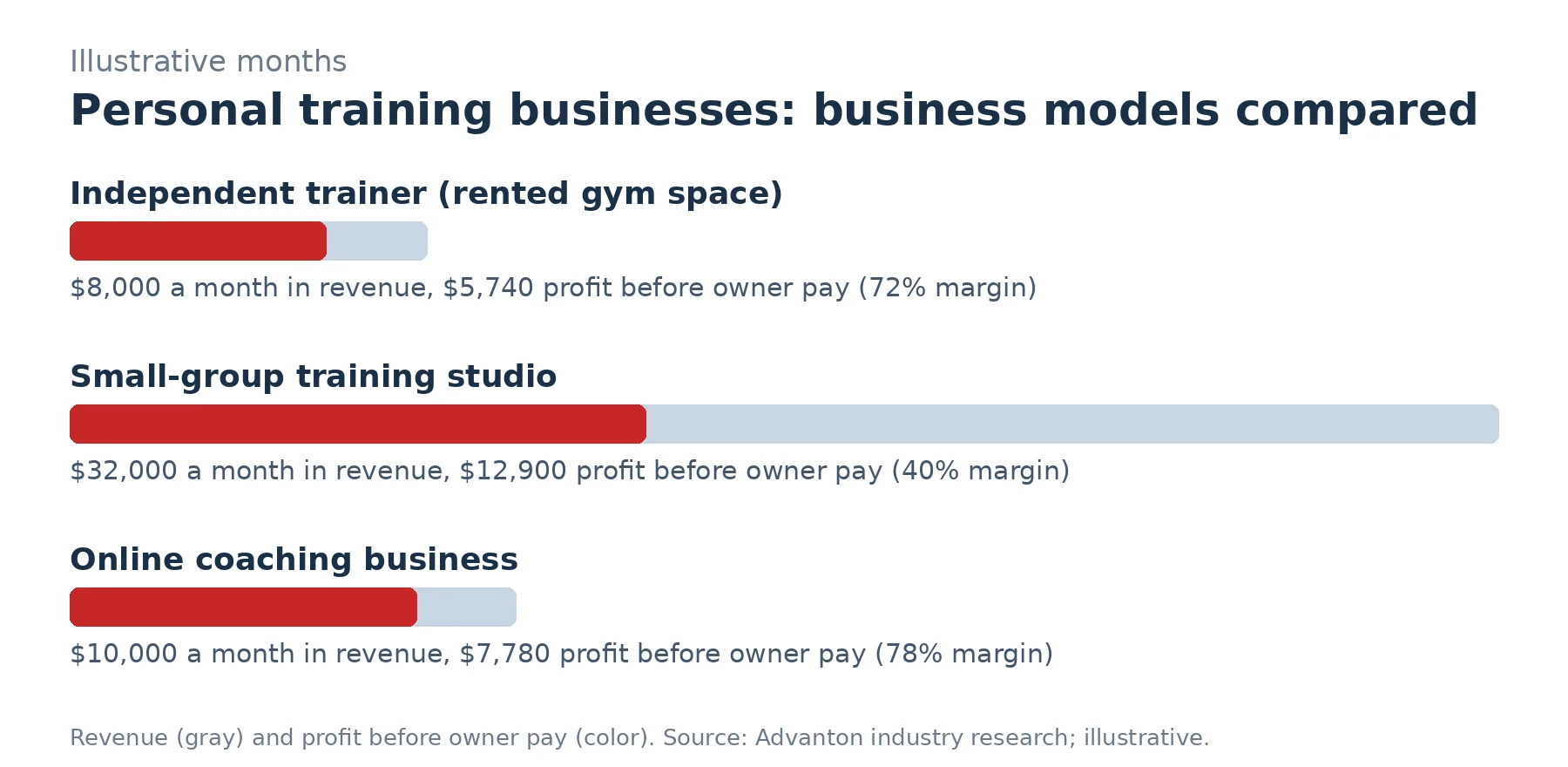
The figures below are illustrative months from our research, not industry averages. They show how revenue and costs typically fit together; your market, prices and costs will differ.
| Business model | Startup costs | Example monthly revenue | Costs | Profit before owner pay | Margin |
|---|---|---|---|---|---|
| Independent trainer (rented gym space) | Low: certification, insurance, equipment, booking app | $8,000 | $2,260 | $5,740 | 72% |
| Small-group training studio | Moderate: space, equipment, build-out | $32,000 | $19,100 | $12,900 | 40% |
| Online coaching business | Low: coaching app, content, marketing | $10,000 | $2,220 | $7,780 | 78% |
Fixed and variable costs
For projections, the most useful split is between variable costs, which rise and fall with sales (materials, supplies, hourly labor, fees), and fixed costs, which you pay every month regardless (rent, salaried staff, insurance, loan payments).
| Business model | Variable costs (% of revenue) | Fixed costs per month | What it means |
|---|---|---|---|
| Independent trainer (rented gym space) | 23.0% | $420 | Mostly fixed: needs steady volume to cover overhead |
| Small-group training studio | 30.9% | $9,200 | Balanced: margins improve as volume grows |
| Online coaching business | 3.5% | $1,870 | Mostly fixed: needs steady volume to cover overhead |
What the numbers say
Independent trainers keep high margins, with gym rental the main cost, but income is capped by sessions per week.
Studios grow revenue through groups and coaches, with rent and equipment as the main fixed costs.
Online coaching scales beyond hours, but depends on marketing and retention.
The three models in brief
Independent trainer. One-on-one sessions in homes, parks or rented gym space. See fitness data.
Small-group training studio. Groups of a few clients with coaching, community and memberships.
Online coaching. Programs, check-ins and app-based coaching. See online courses and coaching data.
Cost structure: small-group training studio
Each cost as a share of the example month’s revenue ($32,000):
| Cost | Monthly amount | Share of revenue | Type |
|---|---|---|---|
| Coach pay | $9,000 | 28.1% | Variable |
| Rent | $5,000 | 15.6% | Fixed |
| Marketing | $2,000 | 6.2% | Fixed |
| Card fees | $900 | 2.8% | Variable |
| Equipment payments | $800 | 2.5% | Fixed |
| Utilities | $500 | 1.6% | Fixed |
| Cleaning | $400 | 1.2% | Fixed |
| Software | $250 | 0.8% | Fixed |
| Insurance | $250 | 0.8% | Fixed |
| Profit before owner pay | $12,900 | 40% |
A first-year projection: small-group training studio
New businesses rarely start at full speed. This projection assumes revenue ramps from 35% of the example month in month 1 to 100% by month 12, variable costs move with revenue, and fixed costs stay the same every month. It’s a planning illustration, not a forecast.
| Month | Revenue | Variable costs | Fixed costs | Profit | Cumulative |
|---|---|---|---|---|---|
| 1 | $11,200 | $3,461 | $9,200 | -$1,461 | -$1,461 |
| 2 | $14,400 | $4,450 | $9,200 | $750 | -$711 |
| 3 | $17,600 | $5,438 | $9,200 | $2,962 | $2,251 |
| 4 | $19,840 | $6,131 | $9,200 | $4,509 | $6,760 |
| 5 | $22,400 | $6,922 | $9,200 | $6,278 | $13,038 |
| 6 | $24,320 | $7,515 | $9,200 | $7,605 | $20,643 |
| 7 | $26,240 | $8,108 | $9,200 | $8,932 | $29,575 |
| 8 | $27,840 | $8,603 | $9,200 | $10,037 | $39,612 |
| 9 | $29,120 | $8,998 | $9,200 | $10,922 | $50,534 |
| 10 | $30,400 | $9,394 | $9,200 | $11,806 | $62,340 |
| 11 | $31,360 | $9,690 | $9,200 | $12,470 | $74,810 |
| 12 | $32,000 | $9,888 | $9,200 | $12,912 | $87,722 |
Year one: revenue $286,720, profit before owner pay $87,722. The first profitable month is month 2. Cumulative results bottom out at -$1,461, which is the minimum cash cushion this plan would need, before any startup costs.
Rent and marketing start before memberships fill classes, so this studio illustration turns profitable in month 2, with a cumulative low of about $1,500.
How trainers earn
- One-on-one sessions and packages.
- Small-group training at lower prices per person.
- Memberships with set sessions per month.
- Online programs and coaching.
- Corporate wellness contracts.
Pricing for results and retention
Packages and memberships encourage consistency, which produces results and keeps clients longer. Price by session length, group size and expertise, and review prices as demand grows.
Certification and scope
Choose a nationally recognized certification, keep CPR and AED certification current, and stay within your scope: refer clients to medical providers or registered dietitians when needed.
A startup checklist for personal training businesses
- Earn an accredited certification and CPR/AED.
- Carry professional liability insurance.
- Use waivers and health screening forms reviewed by an advisor.
- Choose booking and payment software.
- Define your niche and pricing.
Finding your niche
Trainers stand out by specializing: strength for women, older adults, athletes, post-rehabilitation, weight loss or busy professionals. A clear niche makes marketing easier and justifies higher prices.
Where the opportunities are
- Older adults and active aging.
- Small-group strength training.
- Hybrid in-person and online coaching.
- Corporate wellness.
- Sport-specific training.
Key terms
| Term | Meaning |
|---|---|
| Package | A prepaid set of sessions |
| Retention rate | Clients who continue month to month |
| Scope of practice | What trainers can and can’t do without other licenses |
| Semi-private training | Sessions with two to four clients |
Retention is the business
Most clients quit when progress stalls or schedules get busy. Track progress, celebrate wins, check in between sessions and adjust programs. A client who stays a year is worth many new clients.
Key numbers to track
Track sessions per week, average revenue per client, retention rate, referral rate and cost per new client.
Common mistakes
- Underpricing to fill schedules.
- No niche or clear offer.
- Skipping insurance and waivers.
- Giving medical or diet advice beyond scope.
- Relying on one gym for all clients.
Marketing a training business
Client results (with consent), Instagram, Google Business Profile, reviews, referral rewards and partnerships with physical therapists and chiropractors bring clients. See physical therapy data.
Safety and client screening
Every new client should complete a health questionnaire and, where appropriate, get clearance from a medical provider before starting. Progress gradually, teach proper technique, supervise closely and keep emergency procedures ready. Safety protects clients, your reputation and your insurance.
Community keeps clients
Small-group training and studio communities keep clients coming back: friendly competition, challenges, social events and recognizing milestones. Clients who feel part of a group stay longer and bring friends.
Opening a studio
Before leasing space, build a client base that can support rent. Many trainers rent gym space or share a studio first, then open their own when demand is proven.
Equipment for a training business
Independent trainers need portable equipment such as bands, kettlebells and mats, while studios need racks, free weights, cardio machines and flooring. Buy durable equipment that fits your programs, and add pieces as memberships grow rather than filling a space all at once.
Online coaching done well
Successful online coaches combine structured programs with real accountability: weekly check-ins, form reviews and community. Clear subscription terms and easy cancellation build trust.
Test these numbers with your own plan
Open this industry in our free Business Idea Reality Check to start from any model above, change prices, costs, startup budget and your own pay, and see your break-even month, the cash you’d need, three scenarios and how new businesses in this sector survive in your state.
- Start with the closest model and its cost structure.
- Replace every price and cost with local quotes.
- Estimate your ramp: how fast customers will realistically come in year one.
- Map cash month by month with the free Cash & Payroll Planner.
- Build the full plan in the free Business Planner.
About this data
Workforce figures come from the U.S. Bureau of Labor Statistics (Occupational Outlook Handbook and Occupational Employment and Wage Statistics, May 2024 wages and the 2024 to 2034 projections, unless noted). Market figures cite their sources above. Business model figures are illustrative months built from typical prices and costs to show how revenue, fixed costs and variable costs fit together; they are not industry averages or guarantees. We review these profiles when new government data is released, at least once a year, and the same figures power the Business Idea Reality Check.
Licensing and rules
Most states do not license personal trainers, but clients and gyms expect accredited certifications, CPR and AED certification and professional liability insurance; trainers should stay within scope and avoid diagnosing injuries or prescribing diets in ways reserved for licensed professionals; studios need local business licenses and may face zoning and occupancy rules; online coaches should follow consumer protection rules on claims and subscriptions. Requirements change; confirm with your state and local agencies before you start.
Frequently asked questions about personal training businesses
What do personal trainers earn?
About a $46,180 median for exercise trainers and group fitness instructors (2024, BLS as reported), with wide variation.
Do personal trainers need a license?
Most states don’t license trainers, but accredited certifications and insurance are expected.
Is a training studio profitable?
It can be, with strong retention and enough members to cover rent.
How do trainers get clients?
Referrals, results, social media, local search and partnerships.
Should I train online or in person?
Many trainers combine both to reach more clients.
How many clients does a full-time trainer need?
It depends on prices and format; packages, small groups and online programs reduce the number of hours needed for a full income.
How much should a personal trainer charge?
It depends on market, niche and format; packages and small groups help clients commit.
How can I test these numbers?
Open personal training in the Business Idea Reality Check and enter your own prices and costs.
Keep learning
- Fitness industry data
- Online courses and coaching data
- Wellness industry data
- Business Idea Reality Check
Sources
Last reviewed November 1, 2026. Startup costs are estimates; check local prices, licensing and tax rules before you commit money.
In India
Small businesses like this in India
In MoSPI’s survey of unincorporated businesses (proprietorships, partnerships and similar firms), this falls under Personal and community services (salons, repair, laundry, recreation). In 2023-24 India had 80 lakh such establishments employing 1.08 crore workers, and 87.8% were run without hired workers. Across the wider other services group, the number of establishments grew 10.29% between 2023-24 and 2025.
| Urban | Rural | All India | |
|---|---|---|---|
| Value added per business a year | ₹1,90,118 | ₹1,18,169 | ₹1,57,707 |
| Value added per worker a year | ₹1,33,879 | ₹95,399 | ₹1,17,836 |
| Pay per hired worker a year | ₹1,23,337 | ₹76,541 | ₹1,10,529 |
Running it alone or with staff: businesses with no hired workers added about ₹1,16,951 a year on average, while those with hired workers added about ₹5,02,402 (all India).
Where these businesses are: the states with the most small other services businesses are West Bengal (13.1%), Uttar Pradesh (11.6%), Maharashtra (8.8%), Tamil Nadu (6.2%), Gujarat (6.0%) of the national total (2023-24).
Value added is what a business produces minus what it spends on materials and other inputs, before paying its workers and owner, so it’s a rough guide to the income a typical small business generates. These figures cover the whole activity, which can be broader than this one business type. Across all small businesses, average fixed assets such as equipment, furniture and vehicles were ₹3,42,242 per establishment in 2025.
Licences and registrations to expect
- Registration under your state’s Shops and Establishments Act if you have premises or employees.
- A trade licence from your municipal corporation or council for many shop and service businesses.
- GST registration once turnover crosses ₹40 lakh for goods or ₹20 lakh for services (lower in some special category states), or earlier if you sell goods to other states or through e-commerce marketplaces.
- Professional tax registration in states that levy it.
- Free Udyam (MSME) registration, which helps with loans, government schemes and delayed-payment protection.
Rules differ by state and city. Check with your municipal corporation, state departments and a chartered accountant before you start.
Run a business like this in India? List it free in the India Business Directory, with your hours, deals and GST registration.
Free tools for India: Make a GST invoice · Compare business credit cards
Build a market report for Personal Training Businesses in India Pick your state and see market size, earnings, competition and licences, from official data. Free, with a PDF download.
Sources: MoSPI, Annual Survey of Unincorporated Sector Enterprises (ASUSE) 2023-24, full report, Appendix A Tables 4, 29, 33, 35 and 37 (survey period October 2023 to September 2024); MoSPI, Annual Survey of Unincorporated Sector Enterprises (ASUSE) 2025, factsheet (survey period January to December 2025, released 24 March 2026). Licensing summary by Advanton, checked November 2026.