
Caterers, food trucks, bakers, meal prep companies and new food brands need licensed kitchen space but often can’t afford to build their own. Commissary and shared kitchens rent time, storage and equipment to many tenants, turning one commercial kitchen into a hub for local food businesses. Many cities require food trucks to operate from an approved commissary. Food service managers earned a median of $65,310 in May 2024, according to the Bureau of Labor Statistics.
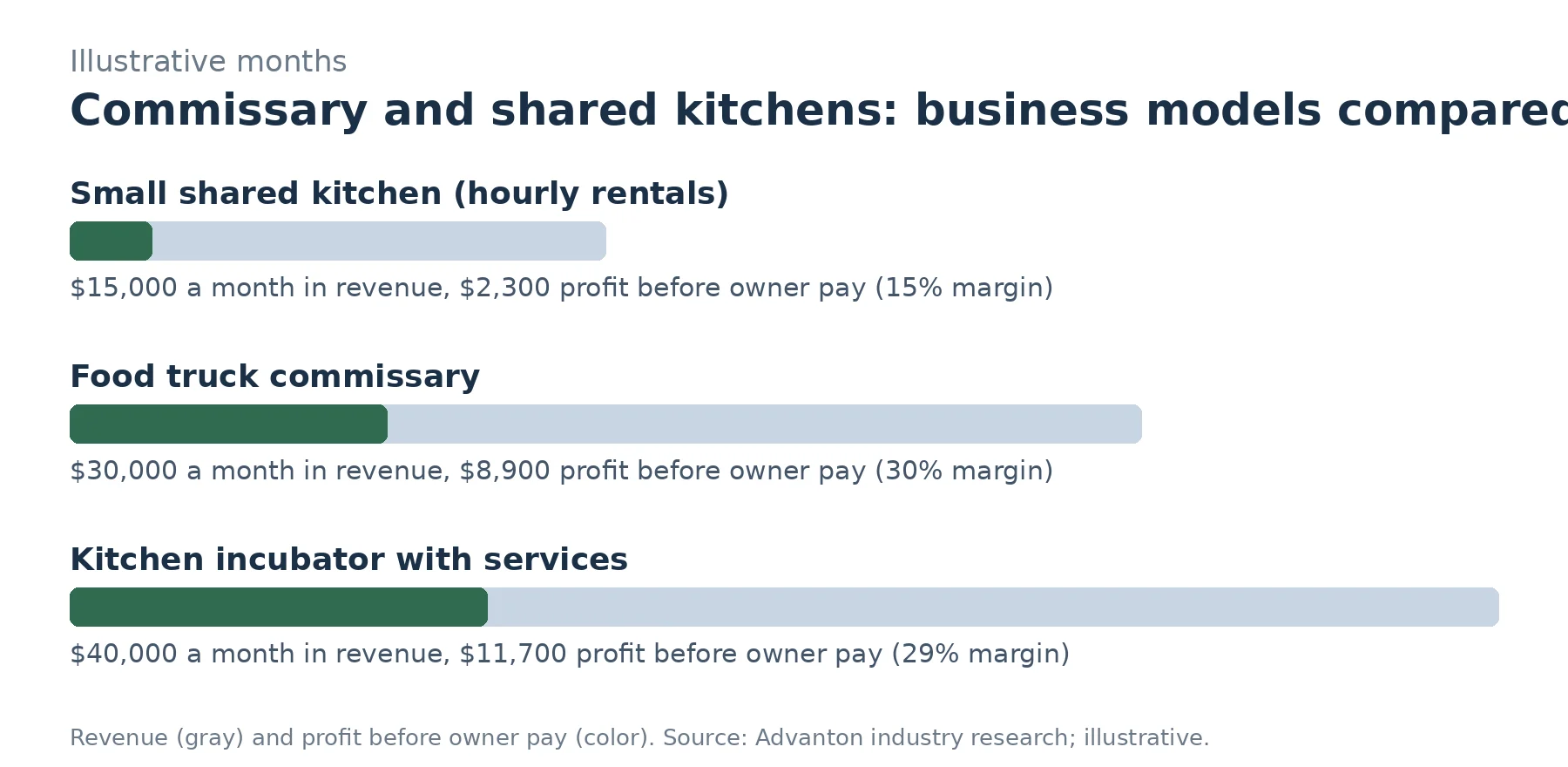
Businesses range from small shared kitchens renting by the hour to food truck commissaries with parking and waste disposal and kitchen incubators offering business services.
The workforce
| Occupation | Jobs (2024) | Median pay (May 2024) | Projected growth, 2024 to 2034 |
|---|---|---|---|
| Food service managers | 352,800 | $65,310 | +6% |
| Cooks | n/a | $35,760 | n/a |
Source: U.S. Bureau of Labor Statistics, Occupational Outlook Handbook and Occupational Employment and Wage Statistics.
Market data
| Measure | Value |
|---|---|
| Share of food service managers who are self-employed (2024) | 30% |
Business models compared
The figures below are illustrative months from our research, not industry averages. They show how revenue and costs typically fit together; your market, prices and costs will differ.
| Business model | Startup costs | Example monthly revenue | Costs | Profit before owner pay | Margin |
|---|---|---|---|---|---|
| Small shared kitchen (hourly rentals) | High: kitchen build-out, equipment, permits | $15,000 | $12,700 | $2,300 | 15% |
| Food truck commissary | High: kitchen, truck parking, water and waste stations, power | $30,000 | $21,100 | $8,900 | 30% |
| Kitchen incubator with services | Very high: kitchen, packaging equipment, staff, programming | $40,000 | $28,300 | $11,700 | 29% |
Fixed and variable costs
For projections, the most useful split is between variable costs, which rise and fall with sales (materials, supplies, hourly labor, fees), and fixed costs, which you pay every month regardless (rent, salaried staff, insurance, loan payments).
| Business model | Variable costs (% of revenue) | Fixed costs per month | What it means |
|---|---|---|---|
| Small shared kitchen (hourly rentals) | 11.0% | $11,050 | Mostly fixed: needs steady volume to cover overhead |
| Food truck commissary | 13.0% | $17,200 | Mostly fixed: needs steady volume to cover overhead |
| Kitchen incubator with services | 11.8% | $23,600 | Mostly fixed: needs steady volume to cover overhead |
What the numbers say
Rent, equipment and staff are fixed, so kitchen utilization decides profit.
Food truck commissaries earn from parking, storage and services as well as kitchen time.
Incubators add program revenue and grants but need more staff.
The three models in brief
Small shared kitchen. Hourly rentals for caterers, bakers and meal prep companies. See catering data.
Food truck commissary. Kitchen access, truck parking, water, waste and storage. See food trucks data.
Kitchen incubator. Shared kitchen plus business coaching and packaging help. See packaged food brands data.
Cost structure: food truck commissary
Each cost as a share of the example month’s revenue ($30,000):
| Cost | Monthly amount | Share of revenue | Type |
|---|---|---|---|
| Rent or mortgage | $7,000 | 23.3% | Fixed |
| Manager and cleaning staff | $5,000 | 16.7% | Fixed |
| Utilities and waste disposal | $3,000 | 10.0% | Variable |
| Equipment loan | $2,500 | 8.3% | Fixed |
| Card fees | $900 | 3.0% | Variable |
| Insurance | $800 | 2.7% | Fixed |
| Maintenance | $800 | 2.7% | Fixed |
| Security | $500 | 1.7% | Fixed |
| Marketing | $400 | 1.3% | Fixed |
| Software | $200 | 0.7% | Fixed |
| Profit before owner pay | $8,900 | 30% |
A first-year projection: food truck commissary
New businesses rarely start at full speed. This projection assumes revenue ramps from 35% of the example month in month 1 to 100% by month 12, variable costs move with revenue, and fixed costs stay the same every month. It’s a planning illustration, not a forecast.
| Month | Revenue | Variable costs | Fixed costs | Profit | Cumulative |
|---|---|---|---|---|---|
| 1 | $10,500 | $1,365 | $17,200 | -$8,065 | -$8,065 |
| 2 | $13,500 | $1,755 | $17,200 | -$5,455 | -$13,520 |
| 3 | $16,500 | $2,145 | $17,200 | -$2,845 | -$16,365 |
| 4 | $18,600 | $2,418 | $17,200 | -$1,018 | -$17,383 |
| 5 | $21,000 | $2,730 | $17,200 | $1,070 | -$16,313 |
| 6 | $22,800 | $2,964 | $17,200 | $2,636 | -$13,677 |
| 7 | $24,600 | $3,198 | $17,200 | $4,202 | -$9,475 |
| 8 | $26,100 | $3,393 | $17,200 | $5,507 | -$3,968 |
| 9 | $27,300 | $3,549 | $17,200 | $6,551 | $2,583 |
| 10 | $28,500 | $3,705 | $17,200 | $7,595 | $10,178 |
| 11 | $29,400 | $3,822 | $17,200 | $8,378 | $18,556 |
| 12 | $30,000 | $3,900 | $17,200 | $8,900 | $27,456 |
Year one: revenue $268,800, profit before owner pay $27,456. The first profitable month is month 5. Cumulative results bottom out at -$17,383, which is the minimum cash cushion this plan would need, before any startup costs.
Rent, staff and equipment payments start before tenants fill the schedule, so this commissary illustration turns profitable in month 5, with a cumulative low of about $17,400, before kitchen build-out.
How commissary kitchens earn
- Hourly kitchen rentals.
- Monthly memberships with set hours.
- Dry, cold and frozen storage fees.
- Truck parking and service fees.
- Packaging equipment rental and workshops.
Scheduling and utilization
A shared kitchen earns only when stations are booked. Online scheduling, minimum monthly commitments and a mix of early-morning bakers, daytime caterers and evening meal prep tenants keep the kitchen busy across the day.
Tenant requirements
Most kitchens require tenants to carry their own permits, food safety certifications and liability insurance, and to follow cleaning and allergen rules. Clear onboarding prevents violations that could affect everyone’s permits.
A startup checklist
- Confirm zoning and health department requirements.
- Design the kitchen for multiple tenants and storage.
- Install hoods, fire suppression and refrigeration.
- Write tenant agreements and rules.
- Choose scheduling and billing software.
Food truck services
Truck commissaries provide fresh water, gray water disposal, grease disposal, power and secure parking. These services must meet local health rules and bring steady monthly revenue.
Where the opportunities are
- Cities requiring commissaries for food trucks.
- Ghost kitchen and delivery tenants.
- Meal prep and catering startups.
- Food brands moving beyond cottage food.
- Culinary classes in off hours.
Key terms
| Term | Meaning |
|---|---|
| Commissary | A licensed kitchen base for mobile and small food businesses |
| Shared kitchen | A kitchen rented to multiple businesses |
| Gray water | Used water from sinks that must be disposed of properly |
| Certificate of insurance | Proof of tenant liability coverage |
Cleaning and sanitation
Shared kitchens need strict cleaning routines between tenants, regular deep cleans, pest control and documented inspections. One tenant’s mistakes can lead to violations for the whole facility.
Key numbers to track
Track booked hours, utilization by time of day, storage occupancy, tenant retention and revenue per square foot.
Common mistakes
- Underestimating build-out costs.
- Weak tenant rules.
- Too little storage.
- Scheduling conflicts.
- Poor cleaning standards.
Marketing a commissary
Health departments, food truck associations, farmers markets and small business centers refer tenants. See food trucks data.
Storage
Dry, refrigerated and frozen storage is often the scarcest resource; price it separately, label every tenant’s space and track usage so storage pays its share of rent.
Equipment
Mixers, ovens, kettles and packaging machines attract tenants; maintain them carefully, train tenants before first use and charge extra for specialized equipment.
Allergens
Clear allergen policies, labeled storage, dedicated equipment where needed and cleaning procedures protect customers of every tenant.
Community
Many shared kitchens build communities of food entrepreneurs who refer customers, share suppliers and collaborate on events, which keeps tenants loyal.
Grants and partnerships
Economic development groups sometimes fund kitchen incubators that support local food businesses.
Insurance
The kitchen needs its own property and liability coverage, and tenants should add the kitchen as an additional insured on their policies.
Pricing kitchen time
Price hourly rates by time of day, with discounts for off-peak hours and monthly memberships. Charge separately for storage, specialized equipment and late cleanup, and require deposits to protect against damage and no-shows.
Onboarding tenants
A structured onboarding session covering permits, insurance, equipment training, cleaning standards and emergency procedures prevents problems and protects the kitchen’s inspection record.
Security and access
Key cards, cameras and tenant logs protect equipment and inventory, especially when tenants work early mornings or late nights.
Test these numbers with your own plan
Open this industry in our free Business Idea Reality Check to start from any model above, change prices, costs, startup budget and your own pay, and see your break-even month, the cash you’d need, three scenarios and how new businesses in this sector survive in your state.
- Start with the closest model and its cost structure.
- Replace every price and cost with local quotes.
- Estimate your ramp: how fast customers will realistically come in year one.
- Map cash month by month with the free Cash & Payroll Planner.
- Build the full plan in the free Business Planner.
About this data
Workforce figures come from the U.S. Bureau of Labor Statistics (Occupational Outlook Handbook and Occupational Employment and Wage Statistics, May 2024 wages and the 2024 to 2034 projections, unless noted). Market figures cite their sources above. Business model figures are illustrative months built from typical prices and costs to show how revenue, fixed costs and variable costs fit together; they are not industry averages or guarantees. We review these profiles when new government data is released, at least once a year, and the same figures power the Business Idea Reality Check.
Licensing and rules
The kitchen itself needs health permits and inspections, and tenants usually need their own food business permits, food safety certifications and liability insurance naming the kitchen; many cities require food trucks to base at an approved commissary for prep, cleaning, water, waste and storage; fire codes cover hood systems and suppression; written agreements should cover scheduling, storage, cleaning standards, allergens and equipment use. Requirements change; confirm with your state and local agencies before you start.
Frequently asked questions
Do food trucks need a commissary?
Many cities require food trucks to operate from an approved commissary.
How do shared kitchens charge?
Hourly rates, monthly memberships, storage fees and service fees.
Do tenants need their own permits?
Usually yes, plus food safety certification and insurance.
Is a commissary kitchen profitable?
It can be, with high utilization, storage revenue and reliable tenants.
What do food service managers earn?
BLS reported a median of $65,310 in May 2024.
How do kitchens prevent cross-contamination?
With cleaning routines, allergen policies and labeled storage.
How can I test these numbers?
Open commissary and shared kitchens in the Business Idea Reality Check and enter your own numbers.
Keep learning
Sources
Last reviewed November 2, 2026. Startup costs are estimates; check local prices, licensing and tax rules before you commit money.
In India
In India: Shared commercial kitchens for cloud kitchen brands.
Small businesses like this in India
In MoSPI’s survey of unincorporated businesses (proprietorships, partnerships and similar firms), this falls under Food and beverage service (restaurants, dhabas, caterers, cafes, stalls). In 2023-24 India had 37 lakh such establishments employing 87.2 lakh workers, and 76% were run without hired workers. Across the wider other services group, the number of establishments grew 10.29% between 2023-24 and 2025.
| Urban | Rural | All India | |
|---|---|---|---|
| Value added per business a year | ₹4,77,219 | ₹2,39,374 | ₹3,63,976 |
| Value added per worker a year | ₹1,76,267 | ₹1,21,567 | ₹1,54,499 |
| Pay per hired worker a year | ₹1,53,418 | ₹1,21,702 | ₹1,45,945 |
Running it alone or with staff: businesses with no hired workers added about ₹1,88,265 a year on average, while those with hired workers added about ₹9,19,348 (all India).
Where these businesses are: the states with the most small other services businesses are West Bengal (13.1%), Uttar Pradesh (11.6%), Maharashtra (8.8%), Tamil Nadu (6.2%), Gujarat (6.0%) of the national total (2023-24).
Value added is what a business produces minus what it spends on materials and other inputs, before paying its workers and owner, so it’s a rough guide to the income a typical small business generates. These figures cover the whole activity, which can be broader than this one business type. Across all small businesses, average fixed assets such as equipment, furniture and vehicles were ₹3,42,242 per establishment in 2025.
Licences and registrations to expect
- FSSAI registration (turnover up to ₹12 lakh), a state FSSAI licence (up to ₹20 crore) or a central licence above that.
- A health or trade licence from your municipality, and a fire NOC for restaurants and commercial kitchens where local rules require one.
- An eating house licence from the police in some cities.
- Registration under your state’s Shops and Establishments Act if you have premises or employees.
- A trade licence from your municipal corporation or council for many shop and service businesses.
- GST registration once turnover crosses ₹40 lakh for goods or ₹20 lakh for services (lower in some special category states), or earlier if you sell goods to other states or through e-commerce marketplaces.
- Professional tax registration in states that levy it.
- Free Udyam (MSME) registration, which helps with loans, government schemes and delayed-payment protection.
Rules differ by state and city. Check with your municipal corporation, state departments and a chartered accountant before you start.
Run a business like this in India? List it free in the India Business Directory, with your hours, deals and GST registration.
Free tools for India: Make a GST invoice · Compare business credit cards
Sources: MoSPI, Annual Survey of Unincorporated Sector Enterprises (ASUSE) 2023-24, full report, Appendix A Tables 4, 29, 33, 35 and 37 (survey period October 2023 to September 2024); MoSPI, Annual Survey of Unincorporated Sector Enterprises (ASUSE) 2025, factsheet (survey period January to December 2025, released 24 March 2026). Licensing summary by Advanton, checked November 2026.

