
Microschools and learning pods are small schools, often 5 to 30 students, with mixed ages, personalized learning and close relationships between teachers and families. Some are homeschool groups that share a teacher, some are hybrid programs that run a few days a week, and some are full-time private schools in homes, churches, offices or storefronts. This guide explains how to start a learning pod or microschool, from licensing and startup costs to pricing and finding customers.
The legal structure matters more than anything else. Depending on your state, your program might operate under homeschool laws, as a registered private school, as a licensed child care program or under a specific microschool law. That choice decides your paperwork, building rules and whether families can use education savings accounts (ESAs) or other school choice funds.
A learning pod or microschool at a glance
Table of Contents
| Topic | What to expect |
|---|---|
| Startup cost | Low to moderate: space, furniture, curriculum, technology, insurance, background checks and marketing |
| Key rules | Homeschool or private school laws, possible child care licensing, zoning and fire rules for the building, background checks |
| Revenue model | Tuition by the year or month, sometimes funded by ESAs and school choice programs |
| How you earn | Full-time tuition, part-time and hybrid programs, enrichment and summer sessions |
| Best for | Experienced educators who want to run a small school their own way |
Who a microschool suits
It suits experienced teachers and education entrepreneurs who want small classes and freedom to teach differently, and who can also handle business tasks: enrollment, budgets, compliance and parent communication. Many founders are former public or private school teachers, or parents who started a pod for their own children and grew it.
Choosing your legal model
- Homeschool co-op or pod: families homeschool under state law, and your program supports them; parents remain responsible for their children’s education.
- Private school: you register or notify the state as a private school and take responsibility for instruction and records.
- Child care program: required in some states when you care for younger children or for long hours without being a school.
- Microschool laws: a few states have created specific rules for microschools.
Homeschool and private school laws differ widely by state; HSLDA summarizes homeschool laws, and your state education department explains private school requirements.
Child care licensing
If you serve preschool-age children, or run long days that function as child care, your state may require a child care license unless an exemption for schools or homeschool groups applies. Check with your state licensing agency, because operating unlicensed child care can lead to closure.
Zoning, fire and building rules
Running a school in a home, church or commercial space can trigger zoning rules (home occupation limits, school use permits), fire code requirements for educational occupancies (exits, alarms, occupant limits) and building codes. Talk to your local zoning and fire officials before you sign a lease or enroll students, and ask about limits on the number of children in a home.
Hiring and safety
Anyone who works with children needs careful screening: run background checks that meet your state’s rules (and the Fair Credit Reporting Act when you use a screening company), check references, train staff to recognize and report abuse under your state’s mandated reporter law, and never leave one adult alone with a child where a second adult could be present. Get signed parent permission and emergency contacts, know each child’s allergies and medical needs, and carry insurance that includes abuse and molestation coverage, which standard policies often exclude.
Private schools in some states must meet teacher qualification or background check requirements. Even where not required, hire experienced educators and screen everyone.
Education savings accounts and school choice
A growing number of states offer education savings accounts (ESAs), vouchers or tax credit scholarships that families can use for private school tuition, and some cover microschools and homeschool expenses. Each program has its own rules on which schools qualify, testing, registration and how funds are paid. If you want ESA families, choose a legal model that qualifies, apply to be an approved provider and keep careful records.
Curriculum and assessment
Decide your educational approach (classical, Montessori-inspired, project-based, self-paced with mentors or a blend) and choose curriculum that covers core subjects. Many states require private schools to teach certain subjects and some require standardized testing. Track progress with portfolios and assessments, and share regular reports with families. Accreditation is optional in many states but can help with credibility and transfers.
Students with disabilities
Families of children with learning differences often look for small schools. Be honest about the support you can provide. Private schools have different obligations than public schools, but businesses open to the public must follow the Americans with Disabilities Act, and some ESA programs serve students with disabilities. Children may also still be eligible for some services through their public school district.
Tuition and enrollment contracts
Set tuition by the year with monthly payment plans, sibling discounts and deposits to hold spots. Use a written enrollment agreement covering tuition, payment dates, withdrawal and refund terms, attendance, behavior policies and photo permissions. Clear contracts protect you when a family leaves mid-year.
Startup costs for a learning pod or microschool
| Item | What to budget for |
|---|---|
| Space | Rent, deposits and safety upgrades |
| Furniture and supplies | Tables, shelves, books, materials |
| Curriculum and technology | Programs, devices, software |
| Staff | Teachers and assistants before tuition arrives |
| Insurance | General liability with abuse coverage, property |
| Compliance | Registration, inspections, background checks |
Use our startup cost calculator and our cash and payroll planner to plan staffing.
A worked example: an 18-student microschool
These are illustrative assumptions for a full-time microschool with 18 students, not predictions.
| Assumption | Monthly | |
|---|---|---|
| Monthly tuition | 18 students at $950 | $17,100 |
| Before and after care and enrichment fees | $1,200 | |
| Revenue | $18,300 | |
| Lead teacher and assistant | With payroll costs | $(9,600) |
| Rent and utilities | $(2,800) | |
| Curriculum, supplies and technology | $(900) | |
| Insurance | $(350) | |
| Field trips and activities | $(500) | |
| Software and payment processing | $(400) | |
| Marketing | $(400) | |
| Profit before owner pay and taxes | $3,350 |
That leaves about $3,350 a month before the owner’s pay and taxes, on about $18,300 of revenue during the school year. Summers are usually slower, so plan cash flow over twelve months.
Loading the calculator…
Online tools and privacy
If students use online learning platforms, choose ones with strong privacy protections, set up accounts through parents and follow the FTC’s COPPA rule for children under 13. Keep student records secure and share them only with parents and authorized people.
Building community
Microschools thrive on community. Hold family meetings, invite parents to share skills, celebrate student projects and plan field trips. Families who feel part of the school stay longer and recruit others.
Hybrid and part-time models
Some families want two or three days a week, with homeschooling the rest. Hybrid programs need less space and fewer staff per student and can be easier to start, but check how your state treats them and whether they qualify for school choice funds.
Staffing a small school
Small schools depend on a few people, so plan for absences: train an assistant who can lead class, keep a list of substitute teachers and write clear daily plans. Many microschools pair a lead teacher with assistants or volunteers, and use specialists for subjects such as art, music or languages.
Marketing
- Information nights and open classrooms.
- Local homeschool groups and parent networks.
- Clear explanation of your approach and schedule.
- Student work showcases with permission.
- ESA and scholarship eligibility where you qualify.
Common mistakes to avoid when starting a learning pod or microschool
- Choosing a legal model without checking state law.
- Leasing space before zoning and fire approval.
- Running unlicensed child care for younger children.
- Weak enrollment contracts and refund terms.
- Promising services you can’t provide.
Your first 90 days as a learning pod or microschool owner
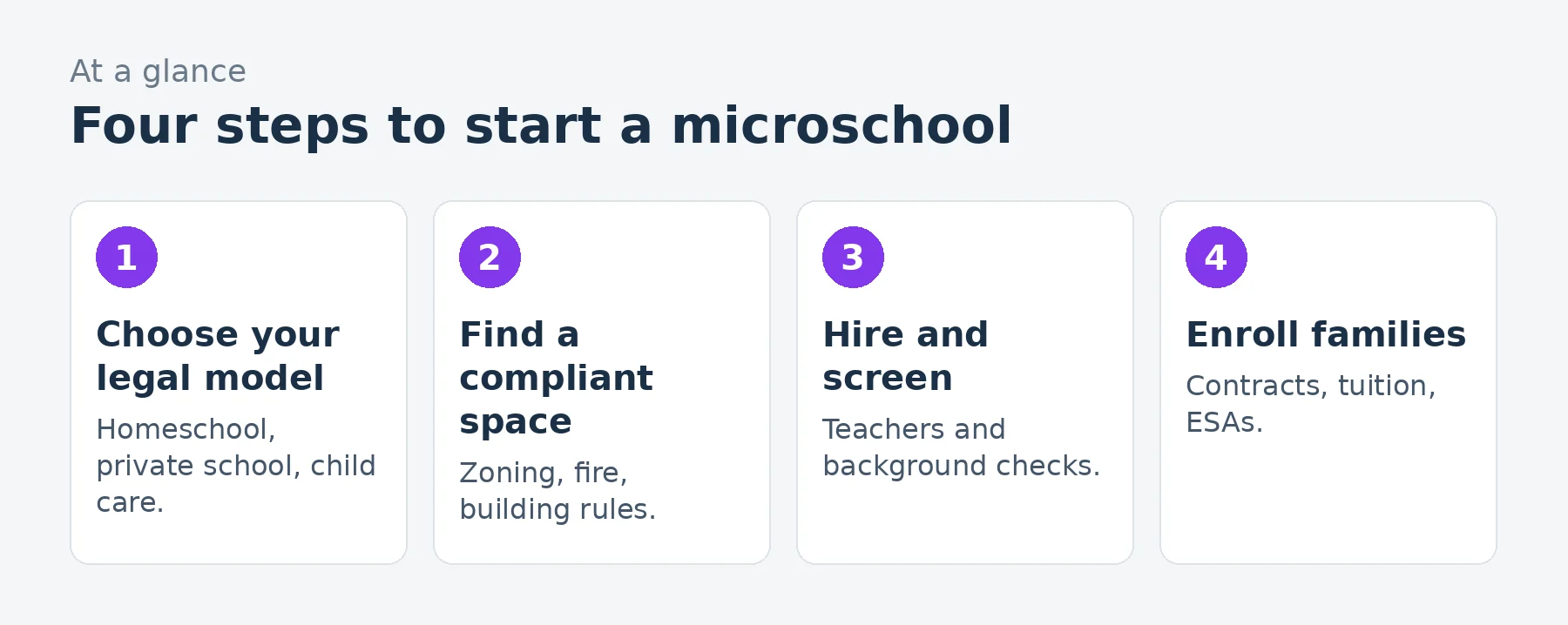
- Days 1-30: research your state’s homeschool, private school and child care rules and choose your model.
- Days 31-60: find a compliant space, plan curriculum and budget and hire staff.
- Days 61-90: hold information nights, enroll founding families and apply for ESA approval where available.
Frequently asked questions about starting a learning pod or microschool
What is a microschool?
A small school, often 5 to 30 students, usually with mixed ages and personalized learning.
Is a learning pod legal?
Yes, when it follows your state’s homeschool, private school or child care rules.
Do microschools need a license?
It depends on the state and your model; some register as private schools, and some need child care licenses.
Can families use ESAs for microschools?
In some states, if the school qualifies under the program’s rules.
Can I run a microschool from home?
Sometimes, but zoning, fire codes and limits on children in homes may apply.
Do microschool teachers need certification?
It depends on the state; many don’t require it for private schools, but experience matters.
How much do microschools charge?
Tuition varies widely by area and program.
Do microschools need accreditation?
Usually not required, but it can help with credibility.
How many students should a microschool start with?
Many start with 5 to 15 students and grow as space and staff allow.
Can a microschool offer high school credits?
It depends on the state and your model; accreditation and clear transcripts help students transfer and apply to college.
Keep learning
- Preschools industry data
- How to start a childcare center
- How to start a tutoring business
- Cash and payroll planner
Sources
- HSLDA, Homeschool laws by state
- ChildCare.gov, State child care licensing and regulated care
- FTC, Using consumer reports: what employers need to know (background checks)
- ADA.gov, Title III regulations for public accommodations
- FTC, Children's Online Privacy Protection Rule (COPPA)
- US Small Business Administration, Apply for licenses and permits
Last reviewed November 4, 2026. Startup costs are estimates; check local prices, licensing and tax rules before you commit money.

