
Families invest in tutoring to help children catch up, keep up or get ahead, and adults hire tutors for career exams, languages and skills. A tutoring business can start with one person teaching a few students after school, then grow into a team of tutors serving a whole community. Startup costs are low, demand is steady through the school year, and happy families refer their friends.
Tutoring business at a glance
Table of Contents
| Services | Homework help, subject tutoring, reading and math support, study skills, exam preparation |
| Formats | In-home, at a learning center, in libraries, or online |
| Licensing | Usually just a business license; check local rules for learning centers |
| Startup costs | Low: materials, scheduling software, insurance, marketing |
| Busy seasons | Back to school, report cards, exam seasons; quieter in summer |
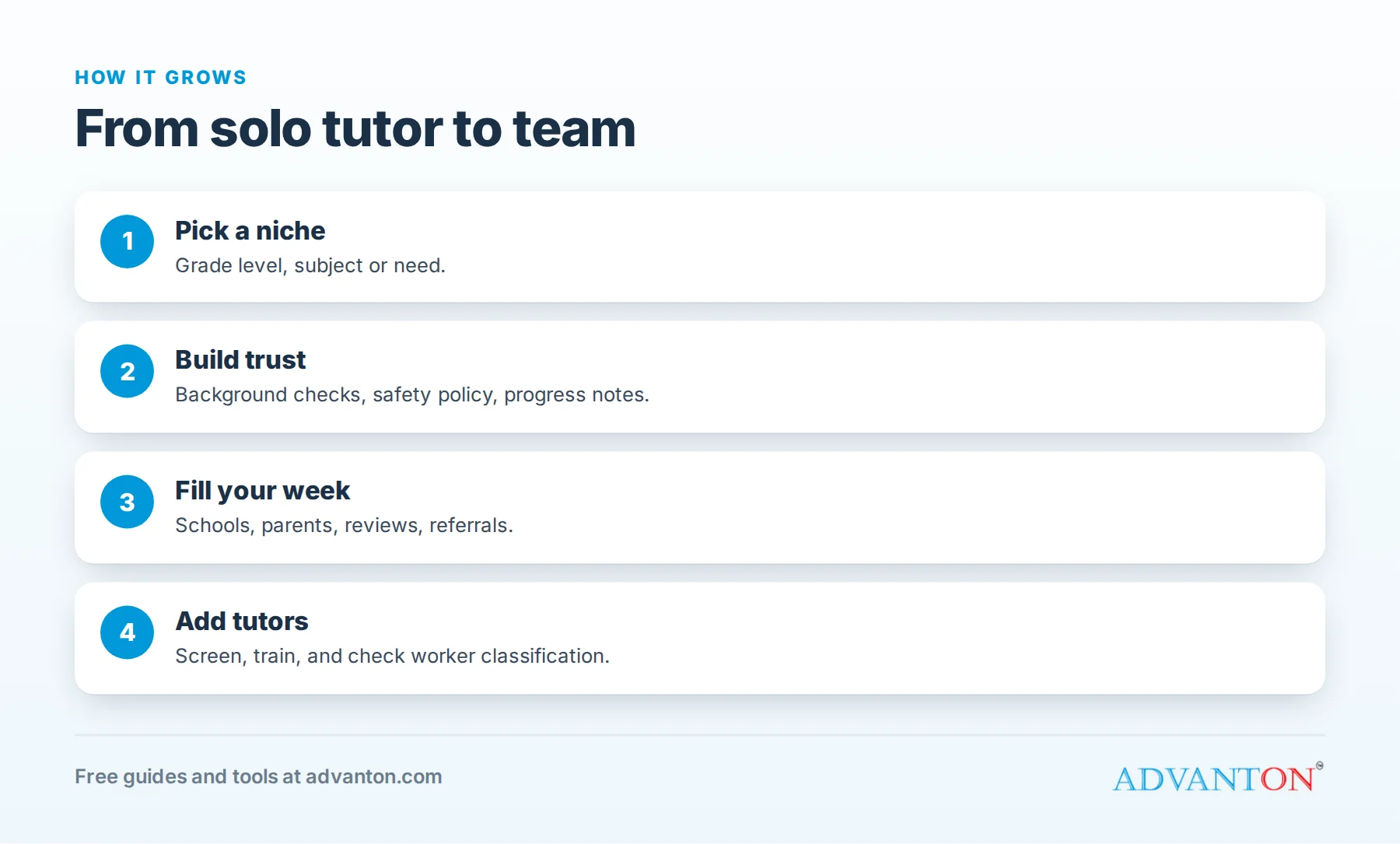
Choose your niche
General "tutoring for all subjects" is hard to market. A clear niche helps families find and trust you:
- Grade level: elementary, middle school, high school or college.
- Subject: math, reading and writing, science, languages, coding.
- Need: catching up, gifted learners, students with learning differences (with appropriate training), study skills and organization.
- Format: small groups, one-to-one, or homework clubs.
Start with what you know best and expand once you have a team.
Safety and trust: non-negotiable
When you work with children, parents need to trust you completely:
- Background checks for you and every tutor, with written consent.
- Clear policies: sessions in shared spaces at home, a parent or guardian nearby for young children, and professional communication through parents.
- Online safety: use business accounts, keep video sessions visible to parents, and follow privacy rules for children’s information.
- Training: child safeguarding basics and how to report concerns.
Put your safety policy on your website. It’s one of the strongest reasons families choose you.
Licensing and setup
- Register your business and get a local business license.
- Check zoning if students will come to your home or you open a learning center.
- Get insurance: general liability and professional liability, plus coverage for any abuse or molestation claims, often essential when working with minors.
- Open a business bank account and use simple invoicing; our free quote and invoice generator works well.
See business licenses and permits explained.
Startup costs to plan for
- Learning materials, workbooks and practice tests.
- A laptop, tablet and reliable internet for online sessions.
- Scheduling and payment software.
- Background checks and insurance.
- Marketing: a website, flyers and a Google Business Profile.
- Optional space: a small room or learning center later.
Total your list with our startup cost calculator.
Pricing your sessions
- Per session: rates vary by subject, grade level, location and tutor experience; specialized and advanced subjects command more.
- Packages: for example, 8 or 12 sessions paid in advance at a small discount, which improves cash flow and commitment.
- Small groups: a lower price per student but higher earnings per hour.
- Assessments: an initial assessment session to set goals.
Research local tutors and learning centers, and use our pricing calculator to make sure your price covers travel, preparation and admin time.
Hiring tutors: contractor or employee?
As you grow, you’ll add tutors. Many tutoring businesses start with independent contractors, but classification depends on the relationship: if you control how, when and where tutors work, set their methods and train them extensively, they may legally be employees. Review IRS guidance on worker classification and your state’s rules, and get professional advice. Whatever the arrangement, screen tutors carefully, check references, and observe a trial session.
Matching tutors to students
Good matches keep families: consider subject expertise, teaching style, the student’s age and personality, schedule and location. Introduce each match with a first session or short meeting, and invite parents to request a change if it isn’t working. Consistent tutor assignments build trust and progress.
A worked example: owner plus three tutors
These figures are illustrative for a busy school month.
| Revenue | Amount |
|---|---|
| Sessions: 220 × $60 | $13,200 |
| Costs | Amount |
|---|---|
| Tutor pay: 160 sessions × $30 | $4,800 |
| Marketing | $600 |
| Scheduling and payment software | $150 |
| Background checks for new tutors | $60 |
| Insurance | $120 |
| Learning materials | $200 |
| Total costs | $5,930 |
Profit before owner’s pay and taxes: $7,270, with the owner teaching about 60 sessions and managing the business. Summer months are usually quieter; summer programs and camps help fill the gap.
A 60-minute session plan
| Minutes | Activity |
|---|---|
| 0 to 5 | Check in: how school went, what’s due, how the student feels |
| 5 to 20 | Review: last session’s topic and any homework |
| 20 to 45 | New skill or main work, with guided practice |
| 45 to 55 | Independent practice while you observe |
| 55 to 60 | Recap, assign practice, and note progress for parents |
A consistent structure helps students feel confident and makes progress easier to track.
Tools for in-person and online tutoring
- A whiteboard or digital whiteboard app for explanations.
- Shared documents for notes and practice.
- Video calls with screen sharing for online sessions.
- A scheduling tool with automatic reminders and online payment.
- A simple student record of goals, sessions and progress.
Show progress
Families stay when they see results:
- Set goals after the first assessment.
- Send short progress notes after sessions or monthly reports.
- Share wins: improved grades, finished projects, confidence.
- Check in with teachers, with parents’ permission.
Learning differences
Many families seek tutoring for children with learning differences such as dyslexia or ADHD. If you serve these students, get appropriate training, work alongside the student’s school plan where parents share it, and be honest about your expertise. Refer families to specialists, such as educational psychologists or certified reading specialists, when a student needs more than tutoring.
Summer programs
Summer is often slow for tutoring, but families still want to prevent learning loss and prepare for the next grade. Offer summer reading clubs, math refreshers, small-group workshops or "next grade ready" programs, priced as short packages. They keep tutors busy and students connected through the year.
Finding families
- Google Business Profile and reviews: "math tutor near me" is a common search.
- Schools and teachers: many teachers refer students; introduce yourself to counselors.
- Parent groups, community boards, libraries and local social media groups.
- Referral rewards: a free session for each family that refers another.
- A simple website with subjects, prices, safety policy and booking; our website builder is free.
- Flyers near schools and community centers, made in our Brand & Print Studio.
Policies that protect your time
- Cancellation policy: for example, 24 hours’ notice or the session is charged.
- Payment terms: packages paid in advance or sessions paid at booking.
- Communication: how and when parents can reach you.
- Late arrivals and no-shows.
Growing into a learning center
Once demand outgrows homes and libraries, a small learning center lets you run several sessions at once, host small groups and build a visible local brand. Before signing a lease, check zoning, parking and safety requirements, confirm you have enough steady students to cover rent, and plan a schedule that fills after-school hours efficiently. Model the numbers with our break-even calculator.
Numbers to track
Track active students, sessions per week, average revenue per student, retention (how many families continue each term), and where new families come from. Our free lead source tracker shows which marketing brings families in.
Build a tutor handbook
As your team grows, write a short handbook covering your safety policy, session structure, progress notes, communication with parents, cancellations, pay and how to raise concerns. Every tutor follows the same standards, families get a consistent experience, and onboarding new tutors becomes much faster.
Common mistakes to avoid
- No safety policy or background checks.
- Underpricing and forgetting preparation and travel time.
- No cancellation policy.
- Too broad a niche.
- No measurable progress for parents to see.
Your first 90 days
- Days 1 to 30: choose your niche, register your business, complete your background check, and set prices and policies.
- Days 31 to 60: launch your website and Google Business Profile, contact schools and parent groups, and take your first students.
- Days 61 to 90: collect reviews, refine packages, and plan when to add your first tutor.
Frequently asked questions
Do I need a teaching license to tutor?
Usually not for private tutoring, though teaching experience and credentials help families trust you. Some school-funded programs require specific qualifications.
Should I tutor in person or online?
Both work. In person suits younger children; online widens your reach. See how to start an online tutoring business.
How do I grow beyond my own hours?
Hire tutors, offer small groups, and add services like test preparation.
When is tutoring busiest?
Back to school, after report cards, and before major exams.
How many students can one tutor handle?
Many part-time tutors work with 10 to 20 regular students a week, depending on session length and travel. Leave time for preparation and progress notes, and avoid back-to-back sessions without breaks. Quality matters more than volume: tired tutors give weaker sessions, and families notice quickly, so build your team’s schedule around steady, sustainable weekly hours with real breaks.
Keep learning
- How to start a test prep business
- How to start an online tutoring business
- How to start a music lessons business
Sources
Last reviewed October 28, 2026. Startup costs are estimates; check local prices, licensing and tax rules before you commit money.


Leave a Reply