
Standardized tests open doors: college admissions, graduate and professional schools, licenses and certifications. Students and their families invest in preparation because the stakes are high and the format is predictable. A test prep business turns deep knowledge of one exam into structured courses and private coaching, often at higher rates than general tutoring.
Test prep at a glance
Table of Contents
| Exams | College admissions, graduate and professional school, high school entrance, professional licensing and certification |
| Formats | Group courses, private tutoring, online classes, practice test events |
| Licensing | Usually a business license; check rules for any classroom space |
| Startup costs | Low to moderate: materials, practice tests, space, marketing |
| Calendar | Driven by official test dates and application deadlines |
Choose your exams
Specialize in one or two exams you know thoroughly, ideally ones you’ve scored highly on yourself:
- College admissions tests for high school students.
- Graduate and professional school exams for college students and adults.
- Professional licensing and certification exams, such as real estate, nursing, accounting or trades, for career changers.
- High school entrance or placement exams in some areas.
Check each exam’s current format, scoring and official test dates directly with the testing organization, since formats change.
Startup costs to plan for
- Official practice materials and your own workbooks.
- Classroom space, rented by the hour from libraries, schools, community centers or coworking spaces.
- Laptop, projector or screen, and online class software.
- Business registration and insurance, including professional liability.
- Marketing: website, flyers and workshop costs.
Total your list with our startup cost calculator.
Course formats
| Format | Best for | Notes |
|---|---|---|
| Group course | Students wanting structure at lower cost | 6 to 10 weeks, set schedule, practice tests |
| Private tutoring | Targeted help or tight timelines | Highest price per hour |
| Online live class | Wider reach | Same structure as in-person |
| Practice test days | Building confidence | Timed, realistic conditions |
| Self-paced materials | Budget-conscious students | Lower price, less support |
Many businesses combine group courses with private sessions for students who need extra help.
Materials and copyright
- Use official practice materials where available, purchased properly; they’re the most realistic.
- Write your own explanations, strategies and practice questions.
- Don’t copy copyrighted test questions or commercial prep books into your handouts without permission.
- Never use leaked or "live" test content, which can violate exam security rules and harm students.
Honest score claims
Parents and students want results, and claims about score improvements are powerful marketing. Keep them honest: base any claim on real, documented averages, explain how they were measured, and avoid guarantees of specific scores. Misleading claims can break consumer protection rules and damage your reputation.
Planning around test dates
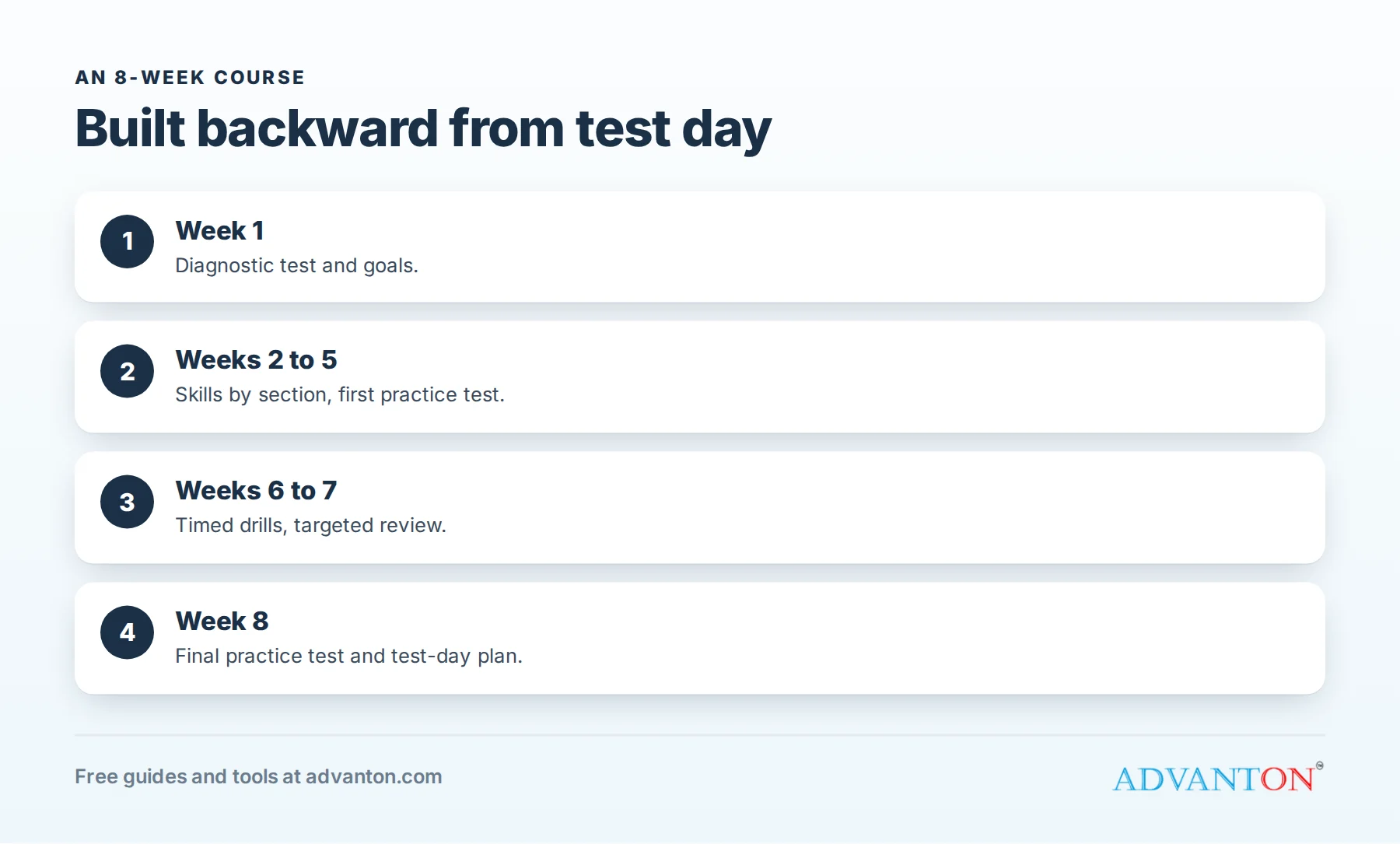
Work backward from official test dates and application deadlines:
- Course starts 8 to 10 weeks before a popular test date.
- Diagnostic test in week one to set goals.
- Weekly lessons and homework by section or skill.
- Full practice tests every two to three weeks.
- Final review and test-day strategy in the last week.
Publish your schedule months ahead, since families plan early.
A sample 8-week syllabus
| Week | Focus |
|---|---|
| 1 | Diagnostic test, goals, test format and scoring |
| 2 | Core skills, section one; pacing basics |
| 3 | Core skills, section two; practice set |
| 4 | Full practice test and review |
| 5 | Advanced question types and common traps |
| 6 | Timed section drills; second practice test |
| 7 | Targeted review of each student’s weakest areas |
| 8 | Final practice test, test-day plan and confidence building |
Teaching strategy, not just content
Students gain the most from learning how the test works:
- Pacing: how long to spend per question, and when to move on.
- Elimination: narrowing choices on difficult questions.
- Question patterns: recognizing common question types and traps.
- Reviewing mistakes: keeping an error log to spot patterns.
- Managing anxiety: breathing, routines and realistic practice under timed conditions.
Pricing
- Group courses: a set price for the full course, including materials and practice tests.
- Private sessions: higher hourly rates for specialized coaching.
- Bundles: course plus a few private sessions.
- Early registration discounts to fill courses.
Research local and online competitors; use our pricing calculator to cover instructor pay, space and materials.
A worked example: one month of a busy season
These figures are illustrative, showing one month’s share of two eight-week courses plus private coaching.
| Revenue | Amount |
|---|---|
| Two group courses: 24 students × $600, half in this month | $7,200 |
| Private sessions: 40 hours × $100 | $4,000 |
| Total revenue | $11,200 |
| Costs | Amount |
|---|---|
| Classroom rental | $1,200 |
| Instructor pay | $2,400 |
| Practice materials and tests | $600 |
| Marketing | $1,500 |
| Software | $150 |
| Total costs | $5,850 |
Profit before owner’s pay and taxes: $5,350. Test prep is seasonal; plan cash with a cash flow forecast around test dates.
Loading the calculator…
Hiring instructors
Look for instructors with high scores and the ability to explain clearly. Observe a sample lesson, train them on your curriculum, and give them your materials and lesson plans so every class is consistent. Check worker classification rules when hiring; see our tutoring business guide.
Safety when teaching minors
Most college admissions and entrance exam students are minors. Run background checks on all instructors, teach in open or shared spaces, communicate through parents for younger students, and use business accounts for messages and online classes. Insurance that covers working with minors is worth discussing with your agent.
Keep parents informed
Parents of younger students want to know how things are going. Send a short update after each practice test showing scores by section, strengths, areas to work on and attendance. Clear communication builds trust and makes it easy for parents to recommend you to other families.
Finding students
- High school counselors and college advisors.
- Parent groups, school newsletters and local social media.
- Free workshops: "How the test works" or a free practice test day, which brings families in.
- Partnerships with tutoring centers and admissions consultants.
- Reviews and referrals from past students.
- A website with course dates, prices and instructors.
Testing accommodations
Students with documented disabilities may be eligible for accommodations, such as extra time, from the testing organization. Requests usually require documentation and must be made well before test day. You can’t grant accommodations, but you can point families to the testing organization’s process early and practice under the conditions students will actually have.
Professional exam prep for adults
Adults preparing for licensing and certification exams have different needs: busy schedules, career pressure and limited study time. Evening and weekend classes, online options, structured study plans and plenty of practice questions work well. Partner with trade schools, employers and professional associations, which often know who’s preparing for exams.
Track results
Record each student’s diagnostic and practice test scores, and their official results if they choose to share them. Use the data to improve your curriculum and, with permission, to make honest claims about average progress.
Keep courses fresh
Testing organizations update formats, question types and scoring from time to time. Check official announcements each season, review your materials after each course, and update practice questions so they reflect the current exam. Ask students after their test what felt different from practice, then adjust.
Test-day logistics
Help students arrive ready: send a checklist the week before covering registration confirmation, identification, approved calculators and supplies, travel time, sleep and breakfast. Remind them of their pacing plan. A calm, prepared student performs closer to their practice scores, and families remember the extra care.
Offer a free diagnostic
A free or low-cost diagnostic test, followed by a short score review, is one of the best ways to attract students. Families see exactly where the student stands, and you can recommend a course or private plan based on real results, not guesswork.
Common mistakes to avoid
- Outdated materials after an exam format changes.
- Score guarantees you can’t keep.
- Copying copyrighted questions.
- Starting courses too close to test dates.
- Ignoring test anxiety and pacing, which matter as much as content.
Your first 90 days
- Days 1 to 30: choose your exam, study its current format, and build your curriculum and diagnostic test.
- Days 31 to 60: set course dates around official test dates, launch registration, and run a free workshop.
- Days 61 to 90: teach your first course, track scores, and gather testimonials.
Frequently asked questions
Do I need to have taken the test myself?
It helps a great deal. High personal scores build credibility, and experience helps you teach strategy.
Can I use official practice tests in my classes?
Purchase them properly and check the publisher’s terms for classroom use.
How long should a course be?
Many run 6 to 10 weeks, depending on the exam and students’ starting points.
Can I teach test prep online?
Yes; see how to start an online tutoring business.
What if a student’s score doesn’t improve?
Review their practice tests and error log to find the cause, such as pacing, content gaps or test anxiety, and adjust the plan. Be honest with families about realistic goals and timelines.
Should I offer refunds?
Set a clear policy before enrolling students, such as full refunds before the course starts and partial refunds early on, in writing.
Keep learning
Last reviewed October 28, 2026. Startup costs are estimates; check local prices, licensing and tax rules before you commit money.
This article is general information, not financial, legal or tax advice. Check the rules that apply to you or talk to a qualified professional before making decisions. See our disclaimer.
Leave a Reply