
Families need safe, enriching early learning, and preschools prepare children for kindergarten while letting parents work. The Bureau of Labor Statistics counted about 555,100 preschool teachers in 2024, with a median wage of $37,120 in May 2024 and 4% projected growth; 63% worked in child daycare services. Childcare workers earned a median of $32,050.
Preschool businesses range from licensed home-based programs to centers with several classrooms and part-day enrichment programs. Licensing, staff-to-child ratios and teacher pay shape every model.
The workforce
| Occupation | Jobs (2024) | Median pay (May 2024) | Projected growth, 2024 to 2034 |
|---|---|---|---|
| Preschool teachers | 555,100 | $37,120 | +4% |
| Childcare workers | n/a | $32,050 | n/a |
Source: U.S. Bureau of Labor Statistics, Occupational Outlook Handbook and Occupational Employment and Wage Statistics.
Market data
| Measure | Value |
|---|---|
| Share of preschool teachers working in child daycare services (2024) | 63% |
Business models compared
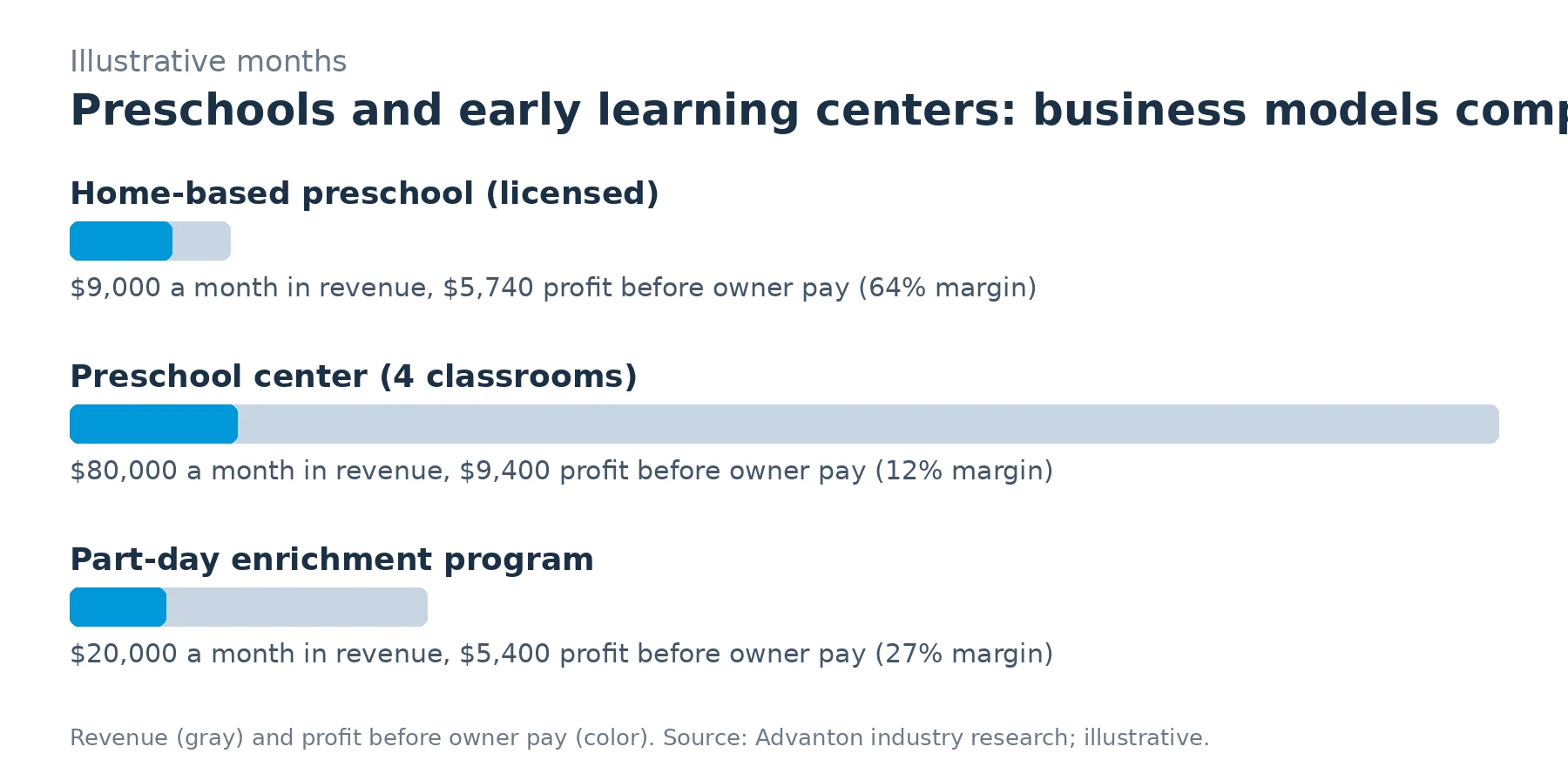
The figures below are illustrative months from our research, not industry averages. They show how revenue and costs typically fit together; your market, prices and costs will differ.
| Business model | Startup costs | Example monthly revenue | Costs | Profit before owner pay | Margin |
|---|---|---|---|---|---|
| Home-based preschool (licensed) | Low: home setup, licensing, supplies, insurance | $9,000 | $3,260 | $5,740 | 64% |
| Preschool center (4 classrooms) | High: facility, build-out, licensing, staff | $80,000 | $70,600 | $9,400 | 12% |
| Part-day enrichment program | Moderate: leased classroom, materials, staff | $20,000 | $14,600 | $5,400 | 27% |
Fixed and variable costs
For projections, the most useful split is between variable costs, which rise and fall with sales (materials, supplies, hourly labor, fees), and fixed costs, which you pay every month regardless (rent, salaried staff, insurance, loan payments).
| Business model | Variable costs (% of revenue) | Fixed costs per month | What it means |
|---|---|---|---|
| Home-based preschool (licensed) | 8.9% | $2,460 | Mostly fixed: needs steady volume to cover overhead |
| Preschool center (4 classrooms) | 6.5% | $65,400 | Mostly fixed: needs steady volume to cover overhead |
| Part-day enrichment program | 6.0% | $13,400 | Mostly fixed: needs steady volume to cover overhead |
What the numbers say
Teacher wages dominate costs because ratios set the minimum staff for every classroom.
Enrollment decides profit: each open seat costs almost as much to staff as a full one.
Home-based programs keep overhead low but serve fewer children.
The three models in brief
Home-based preschool. A licensed program in the provider’s home with a small group. See childcare data.
Preschool center. Several classrooms, a director and full-day or part-day programs.
Part-day enrichment program. Play-based learning, arts or language programs a few mornings a week. See tutoring and education data.
Cost structure: preschool center (4 classrooms)
Each cost as a share of the example month’s revenue ($80,000):
| Cost | Monthly amount | Share of revenue | Type |
|---|---|---|---|
| Teacher and assistant wages | $40,000 | 50.0% | Fixed |
| Rent | $9,000 | 11.2% | Fixed |
| Payroll taxes and benefits | $6,500 | 8.1% | Fixed |
| Director | $5,500 | 6.9% | Fixed |
| Food and supplies | $4,000 | 5.0% | Variable |
| Utilities | $1,800 | 2.2% | Fixed |
| Card and tuition processing | $1,200 | 1.5% | Variable |
| Insurance | $1,200 | 1.5% | Fixed |
| Marketing | $800 | 1.0% | Fixed |
| Curriculum and software | $600 | 0.8% | Fixed |
| Profit before owner pay | $9,400 | 12% |
A first-year projection: preschool center (4 classrooms)
New businesses rarely start at full speed. This projection assumes revenue ramps from 35% of the example month in month 1 to 100% by month 12, variable costs move with revenue, and fixed costs stay the same every month. It’s a planning illustration, not a forecast.
| Month | Revenue | Variable costs | Fixed costs | Profit | Cumulative |
|---|---|---|---|---|---|
| 1 | $28,000 | $1,820 | $65,400 | -$39,220 | -$39,220 |
| 2 | $36,000 | $2,340 | $65,400 | -$31,740 | -$70,960 |
| 3 | $44,000 | $2,860 | $65,400 | -$24,260 | -$95,220 |
| 4 | $49,600 | $3,224 | $65,400 | -$19,024 | -$114,244 |
| 5 | $56,000 | $3,640 | $65,400 | -$13,040 | -$127,284 |
| 6 | $60,800 | $3,952 | $65,400 | -$8,552 | -$135,836 |
| 7 | $65,600 | $4,264 | $65,400 | -$4,064 | -$139,900 |
| 8 | $69,600 | $4,524 | $65,400 | -$324 | -$140,224 |
| 9 | $72,800 | $4,732 | $65,400 | $2,668 | -$137,556 |
| 10 | $76,000 | $4,940 | $65,400 | $5,660 | -$131,896 |
| 11 | $78,400 | $5,096 | $65,400 | $7,904 | -$123,992 |
| 12 | $80,000 | $5,200 | $65,400 | $9,400 | -$114,592 |
Year one: revenue $716,800, profit before owner pay -$114,592. The first profitable month is month 9. Cumulative results bottom out at -$140,224, which is the minimum cash cushion this plan would need, before any startup costs.
Teachers, a director and rent start before classrooms fill, so this center illustration turns profitable in month 9, with a cumulative low of about $140,200, before facility build-out.
How preschools earn
- Tuition by week or month.
- Registration and supply fees.
- Childcare subsidies for eligible families.
- Before and after care.
- Summer programs.
Ratios set your costs
State staff-to-child ratios and group sizes determine how many teachers each classroom needs. Plan enrollment by classroom and age group to keep ratios efficient.
Licensing and safety
Licensing covers facilities, staff qualifications, ratios, health practices, emergency plans and inspections. Build safety into every routine and keep records ready for inspections.
A startup checklist
- Contact your state licensing agency early.
- Plan staffing to meet ratios and qualifications.
- Run background checks for every staff member.
- Choose curriculum and assessment tools.
- Set tuition from real costs and local market rates.
Subsidies and funding
Childcare subsidies, state pre-K programs and food programs can support enrollment and revenue. Each has its own requirements and paperwork.
Where the opportunities are
- Childcare deserts with few options.
- Employer partnerships for workforce childcare.
- Bilingual and specialty programs.
- Before and after care.
- Summer camps.
Key terms
| Term | Meaning |
|---|---|
| Ratio | Number of children per teacher |
| Group size | Maximum children in one group |
| Enrollment rate | Share of available seats filled |
| License-exempt | Programs not required to be licensed under state rules |
Hiring and keeping teachers
Low pay drives turnover across early education. Fair wages, benefits where possible, training and supportive leadership keep teachers, and consistent teachers keep families.
Key numbers to track
Track enrollment by classroom, waitlist, staff turnover, tuition collections, labor cost percentage and inspection results.
Common mistakes
- Opening before licensing is secure.
- Underpricing tuition.
- Poor ratio planning.
- High teacher turnover.
- Weak collection policies.
Marketing a preschool
Tours, reviews, Google Business Profile, community events and parent referrals fill classrooms. See childcare data.
Parent communication
Daily updates, photos and conferences build trust and retention. A parent app that shares meals, naps, activities and milestones keeps families connected and reassured throughout the day.
Curriculum and approach
Play-based, academic, Montessori-inspired and other approaches attract different families. Choose one you can deliver well.
Health and nutrition
Health policies, allergies, medication and meal programs need clear procedures and documentation.
Staff development
Ongoing training in child development, health and safety, curriculum and positive guidance improves quality and is often required for license renewal. Career paths from assistant to lead teacher help retain good staff.
Facilities
Child-safe layouts, outdoor space, restrooms and secure entry are key. Many centers lease and renovate former schools or offices.
Enrollment and waitlists
Full classrooms make a preschool profitable. Tours, open houses and waitlists help fill seats before each school year, and sibling discounts and flexible schedules can attract families. Track enrollment weekly and plan staffing to match.
The director’s role
A strong director manages licensing, staff, curriculum, parent relationships and finances. Many owners serve as director at first; hiring a qualified director frees the owner to grow or open additional locations.
Emergency preparedness
Fire drills, evacuation plans, lockdown procedures, first aid training and emergency contacts are required by licensing and reassure families.
Tuition policies
Clear enrollment agreements cover tuition, late fees, absences and withdrawal notice.
Test these numbers with your own plan
Open this industry in our free Business Idea Reality Check to start from any model above, change prices, costs, startup budget and your own pay, and see your break-even month, the cash you’d need, three scenarios and how new businesses in this sector survive in your state.
- Start with the closest model and its cost structure.
- Replace every price and cost with local quotes.
- Estimate your ramp: how fast customers will realistically come in year one.
- Map cash month by month with the free Cash & Payroll Planner.
- Build the full plan in the free Business Planner.
About this data
Workforce figures come from the U.S. Bureau of Labor Statistics (Occupational Outlook Handbook and Occupational Employment and Wage Statistics, May 2024 wages and the 2024 to 2034 projections, unless noted). Market figures cite their sources above. Business model figures are illustrative months built from typical prices and costs to show how revenue, fixed costs and variable costs fit together; they are not industry averages or guarantees. We review these profiles when new government data is released, at least once a year, and the same figures power the Business Idea Reality Check.
Licensing and rules
States license childcare and preschool programs, setting staff-to-child ratios, group sizes, teacher qualifications, health and safety rules and inspections; comprehensive background checks are required for staff, and programs receiving federal childcare subsidies must meet federal background check requirements; some programs operating only part-day or in schools may be license-exempt under state rules; food programs, fire codes and building rules apply. Requirements change; confirm with your state and local agencies before you start.
Frequently asked questions
Do preschools need a license?
Most states require childcare licensing, with some exemptions for part-day or school-based programs.
What do preschool teachers earn?
BLS reported a median of $37,120 in May 2024.
What are staff-to-child ratios?
State rules setting the number of children per teacher by age.
Can I run a preschool from home?
Many states license home-based programs; check zoning and licensing rules.
How do preschools set tuition?
From real costs, ratios and local market rates.
Do preschool staff need background checks?
Yes. Comprehensive background checks are required.
How long does it take to fill a new preschool?
Often several months to a year, depending on demand, location and marketing; tours and waitlists help.
Can a preschool accept childcare subsidies?
Many do; programs must meet state requirements to participate.
What qualifications do preschool teachers need?
Requirements vary by state and program; many require early childhood credentials or degrees.
How can I test these numbers?
Open preschools in the Business Idea Reality Check and enter your own tuition and costs.
Keep learning
- Childcare industry data
- Tutoring and education data
- Music lessons industry data
- Business Idea Reality Check
Sources
- U.S. Bureau of Labor Statistics, Preschool teachers
- U.S. Bureau of Labor Statistics, Childcare workers
Last reviewed November 1, 2026. Startup costs are estimates; check local prices, licensing and tax rules before you commit money.

