
Parents want their children to learn instruments, and adults return to music for joy and challenge. Weekly lessons create long-term, recurring relationships. The Bureau of Labor Statistics counted about 169,800 musicians and singers in 2024, with a median wage of $42.45 an hour in May 2024 and 47% self-employed; music directors and composers earned a median of $63,670. Many musicians build steady income by teaching. Below is the key industry data on music lessons and music schools, with costs, business models and a first-year projection.
Music teaching businesses range from private teachers in home studios to music schools with multiple teachers and rooms, and online lesson businesses reaching students anywhere.
The workforce
| Occupation | Jobs (2024) | Median pay (May 2024) | Projected growth, 2024 to 2034 |
|---|---|---|---|
| Musicians and singers (median $42.45 an hour) | 169,800 | n/a | +1% |
| Music directors and composers | 47,300 | $63,670 | n/a |
Source: U.S. Bureau of Labor Statistics, Occupational Outlook Handbook and Occupational Employment and Wage Statistics.
Market data
| Measure | Value |
|---|---|
| Share of musicians and singers who are self-employed (2024) | 47% |
Business models compared
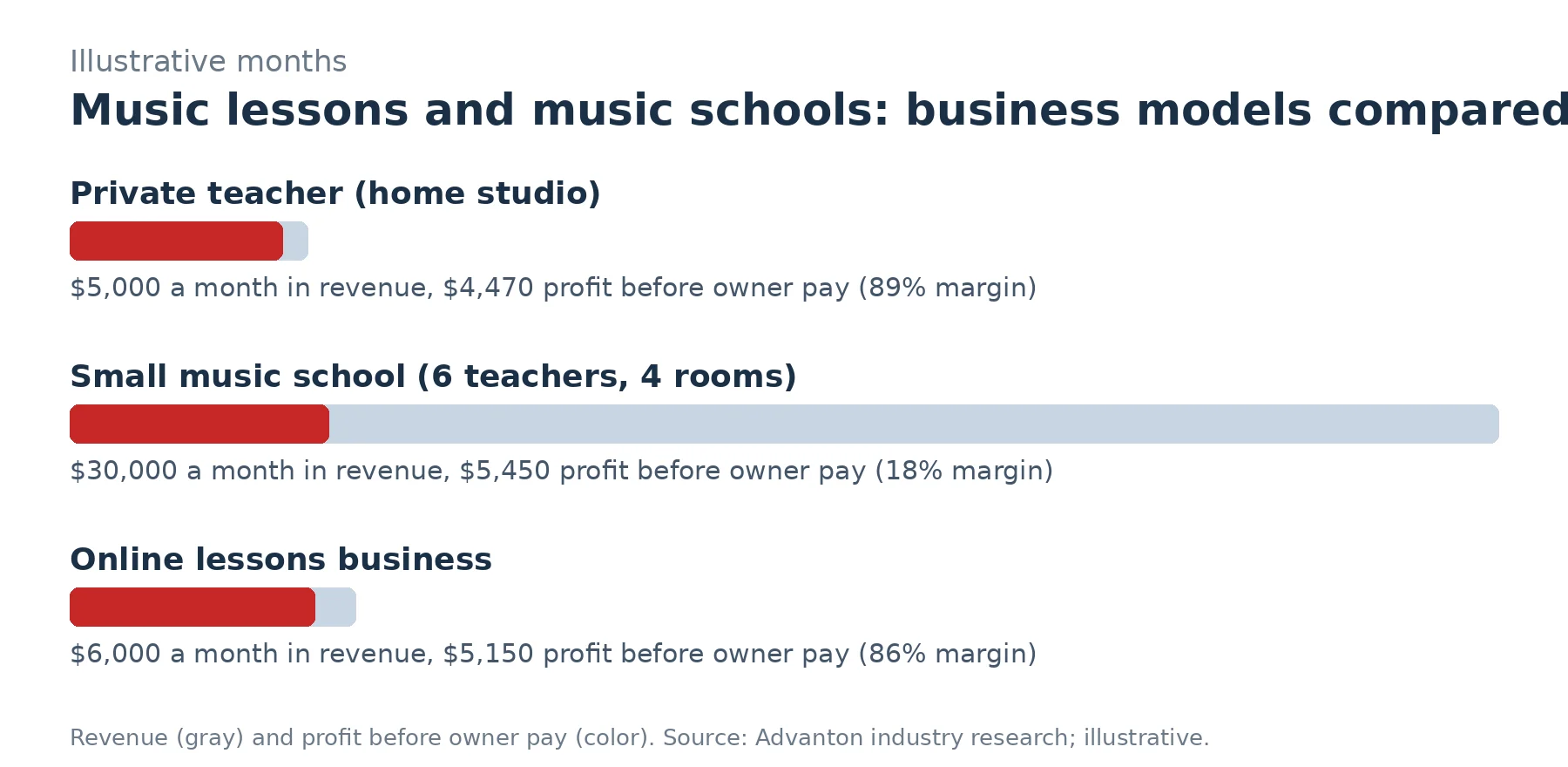
The figures below are illustrative months from our research, not industry averages. They show how revenue and costs typically fit together; your market, prices and costs will differ.
| Business model | Startup costs | Example monthly revenue | Costs | Profit before owner pay | Margin |
|---|---|---|---|---|---|
| Private teacher (home studio) | Low: instrument, studio space, scheduling software | $5,000 | $530 | $4,470 | 89% |
| Small music school (6 teachers, 4 rooms) | Moderate: lease, soundproofing, instruments, staff | $30,000 | $24,550 | $5,450 | 18% |
| Online lessons business | Low: camera, audio gear, scheduling, website | $6,000 | $850 | $5,150 | 86% |
Fixed and variable costs
For projections, the most useful split is between variable costs, which rise and fall with sales (materials, supplies, hourly labor, fees), and fixed costs, which you pay every month regardless (rent, salaried staff, insurance, loan payments).
| Business model | Variable costs (% of revenue) | Fixed costs per month | What it means |
|---|---|---|---|
| Private teacher (home studio) | 3.0% | $380 | Mostly fixed: needs steady volume to cover overhead |
| Small music school (6 teachers, 4 rooms) | 49.7% | $9,650 | Balanced: margins improve as volume grows |
| Online lessons business | 3.0% | $670 | Mostly fixed: needs steady volume to cover overhead |
What the numbers say
Private teachers keep nearly all tuition with minimal overhead.
Music schools pay teachers and rent, so room utilization and enrollment decide margins.
Online lessons reduce location limits but rely on marketing and good audio and video.
The three models in brief
Private teacher. Weekly lessons in a home studio or at students’ homes. See tutoring and education data.
Small music school. Several teachers and instruments, recitals and group classes.
Online lessons business. Live video lessons and courses for students anywhere. See online courses and coaching data.
Cost structure: small music school (6 teachers, 4 rooms)
Each cost as a share of the example month’s revenue ($30,000):
| Cost | Monthly amount | Share of revenue | Type |
|---|---|---|---|
| Teacher pay | $14,000 | 46.7% | Variable |
| Rent | $3,800 | 12.7% | Fixed |
| Front desk | $2,500 | 8.3% | Fixed |
| Marketing | $1,200 | 4.0% | Fixed |
| Payment fees | $900 | 3.0% | Variable |
| Payroll taxes | $900 | 3.0% | Fixed |
| Instruments and maintenance | $400 | 1.3% | Fixed |
| Utilities | $400 | 1.3% | Fixed |
| Insurance | $250 | 0.8% | Fixed |
| Software | $200 | 0.7% | Fixed |
| Profit before owner pay | $5,450 | 18% |
A first-year projection: small music school (6 teachers, 4 rooms)
New businesses rarely start at full speed. This projection assumes revenue ramps from 35% of the example month in month 1 to 100% by month 12, variable costs move with revenue, and fixed costs stay the same every month. It’s a planning illustration, not a forecast.
| Month | Revenue | Variable costs | Fixed costs | Profit | Cumulative |
|---|---|---|---|---|---|
| 1 | $10,500 | $5,219 | $9,650 | -$4,369 | -$4,369 |
| 2 | $13,500 | $6,710 | $9,650 | -$2,860 | -$7,229 |
| 3 | $16,500 | $8,200 | $9,650 | -$1,350 | -$8,579 |
| 4 | $18,600 | $9,244 | $9,650 | -$294 | -$8,873 |
| 5 | $21,000 | $10,437 | $9,650 | $913 | -$7,960 |
| 6 | $22,800 | $11,332 | $9,650 | $1,818 | -$6,142 |
| 7 | $24,600 | $12,226 | $9,650 | $2,724 | -$3,418 |
| 8 | $26,100 | $12,972 | $9,650 | $3,478 | $60 |
| 9 | $27,300 | $13,568 | $9,650 | $4,082 | $4,142 |
| 10 | $28,500 | $14,164 | $9,650 | $4,686 | $8,828 |
| 11 | $29,400 | $14,612 | $9,650 | $5,138 | $13,966 |
| 12 | $30,000 | $14,910 | $9,650 | $5,440 | $19,406 |
Year one: revenue $268,800, profit before owner pay $19,406. The first profitable month is month 5. Cumulative results bottom out at -$8,873, which is the minimum cash cushion this plan would need, before any startup costs.
Rent and front desk costs start before every room is booked, so this music school illustration turns profitable in month 5, with a cumulative low of about $8,900.
How music teachers earn
- Monthly tuition for weekly lessons.
- Group classes and ensembles.
- Summer camps and workshops.
- Recital and exam fees.
- Instrument rentals and sales.
Studio policies
Clear policies on monthly tuition, cancellations, makeup lessons and holidays protect income and set expectations. Monthly tuition beats per-lesson billing for steady cash flow, and automatic payments reduce late tuition.
Teaching children safely
Background checks, open-door or visible lesson spaces, parent communication and clear conduct policies protect students and teachers.
A startup checklist for music lessons and music schools
- Set tuition and policies.
- Complete background checks if teaching minors.
- Check zoning for a home studio.
- Choose scheduling and billing software.
- Plan recitals and performance opportunities.
Where the opportunities are
- Adult beginners.
- Popular instruments such as guitar, piano, drums and voice.
- Rock band and ensemble programs.
- Homeschool music classes.
- Online lessons for rural students.
Key terms
| Term | Meaning |
|---|---|
| Monthly tuition | Fixed monthly fee for weekly lessons |
| Makeup lesson | Rescheduled lesson after an absence |
| Room utilization | Share of available lesson time booked |
| Recital | Student performance event |
Retention and motivation
Students quit when progress feels slow. Goals, recitals, fun repertoire and parent updates keep students engaged for years. Letting students choose some music they love, alongside technical work, keeps practice enjoyable.
Hiring teachers
Music schools need reliable, friendly teachers who connect with students. Classify teachers correctly and pay competitively.
Key numbers to track
Track active students, retention, room utilization, revenue per teacher hour and waitlists by instrument.
Common mistakes
- Per-lesson billing that creates cancellations.
- No makeup policy.
- Underpricing lessons.
- Weak child safety policies.
- No performance goals.
Marketing a music teaching business
Recitals, school partnerships, Google Business Profile, reviews, referrals and social media videos bring students. See tutoring and education data.
Recitals and events
Recitals motivate students and showcase your school. Plan venues, permissions and music licensing where needed.
Instruments and rooms
Soundproofing, quality instruments and comfortable rooms improve lessons and reduce noise complaints from neighbors and other tenants. Tune pianos regularly and keep spare strings, reeds and cables on hand so lessons never stop for small problems.
Group programs
Group classes and ensembles serve more students per hour and build community. Rock bands, choirs and beginner piano groups give students the fun of playing together and often lead to private lessons.
Online lessons done well
Good microphones, lighting and stable internet make online lessons effective. Share recordings and practice assignments.
Adult students
Adults often want flexible scheduling, practical goals and music they love. Evening and weekend slots, short-term packages and adult group classes attract this growing segment and help fill daytime hours that children can’t use.
Summer camps
Camps fill summer gaps and attract new students.
Pricing
Price by lesson length, teacher experience and local demand. Review yearly.
Exams and certificates
Graded music exams and certificate programs give students clear goals and parents visible progress. Preparing students for exams can add structure and motivation, and some families seek teachers specifically for exam preparation.
Instrument rentals
Renting instruments to beginners removes a barrier to starting lessons and can add revenue. Partner with local music stores or manage a small rental inventory with clear agreements.
Parent communication
Regular progress updates keep parents invested.
Test these numbers with your own plan
Open this industry in our free Business Idea Reality Check to start from any model above, change prices, costs, startup budget and your own pay, and see your break-even month, the cash you’d need, three scenarios and how new businesses in this sector survive in your state.
- Start with the closest model and its cost structure.
- Replace every price and cost with local quotes.
- Estimate your ramp: how fast customers will realistically come in year one.
- Map cash month by month with the free Cash & Payroll Planner.
- Build the full plan in the free Business Planner.
About this data
Workforce figures come from the U.S. Bureau of Labor Statistics (Occupational Outlook Handbook and Occupational Employment and Wage Statistics, May 2024 wages and the 2024 to 2034 projections, unless noted). Market figures cite their sources above. Business model figures are illustrative months built from typical prices and costs to show how revenue, fixed costs and variable costs fit together; they are not industry averages or guarantees. We review these profiles when new government data is released, at least once a year, and the same figures power the Business Idea Reality Check.
Licensing and rules
Register the business and follow local zoning for home studios; teachers working with minors should complete background checks, and many schools require them; written studio policies should cover tuition, cancellations and makeup lessons; public performances at recitals may require music licensing depending on the venue; music schools need insurance and must classify teachers correctly as employees or contractors. Requirements change; confirm with your state and local agencies before you start.
Frequently asked questions about music lessons and music schools
What do music teachers earn?
Musicians earned a median of $42.45 an hour in May 2024, and many teachers set their own rates.
Do music teachers need a license?
Private teachers usually don’t, though schools may require background checks.
Should I charge monthly tuition?
Many teachers do for steady income and fewer cancellations.
Can I teach from home?
Often yes; check zoning and noise rules.
How do music schools find teachers?
Local music communities, colleges and referrals.
Are online music lessons effective?
Yes for many instruments, with good audio and video.
How do I keep students motivated?
Goals, recitals, fun repertoire and parent updates.
Do recitals need music licensing?
It depends on the venue and use; check requirements.
How can I test these numbers?
Open music lessons in the Business Idea Reality Check and enter your own tuition and costs.
Keep learning
- Tutoring and education data
- Music and entertainment data
- Preschools data
- Business Idea Reality Check
Sources
Last reviewed November 1, 2026. Startup costs are estimates; check local prices, licensing and tax rules before you commit money.
In India
Small businesses like this in India
In MoSPI’s survey of unincorporated businesses (proprietorships, partnerships and similar firms), this falls under Education and coaching. In 2023-24 India had 19.7 lakh such establishments employing 68.9 lakh workers, and 78.2% were run without hired workers. Across the wider other services group, the number of establishments grew 10.29% between 2023-24 and 2025.
| Urban | Rural | All India | |
|---|---|---|---|
| Value added per business a year | ₹6,21,949 | ₹7,07,032 | ₹6,59,580 |
| Value added per worker a year | ₹1,81,756 | ₹2,02,282 | ₹1,90,942 |
| Pay per hired worker a year | ₹1,65,314 | ₹1,61,357 | ₹1,63,526 |
Running it alone or with staff: businesses with no hired workers added about ₹78,530 a year on average, while those with hired workers added about ₹28,44,624 (all India).
Where these businesses are: the states with the most small other services businesses are West Bengal (13.1%), Uttar Pradesh (11.6%), Maharashtra (8.8%), Tamil Nadu (6.2%), Gujarat (6.0%) of the national total (2023-24).
Value added is what a business produces minus what it spends on materials and other inputs, before paying its workers and owner, so it’s a rough guide to the income a typical small business generates. These figures cover the whole activity, which can be broader than this one business type. Across all small businesses, average fixed assets such as equipment, furniture and vehicles were ₹3,42,242 per establishment in 2025.
Licences and registrations to expect
- Registration under your state’s Shops and Establishments Act if you have premises or employees.
- A trade licence from your municipal corporation or council for many shop and service businesses.
- GST registration once turnover crosses ₹40 lakh for goods or ₹20 lakh for services (lower in some special category states), or earlier if you sell goods to other states or through e-commerce marketplaces.
- Professional tax registration in states that levy it.
- Free Udyam (MSME) registration, which helps with loans, government schemes and delayed-payment protection.
Rules differ by state and city. Check with your municipal corporation, state departments and a chartered accountant before you start.
Run a business like this in India? List it free in the India Business Directory, with your hours, deals and GST registration.
Free tools for India: Make a GST invoice · Compare business credit cards
Build a market report for Music Lessons and Music Schools in India Pick your state and see market size, earnings, competition and licences, from official data. Free, with a PDF download.
Sources: MoSPI, Annual Survey of Unincorporated Sector Enterprises (ASUSE) 2023-24, full report, Appendix A Tables 4, 29, 33, 35 and 37 (survey period October 2023 to September 2024); MoSPI, Annual Survey of Unincorporated Sector Enterprises (ASUSE) 2025, factsheet (survey period January to December 2025, released 24 March 2026). Licensing summary by Advanton, checked November 2026.