
A kayak and paddleboard rental business rents kayaks, canoes and stand-up paddleboards (SUPs) by the hour or day, and often offers guided tours, lessons, sunset paddles and SUP yoga. The best locations are lakes, rivers, bays and beaches with calm water, scenery and steady visitor traffic.
Water safety and permits come first. Under U.S. Coast Guard rules, kayaks, canoes and paddleboards are vessels, so every person needs a Coast Guard-approved life jacket; launching commercially from parks, beaches or public docks usually requires permits; and drownings are a real risk, so safety briefings and weather policies matter. Advanton’s outdoor adventure data shows a median pay of $35,380 for recreation workers (May 2024), across about 327,700 jobs with employment projected to grow about 4%. Owners of guide and rental businesses earn the profit after staff, equipment, permits and insurance, and income is often seasonal. This guide covers location, permits, rules, equipment, operations, pricing, a worked example and a 90-day plan.
A kayak and paddleboard rental business at a glance
Table of Contents
| Topic | What to expect |
|---|---|
| Startup cost | Moderate: a fleet of kayaks and paddleboards, paddles, life jackets, racks, a trailer or storage, booking system and insurance |
| Key rules | Coast Guard-approved life jacket for each person, state boating rules, and permits to operate on public waters and lands |
| How you earn | Hourly and daily rentals, guided tours, lessons, SUP yoga, delivery rentals and group events |
| Key risks | Drowning and cold water, wind and weather, and seasonal demand |
| Best for | Outdoor-loving, safety-minded people in places with good water access and visitors |
Who paddle rental suits
It suits outdoor-loving people who are confident on the water, safety-focused and enjoy welcoming visitors, including first-time paddlers. Weather-dependent seasonal work requires flexibility and planning.
Choosing a location
Look for calm, protected water with scenery, easy launch access, parking and visitor traffic, such as lakes, slow rivers, bays and beaches near tourist areas. Check currents, wind exposure, boat traffic and hazards such as dams or strong tides. Mobile rental businesses deliver boats to customers’ chosen launch points, where local rules allow.
Permits and public waters
Operating commercially on public lands and waters often requires permits: the National Park Service issues commercial use authorizations, the Forest Service issues outfitting and guiding special use permits and the Bureau of Land Management issues special recreation permits, while state parks and local agencies have their own concessions and permits. Permits can be limited in number, so apply early.
Cities, counties and marinas may also require business licenses, beach or dock permits and agreements for storage and launch sites.
Coast Guard and state rules
The Coast Guard treats kayaks, canoes and SUPs as vessels. Each person must have a Coast Guard-approved wearable life jacket of the right size; federal rules require children under 13 to wear life jackets on moving recreational vessels unless states set their own ages; and SUPs used outside narrow surfing, swimming or bathing areas are vessels that need a life jacket, a sound-producing device such as a whistle and, at night, appropriate lights. Many states have additional rules, and some require registration or launch permits for paddlecraft. Many rental businesses require customers to wear life jackets, not just carry them.
Safety briefings and policies
- Give every renter a briefing on paddling basics, routes, hazards and how to get help.
- Set wind, weather and water temperature limits, and close when conditions are unsafe.
- Check swimming ability and group experience; guide inexperienced groups.
- Provide whistles, and note return times so overdue paddlers are noticed.
- Keep a rescue plan, a rescue boat or board and first aid supplies.
- Train staff in water rescue, first aid and CPR.
Equipment
- Kayaks: stable sit-on-top models for beginners; tandems for couples and families.
- SUPs: wide, stable rental boards, inflatable or hard boards.
- Paddles, life jackets in all sizes and leashes for SUPs.
- Racks, trailer or storage and a launch cart.
- Dry bags, whistles and signage.
Buy durable rental-grade equipment, and inspect and clean it daily.
Waivers and insurance
Carry general liability insurance designed for watercraft rentals and tours, property coverage for your fleet and workers’ compensation for employees. Use waivers and acknowledgments of risk, recognizing that enforceability varies by state, especially for minors. Permits usually require naming the agency as an additional insured.
Startup costs to plan for
| Item | What to budget for |
|---|---|
| Fleet | Kayaks, SUPs, canoes |
| Safety gear | Life jackets in all sizes, whistles, rescue equipment |
| Storage and transport | Racks, trailer, storage site |
| Permits and fees | Concession, launch and business permits |
| Booking system | Online booking, waivers, payments |
| Insurance | Liability, property, workers’ compensation |
Use our startup cost calculator for your total.
Pricing
Price rentals by the hour, half day and day, with tandem pricing, and charge per person for guided tours, lessons and SUP yoga. Offer group, birthday and corporate packages. Peak weekend pricing and online booking help manage demand. Use our pricing calculator.
A worked example: a summer month
These are illustrative assumptions for a summer month at a lake location with 24 boats and boards, not predictions.
| Assumption | Monthly | |
|---|---|---|
| Rentals | 1,100 rental hours at $28 average | $30,800 |
| Guided tours and lessons | 60 participants at $55 | $3,300 |
| SUP yoga and group events | $1,800 | |
| Revenue | $35,900 | |
| Seasonal staff | With payroll costs | $(9,500) |
| Permit and concession fees | Share of revenue or flat fee | $(3,200) |
| Equipment depreciation and repairs | $(1,500) | |
| Insurance | Liability coverage, averaged monthly | $(900) |
| Booking platform, card fees and marketing | $(2,000) | |
| Profit before owner pay and taxes | $18,800 |
That leaves about $18,800 in a strong summer month before the owner’s pay and taxes, on about $35,900 of revenue. Most income arrives in a few warm months, so budget for the whole year and consider winter storage costs.
Loading the calculator…
Guided tours and lessons
Guided tours (sunset paddles, wildlife tours, historic waterways) attract visitors willing to pay more and reduce risk for beginners. Lessons and SUP yoga classes bring repeat local customers. Guides should have paddling, rescue and first aid training.
Marketing
- Google Business Profile and travel review sites.
- Partnerships with hotels, vacation rentals and tourism offices.
- Photos and videos of scenic routes.
- Locals: memberships, punch cards and early-morning paddles.
- Groups: camps, corporate outings and parties.
Cold water and changing conditions
Cold water is dangerous even on warm days: sudden immersion can cause gasping and loss of muscle control within minutes. In spring and fall, require life jackets to be worn, consider wetsuits or limits on routes and close earlier when afternoon winds rise. Check forecasts several times a day.
Mobile and delivery rentals
Some businesses deliver kayaks and boards to vacation rentals, beaches or launch sites instead of operating a fixed shop. Delivery models need a trailer, scheduling and clear rules about where customers may paddle, and they still need permits where commercial activity is regulated.
Fleet care and replacement
Rinse equipment after saltwater use, store it out of direct sun, repair damage quickly and retire equipment that is no longer safe. Track the age and condition of every boat, board and life jacket, and budget for regular replacement.
Common mistakes to avoid
- Renting without life jackets that fit every paddler.
- Operating on public waters without permits.
- Ignoring wind and weather limits.
- No briefing or overdue-paddler system.
- Underestimating off-season costs.
Your first 90 days
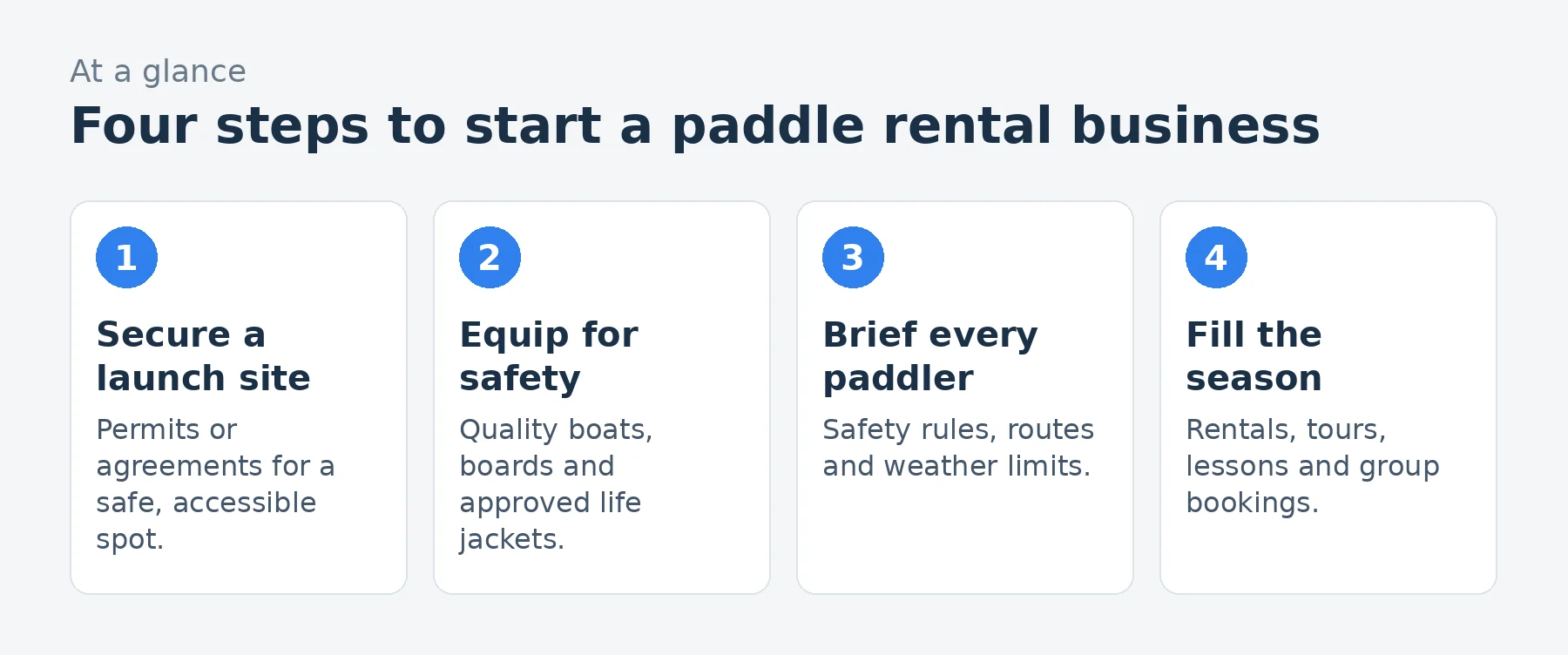
- Days 1-30: choose a location, research permits and Coast Guard and state rules and get insurance quotes.
- Days 31-60: apply for permits, buy fleet and safety gear and write safety and weather policies.
- Days 61-90: train staff, launch online booking and partner with local hotels and tourism offices.
Frequently asked questions
Do kayak renters need life jackets?
Yes. Coast Guard rules require a Coast Guard-approved wearable life jacket for each person, and many businesses require them to be worn.
Are paddleboards considered boats?
SUPs used outside narrow surfing, swimming or bathing areas are considered vessels by the Coast Guard, with life jacket and other requirements.
Do I need a permit to rent kayaks?
Usually, if you operate in parks, beaches, public docks or federal lands and waters; check local and state rules.
How much should I charge for kayak rentals?
Price by the hour, half day and day, with higher per-person prices for tours and lessons.
What insurance does a paddle rental business need?
Liability coverage for watercraft rentals and tours, property coverage for the fleet and workers’ compensation for staff.
Is paddle rental seasonal?
In most areas, yes; plan for winter storage and consider mobile rentals, tours and off-season revenue.
Do children need to wear life jackets?
Federal rules require children under 13 to wear life jackets on moving recreational vessels unless a state sets its own age; many rental businesses require everyone to wear one.
Can I run a kayak rental from my own property?
If you have water access and zoning allows commercial use, yes; you still need insurance and should follow Coast Guard and state rules.
Should I offer guided tours?
Yes. Tours bring higher prices per person and give beginners a safer, more memorable experience.
Keep learning
- Outdoor adventure industry data
- How to start a fishing charter business
- Startup cost calculator
- Pricing calculator
Sources
- U.S. Coast Guard Boating Safety, Life jacket wear and requirements
- U.S. Coast Guard, Paddlecraft and stand-up paddleboard safety requirements
- National Park Service, Commercial use authorizations
- US Bureau of Labor Statistics, Recreation workers
Last reviewed November 3, 2026. Startup costs are estimates; check local prices, licensing and tax rules before you commit money.

