
A fishing charter business takes paying customers fishing: inshore and nearshore trips, offshore trips, lake and river guiding, fly fishing and specialty trips. Charter captains combine fishing knowledge, boat handling and hospitality, and great trips earn repeat customers and referrals.
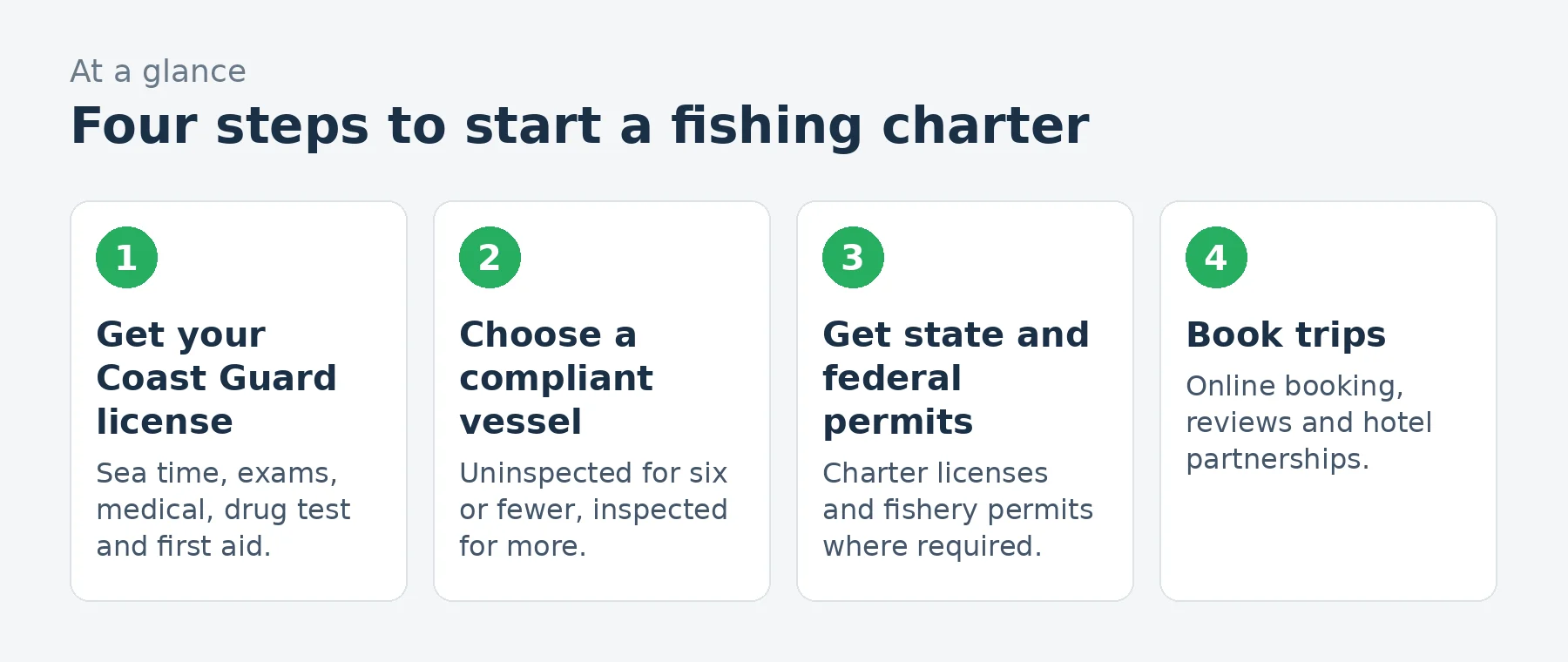
Carrying passengers for hire is regulated. Captains need a U.S. Coast Guard license: the OUPV (often called the six-pack) for up to six passengers on uninspected vessels, or a Master license and an inspected vessel to carry more. Captains must be in a drug testing program, many states require charter licenses and some fisheries require federal permits. Advanton’s outdoor adventure data shows a median pay of $35,380 for recreation workers (May 2024), across about 327,700 jobs with employment projected to grow about 4%. Owners of guide and rental businesses earn the profit after staff, equipment, permits and insurance, and income is often seasonal. This guide covers licensing, vessels, permits, safety, insurance, pricing, a worked example and a 90-day plan.
A fishing charter business at a glance
Table of Contents
| Topic | What to expect |
|---|---|
| Startup cost | Moderate to high: a suitable boat, safety equipment, tackle, licensing, insurance, dockage and marketing |
| Captain’s license | OUPV (six-pack) for up to six passengers for hire on uninspected vessels; Master license for inspected vessels |
| Other requirements | Coast Guard drug testing program, state charter licenses, federal permits for certain fisheries and safety equipment |
| How you earn | Half-day, full-day and specialty trips priced per trip, plus tips and add-ons |
| Best for | Experienced anglers and boat handlers who enjoy hosting people on the water |
Who chartering suits
It suits experienced anglers who know local waters, handle boats confidently and enjoy teaching and entertaining customers. Long days, early mornings, weather and boat maintenance are part of the job.
Coast Guard licenses
- OUPV (six-pack): allows carrying up to six passengers for hire on uninspected vessels. Requirements include documented sea time (including recent experience), exams, a physical, a drug test, first aid and CPR training and a background check.
- Master license: required to operate inspected vessels, which can carry more than six passengers, with more sea time and testing.
- Endorsements for near-coastal or inland waters, and tonnage limits, depend on experience.
Licensing is handled through the Coast Guard’s National Maritime Center, and many captains take approved courses to prepare.
Vessel rules
Boats carrying more than six passengers for hire generally must be inspected by the Coast Guard and hold a Certificate of Inspection, with requirements for construction, stability, safety equipment and crew. Uninspected passenger vessels carrying six or fewer still need required safety equipment: life jackets for everyone, fire extinguishers, visual distress signals, sound signals, navigation lights and more depending on size and waters.
Drug testing
Licensed mariners operating commercial vessels must participate in a Coast Guard-compliant drug and alcohol testing program, usually through a testing consortium, including pre-employment, random and post-accident testing. Mates and crew may also need testing.
State and federal fishing permits
Many states require charter or guide licenses for each captain or vessel, and some cover passengers’ fishing licenses under the charter license, while others require each angler to buy a license. NOAA Fisheries requires federal charter and headboat permits for certain fisheries, such as some reef fish and highly migratory species. Follow bag limits, size limits and seasons strictly, and keep records required by fishery managers.
Insurance
Carry protection and indemnity (P&I) insurance for passenger injuries and liability, hull insurance for the boat and coverage for crew under maritime law. Charter insurance differs from recreational boat insurance, so work with a marine insurance specialist.
Startup costs to plan for
| Item | What to budget for |
|---|---|
| Vessel | Purchase or financing of a suitable boat |
| Licensing | Courses, exams, medical, drug test, credential fees |
| Safety equipment | Life jackets, extinguishers, signals, first aid |
| Tackle and electronics | Rods, reels, fish finders, GPS |
| Permits | State charter license and federal permits |
| Insurance and dockage | P&I, hull, slip fees |
Use our startup cost calculator for your total.
Pricing trips
Charters are usually priced per trip for a set number of passengers (for example, half day and full day), with extra charges for additional anglers up to the license limit, specialty trips and fish cleaning. Include fuel, bait and tackle in prices or state surcharges clearly. Set deposit and weather cancellation policies. Use our pricing calculator.
A worked example: a peak-season month
These are illustrative assumptions for a six-passenger inshore charter in peak season, not predictions.
| Assumption | Monthly | |
|---|---|---|
| Half-day trips | 18 trips at $550 | $9,900 |
| Full-day trips | 8 trips at $900 | $7,200 |
| Revenue | $17,100 | |
| Fuel | $(2,600) | |
| Bait, ice and tackle | $(1,300) | |
| Mate | Paid per trip | $(2,100) |
| Boat loan payment and maintenance | $(2,200) | |
| Dockage | $(600) | |
| Insurance | P&I and hull, averaged monthly | $(700) |
| Booking fees and marketing | $(900) | |
| Profit before owner pay and taxes | $6,700 |
That leaves about $6,700 in a peak-season month before the captain’s pay and taxes, on about $17,100 of revenue. Weather cancellations and off-season months reduce annual income, so plan for the whole year.
Loading the calculator…
Safety on every trip
- Check weather and sea conditions, and cancel when unsafe.
- Give a safety briefing on life jackets, emergency procedures and boat rules.
- Carry required safety equipment and keep it inspected.
- File a float plan with someone on shore.
- Watch for heat, sun and seasickness, and know first aid.
Customer experience
Great charters teach, entertain and adapt: patient instruction for beginners, clean and comfortable boats, good communication and photos of catches. Many captains build loyal clients who book every year.
Marketing
- Online booking platforms and your own website.
- Reviews on travel and booking sites.
- Hotels, resorts and vacation rentals that refer guests.
- Social media with catches and trip videos.
- Corporate and group trips.
Weather and cancellation policies
Write clear policies for weather cancellations (captain’s decision, rescheduling or refund), customer cancellations and deposits. Communicate early when forecasts look poor, and never go out in unsafe conditions to save a booking.
Fish handling and catch rules
Know size and bag limits, protected species and handling rules for releasing fish. Offer fish cleaning, packaging and referrals to local restaurants that cook the catch, and teach customers good catch-and-release practices.
Adding a second boat or captain
Growing charters add boats and licensed captains, sometimes working as independent captains under your brand. Each captain needs the proper credential and drug testing, and each vessel needs proper insurance, equipment and permits.
Conservation and reputation
Customers increasingly value conservation: following regulations, practicing catch and release for some species and supporting healthy fisheries. Conservation-minded captains earn respect from customers and local communities.
Boat maintenance
A broken engine cancels trips and disappoints customers. Follow maintenance schedules, keep spare parts for common failures, inspect safety equipment regularly and keep maintenance records, which insurers and inspectors may ask to see.
Common mistakes to avoid
- Carrying paying passengers without the right Coast Guard license.
- Carrying more than six passengers on an uninspected vessel.
- Skipping drug testing program enrollment.
- Missing state or federal fishing permits.
- Recreational insurance instead of charter coverage.
Your first 90 days
- Days 1-30: document your sea time and start Coast Guard licensing, and research state and federal permits.
- Days 31-60: choose or outfit your vessel, join a drug testing consortium and get marine insurance.
- Days 61-90: obtain charter licenses, set prices and launch online booking and hotel partnerships.
Frequently asked questions
What license do I need to run a fishing charter?
A U.S. Coast Guard OUPV license for up to six passengers on uninspected vessels, or a Master license for inspected vessels, plus state charter licenses where required.
What is a six-pack license?
The Operator of Uninspected Passenger Vessels (OUPV) license, allowing up to six passengers for hire.
Do charter captains need drug testing?
Yes. Licensed mariners operating commercial vessels must be in a Coast Guard-compliant drug testing program.
Do my customers need fishing licenses?
It depends on the state; some charter licenses cover passengers, others require individual licenses.
Do I need federal permits?
For certain fisheries, such as some reef fish and highly migratory species, NOAA Fisheries requires charter permits.
What insurance does a charter boat need?
Protection and indemnity (P&I) and hull insurance, plus crew coverage, from a marine insurance specialist.
How much sea time do I need for an OUPV license?
The Coast Guard requires documented sea time, including recent experience; check the National Maritime Center’s current requirements.
Can I run a charter from my personal boat?
Only if the boat meets requirements for carrying passengers for hire and you hold the proper license, insurance and permits.
How do charters handle tips?
Tips are customary for captains and mates in many areas; mention them in booking information without pressuring customers.
How do I find charter customers?
Through online booking platforms, reviews, hotel and resort partnerships, social media and repeat clients.
Is a charter business seasonal?
In many areas, yes; plan for slower months with maintenance, marketing and, where possible, different target species.
Keep learning
- Outdoor adventure industry data
- How to start a kayak and paddleboard rental business
- How to start a hunting guide business
- Pricing calculator
Sources
- U.S. Coast Guard National Maritime Center, Merchant mariner credentials (OUPV and Master)
- U.S. Coast Guard, Drug and alcohol testing program for mariners
- NOAA Fisheries, Permits for charter and headboat vessels
- U.S. Coast Guard Boating Safety, Life jacket wear and requirements
- US Bureau of Labor Statistics, Recreation workers
Last reviewed November 3, 2026. Startup costs are estimates; check local prices, licensing and tax rules before you commit money.

