
A handbag brand designs and sells bags under its own name: totes, crossbody bags, clutches, backpacks, work bags and small leather goods such as wallets and card holders. Some founders make every bag by hand in a studio; others design the collection and work with small-batch manufacturers.
Bags carry high perceived value, so good design and quality materials can support strong prices. The challenges are sampling costs, material minimums and marketing in a crowded category. Materials also come with labeling rules, especially for leather and imitation leather. The Bureau of Labor Statistics groups related accessory makers with jewelers, reporting a median pay of $49,140 (May 2024). This guide covers niche, design, materials, rules, production, pricing, selling, a worked example and a 90-day plan.
A handbag brand at a glance
Table of Contents
| Topic | What to expect |
|---|---|
| Startup cost | Low to moderate: design tools, samples, materials, hardware, a first small run, photography and a website |
| Key rules | Accurate leather and imitation leather descriptions (FTC guides), country of origin labels, and permits for exotic skins |
| Production | Handmade in your studio, or small-batch manufacturing from your designs |
| How you sell | Your own online store, pop-ups, boutiques and marketplaces |
| Best for | Design-minded founders who care about materials, construction and building a brand |
Who a handbag brand suits
It suits founders with a strong eye for design and detail who enjoy materials and construction, and who are willing to market their brand consistently. Many successful accessory brands begin with one hero bag that customers recommend to friends.
Finding your niche
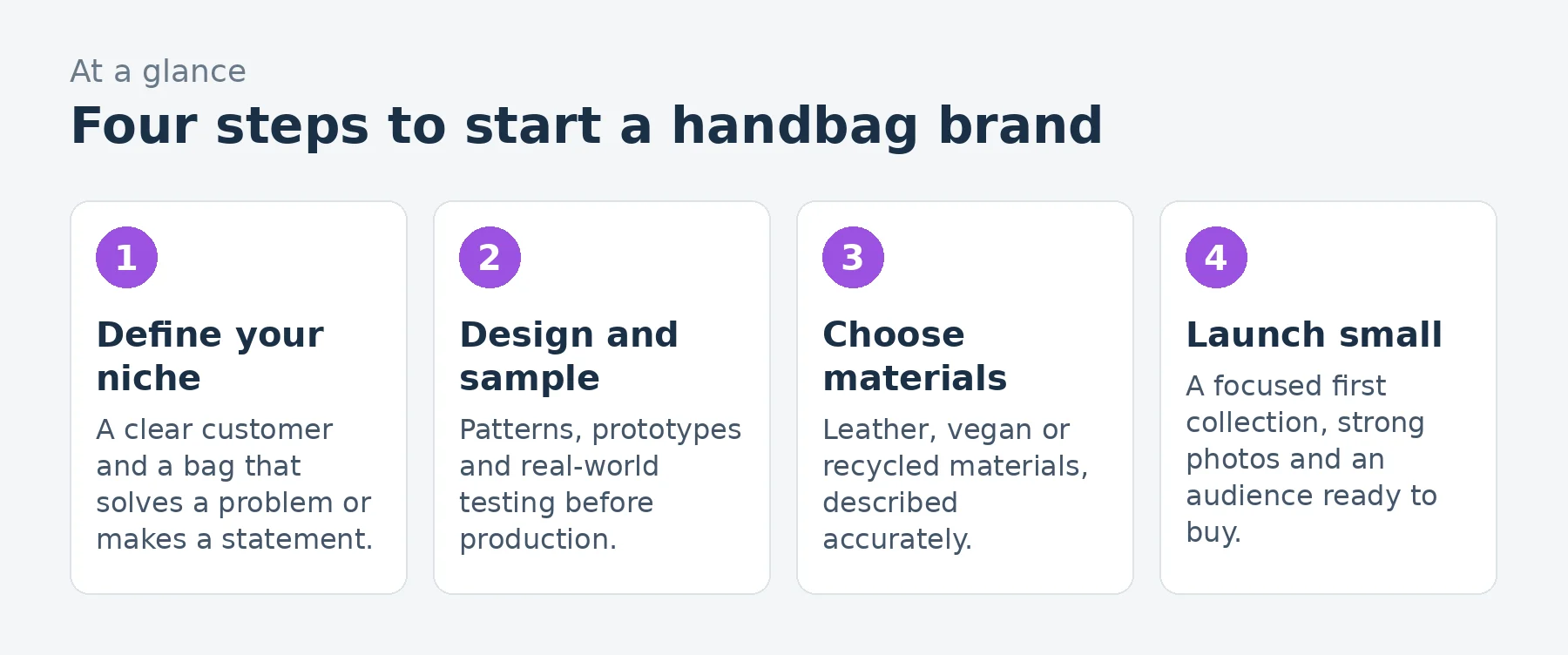
- Work bags that fit laptops and stay professional.
- Sustainable bags from recycled, plant-based or upcycled materials.
- Handcrafted leather goods with heritage techniques.
- Travel and everyday carry with smart organization.
- Cultural or regional designs that celebrate a community.
- Specialty bags for parents, nurses, photographers or musicians.
A clear niche shapes design decisions, materials, pricing and where you market.
Design and sampling
Sketch designs, create patterns and make prototypes. Test them in daily use: strap comfort, weight, pocket layout, durability and how the bag looks after weeks of wear. If you use a manufacturer, prepare a tech pack with measurements, materials, hardware, stitching and construction details, and expect several sample rounds before production.
Materials and hardware
Leather options include full-grain, top-grain and split leathers, with different finishes and prices. Alternatives include canvas, waxed cotton, recycled nylon, cork and plant-based leathers. Choose hardware (zippers, buckles, rings and clasps) that matches your quality level, because cheap hardware is the most common reason bags fail. Order swatches, test samples and confirm that suppliers can reorder the same material.
Leather labeling and claims
The FTC’s Guides for Select Leather and Imitation Leather Products cover how to describe materials. Do not call a product leather if it is not, disclose when leather is split, bonded or embossed to look like another type, and describe imitation materials clearly ("faux leather" or "not leather"). Be careful with terms like "vegan leather": describe what the material actually is.
Country of origin and exotic skins
Imported products generally must be marked with their country of origin for customs, and "Made in USA" claims must meet FTC standards. If you use exotic skins (such as snake, crocodile or ostrich), international trade in many species is controlled under CITES and U.S. wildlife laws, and may require permits and declarations. Many new brands avoid exotic skins to keep sourcing simple.
Children’s bags
Backpacks and bags designed mainly for children 12 and under are children’s products, with lead limits, testing, certificates and tracking labels under federal rules. Plan for these requirements if you design kids’ bags.
Making by hand or manufacturing
- Handmade: maximum control and a strong story, but limited capacity. Leather tools, a cutting table and possibly a sewing machine for leather are needed.
- Small-batch manufacturers: domestic or overseas workshops that produce from your tech packs, with minimum order quantities.
- Hybrid: make limited editions by hand while outsourcing core styles.
Startup costs to plan for
| Item | What to budget for |
|---|---|
| Design and samples | Patterns, prototypes, sample rounds |
| Materials and hardware | Leather or fabric, zippers, buckles, linings |
| First production | Handmade inventory or a small manufacturing run |
| Branding | Labels, logo stamps, dust bags, packaging |
| Photography and website | Product and lifestyle photos, online store |
| Marketing | Launch campaign, creators, ads |
Use our startup cost calculator for your total.
Pricing your bags
Start from the full cost of each bag: materials, hardware, lining, labor or manufacturing, packaging and inbound shipping. Many accessory brands set a wholesale price that covers costs and profit, then retail at about twice wholesale so boutiques can carry them. Direct-to-consumer sales keep the full margin but carry marketing costs. Use our pricing calculator.
A worked example: a small brand
These are illustrative assumptions for a small brand selling online and to boutiques, not predictions.
| Assumption | Monthly | |
|---|---|---|
| Online sales | 60 bags at $185 average | $11,100 |
| Wholesale to boutiques | 40 bags at $90 | $3,600 |
| Revenue | $14,700 | |
| Bag costs | 100 bags at $55 (materials, hardware, labor or manufacturing) | $(5,500) |
| Packaging and shipping | Dust bags, boxes, shipping | $(900) |
| Marketing and ads | $(2,600) | |
| Website, payment and marketplace fees | $(700) | |
| Photography and samples | New styles and seasonal photos | $(500) |
| Insurance and studio costs | $(400) | |
| Profit before owner pay and taxes | $4,100 |
That leaves about $4,100 a month before the founder’s pay and taxes, on about $14,700 of revenue. Marketing is a major cost for new fashion brands, and each new style needs samples, so grow the collection carefully.
Loading the calculator…
Selling your bags
- Your own online store with detailed photos, dimensions and "what fits" images.
- Pop-ups and markets where customers can feel the materials.
- Boutiques that match your style, using a line sheet with wholesale prices.
- Marketplaces for extra reach, with fees.
- Creators and stylists who show the bag in real life.
Photography and product pages
Customers cannot touch a bag online, so photos do the work: front, back, sides, interior, hardware close-ups, the bag being worn and items that fit inside. List exact dimensions, strap drop, weight, materials and care instructions. Clear product pages reduce returns.
Building a collection
Start with one or two styles in a few colors, learn what sells, then add related pieces: a matching wallet, a smaller version or a seasonal color. A tight collection is easier to produce, photograph and market than a wide range of unrelated bags.
Warranty and repairs
A clear warranty or repair policy builds trust in a premium product. Many leather brands offer repairs for stitching or hardware for a period after purchase, which also creates loyal customers who return.
Pop-ups and limited drops
Limited releases create urgency and help you test demand without large inventory. Announce a drop to your email list and social followers, produce a small run and restock bestsellers. In-person pop-ups at boutiques, markets and events let customers feel the quality, which matters for premium bags.
Sustainability as a selling point
Many customers care about how bags are made. Leather offcuts, recycled linings, repair programs and durable construction all support a sustainability story. Make claims specific and true, such as the percentage of recycled content, rather than vague environmental language.
Common mistakes to avoid
- Launching too many styles at once.
- Cheap hardware on an expensive bag.
- Calling materials leather when they are not.
- Skipping real-world testing of samples.
- Underestimating marketing costs.
Your first 90 days
- Days 1-30: define your niche, design two or three bags and source materials and hardware.
- Days 31-60: make or order samples, test them in daily use and finalize labels and packaging.
- Days 61-90: produce a small first run, photograph it, launch online and approach three boutiques.
Frequently asked questions
How much does it cost to start a handbag brand?
It depends on samples, materials and the size of your first run. Starting with one or two styles keeps costs down.
Can I call my bags vegan leather?
Describe the actual material clearly. FTC guidance says imitation leather should not be described in ways that suggest it is leather.
Do I need to put the country of origin on my bags?
Imported products generally need country of origin marking, and Made in USA claims must meet FTC standards.
Should I make bags myself or use a manufacturer?
Handmade offers control and a story; manufacturers offer capacity. Many brands start handmade or use small-batch workshops.
How should I price handbags?
Cover full costs for a wholesale price, then retail at about twice wholesale so boutiques can carry your bags.
Can I use exotic leathers?
Many exotic species are controlled under CITES and U.S. wildlife laws, which may require permits. Check before sourcing.
How many bags should my first run include?
A small run, often a few dozen pieces per style, lets you test demand while limiting unsold inventory.
Where can I find small-batch bag manufacturers?
Through manufacturer directories, trade shows, referrals from other accessory brands and local leather workshops. Ask for samples and references before committing.
Keep learning
- Jewelry and accessories industry data
- How to start a clothing brand
- How to start a handmade jewelry business
- Pricing calculator
Sources
- FTC, Guides for select leather and imitation leather products
- U.S. Customs and Border Protection, Country of origin marking
- U.S. Fish and Wildlife Service, Importing and exporting wildlife products (CITES)
- CPSC, Children's products: lead, tracking labels and certificates
- US Bureau of Labor Statistics, Jewelers and precious stone and metal workers
Last reviewed November 3, 2026. Startup costs are estimates; check local prices, licensing and tax rules before you commit money.

