
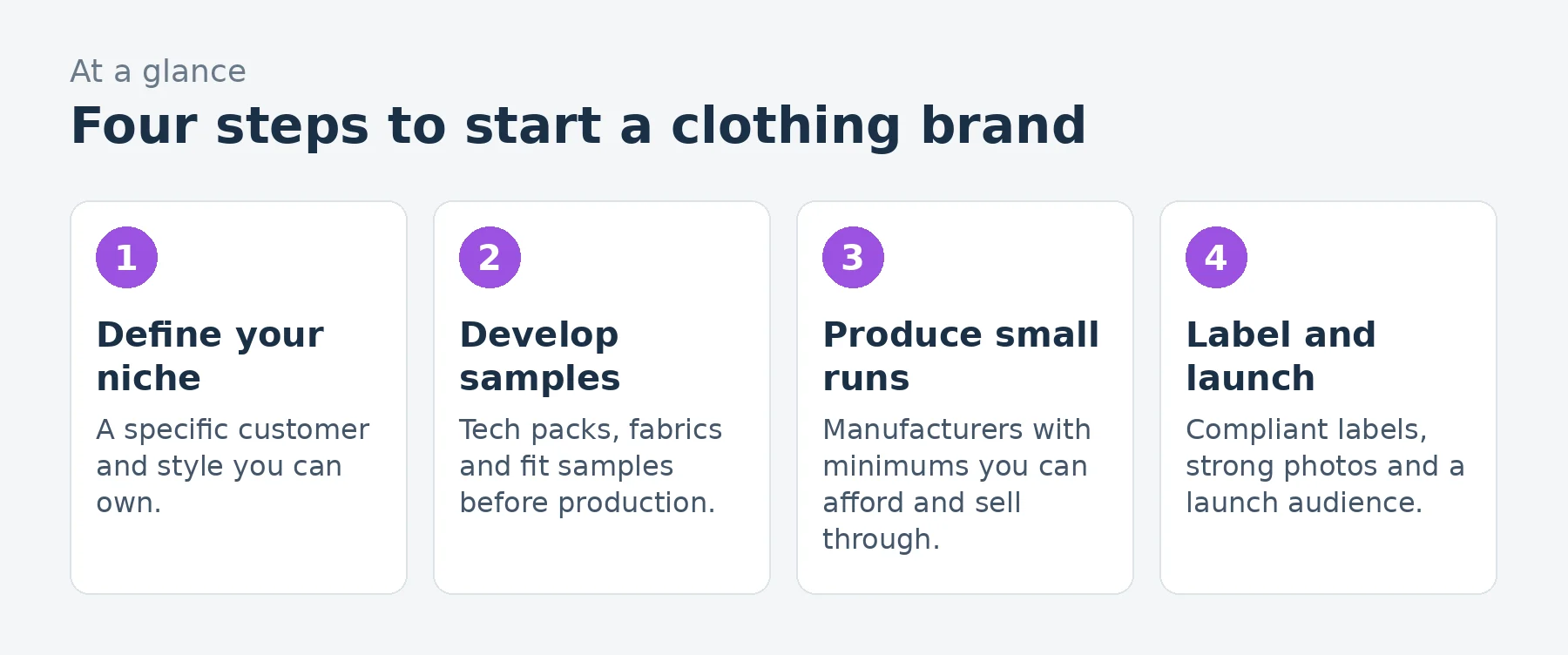
A clothing brand designs apparel and sells it under its own name, whether streetwear, activewear, workwear, children’s clothing, sustainable basics or a niche style for a specific community. Most new brands start small: a focused first collection, sold online and at pop-ups, produced in small runs.
Fashion is competitive and capital-intensive: samples, minimum orders and inventory all cost money before sales arrive, and unsold stock is the biggest risk. Clothing also has labeling rules every brand must follow. The Bureau of Labor Statistics reports a median pay of $80,690 for fashion designers, with about 25,700 jobs and modest projected growth. This guide covers niche, design, manufacturing, labeling, pricing, selling, a worked example and a 90-day plan.
A clothing brand at a glance
Table of Contents
| Topic | What to expect |
|---|---|
| Startup cost | Moderate: design, samples, a first production run, labels and packaging, photography, website and marketing |
| Key rules | FTC labeling of fiber content, country of origin, manufacturer identity and care instructions; extra safety rules for children’s clothing |
| Biggest risk | Unsold inventory from production minimums and wrong sizes or styles |
| How you sell | Your own online store, pop-ups and markets, wholesale to boutiques and marketplaces |
| Best for | Founders with a clear point of view who can market a brand and manage inventory |
Who a clothing brand suits
It suits founders with a clear creative vision who also enjoy marketing, community building and operations. Many successful brands come from founders deeply connected to a community, such as a sport, a profession, a culture or a lifestyle.
Finding your niche
"Clothes for everyone" rarely works. Pick a specific customer and problem: workwear that fits women in the trades, adaptive clothing for people with disabilities, activewear for a particular sport, sustainable basics, clothing celebrating a culture. A clear niche makes design decisions, marketing and word of mouth much easier.
Design, samples and tech packs
Develop a small first collection, often a few styles in a few colors. Create tech packs (detailed specifications with measurements, materials, trims and construction) so manufacturers can produce accurately. Expect several rounds of samples to perfect fit and quality, and test samples on real people in your size range.
Choosing a manufacturer
- Domestic production: smaller minimums, faster turnaround and easier communication, at higher unit costs.
- Overseas production: lower unit costs, higher minimums, longer lead times, shipping and duties.
- Cut-and-sew vs blanks: custom garments from scratch, or decorating existing blank garments for a faster start.
- Print-on-demand: no inventory, but lower margins and less control over quality.
Ask about minimum order quantities, pricing by quantity, sampling costs, lead times, quality control and payment terms. Order a small first run and test sales before scaling.
Labeling rules
Most clothing sold in the U.S. must carry labels showing:
- Fiber content by percentage, using generic fiber names (cotton, polyester and so on).
- Country of origin, such as "Made in USA" or "Made in Portugal," with special rules for products made in the U.S. from imported materials.
- Manufacturer or dealer identity, either the business name or a Registered Identification Number (RN) from the FTC.
- Care instructions under the FTC Care Labeling Rule, describing a safe cleaning method.
Wool products have additional rules. Clothing must also meet the federal flammability standard for clothing textiles, which most ordinary fabrics pass. Brand names and logos can be protected as trademarks; search existing marks before choosing a name.
Children’s clothing has extra rules
Clothing for children 12 and under is a children’s product under federal law: it may need third-party testing for lead in paint, buttons and trims, a Children’s Product Certificate, permanent tracking labels and compliance with drawstring rules for children’s outerwear. Build these costs into your plans if you design for kids.
Startup costs to plan for
| Item | What to budget for |
|---|---|
| Design and samples | Patterns, tech packs, sample rounds |
| First production run | Minimum quantities across sizes |
| Labels and packaging | Care and content labels, hang tags, mailers |
| Photography | Product and lifestyle photos |
| Website and marketing | Online store, launch campaign |
| Working capital | Reorders and slow-selling sizes |
Use our startup cost calculator for your total.
Pricing and margins
Start from your landed cost per item (making, fabric, trims, labels, inbound shipping and duties). Direct-to-consumer brands often price at several times landed cost to cover marketing, returns and overhead; wholesale prices to boutiques are lower, because boutiques mark up again. Make sure both channels still leave profit. Use our pricing calculator.
A worked example: an early-stage online brand
These are illustrative assumptions for an early-stage online brand, not predictions.
| Assumption | Monthly | |
|---|---|---|
| Online sales | 350 items at $58 average | $20,300 |
| Wholesale to boutiques | 200 items at $28 | $5,600 |
| Revenue | $25,900 | |
| Product cost | 550 items at $18 landed (making, fabric, trims, shipping in) | $(9,900) |
| Shipping and fulfillment | $(2,300) | |
| Returns and exchanges | $(900) | |
| Marketing and ads | $(4,500) | |
| Website, software and payment fees | $(1,100) | |
| Photography and content | $(600) | |
| Insurance and storage | $(300) | |
| Profit before owner pay and taxes | $6,300 |
That leaves about $6,300 a month before the founder’s pay and taxes, on about $25,900 of revenue. Marketing often costs as much as making the clothes, and unsold sizes eat profit, so sell through each run before ordering much more.
Selling your clothing
- Your own online store: the highest margin and direct customer relationships.
- Pop-ups, markets and events: let customers try on and give feedback.
- Wholesale to boutiques: reach and credibility, with lower prices per item.
- Marketplaces: extra reach for a fee.
- Community and creators: partnerships with people your customers trust.
Sourcing fabrics and trims
Fabric choices shape quality, cost and minimums. Many mills require large minimum orders, so small brands often buy from fabric wholesalers, use deadstock (surplus fabric from other brands) or rely on manufacturers that source materials. Order swatches, test fabrics for shrinkage, colorfastness and wear, and confirm availability for reorders before committing a style.
Sustainability claims
Customers care about how clothes are made, but claims must be accurate. Terms such as organic, recycled and sustainable should be backed by evidence and, for some materials, certification. Vague environmental claims can mislead customers and attract regulatory attention, so be specific: what material, what percentage and how you know.
Launching a collection
Build an audience before launch: share the design process, collect emails, offer early access and partner with creators your customers follow. A limited first run with a clear launch date creates urgency. After launch, gather feedback on fit and quality before reordering.
Returns and exchanges
Online clothing sales bring returns, mostly for fit. Detailed size charts, measurements on models, fit notes and customer reviews reduce returns. Set a clear return policy and budget for returns in your pricing.
Funding inventory
Production runs require payment before sales. Founders use savings, preorders, crowdfunding, small business loans and, later, inventory financing. Preorders are especially useful: they fund production and prove which styles and sizes customers want.
Protecting your brand name
Search federal and state trademark records and online before choosing a name, so you do not invest in a name someone else owns. Registering a trademark for your brand name and logo strengthens your rights as you grow.
Common mistakes to avoid
- Launching too many styles at once.
- Ordering large runs before proving demand.
- Missing required labels.
- Underestimating marketing costs.
- Poor size runs that leave unsold sizes.
Your first 90 days
- Days 1-30: define your niche and customer, design a small first collection and research manufacturers.
- Days 31-60: create tech packs, order samples, test fit and plan labels and packaging.
- Days 61-90: place a small first run, photograph products, build your store and line up a launch audience.
Frequently asked questions
What labels does clothing need?
Generally fiber content, country of origin, manufacturer identity (name or RN number) and care instructions, under FTC rules.
Do I need an RN number?
Not necessarily; you can use your business name instead, but many brands register a free RN with the FTC.
How much does it cost to start a clothing brand?
It depends on samples, minimums and marketing. Starting with a small collection and small runs keeps costs down.
Are there special rules for children’s clothing?
Yes: lead limits, testing and certificates, tracking labels and drawstring rules for children 12 and under.
Should I use print-on-demand?
It avoids inventory risk but lowers margins and control. Many brands start there, then move to bulk production.
How many styles should a first collection have?
Many brands launch with a handful of styles in a few colors, to limit inventory risk and learn what sells.
Can I make sustainability claims?
Yes, if they are specific and backed by evidence or certification. Avoid vague claims.
Should I take preorders?
Preorders can fund production and show which styles and sizes sell, as long as you clearly communicate delivery dates.
Where can I find clothing manufacturers?
Through manufacturer directories, trade shows, referrals from other brands and sourcing agents. Ask for samples and references before committing.
Keep learning
- Fashion and apparel industry data
- How to start a boutique clothing store
- How to start a custom t-shirt printing business
- Pricing calculator
Sources
- FTC, Threading your way through the labeling requirements (textile products)
- FTC, Clothes captioning: complying with the Care Labeling Rule
- FTC, Registered Identification Number (RN) database
- CPSC, Children's products: lead, tracking labels and certificates
- CPSC, Clothing textiles flammability standard (16 CFR 1610)
- US Bureau of Labor Statistics, Fashion designers
- USPTO, Trademark basics
Last reviewed November 2, 2026. Startup costs are estimates; check local prices, licensing and tax rules before you commit money.

