
A custom T-shirt printing business decorates apparel for schools, sports teams, businesses, events, churches, family reunions and online brands. Shirts are only the start: hoodies, hats, tote bags and promotional items use the same equipment and customers.
You can start small with a heat press or a direct-to-film setup in a garage, or invest in screen printing for large orders. Success depends on choosing the right printing method for your customers, pricing for setup and quantity and respecting copyright and trademark rules. This guide covers methods, equipment, pricing, permissions, customers, a worked example and a 90-day plan.
A custom T-shirt printing business at a glance
Table of Contents
| Topic | What to expect |
|---|---|
| Startup cost | Low to moderate: a heat press and DTF printer at the low end; screen printing presses, dryer and exposure unit for volume |
| Licenses | Business license and sales tax permit; resale certificate for buying blanks |
| Printing methods | Screen printing, direct-to-garment (DTG), direct-to-film (DTF), heat transfer vinyl and embroidery |
| Key rule | Do not print copyrighted artwork, logos or trademarks without permission |
| Best for | Hands-on, detail-oriented people who enjoy design, production and local sales |
Who a T-shirt business suits
It suits people who enjoy hands-on production, design and working with local customers. Deadlines around events and seasons are common, so organization matters. The Bureau of Labor Statistics reports a median pay of $56,260 for craft and fine artists, a reference point for design skills.
Choosing a printing method
| Method | Best for |
|---|---|
| Screen printing | Large orders with few colors; lowest cost per shirt at volume, but setup for each color |
| Direct-to-garment (DTG) | Detailed, full-color designs in small quantities, best on cotton |
| Direct-to-film (DTF) | Full-color transfers on many fabrics, small to medium runs, with a heat press |
| Heat transfer vinyl | Names and numbers, simple designs, very small runs |
| Embroidery | Polos, hats and workwear; see our embroidery guide |
Many shops start with DTF or heat transfer, then add screen printing as bulk orders grow.
Equipment and space
A small DTF or heat transfer setup fits in a spare room or garage; screen printing needs space for a press, dryer, exposure unit, washout area and drying racks, plus ventilation and proper handling of inks and cleaning chemicals. Check local zoning for home-based production and any rules for wastewater from screen cleaning.
Copyright, trademarks and permissions
You cannot legally print designs you do not have rights to: sports team logos, college marks, characters, brand names and artwork copied from the internet are protected by trademark and copyright. Ask customers to confirm they own or have permission to use their artwork, include that in your order terms and decline requests to print protected logos without a license. Original designs you create are protected by copyright automatically.
Startup costs to plan for
| Item | What to budget for |
|---|---|
| Printing equipment | Heat press, DTF printer, or screen press and dryer |
| Supplies | Inks, films, powder, screens, emulsion |
| Blanks | Shirts and apparel from wholesale suppliers |
| Design software | Graphics and separation software |
| Space | Garage, spare room or small shop with ventilation |
| Website | Ordering, quotes and an online store |
Use our startup cost calculator for your total.
Pricing
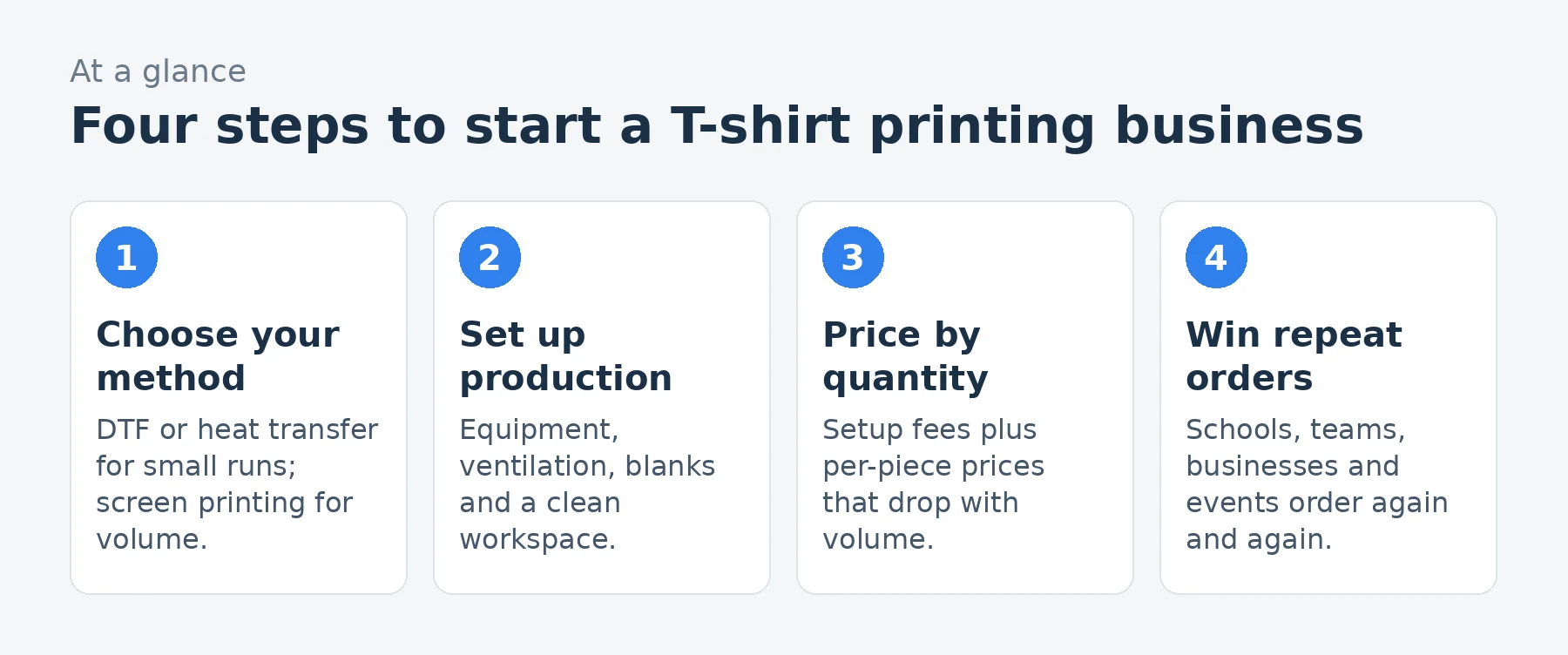
Price with a setup fee (screens, artwork) plus a per-piece price that drops as quantity rises and increases with each extra color or print location. Include blanks, ink, labor and a margin, and charge more for rush orders and specialty garments. Use our pricing calculator and publish a simple price grid for common orders.
A worked example: a small print shop
These are illustrative assumptions for a small shop with DTF and a manual screen press, not predictions.
| Assumption | Monthly | |
|---|---|---|
| Bulk orders | 20 orders averaging 60 shirts at $11 | $13,200 |
| Small and custom orders | $2,800 | |
| Online store sales | $1,200 | |
| Revenue | $17,200 | |
| Blank garments | About 1,350 blanks at $3.75 | $(5,060) |
| Inks, films, screens and supplies | $(1,300) | |
| Part-time help | With payroll costs | $(2,400) |
| Rent and utilities | Small shop | $(1,600) |
| Equipment payments and maintenance | $(700) | |
| Software, marketing and fees | $(600) | |
| Profit before owner pay and taxes | $5,540 |
That leaves about $5,540 a month before the owner’s pay and taxes, on about $17,200 of revenue. Larger orders are more profitable per shirt because setup time is spread across more pieces.
Finding customers
- Schools and sports teams: uniforms, spirit wear and fundraisers.
- Businesses: staff shirts, promotional items and events.
- Churches, clubs and nonprofits: events and fundraisers.
- Family reunions and events: custom designs.
- Online stores: fundraising pages and creators’ merchandise.
Repeat customers are the core of the business, so keep artwork on file and remind them before each season.
Artwork, proofs and orders
- Collect artwork in high resolution or vector formats, or design it for a fee.
- Send a digital proof showing placement, size and colors.
- Confirm sizes, quantities and the deadline in writing.
- Take a deposit or full payment before printing.
- Print a test piece, then run the order and inspect each item.
Choosing blanks
Blank garments vary widely in fit, fabric, weight and price. Offer a few good options at different price points (a basic cotton tee, a premium soft tee, a performance shirt and a hoodie) and order samples to test print quality. Check supplier stock levels before quoting large orders.
Rush orders and seasons
Back-to-school, sports seasons, graduations and the holidays bring rushes. Publish standard turnaround times, charge rush fees for faster delivery and plan staffing for busy seasons. Reliable deadlines are a major reason customers return.
Online stores and fundraisers
Online stores for schools, teams and nonprofits let supporters order directly, with sizes and payments collected online. You print after the store closes, and the organization receives a share as a fundraiser. This reduces size guessing and upfront costs.
Quality control
Inspect prints for alignment, color, coverage and cure, and wash-test new methods. Follow ink and transfer instructions for curing temperatures and times; under-cured prints crack or wash out. Count and fold orders carefully before delivery.
Growing the shop
Growth often comes from adding methods (embroidery, screen printing), a larger press or automatic equipment and promotional products. Track which customers and order types earn the most and focus your marketing there.
Artwork services
Many customers need help with designs. Offer simple artwork services for a fee, such as cleaning up logos, setting text, or creating new designs, and keep files organized for reorders. Make sure any artwork you create or receive is properly licensed.
Marketing locally
Wear your own work, sponsor local teams, sample shirts to coaches, school staff and business owners and post finished orders (with permission) on social media. A professional website with a simple quote form makes ordering easy.
Running orders efficiently
Group orders by method and color, prepare screens or transfers in batches and use checklists for each order. Efficient production lets you take more orders without longer hours.
Common mistakes to avoid
- Printing protected logos without permission.
- Pricing without setup time and per-color costs.
- Promising deadlines you cannot meet.
- Printing before proofs are approved.
- Choosing equipment that does not fit your typical orders.
Your first 90 days
- Days 1-30: choose your method, buy starter equipment and practice on test garments.
- Days 31-60: set up a blank supplier account, create a price grid and build a simple ordering website.
- Days 61-90: contact schools, teams and businesses, and complete first orders with excellent quality.
Frequently asked questions
What is the best printing method for beginners?
Many start with DTF or heat transfer for small orders, adding screen printing for volume later.
Can I print sports team or brand logos?
Not without permission. Logos and characters are protected by trademark and copyright.
How do I price custom T-shirts?
Use a setup fee plus per-piece prices that fall with quantity and rise with colors and print locations.
Can I run a T-shirt business from home?
Many do with DTF or heat press setups, if local zoning allows. Screen printing needs more space and ventilation.
Where do I buy blank shirts?
From wholesale apparel suppliers, usually with a resale certificate.
How many shirts make screen printing worthwhile?
Screen printing becomes cost-effective as quantities rise, because setup is spread across more shirts; small runs often suit DTF or DTG.
How do I handle size mistakes?
Confirm sizes in writing, use online stores for group orders and keep a policy for reprints and exchanges.
Can I sell my own designs online?
Yes. Many printers run their own online brands alongside custom work, using original designs they own.
Is a T-shirt printing business profitable?
It can be when setup fees and quantity pricing are right and repeat customers keep equipment busy.
What file formats do printers need?
Vector files or high-resolution images work best. Many shops redraw or clean up low-quality artwork for a fee.
Do I need a resale certificate to buy blanks?
Usually yes, so you can buy blank garments without paying sales tax and collect tax from customers instead.
What equipment should I buy first?
Buy what fits your typical orders: a quality heat press with DTF transfers for small runs, or a manual screen press and dryer if bulk orders are your focus.
Keep learning
- Print on demand industry data
- How to start an embroidery business
- How to start a clothing brand
- Pricing calculator
Sources
- US Copyright Office, Copyright basics
- USPTO, Trademark basics
- FTC, Threading your way through the labeling requirements (textile products)
- US Bureau of Labor Statistics, Craft and fine artists
Last reviewed November 2, 2026. Startup costs are estimates; check local prices, licensing and tax rules before you commit money.

