
A clothing boutique is a small, curated store selling apparel and accessories chosen for a specific customer: contemporary women’s fashion, menswear, children’s clothing, plus sizes, bridal, outdoor or a regional style. Boutiques compete with large retailers through curation, personal styling and a memorable shopping experience.
Retail fashion depends on buying well: the right styles, sizes and quantities at the right time, then selling them before they need deep markdowns. The Bureau of Labor Statistics reports a median pay of $34,730 for retail sales workers (May 2024). This guide covers customer and location, buying and budgets, pricing, merchandising, selling online, a worked example and a 90-day plan.
A boutique clothing store at a glance
Table of Contents
| Topic | What to expect |
|---|---|
| Startup cost | Moderate: lease and build-out, fixtures, opening inventory, point-of-sale and working capital |
| Licenses | Business license, sales tax permit and resale certificate for wholesale buying |
| Typical pricing | Many boutiques start near keystone (twice wholesale cost), then mark down slower items |
| Key skill | Buying: choosing styles, sizes and quantities your customers will buy at full price |
| Best for | Stylish, customer-focused owners who enjoy buying, merchandising and social media |
Who a boutique suits
It suits stylish, people-oriented owners who love helping customers find what suits them and enjoy the business side of buying, budgets and inventory.
Knowing your customer and location
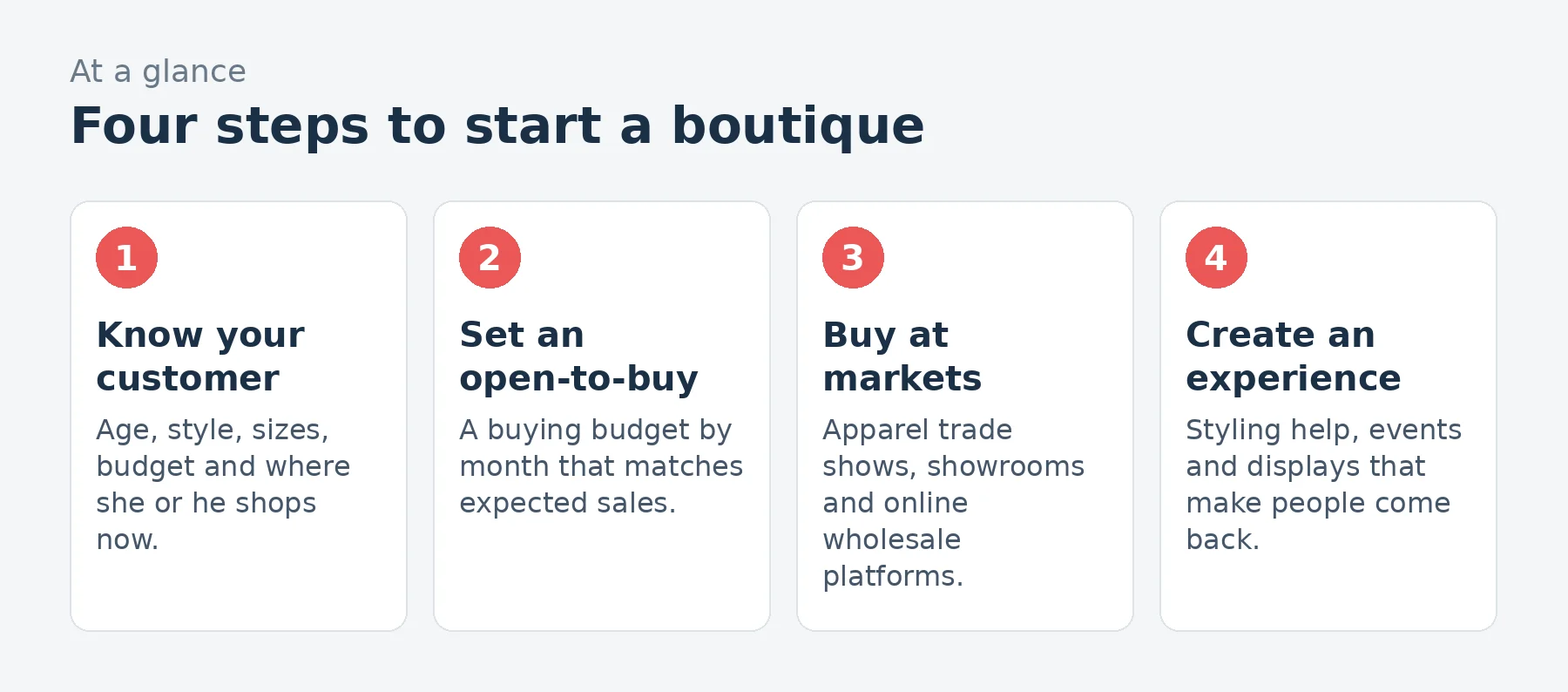
Define your customer precisely: age, lifestyle, sizes, style and price range. Then choose a location where that customer already shops, such as a walkable main street, a lifestyle center or a neighborhood near offices and homes. Visit at different times, and talk to nearby businesses about foot traffic.
Buying at markets and showrooms
Boutiques buy from brands and wholesalers at apparel markets and trade shows, showrooms, online wholesale platforms and from sales representatives. You will need a resale certificate. Watch minimum orders, delivery windows and reorder availability, and favor brands that offer exclusivity in your area so you are not competing with nearby stores on the same items.
Open-to-buy and inventory planning
An open-to-buy plan sets how much you can spend on inventory each month, based on planned sales, current stock and planned markdowns. It prevents overbuying, the most common reason boutiques run out of cash. Track sell-through (the share of each style sold at full price) and use it to guide reorders and future buying.
Sizing and assortment
Buy size runs that match your customers. Track sales by size to avoid leftover extremes. Balance a few higher-priced statement pieces with versatile basics and accessories, which raise sales per customer.
Labels and product rules
Clothing you buy from brands should already carry required labels (fiber content, country of origin, manufacturer identity and care instructions). If you sell children’s clothing, buy from suppliers who meet federal children’s product rules, and check recalls.
Startup costs to plan for
| Item | What to budget for |
|---|---|
| Space | Lease deposits, build-out, fitting rooms |
| Fixtures | Racks, shelving, mirrors, lighting, displays |
| Opening inventory | First season’s buying budget |
| Systems | Point-of-sale with inventory, website |
| Branding | Signage, bags, tissue, photography |
| Working capital | Reorders, markdowns and slow months |
Use our startup cost calculator for your total.
Pricing and markdowns
Many boutiques price near keystone (twice the wholesale cost) or higher for exclusive items, then plan markdowns for slower styles. Mark down earlier and less, rather than late and deep, to recover cash for new inventory. Use our pricing calculator.
A worked example: a small boutique
These are illustrative assumptions for a small boutique in an average month, not predictions.
| Assumption | Monthly | |
|---|---|---|
| In-store sales | $30,000 | |
| Online and social media sales | $8,000 | |
| Revenue | $38,000 | |
| Cost of goods | About 52% of sales, including markdowns | $(19,760) |
| Staff wages | With payroll costs | $(5,800) |
| Rent and utilities | $(4,200) | |
| Point-of-sale, website and card fees | $(1,400) | |
| Marketing, events and photography | $(1,300) | |
| Insurance, packaging and supplies | $(600) | |
| Profit before owner pay and taxes | $4,940 |
That leaves about $4,940 a month before the owner’s pay and taxes, on about $38,000 of revenue. Markdowns are the difference between a good month and a bad one, so buying carefully matters more than buying cheaply.
Merchandising and experience
- Group outfits together so customers can see complete looks.
- Refresh displays and the window weekly.
- Offer personal styling, appointments and wardrobe consultations.
- Keep fitting rooms comfortable and well lit.
- Host events: trunk shows, new arrival nights and collaborations with local businesses.
Selling online and on social media
Many boutiques earn a large share of sales online: an e-commerce site, live shopping events on social media and posts of new arrivals with try-on videos. Online sales need good photos, accurate sizing information and clear return policies.
Staffing and service
Boutique staff should know the products, enjoy styling and remember regular customers. Train them to greet every visitor, suggest complete outfits and accessories and follow up with customers when new arrivals match their taste. Personal service is what large retailers cannot match.
Loyalty and customer data
Collect customer emails and phone numbers (with permission) and note sizes and preferences in your point-of-sale system. Send personal notes about new arrivals, birthday offers and invitations to private events. A small group of loyal customers often drives a large share of sales.
Accessories and add-ons
Jewelry, bags, scarves, belts and gifts raise the average sale and often carry strong margins. Place them near fitting rooms and the register, and include them in outfit displays.
Consignment and local designers
Featuring local designers or consigned pieces adds variety with less upfront cost. Use written consignment agreements covering pricing, the split, time on the floor and payment timing.
Working with brands and minimums
Many brands set minimum opening orders and reorder minimums. Start with fewer brands bought in meaningful depth rather than many brands spread thin, so displays look full and sizes are available. Ask brands about exclusivity, reorder options and marketing support.
Seasons and clearance
Fashion runs on seasons. Plan deliveries so new merchandise arrives regularly, and clear end-of-season stock with planned sales before the next season’s arrivals. Recovering cash from slow styles keeps your open-to-buy healthy.
Building an online store
An online store lets customers shop new arrivals between visits and reaches people beyond your street. Photograph items on real people, list measurements and fabrics, offer local pickup and set a clear return policy. Sync inventory with your point-of-sale so items do not sell twice.
Events that drive sales
Trunk shows with designers, ladies’ nights, styling workshops, charity shopping nights and new-season previews bring customers in and create buzz. Partner with nearby salons, cafés and businesses to share audiences.
Choosing a niche
A clear focus such as sustainable fashion, plus sizes, workwear, occasion dresses or local designers makes the boutique memorable and helps customers recommend it. Niches also make buying decisions easier.
Common mistakes to avoid
- Buying for your own taste instead of your customer’s.
- No open-to-buy plan.
- Carrying the same brands as nearby stores.
- Waiting too long to mark down slow items.
- Ignoring online and social selling.
Your first 90 days
- Days 1-30: define your customer, choose a location and register for a resale certificate.
- Days 31-60: attend a market, place opening orders within an open-to-buy plan and build out the store.
- Days 61-90: open with an event, launch social media and online sales and track sell-through weekly.
Frequently asked questions
How do boutiques price clothing?
Many start near keystone, twice wholesale cost, adjusting for exclusivity and competition, with planned markdowns.
Where do boutiques buy clothing?
At apparel markets and trade shows, showrooms, online wholesale platforms and through sales representatives.
What is open-to-buy?
A monthly inventory budget based on planned sales and stock that prevents overbuying.
Do I need a resale certificate?
Usually yes, to buy inventory without paying sales tax, then collect tax from customers.
Should my boutique sell online?
Many boutiques earn a significant share of sales online and through social media.
How much inventory does a boutique need to open?
Enough to fill the store attractively in your core sizes, within an open-to-buy plan that leaves cash for reorders.
How do boutiques compete with online retailers?
Through curation, personal styling, community events, exclusive brands and their own online and social selling.
When should I mark down clothing?
Earlier and modestly, based on sell-through, rather than late and deep at the end of a season.
Is a boutique clothing store profitable?
It can be with careful buying, an open-to-buy plan, healthy margins and limited markdowns, plus online and event sales.
What size should a boutique be?
Many boutiques are small, focused on a curated selection; enough space for fixtures, fitting rooms and a checkout area matters more than size.
Do I need staff right away?
Many owners work the floor themselves at first, adding part-time staff for weekends, events and holidays as sales grow.
How do I choose brands for my boutique?
Pick brands that fit your customer’s style, sizes and budget, offer reliable deliveries and reorders, and ideally give you some exclusivity in your area.
Keep learning
Sources
- US Bureau of Labor Statistics, Retail sales workers
- FTC, Threading your way through the labeling requirements (textile products)
- CPSC, Children's products: lead, tracking labels and certificates
- US Small Business Administration, Apply for licenses and permits
Last reviewed November 2, 2026. Startup costs are estimates; check local prices, licensing and tax rules before you commit money.

