
Boutiques win with curation: a distinct point of view, personal service and products shoppers can’t find at big-box stores. Many now sell both in store and online, and online shopping reached 17.1% of U.S. retail sales in the second quarter of 2026, according to the Census Bureau. Store staff are retail workers, and retail salespersons earned a median of about $34,580, according to BLS figures as reported.
Boutiques range from pop-ups and online shops to storefronts and hybrid stores with e-commerce, events and styling services. Buying and inventory management decide whether a boutique profits.
The workforce
| Occupation | Jobs (2024) | Median pay (May 2024) | Projected growth, 2024 to 2034 |
|---|---|---|---|
| Retail salespersons (figures as reported) | n/a | $34,580 | n/a |
Source: U.S. Bureau of Labor Statistics, Occupational Outlook Handbook and Occupational Employment and Wage Statistics.
Market data
| Measure | Value |
|---|---|
| E-commerce share of total retail sales, Q2 2026 (Census) | 17.1% |
Business models compared
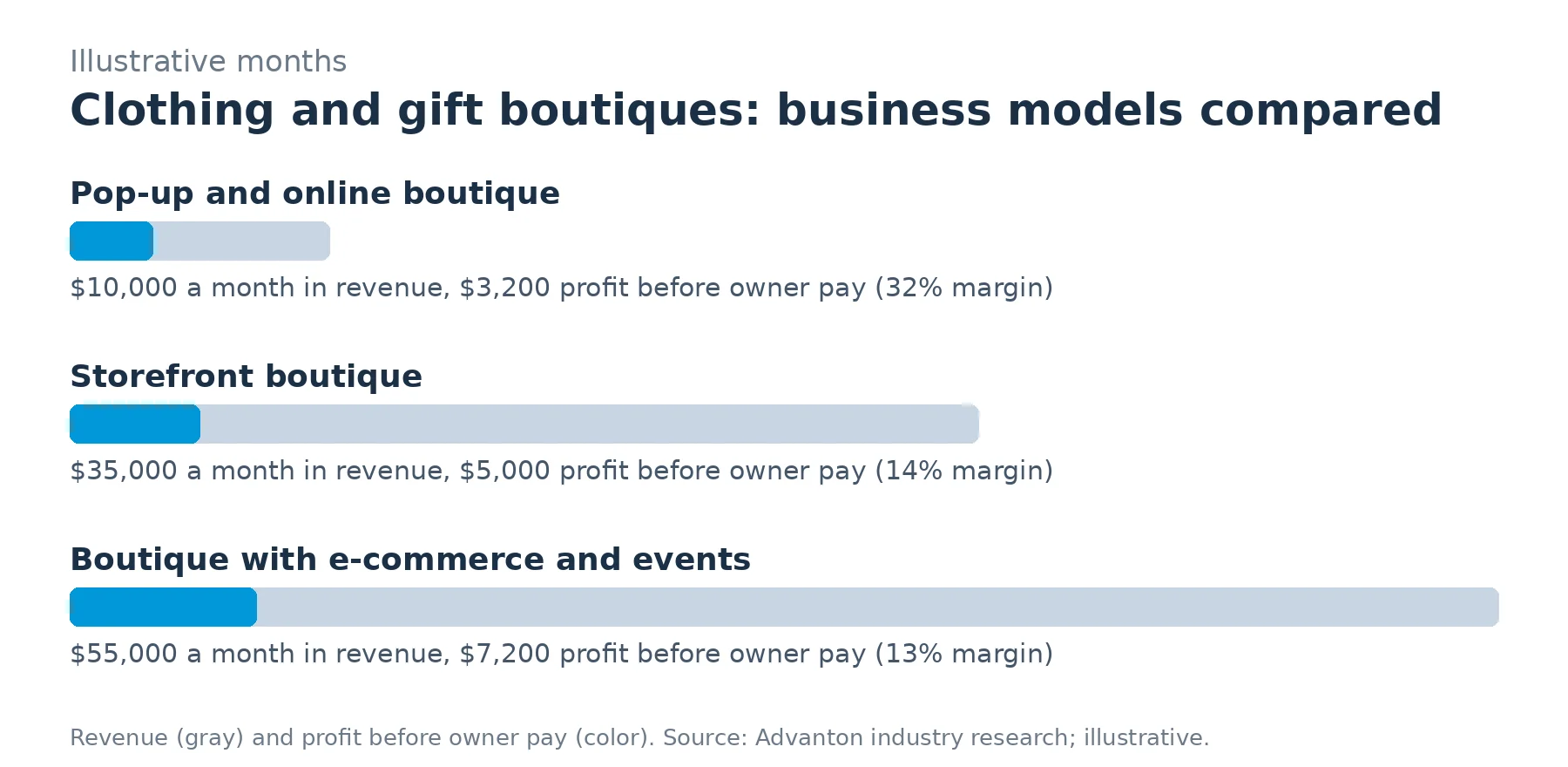
The figures below are illustrative months from our research, not industry averages. They show how revenue and costs typically fit together; your market, prices and costs will differ.
| Business model | Startup costs | Example monthly revenue | Costs | Profit before owner pay | Margin |
|---|---|---|---|---|---|
| Pop-up and online boutique | Low to moderate: initial inventory, store platform, pop-up fixtures | $10,000 | $6,800 | $3,200 | 32% |
| Storefront boutique | Moderate: lease, fixtures, inventory, point of sale | $35,000 | $30,000 | $5,000 | 14% |
| Boutique with e-commerce and events | Moderate to high: storefront, e-commerce, event space | $55,000 | $47,800 | $7,200 | 13% |
Fixed and variable costs
For projections, the most useful split is between variable costs, which rise and fall with sales (materials, supplies, hourly labor, fees), and fixed costs, which you pay every month regardless (rent, salaried staff, insurance, loan payments).
| Business model | Variable costs (% of revenue) | Fixed costs per month | What it means |
|---|---|---|---|
| Pop-up and online boutique | 55.5% | $1,250 | Mostly variable: profitable early, but watch cash flow |
| Storefront boutique | 54.9% | $10,800 | Mostly variable: profitable early, but watch cash flow |
| Boutique with e-commerce and events | 56.2% | $16,900 | Mostly variable: profitable early, but watch cash flow |
What the numbers say
Inventory is the largest cost and the biggest risk, so buying discipline decides profit.
Rent and staff are the main fixed costs of a storefront, making foot traffic and conversion critical.
Online sales and events add revenue with extra costs for photography, shipping and marketing.
The three models in brief
Pop-up and online boutique. Markets, pop-up events and an online store, with low overhead. See fashion and apparel data.
Storefront boutique. A curated shop with personal service. See independent retail data.
Boutique with e-commerce and events. Store plus online sales, styling sessions and community events.
Cost structure: storefront boutique
Each cost as a share of the example month’s revenue ($35,000):
| Cost | Monthly amount | Share of revenue | Type |
|---|---|---|---|
| Inventory (cost of goods) | $17,500 | 50.0% | Variable |
| Rent | $4,500 | 12.9% | Fixed |
| Staff | $4,000 | 11.4% | Fixed |
| Card fees | $1,000 | 2.9% | Variable |
| Marketing | $1,000 | 2.9% | Fixed |
| Shrink and markdown allowance | $700 | 2.0% | Variable |
| Utilities | $500 | 1.4% | Fixed |
| Payroll taxes | $400 | 1.1% | Fixed |
| Insurance | $250 | 0.7% | Fixed |
| Point of sale and software | $150 | 0.4% | Fixed |
| Profit before owner pay | $5,000 | 14% |
A first-year projection: storefront boutique
New businesses rarely start at full speed. This projection assumes revenue ramps from 35% of the example month in month 1 to 100% by month 12, variable costs move with revenue, and fixed costs stay the same every month. It’s a planning illustration, not a forecast.
| Month | Revenue | Variable costs | Fixed costs | Profit | Cumulative |
|---|---|---|---|---|---|
| 1 | $12,250 | $6,725 | $10,800 | -$5,275 | -$5,275 |
| 2 | $15,750 | $8,647 | $10,800 | -$3,697 | -$8,972 |
| 3 | $19,250 | $10,568 | $10,800 | -$2,118 | -$11,090 |
| 4 | $21,700 | $11,913 | $10,800 | -$1,013 | -$12,103 |
| 5 | $24,500 | $13,450 | $10,800 | $250 | -$11,853 |
| 6 | $26,600 | $14,603 | $10,800 | $1,197 | -$10,656 |
| 7 | $28,700 | $15,756 | $10,800 | $2,144 | -$8,512 |
| 8 | $30,450 | $16,717 | $10,800 | $2,933 | -$5,579 |
| 9 | $31,850 | $17,486 | $10,800 | $3,564 | -$2,015 |
| 10 | $33,250 | $18,254 | $10,800 | $4,196 | $2,181 |
| 11 | $34,300 | $18,831 | $10,800 | $4,669 | $6,850 |
| 12 | $35,000 | $19,215 | $10,800 | $4,985 | $11,835 |
Year one: revenue $313,600, profit before owner pay $11,835. The first profitable month is month 5. Cumulative results bottom out at -$12,103, which is the minimum cash cushion this plan would need, before any startup costs.
Rent, staff and marketing begin before regular shoppers build, so this storefront illustration turns profitable in month 5, with a cumulative low of about $12,100, before opening inventory and fixtures.
How boutiques earn
- Markups on curated merchandise.
- Online sales through your own store and marketplaces.
- Styling appointments and personal shopping.
- Events, trunk shows and pop-ups.
- Gift cards and loyalty programs.
Buying and markups
Boutiques often price at about double their wholesale cost, though markups vary by category. Buy from trade shows, showrooms and wholesale platforms, start with smaller quantities and reorder winners quickly.
Inventory turnover
Inventory that sits loses value. Track sell-through by item and vendor, mark down slow sellers on a schedule and use the cash to buy what’s selling. Healthy turnover keeps the store fresh for regulars.
A startup checklist for clothing and gift boutiques
- Define your customer and point of view.
- Get a sales tax permit and resale certificate.
- Build vendor relationships and an opening buy plan.
- Choose point of sale with inventory tracking.
- Plan visual merchandising and window displays.
Location and foot traffic
Walkable shopping streets, downtowns and centers with complementary stores bring browsers. Compare rent with expected traffic, and consider pop-ups to test locations first.
Where the opportunities are
- Local makers and exclusive brands.
- Size-inclusive and niche fashion.
- Gifts and home goods with high impulse appeal.
- Resale and vintage sections.
- Personal styling services.
Key terms
| Term | Meaning |
|---|---|
| Keystone markup | Pricing at about double wholesale cost |
| Sell-through | Share of inventory sold in a period |
| Open-to-buy | Budget for new inventory purchases |
| Shrink | Inventory lost to theft, damage or errors |
Open-to-buy planning
An open-to-buy plan sets how much you can spend on new inventory each month based on sales forecasts and current stock. It prevents overbuying, the most common cause of boutique cash problems.
Key numbers to track
Track sales per square foot, conversion rate, average transaction, sell-through, inventory turns and gross margin after markdowns.
Common mistakes
- Overbuying opening inventory.
- Avoiding markdowns on slow sellers.
- No online presence.
- Rent too high for actual foot traffic.
- Unclear brand identity.
Marketing a boutique
Instagram, email lists, events, collaborations with local businesses, styled photos and loyalty programs bring shoppers back. See independent retail data.
Customer experience
Personal service, remembering customers’ preferences and thoughtful recommendations build loyalty that chains can’t match. A quick text when new arrivals match a regular’s style often brings an immediate visit.
Selling online
Product photos, accurate sizing, easy checkout and fast shipping help a boutique compete online. Live shopping and social selling can reach loyal followers.
Events and community
Trunk shows, styling nights and collaborations with local makers bring new shoppers and create buzz.
Visual merchandising
Window displays, lighting, color-coordinated racks and changing table displays turn browsers into buyers. Refresh displays weekly so regulars see something new, and place impulse items near the register.
Cash flow
Seasonal buying requires cash months before sales. Plan purchases with your cash flow and use markdowns to recover cash from slow inventory.
Test these numbers with your own plan
Open this industry in our free Business Idea Reality Check to start from any model above, change prices, costs, startup budget and your own pay, and see your break-even month, the cash you’d need, three scenarios and how new businesses in this sector survive in your state.
- Start with the closest model and its cost structure.
- Replace every price and cost with local quotes.
- Estimate your ramp: how fast customers will realistically come in year one.
- Map cash month by month with the free Cash & Payroll Planner.
- Build the full plan in the free Business Planner.
About this data
Workforce figures come from the U.S. Bureau of Labor Statistics (Occupational Outlook Handbook and Occupational Employment and Wage Statistics, May 2024 wages and the 2024 to 2034 projections, unless noted). Market figures cite their sources above. Business model figures are illustrative months built from typical prices and costs to show how revenue, fixed costs and variable costs fit together; they are not industry averages or guarantees. We review these profiles when new government data is released, at least once a year, and the same figures power the Business Idea Reality Check.
Licensing and rules
Business license and sales tax registration; resale certificates let boutiques buy wholesale without paying sales tax on inventory; online sales may require collecting sales tax in other states once thresholds are met; clothing you make or import must follow FTC care labeling and textile fiber identification rules; children’s products must meet federal safety requirements; lease terms and signage rules apply. Requirements change; confirm with your state and local agencies before you start.
Frequently asked questions about clothing and gift boutiques
Is a boutique profitable?
It can be, with disciplined buying, healthy markups, regular markdowns and steady traffic.
How do boutiques price products?
Often about double wholesale cost, adjusted by category and market.
Do I need a resale certificate?
It lets you buy inventory wholesale without paying sales tax on it.
Should my boutique sell online?
Most do; online sales extend reach, support the store and keep regulars shopping between visits.
What is open-to-buy?
A monthly budget for new inventory purchases.
How much inventory should a new boutique buy?
Start smaller than you think, test what sells and reorder winners quickly to protect cash.
Where do boutiques find products?
Trade shows, showrooms, wholesale platforms and local makers.
How can boutiques compete with online giants?
With curation, personal service, community events and exclusive or local products.
What labeling rules apply to clothing?
FTC care labeling and fiber identification rules apply to clothing you make or import.
How can I test these numbers?
Open clothing and gift boutiques in the Business Idea Reality Check and enter your own prices and costs.
Keep learning
Sources
- Retail salespersons median wage and openings (BLS, as reported)
- U.S. Census Bureau, Quarterly Retail E-Commerce Sales (Q2 2026)
Last reviewed November 1, 2026. Startup costs are estimates; check local prices, licensing and tax rules before you commit money.
In India
Small businesses like this in India
In MoSPI’s survey of unincorporated businesses (proprietorships, partnerships and similar firms), this falls under Retail trade. In 2023-24 India had 1.99 crore such establishments employing 3.31 crore workers, and 87.5% were run without hired workers. Across the wider trade group, the number of establishments grew 6.18% between 2023-24 and 2025.
| Urban | Rural | All India | |
|---|---|---|---|
| Value added per business a year | ₹3,13,011 | ₹1,61,621 | ₹2,34,248 |
| Value added per worker a year | ₹1,72,641 | ₹1,05,489 | ₹1,40,529 |
| Pay per hired worker a year | ₹1,34,040 | ₹1,14,058 | ₹1,30,041 |
Running it alone or with staff: businesses with no hired workers added about ₹1,60,797 a year on average, while those with hired workers added about ₹7,46,950 (all India).
Where these businesses are: the states with the most small trade businesses are Uttar Pradesh (15.2%), Maharashtra (9.8%), West Bengal (9.0%), Bihar (6.4%), Madhya Pradesh (6.3%) of the national total (2023-24).
Value added is what a business produces minus what it spends on materials and other inputs, before paying its workers and owner, so it’s a rough guide to the income a typical small business generates. These figures cover the whole activity, which can be broader than this one business type. Across all small businesses, average fixed assets such as equipment, furniture and vehicles were ₹3,42,242 per establishment in 2025.
Licences and registrations to expect
- Registration under your state’s Shops and Establishments Act if you have premises or employees.
- A trade licence from your municipal corporation or council for many shop and service businesses.
- GST registration once turnover crosses ₹40 lakh for goods or ₹20 lakh for services (lower in some special category states), or earlier if you sell goods to other states or through e-commerce marketplaces.
- Professional tax registration in states that levy it.
- Free Udyam (MSME) registration, which helps with loans, government schemes and delayed-payment protection.
Rules differ by state and city. Check with your municipal corporation, state departments and a chartered accountant before you start.
Run a business like this in India? List it free in the India Business Directory, with your hours, deals and GST registration.
Free tools for India: Make a GST invoice · Compare business credit cards
Build a market report for Clothing and Gift Boutiques in India Pick your state and see market size, earnings, competition and licences, from official data. Free, with a PDF download.
Sources: MoSPI, Annual Survey of Unincorporated Sector Enterprises (ASUSE) 2023-24, full report, Appendix A Tables 4, 29, 33, 35 and 37 (survey period October 2023 to September 2024); MoSPI, Annual Survey of Unincorporated Sector Enterprises (ASUSE) 2025, factsheet (survey period January to December 2025, released 24 March 2026). Licensing summary by Advanton, checked November 2026.