
Shoppers love finding quality items for less, and many prefer secondhand goods for sustainability and uniqueness. Resale businesses buy, consign or receive donated goods and sell them online or in stores. Their staff are retail workers: retail salespersons earned a median of about $34,580, according to BLS figures as reported, and are among the occupations with the most job openings each year.
Resale businesses include online resellers sourcing from thrift stores and estate sales, consignment boutiques that pay owners when items sell, and thrift stores selling large volumes of donated or purchased goods. Sourcing, pricing and turnover decide profits.
The workforce
| Occupation | Jobs (2024) | Median pay (May 2024) | Projected growth, 2024 to 2034 |
|---|---|---|---|
| Retail salespersons (figures as reported) | n/a | $34,580 | n/a |
Source: U.S. Bureau of Labor Statistics, Occupational Outlook Handbook and Occupational Employment and Wage Statistics.
Business models compared
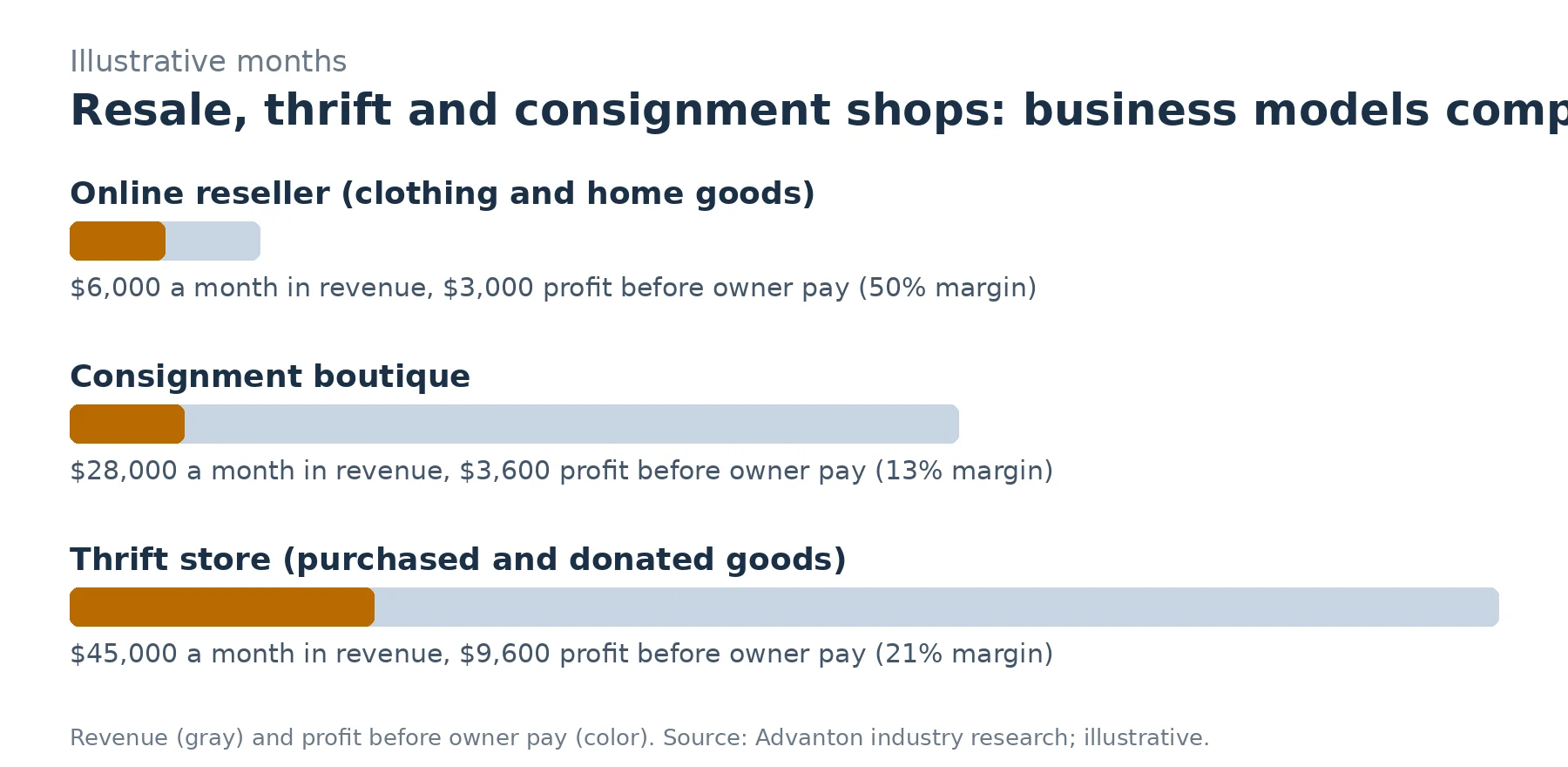
The figures below are illustrative months from our research, not industry averages. They show how revenue and costs typically fit together; your market, prices and costs will differ.
| Business model | Startup costs | Example monthly revenue | Costs | Profit before owner pay | Margin |
|---|---|---|---|---|---|
| Online reseller (clothing and home goods) | Low: sourcing budget, photography setup, shipping supplies | $6,000 | $3,000 | $3,000 | 50% |
| Consignment boutique | Moderate: storefront, fixtures, point of sale with consignor tracking | $28,000 | $24,400 | $3,600 | 13% |
| Thrift store (purchased and donated goods) | Moderate to high: larger space, sorting area, staff | $45,000 | $35,400 | $9,600 | 21% |
Fixed and variable costs
For projections, the most useful split is between variable costs, which rise and fall with sales (materials, supplies, hourly labor, fees), and fixed costs, which you pay every month regardless (rent, salaried staff, insurance, loan payments).
| Business model | Variable costs (% of revenue) | Fixed costs per month | What it means |
|---|---|---|---|
| Online reseller (clothing and home goods) | 43.3% | $400 | Balanced: margins improve as volume grows |
| Consignment boutique | 52.9% | $9,600 | Mostly variable: profitable early, but watch cash flow |
| Thrift store (purchased and donated goods) | 23.8% | $24,700 | Mostly fixed: needs steady volume to cover overhead |
What the numbers say
Online resellers have low overhead and high margins when sourcing is cheap, but listing and shipping take time.
Consignment boutiques avoid buying inventory by paying consignors only when items sell, so payouts are their biggest cost.
Thrift stores depend on volume: large spaces, staff and fast turnover of low-cost goods.
The three models in brief
Online reseller. Sourcing from thrift stores, estate sales and liquidations, selling on marketplaces. See e-commerce data.
Consignment boutique. Curated clothing, furniture or children’s goods on consignment. See independent retail data.
Thrift store. High-volume donated or purchased goods at low prices.
Cost structure: consignment boutique
Each cost as a share of the example month’s revenue ($28,000):
| Cost | Monthly amount | Share of revenue | Type |
|---|---|---|---|
| Consignor payouts | $14,000 | 50.0% | Variable |
| Staff | $4,000 | 14.3% | Fixed |
| Rent | $3,500 | 12.5% | Fixed |
| Card fees | $800 | 2.9% | Variable |
| Marketing | $800 | 2.9% | Fixed |
| Utilities | $500 | 1.8% | Fixed |
| Payroll taxes | $400 | 1.4% | Fixed |
| Consignment software | $200 | 0.7% | Fixed |
| Insurance | $200 | 0.7% | Fixed |
| Profit before owner pay | $3,600 | 13% |
A first-year projection: consignment boutique
New businesses rarely start at full speed. This projection assumes revenue ramps from 35% of the example month in month 1 to 100% by month 12, variable costs move with revenue, and fixed costs stay the same every month. It’s a planning illustration, not a forecast.
| Month | Revenue | Variable costs | Fixed costs | Profit | Cumulative |
|---|---|---|---|---|---|
| 1 | $9,800 | $5,184 | $9,600 | -$4,984 | -$4,984 |
| 2 | $12,600 | $6,665 | $9,600 | -$3,665 | -$8,649 |
| 3 | $15,400 | $8,147 | $9,600 | -$2,347 | -$10,996 |
| 4 | $17,360 | $9,183 | $9,600 | -$1,423 | -$12,419 |
| 5 | $19,600 | $10,368 | $9,600 | -$368 | -$12,787 |
| 6 | $21,280 | $11,257 | $9,600 | $423 | -$12,364 |
| 7 | $22,960 | $12,146 | $9,600 | $1,214 | -$11,150 |
| 8 | $24,360 | $12,886 | $9,600 | $1,874 | -$9,276 |
| 9 | $25,480 | $13,479 | $9,600 | $2,401 | -$6,875 |
| 10 | $26,600 | $14,071 | $9,600 | $2,929 | -$3,946 |
| 11 | $27,440 | $14,516 | $9,600 | $3,324 | -$622 |
| 12 | $28,000 | $14,812 | $9,600 | $3,588 | $2,966 |
Year one: revenue $250,880, profit before owner pay $2,966. The first profitable month is month 6. Cumulative results bottom out at -$12,787, which is the minimum cash cushion this plan would need, before any startup costs.
Rent and staff start before consignors and shoppers fill the racks, so this consignment illustration turns profitable in month 6, with a cumulative low of about $12,800.
How resale businesses earn
- Margins on sourced goods for resellers and thrift stores.
- Consignment commissions on items sold.
- Buy-outright programs paying cash for items.
- Online and in-store sales channels.
- Bulk and wholesale sales of excess goods.
Sourcing
Thrift stores, estate sales, liquidations, garage sales, donations and buy-from-the-public programs all supply inventory. Track cost and sale price by source to learn which channels make money, and build relationships with estate sale companies and movers who see quality items first.
Consignment splits
Consignment shops commonly split sale prices with consignors and set rules for pricing, markdowns, how long items stay and what happens to unsold items. Clear written agreements and transparent consignor portals build trust.
Recalled products are off-limits
It’s illegal to sell recalled products. Check the CPSC recall database, be especially careful with cribs, car seats, strollers and toys, and refuse items you can’t verify.
A startup checklist
- Register the business and get a sales tax permit.
- Check secondhand dealer rules in your city and state.
- Write consignment agreements or buying policies.
- Choose point-of-sale software that tracks consignors or inventory.
- Set pricing and markdown schedules.
Pricing and markdowns
Price by brand, condition and current demand, and use regular markdowns to keep inventory moving. Aging inventory ties up space and cash.
Where the opportunities are
- Designer and luxury consignment.
- Children’s clothing and gear (with recall checks).
- Furniture and home decor.
- Vintage and collectibles.
- Online and in-store hybrids.
Key terms
| Term | Meaning |
|---|---|
| Consignment | Selling goods for owners and paying them after the sale |
| Sell-through | Share of items sold in a period |
| Markdown schedule | Planned price reductions over time |
| Secondhand dealer license | A permit some places require for resellers |
Key numbers to track
Track sell-through, average sale price, inventory age, consignor payouts, sourcing cost by channel and sales per square foot.
Common mistakes
- Overbuying low-demand items.
- No markdown schedule.
- Vague consignment terms.
- Selling recalled products.
- Ignoring secondhand dealer rules.
Marketing a resale business
Instagram drops of new arrivals, email lists, Google Business Profile, reviews, community events and partnerships with stylists and estate sale companies bring shoppers and consignors. See independent retail data.
Selling online and in store
Many shops list their best items online while selling everyday goods in store. Online sales reach collectors and buyers outside your area, while in-store shopping brings regulars and the thrill of discovery.
Sustainability as a selling point
Many shoppers choose secondhand to reduce waste. Tell the story with care: share how many items you keep in use, avoid exaggerated environmental claims and highlight quality and value.
Space and display
Good lighting, clean racks, clear sizing and themed displays make secondhand goods look appealing. Rotate displays often so regulars always see something new.
Handling donations
Thrift stores receiving donations need sorting systems, quality standards and plans for unsellable goods, such as textile recycling and bulk buyers. Nonprofit thrift stores have additional tax and reporting rules.
Test these numbers with your own plan
Open this industry in our free Business Idea Reality Check to start from any model above, change prices, costs, startup budget and your own pay, and see your break-even month, the cash you’d need, three scenarios and how new businesses in this sector survive in your state.
- Start with the closest model and its cost structure.
- Replace every price and cost with local quotes.
- Estimate your ramp: how fast customers will realistically come in year one.
- Map cash month by month with the free Cash & Payroll Planner.
- Build the full plan in the free Business Planner.
About this data
Workforce figures come from the U.S. Bureau of Labor Statistics (Occupational Outlook Handbook and Occupational Employment and Wage Statistics, May 2024 wages and the 2024 to 2034 projections, unless noted). Market figures cite their sources above. Business model figures are illustrative months built from typical prices and costs to show how revenue, fixed costs and variable costs fit together; they are not industry averages or guarantees. We review these profiles when new government data is released, at least once a year, and the same figures power the Business Idea Reality Check.
Licensing and rules
Business license and sales tax permit; some states and cities require secondhand dealer or pawn licenses, holding periods and transaction records for certain goods to deter stolen property sales; federal law makes it illegal to sell recalled products, so check the CPSC recall database, especially for children’s items such as cribs, car seats and toys; consignment agreements should spell out commission splits, pricing, payout timing and unsold item terms. Requirements change; confirm with your state and local agencies before you start.
Frequently asked questions
Is a resale business profitable?
It can be, with cheap sourcing, smart pricing and fast inventory turnover.
Do I need a license to sell secondhand goods?
Usually a business license and sales tax permit; some places require secondhand dealer licenses.
Can I sell recalled items?
No. It’s illegal to sell recalled products; check the CPSC recall database.
How do consignment splits work?
The shop and consignor share the sale price under a written agreement that also covers pricing and payout timing.
Where do resellers find inventory?
Thrift stores, estate sales, liquidations, garage sales and buy-from-the-public programs.
Should I sell online or in a store?
Many businesses combine both to reach more buyers.
How long do consignment items stay on the floor?
Many shops set a period such as 60 to 90 days, with markdowns along the way and clear terms for unsold items.
How can I test these numbers?
Open resale, thrift and consignment in the Business Idea Reality Check and enter your own prices and costs.
Keep learning
- Independent retail data
- E-commerce industry data
- Fashion and apparel data
- Business Idea Reality Check
Sources
Last reviewed November 1, 2026. Startup costs are estimates; check local prices, licensing and tax rules before you commit money.

