
A handmade jewelry business designs and makes earrings, necklaces, bracelets and rings, from beaded and wire pieces to fine metalsmithing in silver and gold. It can start at a kitchen table with modest tools and grow into a studio, online brand and wholesale business.
Competition is strong, especially online, so success comes from a distinctive style, excellent photos and accurate descriptions of materials. Jewelry also has specific rules for metal and stone claims. The Bureau of Labor Statistics reports a median pay of $49,140 for jewelers and precious stone and metal workers (May 2024), with about 35,100 jobs and employment projected to decline about 5% over the decade. This guide covers styles, materials, rules, pricing, selling, a worked example and a 90-day plan.
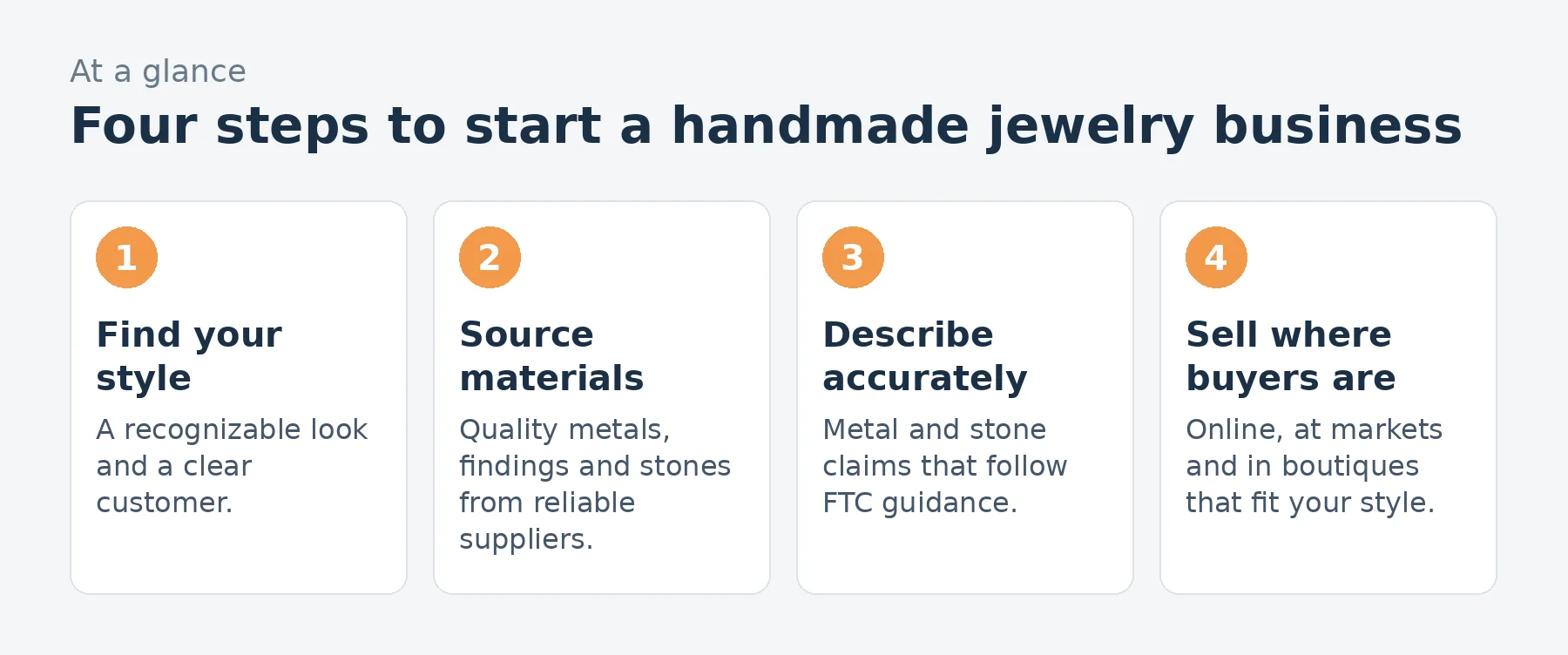
A handmade jewelry business at a glance
Table of Contents
| Topic | What to expect |
|---|---|
| Startup cost | Low: tools and materials for beading or wire work; more for metalsmithing, soldering and casting equipment |
| Key rules | Truthful metal and stone descriptions under the FTC Jewelry Guides; trademark required with quality marks; lead limits for children’s jewelry |
| How you sell | Your own website, online marketplaces, craft fairs and markets, boutiques and custom orders |
| Pricing | Materials plus labor at a fair hourly rate, overhead and margin, with room for wholesale |
| Best for | Creative makers with a distinctive style who enjoy marketing their work |
Who handmade jewelry suits
It suits creative makers who enjoy detailed work and are willing to market themselves through photos, social media and events. Many start part-time and grow as their style finds an audience.
Choosing a style and technique
- Beading and stringing: low startup costs, quick production.
- Wire wrapping: sculptural pieces with simple tools.
- Metalsmithing: sawing, soldering and forming silver and gold for higher-value pieces.
- Casting: wax carving or 3D-printed models cast in metal, often through casting services.
- Mixed media: resin, clay, glass, wood or textile elements.
A recognizable style, such as minimalist gold-filled pieces, bold statement earrings or nature-inspired silver, helps customers remember and recommend you.
Materials and suppliers
Buy metals, findings, chain and stones from reputable jewelry suppliers. Know exactly what you are buying (solid gold, gold-filled, plated, sterling silver, stainless steel, brass) so you can describe it truthfully. Many customers have nickel allergies, so hypoallergenic findings such as titanium, niobium, sterling or gold for earring wires are popular.
Metal and stone claims
The FTC’s Jewelry Guides explain how to describe metals truthfully: karat gold markings must be accurate, and terms such as gold-filled, gold-plated and vermeil have specific meanings. Under the National Gold and Silver Stamping Act, if you stamp a quality mark such as "14K" or "925" on jewelry, you must also stamp a registered trademark. Describe stones accurately too, distinguishing natural, lab-grown and simulated stones.
Children’s jewelry
Jewelry designed or intended mainly for children 12 and under is a children’s product with strict lead limits, testing and certification requirements, and some states restrict cadmium. If you make children’s pieces, use compliant materials and testing; otherwise, design and market for adults.
Startup costs to plan for
| Item | What to budget for |
|---|---|
| Tools | Pliers, cutters, files, and soldering or saw setup for metalwork |
| Materials | Metals, findings, chain, stones, beads |
| Photography | Lightbox, camera or phone, props |
| Packaging | Boxes, pouches, cards, shipping supplies |
| Market booth | Displays, table, tent, payment reader |
| Website and listings | Online store and marketplace fees |
Use our startup cost calculator for your total.
Pricing your jewelry
Add materials, your labor at a fair hourly rate, overhead (tools, packaging, fees) and a profit margin to reach a wholesale price, then set retail around twice that so you can sell to boutiques without losing money. Precious metal prices change, so update prices for gold and silver pieces regularly. Use our pricing calculator.
A worked example: an established maker
These are illustrative assumptions for an established maker selling online and at markets, not predictions.
| Assumption | Monthly | |
|---|---|---|
| Online sales | 90 pieces at $48 average | $4,320 |
| Craft fairs and markets | 3 events at $700 | $2,100 |
| Wholesale to boutiques | 60 pieces at $24 | $1,440 |
| Revenue | $7,860 | |
| Materials | Metals, findings, stones and chain | $(1,700) |
| Packaging and shipping | $(500) | |
| Marketplace, payment and event fees | $(700) | |
| Marketing and photography | $(400) | |
| Tools, insurance and software | $(200) | |
| Profit before owner pay and taxes | $4,360 |
That leaves about $4,360 a month before taxes and the value of your time, on about $7,860 of revenue. Track hours per piece; underpricing labor is the most common mistake handmade jewelers make.
Where to sell
- Your own website: highest margin and control.
- Online marketplaces: built-in buyers, with fees and competition.
- Craft fairs and markets: customers can see and try pieces.
- Boutiques and galleries: wholesale or consignment.
- Custom and bridal work: higher-value commissions.
Photography and descriptions
Jewelry sells on photos. Use clean, consistent backgrounds, natural light, close-ups and photos on a person to show scale. Describe materials, dimensions, closures and care accurately in every listing.
Pricing with precious metal prices
Gold and silver prices move daily. For pieces with significant precious metal content, recalculate material costs regularly, consider a metal surcharge or price ranges for custom work and avoid holding prices fixed for long periods. Gold-filled and sterling pieces are less affected but still change over time.
Custom and bridal work
Custom pieces, such as engagement rings, wedding bands, name necklaces and heirloom redesigns, command higher prices and build loyal clients. Use a written order with design, materials, price, deposit and timeline, share sketches or renderings for approval and keep customers updated.
Selling wholesale to boutiques
Boutiques want cohesive collections, reliable reorders and clear wholesale terms: minimum orders, payment terms and display support. Create a line sheet with photos, wholesale and suggested retail prices, and keep your own retail price consistent so you do not undercut stores carrying your work.
Displays at markets
Market displays should be eye-level, well lit and organized by style or price. Mirrors, clear price tags and a few pieces customers can try on increase sales. Secure displays to deter theft, and use a card reader for quick checkout.
Care cards and customer service
Include care cards explaining how to store, clean and protect each material. Clear care instructions reduce returns and complaints and show professionalism. Offer simple repairs or adjustments to build loyalty.
Building collections
Design in collections (a few related pieces sharing a theme, material or motif) rather than one-off items. Collections make your style easier to recognize, help customers buy matching sets and simplify photos and marketing.
Packaging
Packaging is part of the product, especially for gifts. Branded boxes or pouches, a thank-you card and secure shipping materials make pieces feel premium and protect them in transit.
Production as you grow
As orders grow, batch production steps (cutting, forming, finishing), standardize popular designs and consider casting or outside services for repeat pieces. Keep one-of-a-kind work as a premium line.
Social media
Short videos of your process, styling ideas and new releases build a following. Consistent photos and a clear brand look make your feed recognizable.
Taxes and insurance
Collect sales tax where required, keep records of materials and sales and consider insurance for inventory, tools and markets.
Common mistakes to avoid
- Underpricing labor.
- Inaccurate metal descriptions (for example, calling plated jewelry gold).
- Stamping karat marks without a trademark.
- Weak photos.
- Selling children’s jewelry without meeting lead rules.
Your first 90 days
- Days 1-30: define your style, build a cohesive collection of 20 to 30 pieces and price them properly.
- Days 31-60: photograph everything, open an online store and design packaging.
- Days 61-90: sell at two markets, approach three boutiques and collect reviews.
Frequently asked questions
Do I need a license to sell handmade jewelry?
Usually just a business license and sales tax permit. Jewelry claims and children’s products have specific rules.
Can I call my jewelry gold?
Only if it is solid gold of the stated karat. Gold-filled and plated jewelry must be described as such under FTC guidance.
Do I need to stamp my silver jewelry?
Not necessarily, but if you stamp a quality mark like 925, you must also stamp a registered trademark.
How should I price handmade jewelry?
Materials plus labor, overhead and margin for a wholesale price, then about twice that for retail.
What are hypoallergenic earring materials?
Titanium, niobium, surgical-grade options, sterling silver and solid gold are common choices for sensitive ears.
Should I sell on marketplaces or my own website?
Many makers use both: marketplaces for discovery and their own site for higher margins and repeat customers.
How many pieces should I bring to a market?
Enough to fill your display attractively across price points, with backup stock of best sellers.
Can I make jewelry from recycled metals?
Yes. Many jewelers use recycled gold and silver; describe it accurately in your listings.
Do I need special tools to start?
Beading and wire work need only basic pliers and cutters; metalsmithing adds a saw, files, a torch and soldering supplies.
Keep learning
- Jewelry and accessories industry data
- How to start a permanent jewelry business
- How to start a watch repair business
- Pricing calculator
Sources
- FTC, Guides for the jewelry, precious metals and pewter industries
- US Code, National Gold and Silver Stamping Act (15 U.S.C. 291-300)
- CPSC, Children's jewelry and lead limits
- US Bureau of Labor Statistics, Jewelers and precious stone and metal workers
Last reviewed November 2, 2026. Startup costs are estimates; check local prices, licensing and tax rules before you commit money.

