
A solar installation business designs and installs solar panel systems, and often battery storage, for homes, businesses, farms and public buildings. Work includes site assessment, system design, permitting, installation, inspection, utility interconnection and ongoing service.
Solar requires licensed electrical and contractor work, strict code compliance and careful roof work. The market also changed in 2025: the federal tax credit for homeowners’ solar ended for systems installed after 2025, while commercial credits continue with deadlines and state programs vary. Installers that sell honestly and serve commercial, battery and service markets are best positioned. The Bureau of Labor Statistics reports a median pay of $51,860 for solar photovoltaic installers (May 2024), across about 28,600 jobs, with employment projected to grow about 42% over the decade, one of the fastest rates of any occupation. This guide covers licensing, codes, incentives, operations, pricing, a worked example and a 90-day plan.
A solar installation business at a glance
Table of Contents
| Topic | What to expect |
|---|---|
| Startup cost | Moderate to high: licensing, tools and safety equipment, vehicles, design software, insurance, working capital for equipment and permits |
| Licensing | State contractor licenses and licensed electricians for electrical work; some states have solar-specific licenses |
| Credentials | NABCEP certifications are widely recognized for installers and designers |
| Incentives | Federal homeowner credit ended after 2025; commercial credits continue with deadlines; state and utility programs vary |
| Best for | Licensed electricians and contractors who want to specialize in energy systems |
Who solar installation suits
It suits licensed electricians and experienced contractors comfortable with roof work, electrical systems and permits, who want to build a specialized energy business. Strong project management matters as much as installation skill.
Licensing
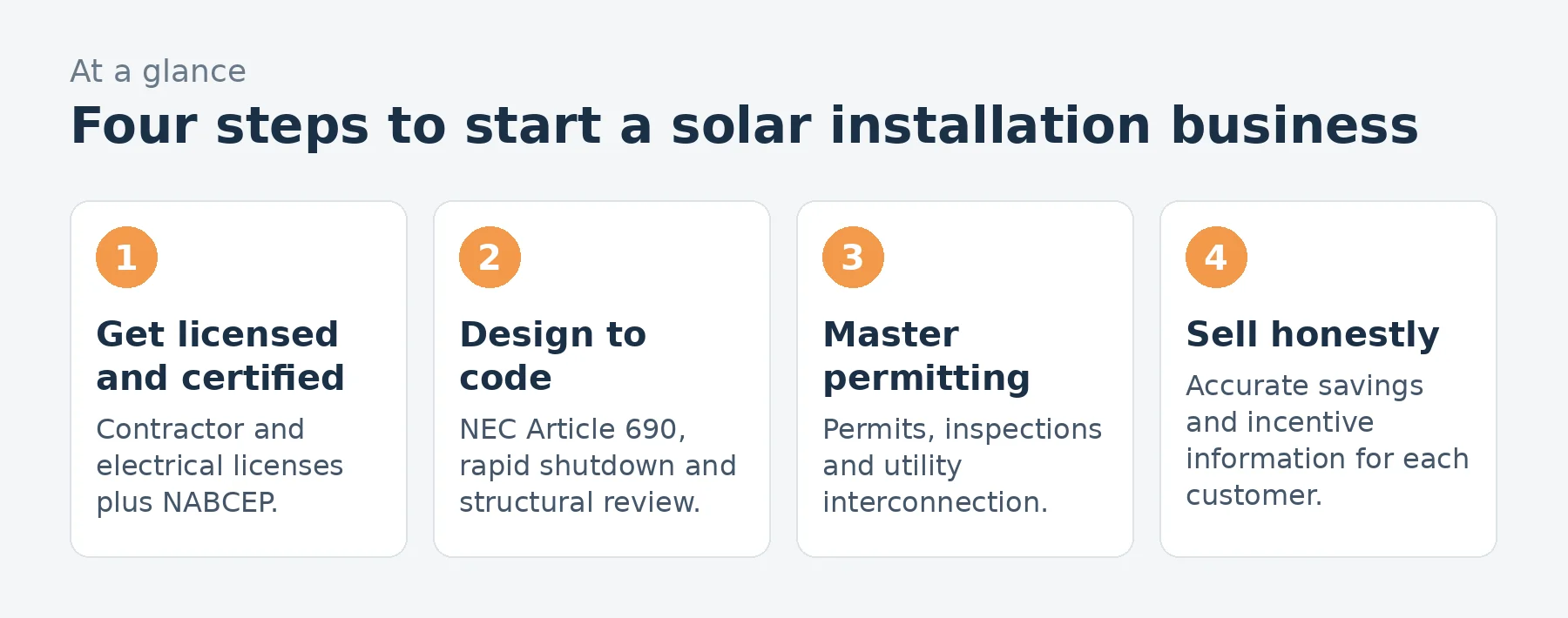
Solar work involves electrical systems and roofs, so states require contractor licenses and usually licensed electricians for electrical connections; some states have solar-specific license classifications. Local permits and inspections apply to every installation. Confirm requirements in each state and city where you will work.
Certification
NABCEP (North American Board of Certified Energy Practitioners) offers widely recognized certifications, including the PV Installation Professional credential, which requires training, experience and an exam. Many utilities, programs and customers prefer or require NABCEP-certified installers. Manufacturer training is often required for warranties.
Codes and safety
Solar systems must follow the National Electrical Code, especially Article 690 for photovoltaic systems, including rapid shutdown requirements that protect firefighters, plus fire code setbacks, structural requirements and local amendments. Roof work requires fall protection under OSHA rules. Battery systems bring additional code requirements for installation and location.
Incentives after 2025
Federal incentives changed in 2025. Under the federal tax law enacted in July 2025, the residential clean energy credit for homeowners’ solar and battery systems ended for expenditures after December 31, 2025, and the energy efficient home improvement credit also ended for improvements after 2025. Commercial clean energy credits continue with new deadlines tied to when projects begin construction or are placed in service. State incentives, utility rebates, net metering rules and solar renewable energy credits vary widely, so check current programs (DSIRE tracks many of them) and never quote incentives a customer may not qualify for.
Permits and interconnection
Each project typically needs building and electrical permits, an inspection and utility interconnection approval before the system can operate. Utilities set rules for system size, metering and compensation for exported power (net metering or other tariffs), which have changed in several states. Build a permitting process and relationships with local building departments and utilities.
Startup costs for a solar installation business
| Item | What to budget for |
|---|---|
| Licensing and certification | Contractor license, electrical licenses, NABCEP |
| Tools and safety | Fall protection, ladders, electrical testing equipment |
| Vehicles | Work trucks and trailers |
| Design software | System design, shading analysis and proposals |
| Insurance | General liability, workers’ compensation, auto, bonds |
| Working capital | Equipment purchases and payroll before customer payments |
Use our startup cost calculator for your total.
Pricing
Price systems by size and complexity (often expressed per watt), covering equipment, labor, permits, engineering, interconnection, warranties, overhead and profit. Collect deposits and progress payments tied to milestones. Use our pricing calculator to check margins on each project.
A worked example: a small installer
These are illustrative assumptions for a small installer completing residential and small commercial projects, not predictions.
| Assumption | Monthly | |
|---|---|---|
| Residential systems | 4 systems averaging $22,000 | $88,000 |
| Small commercial and battery projects | $30,000 | |
| Service and maintenance | $3,000 | |
| Revenue | $121,000 | |
| Equipment | Panels, inverters, racking, batteries, about 45% of project revenue | $(53,100) |
| Installation crew | Electricians and installers, with payroll costs | $(26,000) |
| Permits, interconnection and engineering | $(3,000) | |
| Sales costs | Commissions and marketing | $(9,000) |
| Vehicles, insurance and software | $(5,500) | |
| Profit before owner pay and taxes | $24,400 |
That leaves about $24,400 a month before the owner’s pay and taxes, on about $121,000 of revenue. Project revenue is lumpy and depends on permitting timelines, so working capital and a steady sales pipeline are essential.
Loading the calculator…
Batteries and service
Battery storage for backup power and managing utility rates is a growing market, along with service for existing systems: inspections, repairs, inverter replacements and monitoring. Thousands of older systems need maintenance, and service work steadies revenue.
Commercial and agricultural projects
Businesses, farms, schools and nonprofits install solar to reduce electricity costs. Commercial projects are larger, involve more engineering and financing analysis and may qualify for commercial incentives with their own requirements and deadlines.
Finding customers
- Referrals from past customers.
- Roofers and electricians as partners.
- Businesses and farms with high electricity bills.
- Community solar and cooperative programs where available.
- Honest online content about costs and savings.
Roofing partnerships
Many solar projects need roof repairs or replacement first, since removing panels later is costly. Partnering with roofers, or adding roofing services, helps customers and avoids installing on roofs near the end of their life. Coordinate warranties so roof penetrations are covered.
Monitoring and performance
Monitoring systems track production and alert you to problems. Review performance after installation, explain monitoring apps to customers and respond quickly to underperformance. Systems that perform as promised generate referrals.
Warranties
Explain the three layers of warranties: equipment warranties from manufacturers, production guarantees where offered and your workmanship warranty. Clear warranty terms, and the financial stability to honor them, reassure customers making a long-term investment.
Equipment sourcing
Work with established distributors, verify equipment is listed and approved for your market and understand any domestic content or trade rules affecting commercial incentives and supply. Equipment availability and prices can change with tariffs and trade policy.
Hiring and training crews
Solar crews need electrical knowledge, safe roof work habits and attention to detail. Hire licensed electricians for electrical work, train installers on manufacturer requirements and fall protection and document quality checks on every job.
Net metering and export rules
How utilities pay for exported solar power has changed in several states, with some moving from full retail net metering to lower export rates. These changes affect system design (for example, adding batteries to use more solar on site) and savings. Explain current rules accurately for each customer’s utility.
Common mistakes to avoid when starting a solar installation business
- Quoting federal homeowner credits that no longer apply.
- Overstating savings.
- Skipping structural review of roofs.
- Weak fall protection.
- Running out of working capital during permitting delays.
Your first 90 days as a solar installation business owner
- Days 1-30: confirm licensing, start NABCEP preparation and research local permitting and utility rules.
- Days 31-60: set up design software, suppliers, insurance and pricing.
- Days 61-90: complete first installations carefully, document them and build referral partnerships.
Frequently asked questions about starting a solar installation business
Do I need a license to install solar panels?
Yes. States require contractor licenses and usually licensed electricians for electrical work; some have solar-specific licenses.
Is the federal solar tax credit still available for homeowners?
No. The residential clean energy credit ended for expenditures after December 31, 2025; check state and utility programs.
What is NABCEP certification?
Widely recognized certifications for solar professionals, including the PV Installation Professional credential.
What is rapid shutdown?
An electrical code requirement that lets solar systems reduce voltage quickly to protect firefighters.
How are solar systems priced?
Usually by system size and complexity, often per watt, covering equipment, labor, permits and profit.
Is solar installation still a growing field?
BLS projects solar installer employment to grow about 42% over the decade, though markets vary with incentives and policy.
Do solar installers need to be electricians?
Electrical connections typically require licensed electricians, though installers may handle mounting under contractor licenses, depending on the state.
How long does a residential solar installation take?
Installation often takes a day or a few days, but permitting, inspection and utility approval can take weeks or months.
Should solar installers offer batteries?
Yes, where customers value backup power or export rules reward using more solar on site; batteries add code and design requirements.
How do installers get paid?
Usually through deposits and milestone payments from customers or financing companies, tied to installation and approval stages.
What insurance do solar installers need?
General liability, workers’ compensation, commercial auto and often bonds required by licensing or contracts.
Can I install solar on commercial buildings?
Yes, with the right licenses and engineering; commercial projects often involve larger systems and different incentives.
Keep learning
- Solar installation industry data
- How to start a solar sales business
- How to start an EV charging business
- Startup cost calculator
Sources
- US Bureau of Labor Statistics, Solar photovoltaic installers
- NABCEP, Solar installer and sales certifications
- NFPA 70, National Electrical Code (Article 690 solar PV, Article 625 EV charging)
- IRS, Residential clean energy credit (and its end for expenditures after 2025)
- DSIRE, Database of state incentives for renewables and efficiency
Last reviewed November 3, 2026. Startup costs are estimates; check local prices, licensing and tax rules before you commit money.

