
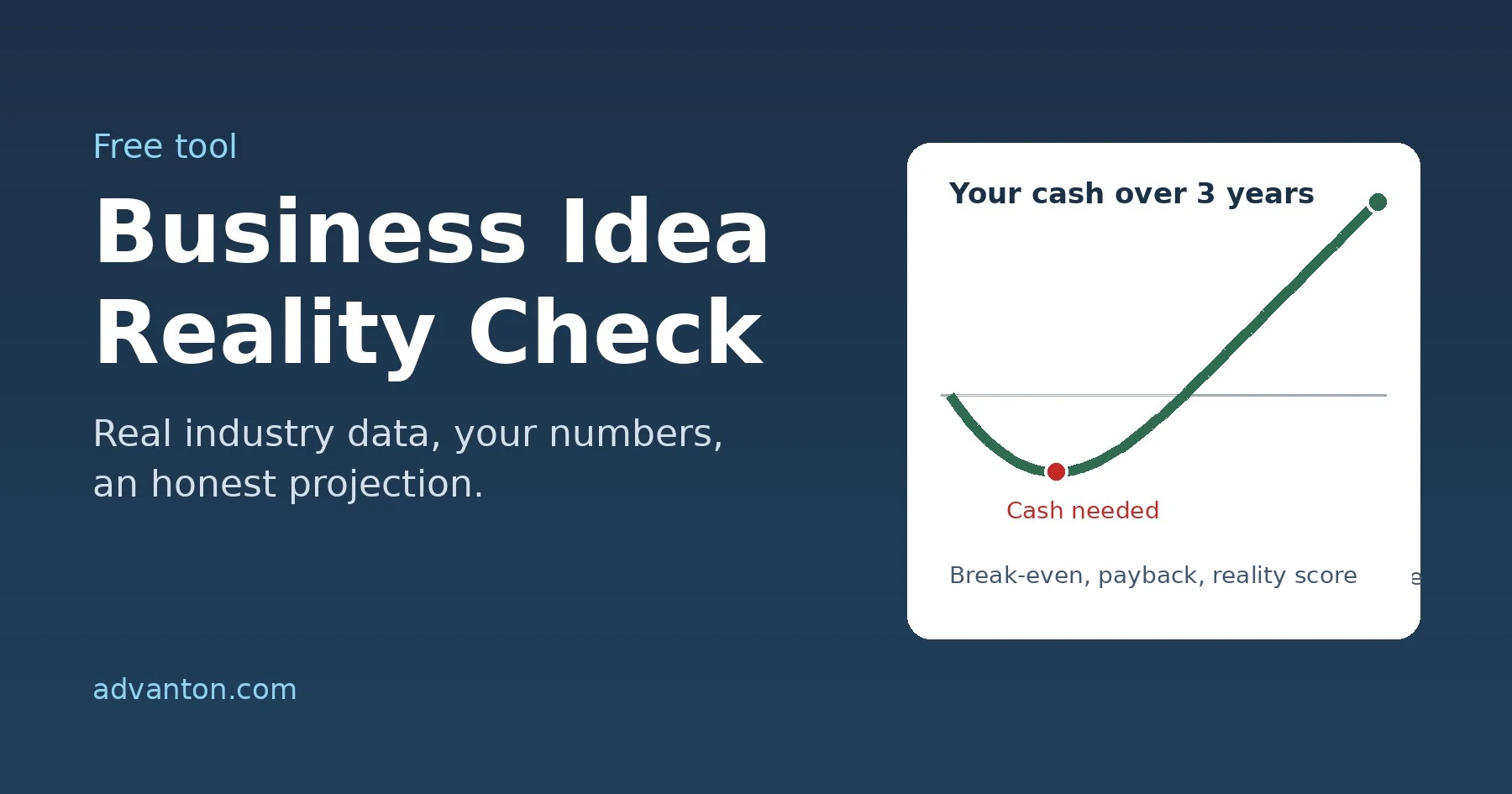
Every business starts with an idea, and most ideas look better in your head than on paper. This free tool helps you find out, in a few minutes, whether the numbers behind your idea hold together. Pick an industry, start from a real business model, adjust it to your plans, and see when you could break even, how much cash you would need, and how new businesses in that industry actually fare. Nothing you enter leaves your browser.
Loading industry data…
How to read your results
- Monthly profit begins: the first month your sales cover your costs (and your own pay, if you entered one).
- Cash you could need: your startup costs, the losses before you break even, and a three-month reserve of fixed costs. It’s the number most new owners underestimate.
- Startup paid back: the month your cumulative profit recovers what you put in.
- What has to be true: the monthly sales you need to break even. If you add an average sale, you’ll also see how many customers that takes each month.
- Three scenarios: cautious assumes 20% lower sales and a slower start; strong assumes 15% higher sales and a faster start. Plan for the cautious line, and hope for the strong one.
Where the data comes from
Industry pay, job counts and growth projections come from the U.S. Bureau of Labor Statistics. New-business survival rates by industry and state come from the BLS Business Employment Dynamics program (data through March 2025): nationally, 77.9% of new businesses with employees were still open after one year, 51.4% after five years and 34.7% after ten. The starting business models come from Advanton’s industry research and are illustrative, so replace them with your own quotes and prices.
Two caveats matter. The survival data covers businesses with employees, so solo businesses aren’t represented. And closing isn’t always failing: owners also retire, sell or move.
About the reality score
The score combines six factors: cash runway (25%), break-even speed (20%), profit margin (20%), your readiness (15%), industry demand (10%) and industry staying power (10%). Serious gaps cap the score: a plan your cash can’t fund, or one that never turns a profit, can’t score as promising. The score is a planning aid, not a prediction. No tool can tell you whether a particular business will succeed; your preparation, location, customers and execution matter most.
How to improve a weak result
- Cash gap: start smaller, lower startup costs, lease instead of buying, or line up financing before you commit.
- Slow break-even: test higher prices, reduce fixed costs or launch with a smaller team.
- Thin margin: look for costs that rise with every sale, such as materials, fees and labor, and price accordingly.
- Readiness: work in the field first, take a course, and confirm licenses and permits for your state and city.
Frequently asked questions
Is this business idea checker free?
Yes. There’s no sign-up, and your numbers stay in your browser.
Can it tell me if my business will succeed?
No tool can. It shows whether your numbers hold together and how new businesses in your industry and state fare, so you can plan with clearer eyes.
Where do the survival rates come from?
The U.S. Bureau of Labor Statistics Business Employment Dynamics program, data through March 2025.
Can I share my results?
Yes. Copy a link that recreates your exact plan, or save it as a PDF.
My industry isn’t listed. What should I do?
Search for the closest match, such as "retail", "consulting" or "construction", then adjust the numbers to fit your idea.
Keep learning
Last reviewed October 31, 2026.

