
A security guard company provides trained officers to protect property and people: commercial buildings, construction sites, retail stores, apartment communities, events, hospitals, schools and industrial sites. Services include standing posts, mobile patrols, access control, event security and, in some cases, armed protection.
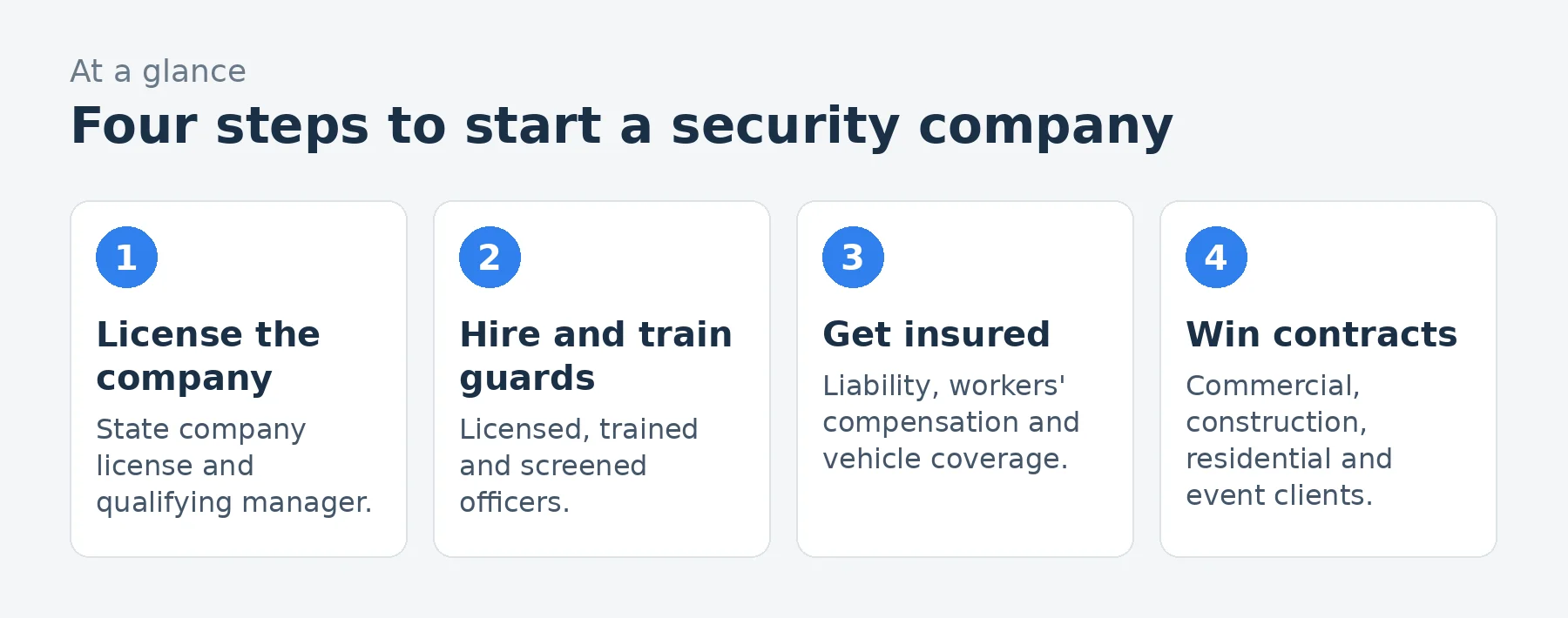
Private security is licensed in most states: companies need a license (often with a qualifying manager who has experience), guards need individual licenses or registrations with required training and armed guards need additional firearm licensing. The Bureau of Labor Statistics reports a median pay of $38,370 for security guards (May 2024), across about 1.27 million jobs. This guide covers licensing, training, insurance, policies, contracts, pricing, a worked example and a 90-day plan.
A security guard company at a glance
Table of Contents
| Topic | What to expect |
|---|---|
| Startup cost | Moderate: company licensing, insurance, uniforms, equipment, patrol vehicles, scheduling software and payroll capital |
| Licensing | Company license in most states, individual guard licenses with training and separate armed guard permits |
| Key duties | Training, background checks, use of force policies, incident reporting and uniforms that do not imitate police |
| How you earn | Hourly bill rates for officers, plus patrol, event and alarm response services |
| Best for | Experienced security, military or law enforcement professionals with management skills |
Who a security company suits
It suits people with security, military or law enforcement experience who can recruit, train and manage officers, sell contracts and handle round-the-clock operations. Reliability is everything: a missed shift can leave a client’s property unprotected.
Company licensing
Most states license private security companies. Licensing often requires a qualifying manager with documented experience, an exam, background checks, insurance and fees. Examples include California’s Bureau of Security and Investigative Services (private patrol operator licenses), Texas’s DPS Private Security Program and Florida’s Division of Licensing. Rules vary widely, so check your state and every state where you will operate.
Guard licensing and training
- California: guards need a guard registration (guard card) and 40 hours of training, with part completed before assignment and the rest within months.
- Florida: unarmed officers need a Class D license with required training; armed officers need a Class G license.
- New York: guards complete an 8-hour pre-assignment course, on-the-job training and annual in-service training.
- Texas: guards register with the Private Security Program and complete required training, with commissioned officers for armed work.
Most states also require background checks and fingerprints, and renewal with continuing training.
Armed security
Armed guards require additional licensing, firearms training, qualification and periodic requalification, plus higher insurance costs and stricter supervision. Many new companies start with unarmed services and add armed services only with experienced leadership and strong policies.
Policies and conduct
Write post orders for each site describing duties, patrol routes, access control procedures and emergency contacts. Adopt use of force policies limited to what the law allows, train officers to observe and report rather than confront when possible and require detailed incident reports. Many states prohibit uniforms, badges and vehicles that could be mistaken for police.
Insurance
Carry general liability insurance designed for security firms (including coverage for assault and battery claims), workers’ compensation, commercial auto for patrol vehicles and often bonds required by licensing or clients. Contracts commonly require specific coverage levels and additional insured status.
Startup costs to plan for
| Item | What to budget for |
|---|---|
| Licensing | Company license, qualifying manager exam, fees |
| Insurance | Liability, workers’ compensation, auto, bonds |
| Uniforms and equipment | Uniforms, radios, flashlights, guard tour systems |
| Patrol vehicle | Marked vehicle that does not imitate police |
| Software | Scheduling, time tracking, incident reporting |
| Working capital | Payroll before clients pay |
Use our startup cost calculator for your total.
Pricing and bill rates
Security contracts are priced as hourly bill rates per officer, covering wages, payroll taxes, workers’ compensation, insurance, uniforms, supervision, overhead and profit. Armed and specialized officers bill higher. Mobile patrols may be priced per visit or monthly. Use our pricing calculator to build bill rates from your costs.
A worked example: a small guard company
These are illustrative assumptions for a small unarmed guard company, not predictions.
| Assumption | Monthly | |
|---|---|---|
| Guard services | 4,000 officer hours at $32 bill rate | $128,000 |
| Mobile patrol contracts | $6,000 | |
| Revenue | $134,000 | |
| Officer wages | 4,000 hours at $20 | $(80,000) |
| Employer payroll costs | Taxes and workers’ compensation | $(14,400) |
| Supervisors and office staff | $(10,000) | |
| Insurance | General liability and other coverage | $(3,200) |
| Patrol vehicle, fuel and equipment | $(2,500) | |
| Software, uniforms, training and licenses | $(2,200) | |
| Payroll funding and marketing | $(2,000) | |
| Profit before owner pay and taxes | $19,700 |
That leaves about $19,700 a month before the owner’s pay and taxes, on about $134,000 of revenue. Margins depend on bill rates, overtime control and workers’ compensation costs, so pricing every contract carefully matters.
Loading the calculator…
Recruiting and retaining officers
Turnover is high in security. Pay competitively, offer steady schedules, provide good training and supervision and recognize reliable officers. Retention improves service quality and reduces recruiting and training costs.
Winning contracts
- Construction sites needing overnight and weekend coverage.
- Property managers for apartments and commercial buildings.
- Retail stores and shopping centers.
- Events, concerts and festivals.
- Healthcare, schools and industrial sites, with additional training needs.
Operations and technology
Use scheduling software to cover every shift, guard tour systems to verify patrols, mobile incident reporting and a supervisor on call 24 hours a day. Clients value real-time reports and fast responses.
Event security
Concerts, festivals, sports and private events need crowd management, bag checks, access control and emergency response. Event work needs officers trained for crowds, coordination with venue staff and police and clear plans for medical emergencies and evacuations. Some states require additional licensing or training for crowd management.
Verifying patrols and reporting
Clients want proof that guards are doing their jobs. Guard tour systems record checkpoints, and mobile reporting apps send real-time incident reports with photos. Monthly summaries of patrols, incidents and recommendations demonstrate value and help retain contracts.
Mobile patrol services
Mobile patrols visit several properties per shift, checking doors, lighting and grounds, and responding to alarms. Patrol routes serve many small clients efficiently and can be more affordable for clients than a standing post.
Working with law enforcement
Officers should know how and when to contact police, preserve scenes and cooperate with investigations. Building good relationships with local law enforcement helps your officers and your clients.
Contracts and scope
Security service agreements should define posts and hours, officer qualifications, duties and limits (such as no arrests beyond what the law allows), bill rates and overtime, holiday rates, insurance, indemnification, reporting and termination. Clear scope protects both the client and your company.
Supervision and quality control
Supervisors should visit posts, check officers’ appearance and alertness and review reports. Regular site audits catch problems before clients do, and they show clients that you manage quality actively.
Specialized security services
As the company grows, specialized services such as healthcare security, executive protection, loss prevention for retailers and fire watch for construction sites can command higher bill rates. Each requires additional training and, sometimes, separate licensing.
Common mistakes to avoid
- Posting unlicensed or untrained guards.
- Underpricing bill rates that do not cover burden.
- Uniforms or vehicles that resemble police.
- Weak use of force policies and reporting.
- Running out of payroll cash.
Your first 90 days
- Days 1-30: confirm your state’s company and guard requirements and apply for the company license.
- Days 31-60: buy insurance, write policies and post orders and recruit licensed officers.
- Days 61-90: price contracts, pitch property managers and construction firms and start first posts.
Frequently asked questions
Do I need a license to start a security company?
In most states, yes, a company license, often with a qualifying manager, plus licenses for each guard.
How much training do security guards need?
It varies; California requires 40 hours, Florida requires training for a Class D license and New York requires 8 hours before assignment plus more training.
Can my guards carry guns?
Only with armed guard licenses, firearms training and qualification, and appropriate insurance.
How do security companies price services?
Hourly bill rates per officer that cover wages, payroll costs, insurance, supervision and profit.
What insurance do security companies need?
General liability designed for security, workers’ compensation, commercial auto and bonds where required.
Can security uniforms look like police uniforms?
Many states prohibit uniforms, badges and vehicles that could be mistaken for police.
What is a qualifying manager?
A licensed individual with required experience who is responsible for a security company’s compliance under many state licensing laws.
Is the security guard business profitable?
It can be with fair bill rates, controlled overtime and steady contracts, though margins per hour are often thin.
How do security companies find officers?
Through job boards, referrals, training schools and veterans’ programs, offering steady schedules and fair pay.
Can I start a security company without law enforcement experience?
Possibly, but many states require a qualifying manager with security or related experience; partnering with an experienced manager is common.
How long does it take to get a security company license?
It depends on the state; background checks, exams and application reviews can take weeks to months.
Keep learning
- Security guards industry data
- How to start an alarm and camera installation business
- How to start a staffing agency
- Pricing calculator
Sources
- US Bureau of Labor Statistics, Security guards and gambling surveillance officers
- California Bureau of Security and Investigative Services (guards and alarm companies)
- Texas Department of Public Safety, Private Security Program
- Florida Division of Licensing, Security officer licenses (Class D and G)
- New York Department of State, Security guard licensing and training
Last reviewed November 3, 2026. Startup costs are estimates; check local prices, licensing and tax rules before you commit money.

