
Businesses, apartment communities, construction sites, events and hospitals hire security officers to protect people and property. Security services run on contracts billed by the hour, which makes recruiting, scheduling and supervision the core of the business. The Bureau of Labor Statistics counted about 1.3 million security guards in 2024, with a median wage of $38,370 in May 2024; BLS notes that most states require guards to be licensed, especially if they carry firearms.
Companies range from small unarmed guard services to event security firms and mobile patrol operations that check multiple properties each night.
The workforce
| Occupation | Jobs (2024) | Median pay (May 2024) | Projected growth, 2024 to 2034 |
|---|---|---|---|
| Security guards and gambling surveillance officers | about 1.3 million | $38,370 | 0% |
Source: U.S. Bureau of Labor Statistics, Occupational Outlook Handbook and Occupational Employment and Wage Statistics.
Business models compared
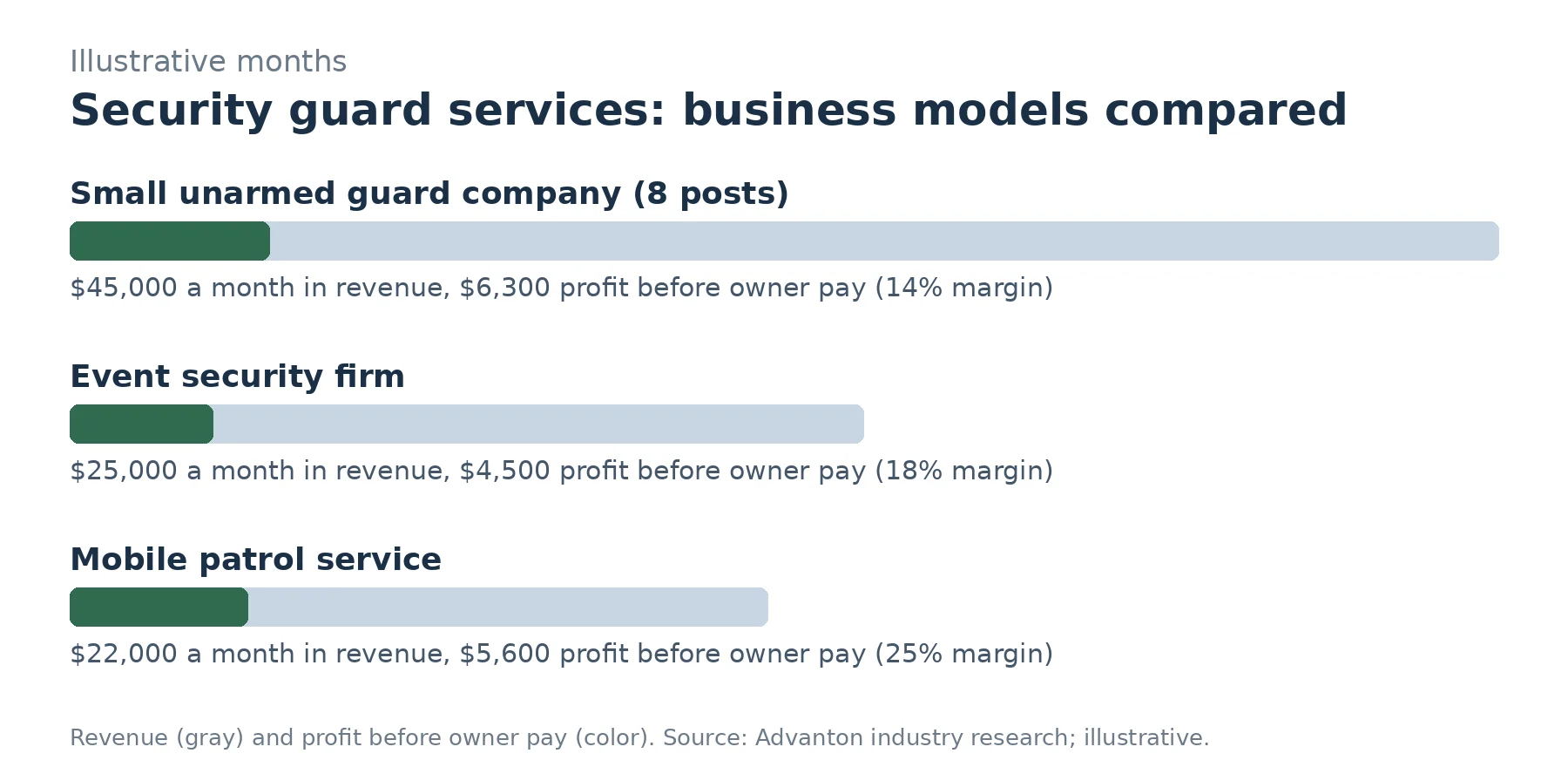
The figures below are illustrative months from our research, not industry averages. They show how revenue and costs typically fit together; your market, prices and costs will differ.
| Business model | Startup costs | Example monthly revenue | Costs | Profit before owner pay | Margin |
|---|---|---|---|---|---|
| Small unarmed guard company (8 posts) | Moderate: agency license, insurance, uniforms, scheduling software | $45,000 | $38,700 | $6,300 | 14% |
| Event security firm | Moderate: licenses, insurance, staff pool, radios | $25,000 | $20,500 | $4,500 | 18% |
| Mobile patrol service | Moderate: marked vehicles, licenses, reporting software | $22,000 | $16,400 | $5,600 | 25% |
Fixed and variable costs
For projections, the most useful split is between variable costs, which rise and fall with sales (materials, supplies, hourly labor, fees), and fixed costs, which you pay every month regardless (rent, salaried staff, insurance, loan payments).
| Business model | Variable costs (% of revenue) | Fixed costs per month | What it means |
|---|---|---|---|
| Small unarmed guard company (8 posts) | 68.2% | $8,000 | Mostly variable: profitable early, but watch cash flow |
| Event security firm | 62.0% | $5,000 | Mostly variable: profitable early, but watch cash flow |
| Mobile patrol service | 52.7% | $4,800 | Mostly variable: profitable early, but watch cash flow |
What the numbers say
Guard wages are the largest cost, so bill rates must cover pay, payroll taxes, insurance, supervision and overhead.
Thin margins reward efficient scheduling and low turnover.
Mobile patrol spreads costs across many clients, making each patrol stop more profitable.
The three models in brief
Small unarmed guard company. Standing posts at businesses, apartments and construction sites. See security services data.
Event security firm. Crowd management, access control and staffing for events. See events data.
Mobile patrol service. Scheduled patrols and alarm response for multiple properties.
Cost structure: event security firm
Each cost as a share of the example month’s revenue ($25,000):
| Cost | Monthly amount | Share of revenue | Type |
|---|---|---|---|
| Staff wages | $13,500 | 54.0% | Variable |
| Coordinator | $2,500 | 10.0% | Fixed |
| Payroll taxes | $2,000 | 8.0% | Variable |
| Insurance | $1,200 | 4.8% | Fixed |
| Marketing | $600 | 2.4% | Fixed |
| Equipment and radios | $400 | 1.6% | Fixed |
| Training | $300 | 1.2% | Fixed |
| Profit before owner pay | $4,500 | 18% |
A first-year projection: event security firm
New businesses rarely start at full speed. This projection assumes revenue ramps from 35% of the example month in month 1 to 100% by month 12, variable costs move with revenue, and fixed costs stay the same every month. It’s a planning illustration, not a forecast.
| Month | Revenue | Variable costs | Fixed costs | Profit | Cumulative |
|---|---|---|---|---|---|
| 1 | $8,750 | $5,425 | $5,000 | -$1,675 | -$1,675 |
| 2 | $11,250 | $6,975 | $5,000 | -$725 | -$2,400 |
| 3 | $13,750 | $8,525 | $5,000 | $225 | -$2,175 |
| 4 | $15,500 | $9,610 | $5,000 | $890 | -$1,285 |
| 5 | $17,500 | $10,850 | $5,000 | $1,650 | $365 |
| 6 | $19,000 | $11,780 | $5,000 | $2,220 | $2,585 |
| 7 | $20,500 | $12,710 | $5,000 | $2,790 | $5,375 |
| 8 | $21,750 | $13,485 | $5,000 | $3,265 | $8,640 |
| 9 | $22,750 | $14,105 | $5,000 | $3,645 | $12,285 |
| 10 | $23,750 | $14,725 | $5,000 | $4,025 | $16,310 |
| 11 | $24,500 | $15,190 | $5,000 | $4,310 | $20,620 |
| 12 | $25,000 | $15,500 | $5,000 | $4,500 | $25,120 |
Year one: revenue $224,000, profit before owner pay $25,120. The first profitable month is month 3. Cumulative results bottom out at -$2,400, which is the minimum cash cushion this plan would need, before any startup costs.
Supervisors, insurance and office costs start before contracts fill posts, so this guard company illustration turns profitable in month 3, with a cumulative low of about $2,400.
How security companies earn
- Hourly bill rates for guard posts.
- Overtime and holiday rates.
- Event staffing by the hour.
- Mobile patrol per stop or per month.
- Alarm response contracts.
Pricing bill rates
Bill rates must cover wages, payroll taxes, workers’ compensation, insurance, uniforms, training, supervision, overhead and profit. Many companies calculate a markup over pay to reach a sustainable bill rate.
Licensing and training
State licensing typically requires training hours, background checks and fingerprinting for guards, plus a company license with a qualified manager. Armed posts require firearms training and permits.
A startup checklist for security guard services
- Obtain the company license and qualify a manager if required.
- Get high-limit liability insurance and workers’ compensation.
- Build training programs that meet state rules.
- Choose scheduling and reporting software with GPS check-ins.
- Write post orders for every client site.
Recruiting and retention
Turnover is the industry’s biggest challenge. Fair pay, reliable schedules, training, respect and recognition reduce turnover and protect contracts.
Where the opportunities are
- Construction site security.
- Apartment community patrols.
- Healthcare and school security.
- Event and concert staffing.
- Technology-supported guarding with cameras and remote monitoring.
Key terms
| Term | Meaning |
|---|---|
| Post orders | Written instructions for each guard post |
| Bill rate | Hourly price charged to clients |
| Mobile patrol | Vehicle patrols covering several properties |
| Qualified manager | The licensed person responsible for a security company in some states |
Supervision and quality
Site visits, GPS check-ins, daily activity reports and client reviews show clients that posts are covered and guards are alert.
Key numbers to track
Track bill rate versus pay rate, gross margin per contract, overtime, turnover, missed shifts and client renewals.
Common mistakes
- Underpricing contracts.
- Unlicensed guards on posts.
- High turnover and missed shifts.
- Weak use-of-force training.
- Insufficient insurance.
Marketing a security company
Property managers, construction companies, event organizers and businesses hire through referrals and bids. A professional website, reviews and responsive proposals win contracts. See how to win commercial contracting jobs.
Armed vs unarmed
Armed security brings higher rates, stricter licensing, more training and higher insurance costs. Many companies focus on unarmed services until they have systems and experience.
Technology and guarding
Cameras, access control and remote monitoring complement guards. Combining technology with patrols can lower costs for clients while improving coverage.
Customer service
Guards are often the first person visitors meet. Train for courtesy, communication and de-escalation as well as security.
Training beyond the minimum
State minimum training is a starting point. Site-specific training, de-escalation, first aid and report writing make guards more effective and reduce incidents, which helps retain contracts.
Contracts
Clear contracts define post hours, duties, bill rates, overtime, liability and termination. Avoid accepting unlimited liability.
Incident reporting
Detailed, timely incident reports protect clients, guards and the company. Digital reporting with photos, timestamps and GPS check-ins gives clients confidence and supports insurance claims or investigations.
Growing from one contract to many
Most companies start with a few posts, then grow through referrals from satisfied property managers and businesses. Add supervisors as posts multiply, so quality doesn’t slip as the company grows.
Payroll compliance
Overtime, breaks and wage rules apply to guards. Accurate timekeeping protects workers and the company.
Test these numbers with your own plan
Open this industry in our free Business Idea Reality Check to start from any model above, change prices, costs, startup budget and your own pay, and see your break-even month, the cash you’d need, three scenarios and how new businesses in this sector survive in your state.
- Start with the closest model and its cost structure.
- Replace every price and cost with local quotes.
- Estimate your ramp: how fast customers will realistically come in year one.
- Map cash month by month with the free Cash & Payroll Planner.
- Build the full plan in the free Business Planner.
About this data
Workforce figures come from the U.S. Bureau of Labor Statistics (Occupational Outlook Handbook and Occupational Employment and Wage Statistics, May 2024 wages and the 2024 to 2034 projections, unless noted). Market figures cite their sources above. Business model figures are illustrative months built from typical prices and costs to show how revenue, fixed costs and variable costs fit together; they are not industry averages or guarantees. We review these profiles when new government data is released, at least once a year, and the same figures power the Business Idea Reality Check.
Licensing and rules
Most states license security guards and the companies that employ them, with training hours, background checks and fingerprinting; armed guards need additional firearms training and permits; some states and cities have their own registration rules; companies need general liability insurance, often with high limits, plus workers’ compensation; uniforms and vehicles must not imitate police; use-of-force policies and training protect clients and the public. Requirements change; confirm with your state and local agencies before you start.
Frequently asked questions about security guard services
Do security guards need a license?
Most states license guards, especially armed guards.
Does a security company need a license?
Many states license security companies and require a qualified manager.
What do security guards earn?
BLS reported a median of $38,370 in May 2024.
How do security companies price services?
Hourly bill rates that cover wages, taxes, insurance, supervision and overhead.
Is a security company profitable?
It can be, with sustainable bill rates, low turnover and strong supervision.
How do security companies find guards?
Job boards, referrals, veterans programs and training partnerships, with competitive pay and steady schedules to keep them.
Can I start a security company with no experience?
Many states require a qualified manager with experience; partnering with experienced professionals helps.
What insurance do security companies need?
High-limit general liability and workers’ compensation, with additional coverage for armed services.
How can I test these numbers?
Open security guard services in the Business Idea Reality Check and enter your own rates and costs.
Keep learning
- Security services data
- Events and weddings data
- Commercial cleaning data
- Business Idea Reality Check
Sources
Last reviewed November 1, 2026. Startup costs are estimates; check local prices, licensing and tax rules before you commit money.
In India
Small businesses like this in India
In MoSPI’s survey of unincorporated businesses (proprietorships, partnerships and similar firms), this falls under Administrative and support services. In 2023-24 India had 23.6 lakh such establishments employing 43.1 lakh workers, and 80.7% were run without hired workers. Across the wider other services group, the number of establishments grew 10.29% between 2023-24 and 2025.
| Urban | Rural | All India | |
|---|---|---|---|
| Value added per business a year | ₹3,40,306 | ₹1,94,921 | ₹2,57,316 |
| Value added per worker a year | ₹1,64,755 | ₹1,18,208 | ₹1,40,784 |
| Pay per hired worker a year | ₹1,29,813 | ₹86,299 | ₹1,12,714 |
Running it alone or with staff: businesses with no hired workers added about ₹1,52,541 a year on average, while those with hired workers added about ₹6,94,636 (all India).
Where these businesses are: the states with the most small other services businesses are West Bengal (13.1%), Uttar Pradesh (11.6%), Maharashtra (8.8%), Tamil Nadu (6.2%), Gujarat (6.0%) of the national total (2023-24).
Value added is what a business produces minus what it spends on materials and other inputs, before paying its workers and owner, so it’s a rough guide to the income a typical small business generates. These figures cover the whole activity, which can be broader than this one business type. Across all small businesses, average fixed assets such as equipment, furniture and vehicles were ₹3,42,242 per establishment in 2025.
Licences and registrations to expect
- A licence under the Private Security Agencies (Regulation) Act (PSARA) from your state’s controlling authority, with police verification and training for guards.
- Registration under your state’s Shops and Establishments Act if you have premises or employees.
- A trade licence from your municipal corporation or council for many shop and service businesses.
- GST registration once turnover crosses ₹40 lakh for goods or ₹20 lakh for services (lower in some special category states), or earlier if you sell goods to other states or through e-commerce marketplaces.
- Professional tax registration in states that levy it.
- Free Udyam (MSME) registration, which helps with loans, government schemes and delayed-payment protection.
Rules differ by state and city. Check with your municipal corporation, state departments and a chartered accountant before you start.
Run a business like this in India? List it free in the India Business Directory, with your hours, deals and GST registration.
Free tools for India: Make a GST invoice · Compare business credit cards
Build a market report for Security Guard Services in India Pick your state and see market size, earnings, competition and licences, from official data. Free, with a PDF download.
Sources: MoSPI, Annual Survey of Unincorporated Sector Enterprises (ASUSE) 2023-24, full report, Appendix A Tables 4, 29, 33, 35 and 37 (survey period October 2023 to September 2024); MoSPI, Annual Survey of Unincorporated Sector Enterprises (ASUSE) 2025, factsheet (survey period January to December 2025, released 24 March 2026). Licensing summary by Advanton, checked November 2026.