
A hunting guide or outfitter business leads clients on hunts: big game such as elk, deer and bear, waterfowl, upland birds, turkeys and more. Outfitters typically provide land access, guides, lodging, meals, transportation and sometimes horses, while guides lead clients in the field.
Guiding is regulated by states, many of which license outfitters and guides (for example, Montana, Idaho, Colorado and Alaska have formal licensing systems), and operating on federal lands requires Forest Service or BLM permits. Guides must follow game laws carefully, since violations can bring heavy penalties, including under the federal Lacey Act. Advanton’s outdoor adventure data shows a median pay of $35,380 for recreation workers (May 2024), across about 327,700 jobs with employment projected to grow about 4%. Owners of guide and rental businesses earn the profit after staff, equipment, permits and insurance, and income is often seasonal. This guide covers licensing, land access, permits, safety, operations, pricing, a worked example and a 90-day plan.
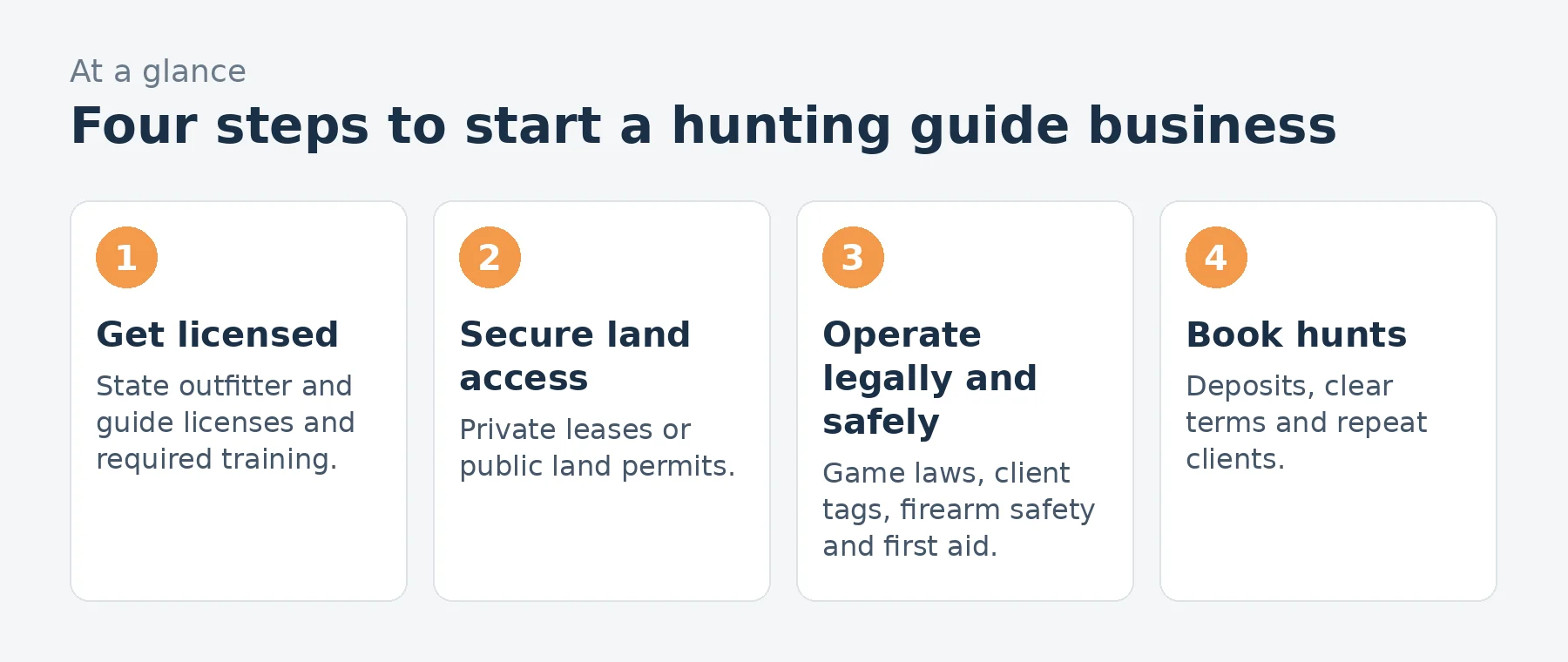
A hunting guide business at a glance
Table of Contents
| Topic | What to expect |
|---|---|
| Startup cost | Moderate: licensing, land leases or permits, vehicles, camp equipment, optics, insurance and marketing |
| Licenses | State outfitter and guide licenses where required, often with experience, first aid, testing and insurance requirements |
| Land access | Private land leases and agreements, or Forest Service and BLM permits for public land |
| Key laws | State game laws, client licenses and tags, the Lacey Act and firearms rules |
| Best for | Skilled, ethical hunters who know an area deeply and enjoy hosting clients |
Who guiding suits
It suits highly skilled, ethical hunters who know their area’s terrain and game intimately, can handle long days in tough conditions and enjoy teaching and hosting clients. Safety judgment and patience are essential.
State licensing
Many states regulate guides and outfitters. Montana’s Board of Outfitters, Idaho’s Outfitters and Guides Licensing Board, Colorado’s outfitter registration and Alaska’s registered guide system are examples, often requiring experience, first aid and CPR, testing, insurance or bonds and approved operating areas. Some states have lighter requirements, especially for private land guiding. Check the rules for every state and species you guide.
Land access
Outfitters need reliable access to good hunting ground. On private land, sign written leases or access agreements covering seasons, species, number of hunters, fees and liability. On public land, commercial guiding generally requires permits: Forest Service outfitting and guiding special use permits and BLM special recreation permits, which can be limited in number and assigned to specific areas.
Game laws and the Lacey Act
Clients must hold the right licenses and tags, many of which are limited and allocated through draws. Guides must follow seasons, bag limits, legal methods and tagging and reporting rules. The federal Lacey Act makes it a crime to transport or sell wildlife taken in violation of state or federal law, and guides who help clients break game laws can face serious federal penalties and license loss.
Firearms, safety and first aid
Brief clients on firearm safety, shooting lanes and hunter orange rules, confirm hunter education where states require it and assess clients’ shooting skills before hunts. Carry first aid kits, communication devices for remote areas and an emergency plan. Many states require guides to hold first aid certification.
Camps, lodging and horses
Outfitters may run lodges, wall tent camps or work with local lodging. Food service may require permits, and camps on public land must follow permit conditions on sanitation, bear safety and leave-no-trace practices. Horses and mules for backcountry hunts need care, experienced wranglers and liability coverage.
Insurance and contracts
Carry liability insurance designed for outfitters (often required by licensing boards and land permits), vehicle coverage and workers’ compensation for employees. Use written booking contracts covering what is included, deposits, cancellations, weather, client responsibilities, success expectations (no guarantees) and waivers.
Startup costs to plan for
| Item | What to budget for |
|---|---|
| Licensing | Outfitter and guide licenses, training, testing |
| Land access | Leases or public land permit fees |
| Camp and lodging | Tents, cabins, cooking equipment, food |
| Vehicles and stock | Trucks, trailers, horses or ATVs |
| Gear | Optics, game processing, communication devices |
| Insurance | Outfitter liability, vehicles, workers’ compensation |
Use our startup cost calculator for your total.
Pricing hunts
Price hunts per hunter for a set number of days, with differences for species, accommodation level and guide ratio (one-on-one or two clients per guide). Take deposits to hold dates, collect balances before arrival and state what is not included, such as licenses, tags, processing and gratuities. Use our pricing calculator.
A worked example: a fall season
These are illustrative assumptions for a small outfitter’s fall season, averaged per month over a four-month season, not predictions.
| Assumption | Monthly | |
|---|---|---|
| Guided hunts | 6 clients a month at $4,500 | $27,000 |
| Lodging and meals add-ons | $2,000 | |
| Revenue | $29,000 | |
| Guides | Seasonal guides, with payroll costs | $(7,000) |
| Land leases and permit fees | Averaged monthly | $(5,500) |
| Camp, food and supplies | $(2,500) | |
| Vehicles, fuel and horse care | $(3,000) | |
| Insurance and licenses | Averaged monthly | $(1,000) |
| Marketing and booking | $(800) | |
| Profit before owner pay and taxes | $9,200 |
That leaves about $9,200 a month during the season before the outfitter’s pay and taxes, on about $29,000 of revenue. Most revenue is earned in a few months, so deposits, repeat clients and off-season services matter.
Loading the calculator…
Ethics and client experience
Great outfitters promote fair chase, respect landowners and wildlife and manage client expectations honestly: success depends on weather, game and shooting, and no ethical outfitter guarantees a harvest. Comfortable camps, good food and skilled guides bring clients back year after year.
Marketing
- Hunting shows and expos.
- Referrals and repeat clients, the strongest source.
- Booking agents that represent outfitters (for a commission).
- A website with honest information on hunts, success, lodging and pricing.
- Photos and stories shared with client permission.
Off-season income
Many outfitters add fishing trips, wildlife and photography tours, horseback trips, shed hunting, predator hunts or lodge rentals to use land, staff and facilities outside hunting seasons, subject to permit terms.
Hiring and training guides
Guides must be licensed where states require it, know the area and game and share your safety and ethics standards. Train guides on client service, firearm safety, emergency procedures and regulations, and pair new guides with experienced ones.
Landowner relationships
Private land leases depend on trust. Respect property, follow agreed rules on roads, gates, livestock and hunter numbers, report harvests and help with land management. Good relationships secure access for years.
Clients from other states and countries
Nonresident and international clients face extra rules: nonresident licenses and draws, firearm import and transport rules for international visitors and wildlife export requirements for trophies. Give clients clear guidance and timelines well before hunts.
Game care and processing
Proper field care preserves meat and trophies. Have plans for quartering, cooling, transport and processing, and partner with local processors and taxidermists. Many states have rules on wanton waste and meat recovery.
Booking and deposits
Many hunts book a year or more ahead, especially for limited-draw tags. Take nonrefundable or partially refundable deposits, explain what happens if clients do not draw tags and keep a waitlist to fill cancellations.
Common mistakes to avoid
- Guiding without required state licenses.
- Operating on public land without permits.
- Bending game laws for clients.
- Unclear contracts and deposit policies.
- Overbooking land or guides.
Your first 90 days
- Days 1-30: research licensing, apply for outfitter or guide licenses and contact landowners and land agencies.
- Days 31-60: secure leases or permits, buy insurance and plan camps and equipment.
- Days 61-90: set hunt packages and contracts, build a website and attend a hunting expo.
Frequently asked questions
Do I need a license to be a hunting guide?
Many states license outfitters and guides, such as Montana, Idaho, Colorado and Alaska; requirements vary by state.
Can I guide hunts on public land?
Commercial guiding on federal land generally requires Forest Service or BLM permits, which can be limited.
What is the Lacey Act?
A federal law making it a crime to transport or sell wildlife taken in violation of state or federal law.
Do outfitters guarantee a harvest?
Ethical outfitters do not; success depends on weather, game and shooting, and contracts should say so.
How do outfitters price hunts?
Per hunter for a set number of days, varying by species, lodging and guide ratio, with deposits.
What insurance do hunting guides need?
Outfitter liability insurance, vehicle coverage and workers’ compensation for employees.
Do my clients need hunter education?
Many states require hunter education for licenses depending on age; check each state’s rules and tell clients early.
When do clients book hunts?
Often months to a year ahead, especially for draw hunts; booking shows and repeat clients fill many dates.
Can I guide in more than one state?
Yes, if you meet each state’s licensing and land access requirements.
What should a hunt package include?
Typically guiding, lodging, meals and field transport, with licenses, tags, processing and gratuities listed separately.
Do outfitters need bonds?
Some states require bonds or proof of insurance for outfitter licenses; check your state’s requirements.
Keep learning
- Outdoor adventure industry data
- How to start a fishing charter business
- How to start a climbing gym
- Pricing calculator
Sources
- Montana Board of Outfitters, Outfitter and guide licensing
- USDA Forest Service, Outfitting and guiding special use permits
- Bureau of Land Management, Special recreation permits
- U.S. Fish and Wildlife Service, Lacey Act
- US Bureau of Labor Statistics, Recreation workers
Last reviewed November 3, 2026. Startup costs are estimates; check local prices, licensing and tax rules before you commit money.

