
A climbing gym offers indoor bouldering and rope climbing, plus classes, youth programs, fitness areas, yoga and community events. Climbing has grown into a mainstream fitness activity, and gyms succeed when they build a loyal membership community.
Climbing gyms are capital-intensive: tall buildings, engineered walls, thick padded flooring, holds and safety systems. Safety practices matter too, from belay checks to auto belay inspections, and the Climbing Wall Association publishes industry practices many gyms follow. Advanton’s outdoor adventure data shows a median pay of $35,380 for recreation workers (May 2024), across about 327,700 jobs with employment projected to grow about 4%. Owners of guide and rental businesses earn the profit after staff, equipment, permits and insurance, and income is often seasonal. This guide covers gym types, buildings, design, safety, staffing, memberships, programs, a worked example and a 90-day plan.
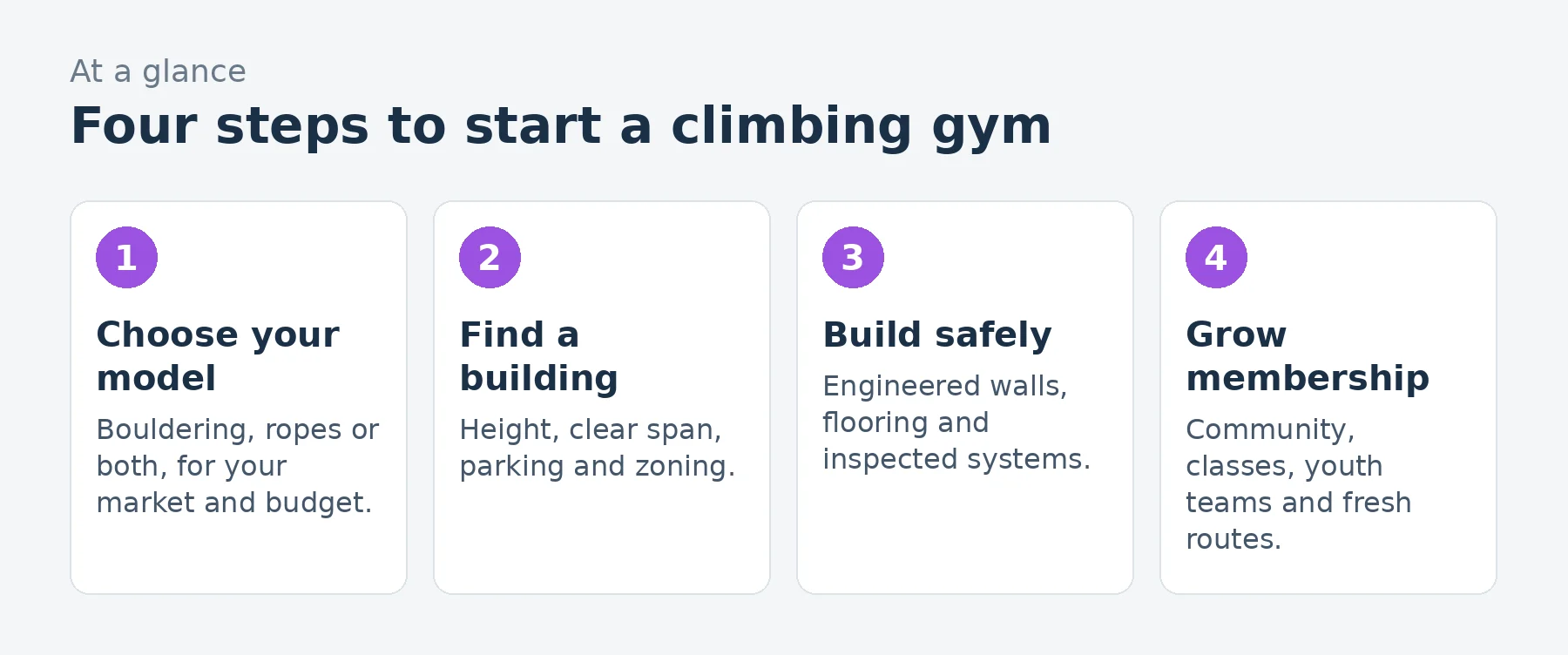
A climbing gym at a glance
Table of Contents
| Topic | What to expect |
|---|---|
| Startup cost | High: building lease and build-out, engineered walls, flooring, holds, auto belays, fitness equipment and front desk systems |
| Licenses | Business license, zoning, building permits and occupancy approvals |
| Key safety | Climbing Wall Association practices, belay testing, auto belay inspections, staff training and supervision |
| How you earn | Memberships, day passes, classes, youth teams and camps, parties, gear rental and retail |
| Best for | Experienced climbers with business skills and access to significant capital |
Who a climbing gym suits
It suits experienced climbers who understand the community and have business discipline, financing and patience. Gyms take significant investment and time to fill with members.
Bouldering, ropes or both
- Bouldering gyms: shorter walls with padded floors and no ropes; lower build costs and staffing, very social.
- Rope gyms: taller walls for top rope, lead climbing and auto belays; more equipment, training and supervision.
- Full-service gyms: both, plus fitness areas, yoga and larger programs.
Market research on local climbers, competitors and demographics guides your choice.
Finding a building
Look for tall, clear-span buildings (often warehouses) with enough height for your walls, parking, visibility and zoning for recreation or assembly use. Structural engineering is needed for walls attached to buildings. Lease terms should reflect the large build-out you will invest in.
Wall design and construction
Work with experienced climbing wall manufacturers who engineer and install walls, and plan padded flooring for bouldering areas, holds, volumes and spaces for setting. Design for a range of difficulties, traffic flow, sight lines for staff and space for beginners, kids and training.
Safety practices
- Follow Climbing Wall Association industry practices for operations, inspections and training.
- Require belay checks before climbers belay independently, and retest periodically.
- Inspect and maintain auto belays according to manufacturer requirements, with documented inspections.
- Inspect holds, ropes, harnesses and flooring regularly, and retire worn equipment.
- Orient every new climber to rules and falling safely in bouldering areas.
- Train staff in supervision, rescue, first aid and emergency plans.
Waivers and insurance
Use waivers and orientation acknowledgments (enforceability varies by state, especially for minors), and carry liability insurance designed for climbing facilities, property coverage and workers’ compensation. Insurers often require documented safety and inspection programs.
Youth programs and SafeSport
Youth climbing teams, camps and classes are a major revenue source. Teams affiliated with USA Climbing follow SafeSport requirements, and all youth programs should use background checks, two-adult policies and parent communication.
Startup costs to plan for
| Item | What to budget for |
|---|---|
| Building | Lease deposits, improvements, HVAC, restrooms |
| Walls | Design, engineering, manufacturing, installation |
| Flooring | Padded bouldering floors and rope area surfaces |
| Holds and safety systems | Holds, volumes, ropes, auto belays |
| Fitness and amenities | Training area, yoga room, lockers |
| Systems | Front desk software, waivers, point of sale |
Use our startup cost calculator for your total.
Memberships and pricing
Most revenue comes from monthly memberships, with day passes, punch cards, family and student rates and pre-opening founding memberships. Follow state automatic renewal laws: clear terms, consent and easy cancellation. Use our pricing calculator to test membership and staffing scenarios.
A worked example: an established bouldering gym
These are illustrative assumptions for an established bouldering gym, not predictions.
| Assumption | Monthly | |
|---|---|---|
| Memberships | 650 members at $79 | $51,350 |
| Day passes and punch cards | $9,000 | |
| Classes, youth teams and camps | $7,500 | |
| Parties, retail and rentals | $4,500 | |
| Revenue | $72,350 | |
| Staff wages | Front desk, setters, coaches, with payroll costs | $(24,000) |
| Rent and utilities | $(16,000) | |
| Build-out loan payments | $(9,000) | |
| Holds, setting and maintenance | $(2,500) | |
| Insurance, software and card fees | $(4,200) | |
| Marketing and events | $(1,500) | |
| Profit before owner pay and taxes | $15,150 |
That leaves about $15,150 a month before the owner’s pay and taxes, on about $72,350 of revenue. Membership growth and retention drive everything, and large fixed costs make the first year or two the hardest.
Loading the calculator…
Route setting
Regular route setting keeps members engaged: reset sections on a schedule so there is always something new, offer routes for every level and gather feedback. Head setters are key staff, and setting needs time, holds and safety procedures.
Programs and community
- Intro to climbing and belay classes.
- Technique and lead climbing courses.
- Youth teams, camps and birthday parties.
- Yoga, fitness classes and training programs.
- Community nights, competitions and inclusive climbing groups.
Accessibility
As a public accommodation, a climbing gym must meet ADA requirements for accessible entrances, restrooms, front desk and common areas. Adaptive climbing programs welcome climbers with disabilities and strengthen community ties.
Turning first-timers into members
Many visitors try climbing once. Welcome them with a clear orientation, intro classes and a first-month membership offer, and follow up after visits. Friendly staff and beginner-friendly routes turn first-timers into regulars.
Staffing the gym
Gyms need front desk staff, route setters, instructors, youth coaches and managers. Train everyone on safety, supervision, belay testing, emergency procedures and customer service, and schedule enough staff on busy evenings and weekends.
Competitions and events
Bouldering competitions, community nights and film screenings bring members together and attract new climbers. Youth competitions through USA Climbing involve team programs and SafeSport compliance.
Training and fitness areas
Training boards, hangboards, weights and yoga spaces keep members engaged and support higher membership prices. Many gyms offer fitness classes that appeal to members’ partners and friends who do not climb.
Pre-opening sales
Selling founding memberships before opening builds a base, tests demand and generates early cash. Offer special rates, keep members updated on construction and make sure renewal terms are clear.
Front desk and check-in systems
Climbing gym software handles memberships, waivers, check-ins, belay certifications, class bookings and retail. Tracking belay status at check-in helps staff enforce safety rules consistently.
Kids and birthday parties
Kids’ climbing, after-school programs and birthday parties fill weekday afternoons and weekends. They need dedicated staff, age-appropriate walls or auto belays and clear supervision ratios.
Financing the build
Climbing gyms are often funded through a combination of owner investment, SBA-backed loans, equipment financing and investors. Lenders want a detailed business plan with market research, membership projections, build-out quotes and experienced management. Use our business planner to organize the numbers.
Common mistakes to avoid
- Underestimating build-out costs and time.
- A building too short or poorly located.
- Weak belay testing and auto belay inspections.
- Stale routes that drive members away.
- Confusing membership cancellation terms.
Your first 90 days
- Days 1-30: research the market, build a financial model and approach lenders and investors.
- Days 31-60: find a building, engage a wall manufacturer and confirm zoning and permits.
- Days 61-90: finalize designs and financing, sell founding memberships and hire key staff.
Frequently asked questions
How much does it cost to open a climbing gym?
It is capital-intensive; walls, flooring and building improvements are the largest costs, especially for rope gyms.
Is a bouldering gym cheaper than a rope gym?
Generally yes, with lower wall heights, fewer safety systems and simpler staffing.
What safety standards do climbing gyms follow?
Many follow Climbing Wall Association industry practices, plus manufacturer requirements for walls and auto belays.
How do climbing gyms make money?
Mostly from memberships, plus day passes, classes, youth teams, parties, rentals and retail.
Do climbing gyms need waivers?
Most use waivers and orientation, though enforceability varies by state; insurance and safety programs are essential.
How often should routes be reset?
Regularly, on a rotating schedule, so members always have new climbs.
How many members does a climbing gym need?
It depends on costs; many gyms need several hundred members plus day pass traffic to be profitable.
Do climbing gyms need certified staff?
Not legally certified in most places, but staff training, instructor certifications and documented safety practices are expected.
Can a climbing gym be profitable?
Yes, with strong membership growth and retention, though high build-out costs make the first years challenging.
What size building does a climbing gym need?
It depends on the model; bouldering gyms need less height than rope gyms, but both need large, open floor areas.
How long does it take to open a climbing gym?
Often many months from building search to opening, including design, permits, wall manufacturing and installation.
Keep learning
- Outdoor adventure industry data
- How to start a batting cage or training facility
- How to start a hunting guide business
- Startup cost calculator
Sources
- Climbing Wall Association, Industry practices and standards
- USA Climbing, Youth competitive climbing and SafeSport
- ADA.gov, Title III regulations for public accommodations
- California Automatic Renewal Law (Business and Professions Code section 17600 and following)
- US Bureau of Labor Statistics, Recreation workers
Last reviewed November 3, 2026. Startup costs are estimates; check local prices, licensing and tax rules before you commit money.

