
An indoor batting cage or sports training facility rents cages and training space to players and teams, and offers lessons, memberships, camps and parties. Baseball and softball facilities are common, and many expand into multi-sport turf for speed, agility and team practices.
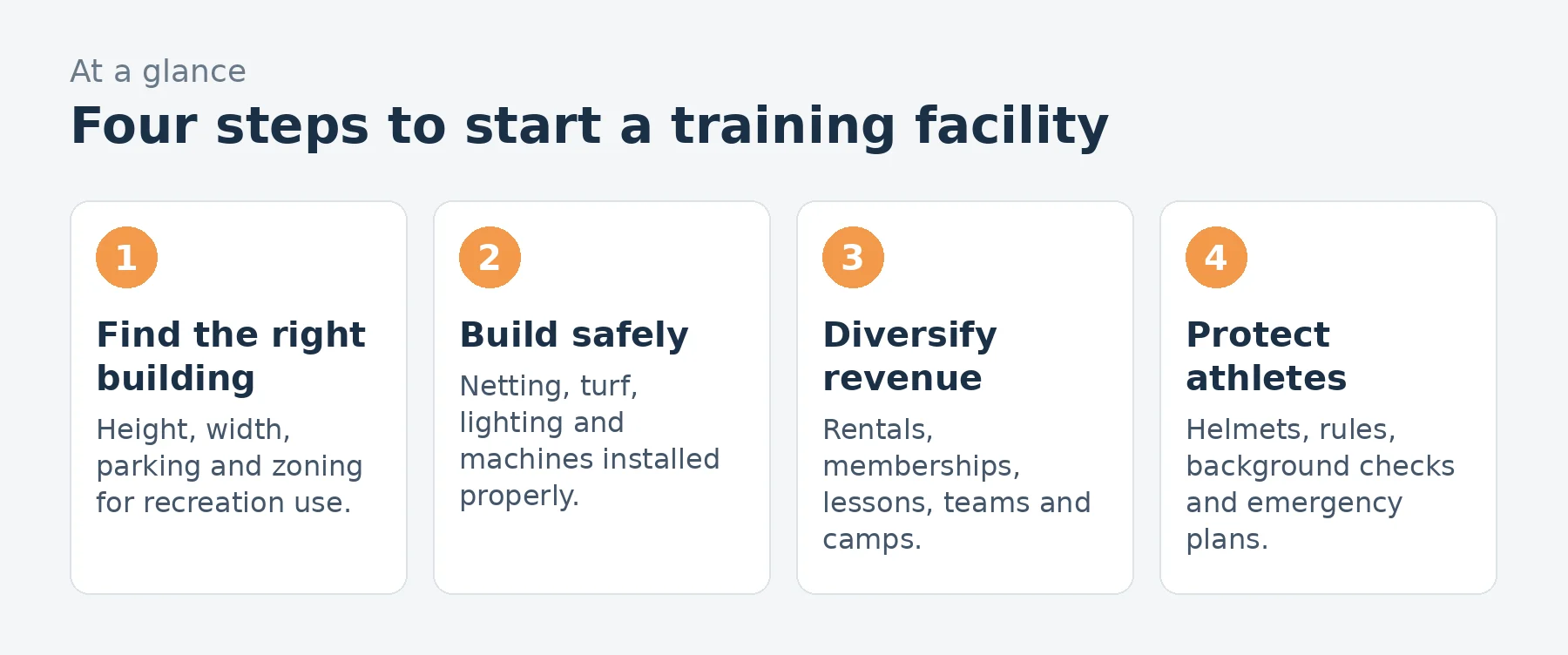
The business depends on keeping lanes busy across seasons, with strong winter and spring demand from teams and players. A facility needs the right building, safe netting and equipment, coaches who attract athletes and youth safety policies. Advanton’s sports and recreation data shows a median pay of $35,380 for recreation workers (May 2024), across about 327,700 jobs with employment projected to grow about 4%; owners earn the profit after staff, facilities and insurance. This guide covers space, equipment, revenue streams, safety, insurance, a worked example and a 90-day plan.
A batting cage or training facility at a glance
Table of Contents
| Topic | What to expect |
|---|---|
| Startup cost | Moderate to high: lease and build-out, netting, turf, pitching machines, technology, lighting and HVAC |
| Licenses | Business license, zoning approval for recreation use, building permits and occupancy inspections |
| How you earn | Lane and space rentals, memberships, lessons, team rentals, camps, clinics, parties and retail |
| Key safety | Helmets and safe cage design, youth protection policies, concussion protocols and emergency plans |
| Best for | Former players and coaches with community connections and business discipline |
Who a training facility suits
It suits former players and coaches with strong local connections who enjoy developing athletes and can manage a facility: staff, maintenance, scheduling and marketing.
Choosing a building
Batting cages need long, tall, open space: typical cages run about 70 feet long, and ceiling height matters for hitting and pitching. Warehouses and flex industrial spaces often work, but check zoning for recreational use, parking for busy evenings, HVAC for comfort, restrooms and accessibility. Building and occupancy permits apply to the build-out.
Equipment and technology
- Netting and cage frames professionally installed, with protective screens for pitchers and feeders.
- Pitching machines for baseball and softball at different speeds.
- Turf for cages and open training areas.
- Lighting suitable for tracking balls.
- Ball-tracking and video technology that measures exit velocity and swing data.
- Helmets, bats and balls, inspected and replaced regularly.
Revenue streams
- Hourly cage rentals for players and families.
- Memberships with monthly cage time and discounts.
- Lessons with in-house or independent coaches (facility fee or revenue share).
- Team rentals for practices in the offseason.
- Camps, clinics and leagues.
- Birthday parties and corporate events.
- Retail: bats, gloves, balls and training aids.
Athlete safety
Require helmets in cages, enforce rules on who may be in lanes, keep machines supervised, inspect nets daily and post safety rules. For youth programs, run background checks on coaches and staff, follow SafeSport-style policies that avoid one-on-one interactions out of view and follow state concussion laws. Keep first aid supplies, an AED and an emergency plan.
Insurance, waivers and accessibility
Carry general liability insurance designed for sports facilities, property coverage for equipment and workers’ compensation for employees, and require independent coaches to carry their own insurance. Use waivers, noting enforceability for minors varies by state. As a public accommodation, follow ADA accessibility requirements for entrances, restrooms and facilities.
Startup costs to plan for
| Item | What to budget for |
|---|---|
| Lease and build-out | Deposits, construction, restrooms, HVAC |
| Netting and turf | Cages, screens, turf areas |
| Machines and technology | Pitching machines, tracking systems |
| Front desk and software | Booking, memberships, waivers, point of sale |
| Insurance and permits | Liability, property, building permits |
| Opening marketing | Grand opening, team outreach |
Use our startup cost calculator for your total.
Pricing
Price cage rentals by the hour (often with peak and off-peak rates), memberships monthly with included hours, team rentals in blocks and camps per participant. Decide how independent coaches pay the facility: hourly space fees or a share of lesson revenue. Use our pricing calculator.
A worked example: a six-cage facility
These are illustrative assumptions for a six-cage facility in its busy season, not predictions.
| Assumption | Monthly | |
|---|---|---|
| Cage rentals | 520 lane-hours at $40 | $20,800 |
| Memberships | 90 members at $79 | $7,110 |
| Lessons (facility share) | Coaches pay a share of lesson revenue | $3,200 |
| Team rentals, camps and parties | $5,500 | |
| Revenue | $36,610 | |
| Staff wages | Front desk and supervisors | $(6,500) |
| Rent and utilities | Warehouse space with HVAC | $(11,000) |
| Equipment payments and maintenance | Machines, nets, technology | $(2,200) |
| Insurance | $(900) | |
| Software, marketing and supplies | $(1,500) | |
| Profit before owner pay and taxes | $14,510 |
That leaves about $14,510 a month before the owner’s pay and taxes, on about $36,610 of revenue in busy months. Summer can be slower for indoor facilities, so plan camps, leagues and multi-sport uses to fill the calendar.
Loading the calculator…
Working with coaches
Coaches attract athletes. Recruit respected local coaches as employees or independent contractors, set clear rules for scheduling, conduct, insurance and background checks, and promote them on your website. Strong coaches turn a facility into a training destination.
Filling the calendar year-round
Winter and spring bring peak demand from teams preparing for seasons. Fill summer and fall with camps, leagues, softball and multi-sport training (soccer, football speed and agility), corporate events and parties.
Marketing
- Local teams, travel clubs and high school programs.
- Youth leagues through sponsorships and discounts.
- Social media with athlete highlights (with permission).
- Google Business Profile and reviews for "batting cages near me" searches.
- Grand opening events and free trial sessions.
Designing memberships
Memberships work best with clear value: a set number of cage hours each month, discounts on lessons and camps and priority booking. Offer individual and family tiers, and use automatic billing with clear renewal and cancellation terms, as state auto-renewal laws require.
Scheduling and booking
Online booking for lanes, lessons and team rentals reduces front desk work and lets customers book at night. Set rules for cancellations, no-shows and peak-hour limits so lanes are shared fairly.
Retail and services
A small pro shop with bats, gloves, balls, batting gloves and training aids adds revenue and convenience. Bat regripping, glove repair and equipment fitting can add more.
Facility maintenance
Inspect netting, frames, turf and machines daily, rotate and replace balls, clean regularly and log maintenance. Safe, clean facilities protect athletes and your reputation.
Leagues and competitions
In-house hitting leagues, home run derbies and skills competitions bring athletes in during slower months and build community. Technology that tracks exit velocity and distance makes competitions fun and shareable.
Staffing the front desk
Front desk staff check in customers, enforce safety rules, sell memberships and keep lanes on schedule. Train them on safety procedures, emergency plans and customer service, since they shape every visitor’s experience.
Measuring performance
Track lane utilization by hour, membership growth and churn, lesson volume and revenue per square foot. Use the data to adjust peak pricing, staffing and programs.
Common mistakes to avoid
- A building without enough height or parking.
- Poorly installed netting.
- Relying on one sport and one season.
- Independent coaches without insurance or background checks.
- Unsupervised pitching machines.
Your first 90 days
- Days 1-30: research demand, find a building and confirm zoning and permits.
- Days 31-60: plan the build-out, order netting, turf and machines and recruit coaches.
- Days 61-90: finish construction, set up booking and memberships and launch with team outreach.
Frequently asked questions
How much does it cost to open a batting cage facility?
It depends on space and build-out; netting, turf, machines, technology and HVAC are major costs.
How do batting cage facilities make money?
From cage rentals, memberships, lessons, team rentals, camps, parties and retail.
What size building do I need?
Long, tall open space; cages commonly run about 70 feet long, plus room for training areas and a lobby.
Do I need special insurance?
Yes, general liability for sports facilities, property coverage and workers’ compensation for employees.
Should coaches be employees or contractors?
Either can work if classified correctly, with clear agreements, insurance and background checks.
Is an indoor training facility seasonal?
Demand peaks in winter and spring; camps, leagues and multi-sport uses help fill other seasons.
Can a training facility serve sports other than baseball?
Yes. Turf areas suit speed and agility, soccer, football, lacrosse and team practices, helping fill slower seasons.
How do facilities work with independent coaches?
Usually through hourly space fees or a share of lesson revenue, with insurance and background check requirements.
Do batting cage facilities need staff on site?
Yes. Supervision is important for safety, especially with pitching machines and young players.
What insurance do training facilities need?
General liability for sports facilities, property coverage for equipment and building improvements and workers’ compensation for employees.
How many cages should I start with?
It depends on space and demand; many facilities start with several cages plus an open turf area.
Can I open a batting cage outdoors?
Yes, outdoor cages cost less to build but depend on weather and daylight; many facilities combine indoor and outdoor space.
What permits does a training facility need?
Typically a business license, zoning approval for recreational use, building permits for the build-out and an occupancy inspection.
Keep learning
- Sports and recreation industry data
- How to start a sports coaching business
- How to start a youth sports league
- Startup cost calculator
Sources
- US Bureau of Labor Statistics, Recreation workers
- U.S. Center for SafeSport, Protecting athletes and the SafeSport Authorization Act
- CDC, HEADS UP concussion training for youth sports
- ADA.gov, Title III regulations for public accommodations
- US Small Business Administration, Apply for licenses and permits
Last reviewed November 3, 2026. Startup costs are estimates; check local prices, licensing and tax rules before you commit money.

