
An interpreting service provides spoken or sign language interpretation in real time: at medical appointments, court hearings, schools, business meetings, conferences and government services, in person, by phone or by video. Interpreting makes communication possible for people who speak other languages or who are deaf or hard of hearing.
Demand is supported by law: healthcare programs receiving federal funds must provide language assistance under Section 1557 of the Affordable Care Act, and the ADA requires effective communication for people who are deaf or hard of hearing. Medical, court and sign language interpreting each have recognized certifications. The Bureau of Labor Statistics reports a median pay of $59,440 for interpreters and translators (May 2024), across about 75,300 jobs, with employment projected to grow about 2% over the decade. This guide covers settings, certifications, ethics, technology, pricing, a worked example and a 90-day plan.
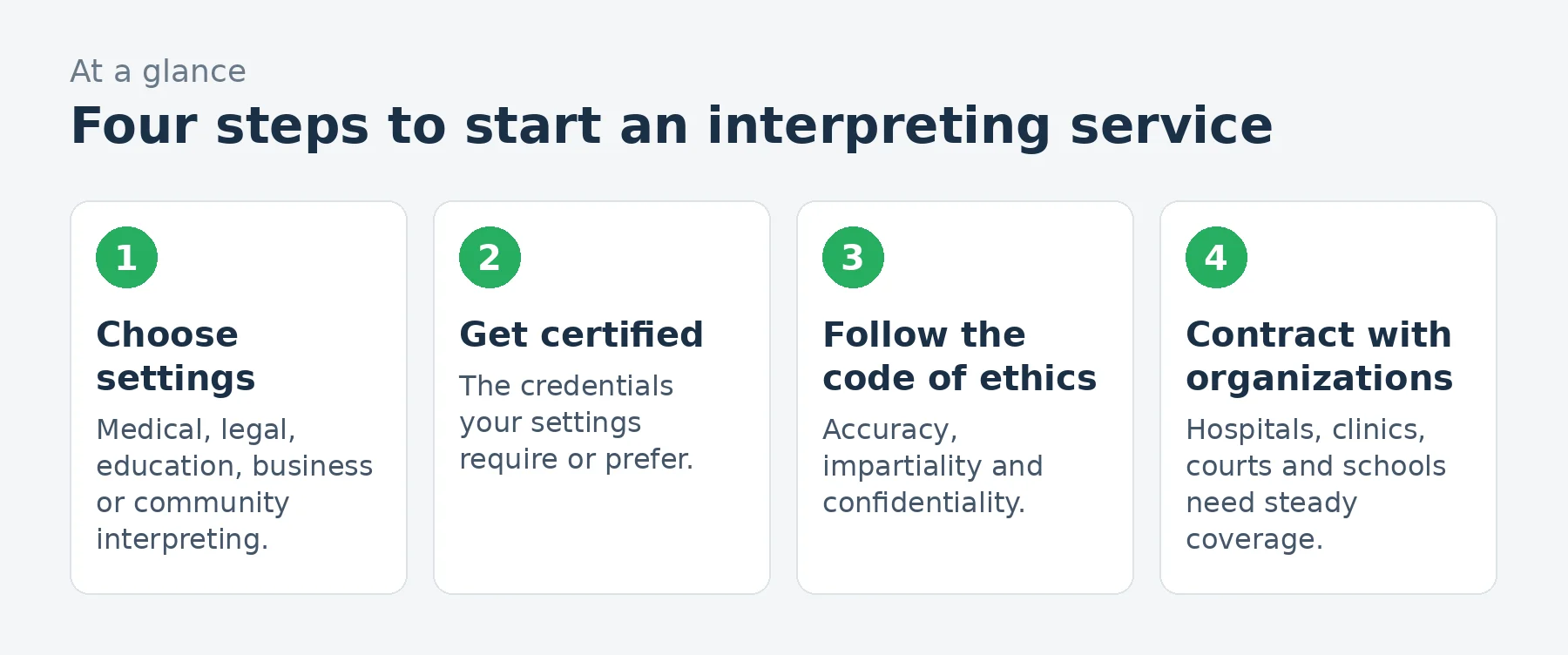
An interpreting service at a glance
Table of Contents
| Topic | What to expect |
|---|---|
| Startup cost | Low to moderate: training and certification, insurance, scheduling software, video and phone platforms and marketing |
| Certifications | CCHI or NBCMI for medical interpreters; state or federal court certification for courts; RID for sign language interpreters |
| Legal drivers | Section 1557 language access in healthcare, Title VI for federally funded programs and the ADA for deaf and hard of hearing people |
| How you charge | Hourly rates with minimums, travel and cancellation fees, or per-minute rates for phone and video interpreting |
| Best for | Fluent, calm communicators who handle pressure and follow strict ethics |
Who interpreting suits
It suits people with native-level fluency in their working languages, excellent memory and concentration, cultural knowledge and composure in emotional or high-stakes situations. Interpreters must stay neutral and accurate, even when conversations are difficult.
Interpreting settings
- Healthcare: hospitals, clinics, mental health and home health visits.
- Legal: courts, depositions, attorney meetings and immigration proceedings.
- Education: parent-teacher meetings and special education meetings.
- Business and conferences: meetings, negotiations and events, sometimes simultaneous interpreting.
- Community and government services: social services, housing and benefits offices.
- Sign language interpreting in all of these settings.
Modes and technology
Interpreters work consecutively (speaker pauses, interpreter speaks) or simultaneously (in real time, often with equipment). Remote options include over-the-phone interpreting and video remote interpreting (VRI), which healthcare providers use widely. Remote work needs secure, high-quality audio and video, and some settings and patients need in-person interpreters.
Medical interpreter certification
Healthcare clients increasingly expect certified or qualified interpreters. The Certification Commission for Healthcare Interpreters (CCHI) and the National Board of Certification for Medical Interpreters (NBCMI) offer national certifications that require training, language proficiency and exams. Section 1557 rules emphasize the use of qualified interpreters in covered health programs.
Court interpreter certification
State courts certify interpreters, often using exams developed through the National Center for State Courts’ consortium, with different credential levels by language. Federal courts certify Spanish interpreters through a federal exam and use other standards for other languages. Court work requires precise legal terminology and strict protocols.
Sign language interpreting
The ADA requires effective communication for people who are deaf or hard of hearing, which often means qualified sign language interpreters. National credentials such as those from the Registry of Interpreters for the Deaf (RID) are widely recognized, and many states license or register sign language interpreters. Deaf interpreters and specialized credentials serve particular needs.
Ethics and confidentiality
Interpreters follow codes of ethics: interpret accurately and completely, stay impartial, maintain confidentiality, avoid giving advice and disclose conflicts of interest. In healthcare, interpreters handle protected health information and follow HIPAA requirements; agencies may sign business associate agreements with healthcare clients.
Startup costs to plan for
| Item | What to budget for |
|---|---|
| Training and certification | Medical, court or sign language credentials |
| Technology | Scheduling, secure video and phone platforms, headsets |
| Insurance | Professional liability |
| Contracts | Client service agreements and interpreter agreements |
| Vehicle and travel | On-site assignments |
| Marketing | Healthcare, legal and education outreach |
Use our startup cost calculator for your total.
Pricing
On-site interpreting is usually billed hourly with a minimum (often two hours), plus travel time or mileage and cancellation fees for late cancellations. Phone and video interpreting are often billed per minute. Certified, legal, rare-language and simultaneous interpreting command higher rates. Use our pricing calculator.
A worked example: a small agency
These are illustrative assumptions for a small agency with a mix of on-site and remote work, not predictions.
| Assumption | Monthly | |
|---|---|---|
| On-site interpreting | 140 hours at $70 average | $9,800 |
| Video and phone interpreting | 1,800 minutes at $1.80 | $3,240 |
| Travel and cancellation fees | $900 | |
| Revenue | $13,940 | |
| Contract interpreter pay | For assignments not covered by the owner | $(5,200) |
| Scheduling and video platform | $(300) | |
| Insurance | Professional liability | $(150) |
| Training and certification maintenance | $(100) | |
| Marketing and travel costs | $(600) | |
| Profit before owner pay and taxes | $7,590 |
That leaves about $7,590 a month before the owner’s pay and taxes, on about $13,940 of revenue. Contracts with hospitals and clinics provide steady volume, while minimums and cancellation fees protect income.
Loading the calculator…
Building an agency
Agencies schedule interpreters for clients across languages, using vetted contract interpreters. Verify credentials and language skills, require confidentiality agreements, classify workers correctly and track quality through client feedback. Reliable scheduling, especially for urgent requests, wins contracts.
Finding clients
- Hospitals, clinics and health systems with language access programs.
- Courts and law firms.
- School districts for family meetings.
- Government agencies and nonprofits.
- Businesses with international clients or conferences.
Remote interpreting quality
Remote interpreting depends on technology. Use a wired internet connection, a quality headset with noise cancellation, a quiet private room and secure platforms approved by clients. Test equipment before sessions, and know when to request an in-person interpreter, for example for some mental health or complex medical appointments.
Self-care and vicarious trauma
Interpreters often hear distressing information in hospitals, courts and social services. Debriefing with peers, setting limits on difficult assignments and taking breaks help prevent burnout and protect accuracy over long sessions.
Rare and indigenous languages
Demand for less common languages often exceeds supply, and agencies that can reliably provide them win contracts. Building relationships with interpreters of rare and indigenous languages, and supporting their training, can be a strong differentiator.
Conference interpreting
Simultaneous conference interpreting requires advanced training, teamwork (interpreters usually work in pairs and rotate) and booth or remote simultaneous interpreting equipment. It commands premium rates for business and international events.
Client contracts
Agreements with hospitals, clinics and courts should cover rates, minimums, cancellation terms, response times for urgent requests, credentials required, confidentiality, HIPAA terms where relevant, remote platform requirements and invoicing. Clear terms prevent disputes and make your service easy to buy.
Scheduling and urgent requests
Healthcare and legal clients often need interpreters on short notice. A scheduling system with interpreter availability, automated confirmations and a backup roster helps fill urgent requests and builds a reputation for reliability.
Recruiting qualified interpreters
Agencies must verify language proficiency, training and certifications, check references and test interpreters before assigning them. Provide orientation on your code of conduct, confidentiality, scheduling and client expectations, and collect client feedback after assignments.
Common mistakes to avoid
- Interpreting in settings without the required credentials.
- Adding advice or opinions while interpreting.
- Breaking confidentiality.
- No minimums or cancellation fees.
- Using family members or untrained bilinguals as substitutes in agency work.
Your first 90 days
- Days 1-30: choose settings and languages, start certification and set up scheduling and remote tools.
- Days 31-60: buy insurance, write agreements and recruit qualified contract interpreters if building an agency.
- Days 61-90: contact hospitals, clinics, courts and schools and deliver first assignments.
Frequently asked questions
Do interpreters need certification?
It depends on the setting: courts certify interpreters, healthcare clients increasingly require CCHI or NBCMI certification and many states regulate sign language interpreters.
Why do hospitals need interpreters?
Section 1557 requires covered health programs to provide language assistance, and the ADA requires effective communication for deaf and hard of hearing people.
How do interpreters charge?
Hourly with minimums for on-site work, plus travel and cancellation fees, or per minute for phone and video.
What is video remote interpreting?
Interpreting delivered by video, widely used in healthcare for quick access to interpreters.
Can interpreters give advice?
No. Interpreters convey messages accurately and impartially without adding advice or opinions.
What is the difference between translation and interpreting?
Translation is written; interpreting is spoken or signed in real time.
Do medical interpreters need training hours before certification?
Yes, national medical interpreter certifications generally require completed interpreter training, language proficiency and exams.
Can interpreters work remotely full time?
Many do, through phone and video platforms, though some settings and clients require in-person interpreting.
How do interpreting agencies make money?
By billing clients more per hour or minute than they pay contract interpreters, covering scheduling, quality control and profit.
What languages are most in demand?
Spanish is the most requested in many U.S. areas, with strong demand for other languages depending on local communities.
Do interpreters need insurance?
Professional liability insurance is recommended, and many healthcare and legal clients require it in contracts.
Keep learning
- Translation services industry data
- How to start a translation business
- How to start a court reporting business
- Pricing calculator
Sources
- Certification Commission for Healthcare Interpreters (CCHI)
- National Board of Certification for Medical Interpreters (NBCMI)
- HHS Office for Civil Rights, Section 1557 language access requirements
- National Center for State Courts, Court interpreter certification
- U.S. Courts, Federal court interpreter certification
- Registry of Interpreters for the Deaf (RID), certification
- ADA.gov, Effective communication requirements
- US Bureau of Labor Statistics, Interpreters and translators
Last reviewed November 3, 2026. Startup costs are estimates; check local prices, licensing and tax rules before you commit money.

