
A court reporting business creates verbatim records of legal proceedings: depositions, hearings, arbitrations and trials, plus captioning for live events and broadcasts. Freelance court reporters work for law firms and court reporting agencies, delivering certified transcripts that attorneys rely on.
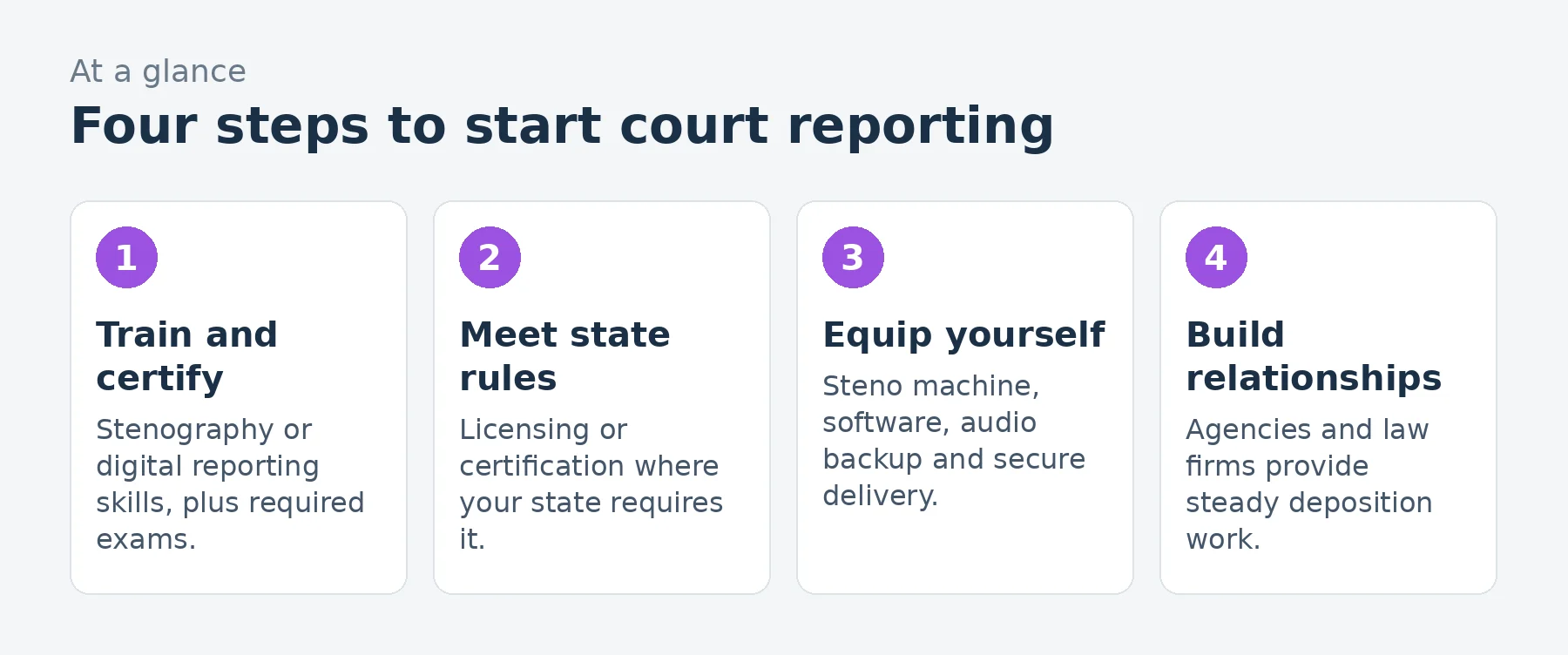
Skilled stenographers are in short supply in many areas, which supports demand for qualified reporters. Many states license or certify court reporters: California requires a Certified Shorthand Reporter license, and Texas certifies reporters through the Judicial Branch Certification Commission. National credentials from the National Court Reporters Association and, for digital reporters, AAERT add credibility. This guide covers training, licensing, services, pricing, equipment, a worked example and a 90-day plan.
A court reporting business at a glance
Table of Contents
| Topic | What to expect |
|---|---|
| Startup cost | Moderate: stenography training, a steno machine and software (or digital recording equipment), certifications, insurance and a vehicle |
| Licensing | Many states license or certify reporters, such as California’s CSR and Texas certification |
| Certifications | NCRA credentials such as the RPR, RMR and CRR; AAERT certifications for digital reporters and transcribers |
| How you charge | Appearance fees plus per-page transcript rates, copies, expedited delivery and realtime fees |
| Best for | Precise, focused people with excellent language skills and steady speed under pressure |
Who court reporting suits
It suits people with exceptional focus, accuracy, vocabulary and grammar who can write quickly for hours and handle technical, legal and medical terms. Stenography training takes significant time and practice to reach the required speeds.
Stenographic vs digital reporting
Stenographic reporters use steno machines and computer-aided translation software to capture speech at high speed, and can provide realtime text. Digital reporters use multi-channel audio recording with annotations, then produce transcripts, often with transcriptionists. Acceptance of digital reporting varies by jurisdiction and client, so learn your local rules and preferences.
Licensing and certification
- State licensing: many states require licensing or certification, such as California’s Certified Shorthand Reporter license from the Court Reporters Board and Texas certification through the Judicial Branch Certification Commission.
- NCRA credentials: the Registered Professional Reporter (RPR), Registered Merit Reporter (RMR) and Certified Realtime Reporter (CRR) are widely recognized.
- Digital reporting: AAERT offers certifications for electronic reporters and transcribers.
Requirements and reciprocity differ by state, so confirm them before taking work.
Services to offer
- Depositions for law firms, in person and remote.
- Hearings, arbitrations and administrative proceedings.
- Realtime feeds for attorneys during proceedings.
- Expedited and daily transcripts.
- Video deposition coordination with legal videographers.
- CART captioning and broadcast captioning for accessibility, with additional training.
Equipment and software
Stenographic reporters need a professional steno machine, computer-aided translation software, a laptop, audio backup and secure delivery systems. Digital reporters need professional multi-channel recording equipment and transcription software. Remote depositions require reliable internet, video platforms and good audio.
Startup costs to plan for
| Item | What to budget for |
|---|---|
| Training | Court reporting school or program |
| Equipment | Steno machine or digital recording kit, laptop |
| Software | Computer-aided translation or transcription software |
| Licensing and certification | Exams, license fees, continuing education |
| Insurance | Professional liability |
| Vehicle and travel | Travel to depositions and hearings |
Use our startup cost calculator for your total.
Pricing
Freelance reporters usually charge an appearance fee plus per-page transcript rates, with additional fees for copies, expedited delivery, realtime and exhibits. Official court reporters’ rates are sometimes set by statute or court rules, while deposition rates are set by the market and agencies. Use our pricing calculator.
A worked example: a freelance reporter
These are illustrative assumptions for an experienced freelance stenographic reporter, not predictions.
| Assumption | Monthly | |
|---|---|---|
| Appearance fees | 14 depositions at $150 | $2,100 |
| Transcript pages | 1,700 pages at $4.50 | $7,650 |
| Copies, expedites and realtime | $1,900 | |
| Revenue | $11,650 | |
| Scopist and proofreader | Editing help, per page | $(1,700) |
| Software and support | $(150) | |
| Equipment payments and maintenance | $(200) | |
| Vehicle and travel | $(400) | |
| Insurance, memberships and education | $(150) | |
| Profit before owner pay and taxes | $9,050 |
That leaves about $9,050 a month before the reporter’s pay and taxes, on about $11,650 of revenue. Transcript pages, not appearance fees, are where most income comes from, so fast, accurate transcript production matters.
Loading the calculator…
Producing transcripts
- Prepare a word list of names and terms before the proceeding.
- Capture the record accurately, with audio backup.
- Edit the transcript, often with a scopist.
- Proofread and certify the transcript.
- Deliver securely with exhibits and indexes.
Many reporters work with scopists (editors) and proofreaders to deliver transcripts faster.
Agencies or independence
Many reporters start by taking assignments from court reporting agencies, which handle scheduling, billing and client relationships for a share of fees. Independent reporters build direct relationships with law firms and keep more revenue, but handle marketing and administration. Some eventually start agencies of their own.
Finding clients
- Court reporting agencies needing freelance reporters.
- Law firms, especially litigation practices.
- Government agencies with administrative hearings.
- Captioning companies for CART and broadcast work.
- Professional associations and state court reporter associations.
Ethics and impartiality
Court reporters must remain impartial, protect the confidentiality of proceedings and transcripts and follow state ethics rules on relationships with parties and attorneys. Some states restrict certain contracting arrangements to protect impartiality.
Remote depositions
Remote and hybrid depositions are now common. Reporters need reliable video platforms, good audio, a backup internet connection and procedures for swearing in witnesses remotely under their state’s rules, plus secure handling of exhibits shared on screen.
Realtime and captioning
Realtime reporting, where attorneys see text as testimony happens, commands premium rates. CART captioning for people who are deaf or hard of hearing, and broadcast captioning, use the same skills and expand the market beyond legal work, with additional training and certification.
Working with scopists and proofreaders
Scopists edit draft transcripts and proofreaders catch final errors, letting reporters take more assignments. Build relationships with reliable editors, agree on per-page rates and turnaround and protect confidentiality in your agreements.
Starting an agency
Experienced reporters sometimes start agencies that schedule reporters, videographers and interpreters for law firms. Agencies earn a share of each job and handle billing, technology and marketing, but must recruit and retain reliable reporters in a tight market.
Continuing education
Many states and certifications require continuing education. Use it to build realtime skills, learn new technology and keep up with ethics rules and procedures in your state.
Building speed and accuracy
Certification exams test speed and accuracy, and so does every deposition. Practice regularly with dictation, build briefs for common phrases, maintain dictionaries in your software for names and terms and review transcripts to learn from errors.
Delivering transcripts securely
Transcripts and exhibits often contain confidential information. Deliver them through secure portals or encrypted files, keep backups according to your state’s retention rules and limit who can access raw audio and notes.
Working with legal videographers
Many depositions are recorded on video as well as transcribed. Coordinating with legal videographers, synchronizing video with transcripts and offering combined packages can add value for attorneys and increase revenue per job.
Common mistakes to avoid
- Working without required state licensing.
- No audio backup.
- Late transcripts.
- Insecure delivery of confidential transcripts.
- Underpricing expedited work.
Your first 90 days
- Days 1-30: confirm state requirements, complete certification exams and set up equipment and software.
- Days 31-60: register with court reporting agencies and build a scopist relationship.
- Days 61-90: take regular assignments, build law firm contacts and plan realtime certification.
Frequently asked questions
Do court reporters need a license?
Many states license or certify court reporters, such as California’s CSR and Texas certification; requirements vary by state.
What is the RPR?
The Registered Professional Reporter, a widely recognized certification from the National Court Reporters Association.
How do court reporters get paid?
Usually appearance fees plus per-page transcript rates, with extra fees for copies, expedited delivery and realtime.
Is digital court reporting allowed?
It depends on the jurisdiction and client; acceptance of digital reporting varies.
What is a scopist?
An editor who helps court reporters edit transcripts so they can be delivered faster.
Is there demand for court reporters?
Many areas report shortages of qualified stenographers, supporting demand for certified reporters.
How long does it take to become a court reporter?
Stenography programs often take two years or more to reach certification speeds, depending on practice and program.
Can court reporters work from home?
Remote depositions and captioning let many reporters work from home part of the time, with professional equipment and connectivity.
Do court reporters need insurance?
Professional liability insurance is recommended, along with equipment coverage for expensive steno machines and laptops.
What equipment does a court reporter need?
A professional steno machine, computer-aided translation software, a laptop, audio backup and reliable internet for remote work.
How are transcript pages priced?
Usually per page, with higher rates for expedited or daily delivery, copies and realtime; official court rates may be set by rule or statute.
Should I work through agencies?
Many reporters start with agencies for steady assignments, then build direct law firm relationships over time.
What is CART captioning?
Communication Access Realtime Translation, live captioning for people who are deaf or hard of hearing, using court reporting skills.
Keep learning
- Legal services industry data
- How to start a paralegal services business
- Startup cost calculator
- Pricing calculator
Sources
- National Court Reporters Association (NCRA), certifications
- Court Reporters Board of California, Certified shorthand reporter licensing
- Texas Judicial Branch Certification Commission (process servers and court reporters)
- AAERT, American Association of Electronic Reporters and Transcribers
- US Bureau of Labor Statistics, Court reporters and simultaneous captioners
Last reviewed November 3, 2026. Startup costs are estimates; check local prices, licensing and tax rules before you commit money.

